


German stockists looking to destock in May: survey

German buyers are looking to stay in waiting mode as the latest monthly S&P Global Platts steel sentiment survey showed the index for inventories continuing to drop this month.
Stockholders and traders indicated they would remain hesitant about booking orders in the coming weeks. The index for that particular sector was at 8.3, indicating the intention to destock. Stockholders in particular sit on high stocks.
As reported, March levels at German stockholders stood at 1.55 million mt for flats and 878,000 mt for long products, the highest levels since July 2014.
Traders on the other hand are currently waiting for clarity over the details of expected safeguard measures by the EU on steel imports following the US Section 232 tariff announcements, while activity in the northern European import market remains subdued.
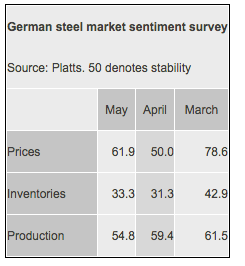
End-users expect inventories to rise, indicating they would increase purchasing this month. Overall, Platts’ index for inventories gave a reading of 33.3, significantly below the 50.0 mark that notes stability.
The pricing outlook increased to 61.9, suggesting the expectation of increasing prices. Mills and end buyers were the most bullish, while the stockholding side showed a bearish outlook at 41.7. Sources said German producers would keep prices firm for the moment.
The outlook for May production was up slightly from last month’s survey, with an overall indication of 54.8. Mills and stockholding respondents were firm in their outlook, but end users indicated they would slightly decrease output in May.
Laura Varriale, PLATTS

Polish distributor sees improved outlook, but 232 threat
The outlook for Polish economic growth in 2018 has improved from forecasts made last year, with Gdp now set to rise over 4% this year. Steel consumption, meanwhile, should grow 2-3% and 1.9% in the EU as a whole. However, US 232 steel tariffs look set to change trading patterns, which could have a negative impact on the EU market. This is according to top-three Polish distributor Konsorcjum Stali (KS).
Stable consumption should help support current steel price trends; however, 232 tariffs are a new factor that could destabilise the situation, according to KS. “The US’ protectionist trade policy could result in repercussions from other countries and lead to a trade war,” the distributor says in a report seen by Kallanish. The tariffs are “… one of the biggest threats to economic stability in the coming years.”
In 2017 KS increased sales 5% on-year to 639,000 tonnes. This was driven by a 7% rise in traded product sales to 398,000t. Rebar sales rose 15% to 168,000t, but sheet deliveries fell -6.8% to 69,000t. Z and G sections sales were flat at 60,000t. Sales of KS-produced or processed products, meanwhile, rose 3.4% to 241,000t.
Sheet deliveries nevertheless generated 17.9% more revenue at PLN 183.4 million ($51.35m) due to the gradual ramp-up of the coil service centre in Krakow, which was opened in 2013, and the resulting increase in cold and hot-dip galvanized coil processing.
Exports accounted for 0.56% of KS revenue in 2017, down from 0.58% in 2016.
Celsa Huta Ostrowiec and CMC Poland accounted for 26.2% and 19.2% respectively of KS’ procurement in 2017.
KS says the anticipated investment into developing the Polish railways and energy sector, as well as further expansion of road infrastructure and residential construction will continue to generate significant steel demand. However, Brexit will result in a reduction of EU structural and investment funding available for poorer member countries. “This could have a negative impact on the scope of investments realised in Poland after 2020, and therefore also have a negative impact on steel demand in Poland,” KS observes.
KS reported a 26% increase in revenue in 2017 to PLN 1.53 billion, but net profit fell -3% to PLN 41.55m due to higher costs.