

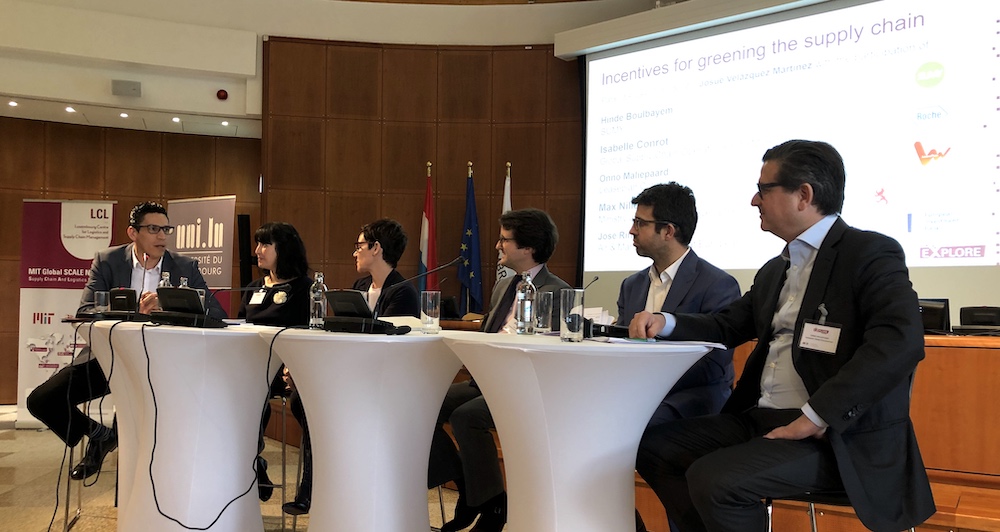
EUROMETAL at LCL eXplore conference
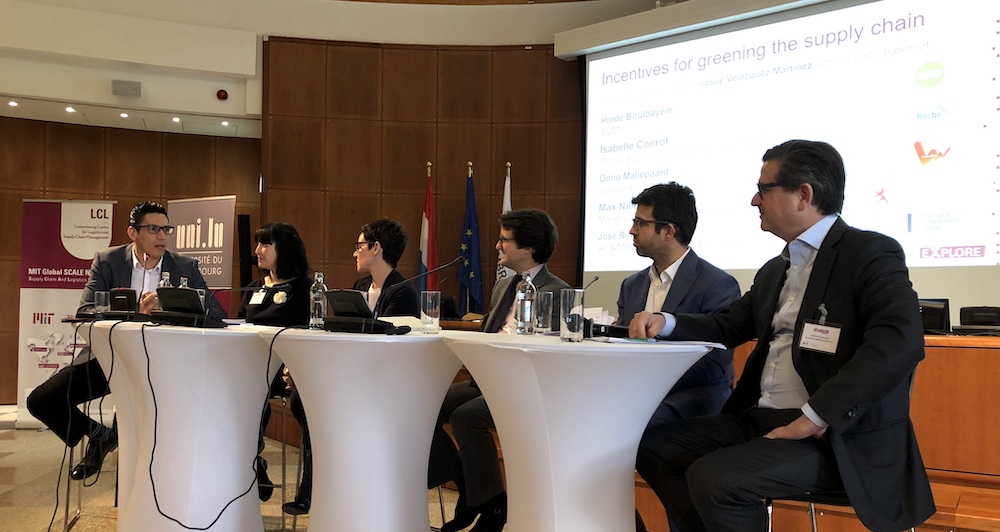
“Navigating the green supply chain”
The conference, organized by the Luxembourg Center for Logistics and Supply Chain Management (LCL) of the University of Luxembourg, highlighted some issues which are or will become of high strategic importance also for Steel Supply Chains.
EU Commission plans emission standards for Heavy Duty Vehicles (HDV)
It may be remembered, that EU Commission directives on battery certification and on fuel efficiency of tires are already steps to reduce emissions.
For HDV, EU Commission now plans to introduce a certification regulation to reduce CO2 outputs. This regulation would be introduced step-by-step.
The regulation would be based on output of gCO2 / tkm.
The output of CO2 would have to be reduced by -15 % up to 2025 and by -30% up to 2030, compared to the reference of the year 2019. The final target being to reduce CO2 output by -50 %.
The regulation would be accompanied by financial incentives in order to encourage Zero or Low Emission Vehicles fleets.
In case of infringements, heavy penalties would apply.
Sustainable Logistics
A speaker of MIT presented an optimization model regarding sustainable logistics.
Rising global urbanization and e-commerce are calling for sustainable logistics.
The optimization models are based on geospatial analysis and machine learning algorithms.
They are not only based on distance, but take into account topology, elevation, load weight and truck model.
A case study demonstrated the efficiency of such models.
MANAGING SUPPLY CHAIN RESILIENCE
A supply chain sub-sums many networks. Supply networks are endangered by various types of risks. Modelling these complex networks allows to investigate their structure and potentially identify risks.
In fact, the structure of supply networks impacts on supply network performance in risky circumstances, as can be seen today with the lot of uncertainties surrounding BREXIT.
To face supply chain disruptions, economic operators have to implement pro-active resilient supply networks to face such disruptions.
Usually supply network operators, know about risks and uncertainties of their immediate suppliers or customers, but mostly ignore the types of risks of their supplier’s suppliers or their customer’s customers.
The meeting was attended by about 100 participants: teachers, students, professionals.

Klöckner foresees increased demand in Europe and US
Steel distribution group Klöckner & Co mostly expects to see slight growth in real steel demand and shipments for 2019 for its key markets of Europe and the US, Kallanish hears from the company.
The German-based group anticipates revenues to even rise sharply on the back of investments in expansion and an expected higher overall steel price level than in the preceding year. Klöckner forecasts a slight increase in its operating income, even though a repeat of the previous year’s positive price effects in the US is not expected.
In its fiscal year 2018, Klöckner’s revenues rose 7.9% to €6.8 billion ($7.7 billion) largely because of higher prices. Operating income (Ebitda) improved by 3.4% to €227 million. Apart from the positive trend in prices over much of the year, it attributes the increase primarily to [… internal] optimisation measures. Net income was €69m, compared with a prior-year figure of €102m, which was boosted by one-off tax effects.
Klöckner highlights the independent industry platform XOM Materials, launched in Europe in February 2018, as a major step in its progress. Around 50 employees now work for the company at five locations. The platform is set to launch in the US within the first half of 2019. A first financing round with external investors is expected to be completed by the end of this year.
“In XOM Materials, we have realised our vision for the future of steel distribution,” ceo Gisbert Rühl says. “The platform – which is open to everyone in the market – will gradually unravel the traditional steel industry value chain and replace it with a digital network.”

EU steel distributors report disappointing start to 2019

Steel distributors across Europe have begun 2019 with disappointing figures, confirming the bleak sentiment reported by market observers, Kallanish learns from the latest data published by EUROMETAL.
Flat steel service centres saw their shipments fall by -4.5% year-on-year in January, continuing the negative trend registered since the end of last year.
EUROMETAL calculates that stock levels at steel service centres ended January at a lower level than in January 2019, signalling that a destocking activity also took place during the month.
General proximity distributors, majoring in long products’ distribution, also saw their shipments fall by -6.2% y-o-y in January, confirming that the weakness was visible across the range of all products in Europe. “Only profiles and hot rolled flats registered higher shipments,” EUROMETAL says.