


German steel industry opinions diverge on carsharing
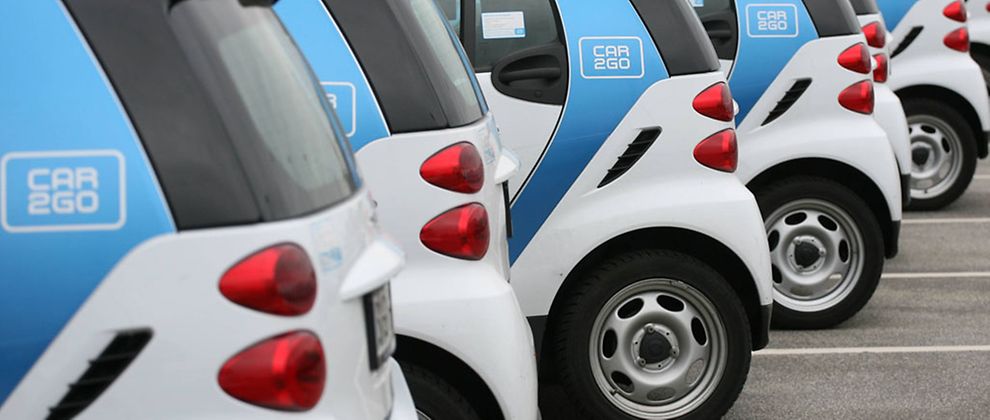
The idea of carsharing and what it means for steel suppliers has not been discussed too widely in the steel world. Just lately however some diverging views have surfaced on the topic within the sector.
“Society will need fewer cars in the future, and possibly less steel in the cars that will be built,” says Klöckner & Co’s ceo Gisbert Rühl when asked about the issue. He says that a privately-owned car runs for about 2 hours per day on average, whereas a shared car is used for some 30% of the day, or 7-8 hours. That means fewer cars sold, “… and it is a development that is coming faster than many deem possible,” he told Kallanish on the sidelines of the recent Handelsblatt/Euroforum conference in Düsseldorf.
On the conference’s second day, however, steel managers such as Paul Brettnacher of ArcelorMittal Europe offered a different opinion. Given that shared cars are used much more than privately-owned cars, they will need replacement relatively earlier, which will maintain car-production, and hence steel usage, he and others suggested.
Meanwhile, Germany’s automotive suppliers’ interest group, ArGeZ issued its outlook for the industry at the fair in Hanover. In 2018, car industry revenues totalled €264 billion ($296 billion), an increase of 3% year-on-year, whilst capacity utilisation rose to 87%.
ArGeZ spokesman Christian Vietmeyer, who is also the managing director of steel and metal fabricators’ federation WSM, notes that passenger car production so far this year remains steady. The falls in output that happened due to the WLTP procedure are “… only an aftermath now,” he says. Signals from China are ambivalent, whilst production prognoses in the UK and the US have become difficult due to the risks of Brexit and the imposition of tariffs respectively.
He also referred to the recent requirement by one major automotive producer that tier suppliers should lower costs and prices. “We are facing numerous challenges in emission-free drives, autonomous cars etc., which will affect the entire production chain,” Vietmeyer says. “Therefore, it does not fit in at all if an OEM creates unilateral cost pressures.”


German steel sector views vary on electric cars

Opinions among Germany’s carmakers diverge significantly on the question of how quickly the electric motor will become the main means of propulsion in a motor car. So do the opinions of steel suppliers as to which material will dominate.
In March, Volkswagen ceo Herbert Diess challenged most of the country’s other carmakers with his call for a quicker complete conversion from the internal combustion engine. Even the industry’s vehicle manufacturers’ association VDA felt uneasy about this turn of events.
“In principle, I wish for an open technology, rather than set a radical course like VW, and confine the research and development on one direction,” says Wolfgang Mitterdorfer, an executive in voestalpine’s Steel Division. At the Handelsblatt/Euroforum conference in Düsseldorf, he was joined by ArcelorMittal Europe’s Paul Brettnacher, who said that the change is also a question of feasibility.
“You need to look at the entire chain; it will take an enormous amount of money to adjust it, and you cannot do it all at once,” Brettnacher said in a discussion monitored by Kallanish. Mitterdorfer said that he himself drives a hybrid car, and the consensus at the event seemed to be that hybrid will likely provide the bridging technology for a while.
Participants at the conference all remain optimistic about the future for strip steel in electric engines, due to its safety, price advantage, and range of grades used. Gisbert Rühl of Klöckner & Co however takes a somewhat different stance. He believes that the role of steel will matter less than that of other technology such as sensors in the electric car. The requirement for high-quality sheet will trend towards the use of aluminium, he believes, and that is why Klöckner has invested heavily in an all-new aluminium processing line at its Becker service centre operation.