

Global trade measures may cause local steel overcapacity
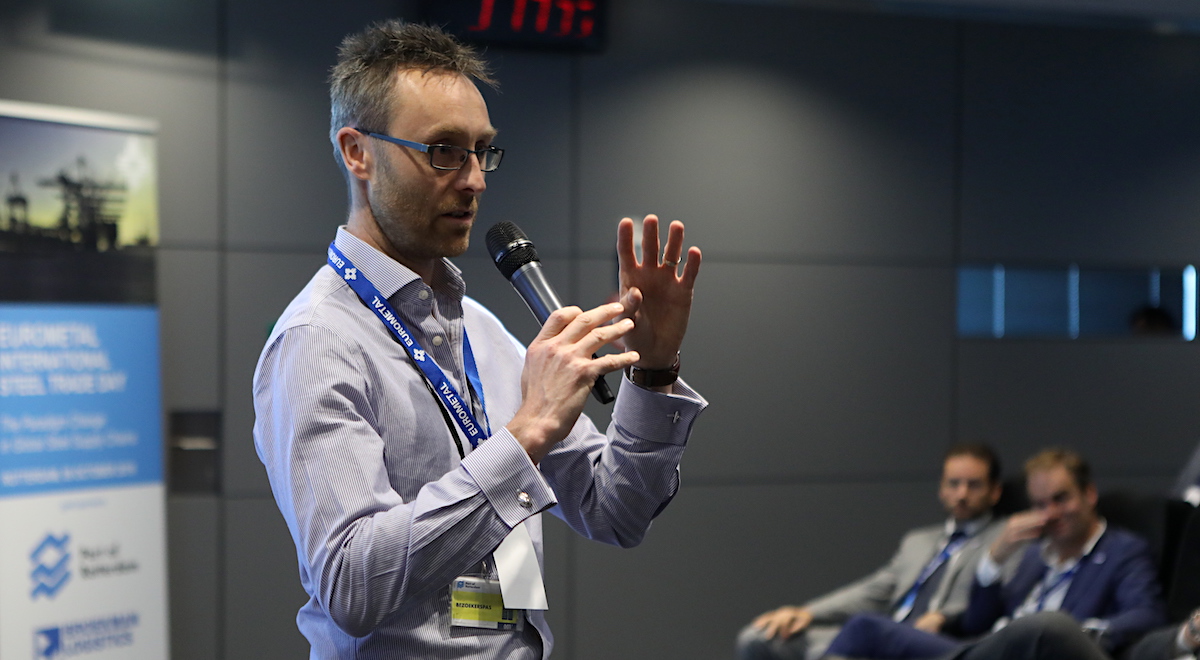
The wave of global safeguard measures is likely to cause a shift from a globalised market to more localised markets, analyst Matt Watkins said at Eurometal’s Steel Trade Day in Rotterdam attended by Kallanish.
Regarding the immediate trade war between China and the USA, he believes that the two powers will find a deal to clarify the situation sooner or later. In the longer run however, steel sellers will not be looking for international opportunities as much as they used to. And this will lead to overcapacities as people have to rely on their local mills, he said at the meeting entitled ‘The Paradigm Change in the Global Steel Supply Chain’.
In detail, he observed that cheap steel for the EU is not coming so much from Turkey these days as it is originating from India. “We have seen many Indian imports, partly for seasonal reasons: high inventories in India plus the monsoon period, which is slowing down local activity, therefore more imports,” he said. And there may be a change ahead. “Recently, it was mostly hot-rolled coil because these new capacities built up faster than for cold-rolled. So, we may see less import of HRC next year, but more CRC,” Watkins continued.
Also, the possibility of a carbon border adjustment in which the EU is imposing CO₂ costs on exporting countries may hit nearby suppliers of slab. “Much of European steel is based on a re-rolling model, and that could affect the main slab suppliers Russia and Ukraine,” he added.

thyssenkrupp and partners study ‘blue’ hydrogen for steelmaking
thyssenkrupp Steel Europe has joined up with Norwegian-based energy company Equinor and natural gas transmission system operator Open Grid Europe to explore the decarbonised production and supply of ‘blue’ hydrogen.
The study’s premise will be the production of hydrogen from natural gas and permanent offshore storage of carbon dioxide accrued in the process, Kallanish hears from the steelmaker. The gas is meant to be stored potentially in the Equinor-operated “Northern Lights” storage facility project on the Norwegian shelf, and then sent to tk’s steel plant in Duisburg.
Equinor is Europe’s second largest gas supplier and the largest operator of offshore gas and oil production facilities. Open Grid Europe will add its knowledge in transmitting and transporting gases to the study.
tk is currently pursuing two routes for fossil-free steelmaking. One is the avoidance of carbon dioxide emissions by injecting hydrogen instead of coal into its blast furnaces. The other, Carbon2Chem, is based

Dansteel to make 5% of sales via its new service center
Danish plate mill Dansteel, part of Russian mining and steel group NLMK, aims to initially pass through 5% of its annual sales volume to its newly created steel service center, a spokesman for NLMK told S&P Global Platts Wednesday.
The Frederiksvaerk-based mill has just inaugurated its steel service center, which specializes in custom plate cutting and edge beveling. It is capable of processing up to 32 meter long plates with 8 mm-150 mm thicknesses and up to 4 meters wide.
Dansteel is seeing good demand for the added services from makers of wind turbines, pressure vessels, bridge builders and other heavy industry end-users, according to NLMK.
Previously, Dansteel outsourced these services to a third party but decided to invest in in-house expertise and develop its own steel service business. With this in view, NLMK made a minor investment in upgrading an old cutting machine installed at the plant and in skills and training of a new team.
Dansteel sold 290,000 mt of steel plate in the first half. Its sales grew 9% last year to 520,000 mt.
— Ekaterina Bouckley

Turkey nearly exhausts EU rebar quota
Turkey has almost exhausted its rebar quota into the EU after 1,410t cleared customs in the past 24 hours, leaving only 79t of its allowance remaining.
CIS countries are also reaching critical stages in rebar exports to the EU. Ukraine has only 45,251t remaining, with 336t awaiting allocation — only 28pc of its original allowance of 160,848t. While slightly more restrained, Russia has only 40pc remaining on the 241,998t allowance it was given on 1 July. This is expected to change over the next month or so with the arrival of winter in Russia and CIS mills needing to redirect rebar sales to the export market.
Turkish wire rod exports into the EU are also close to critical, with just over 30pc currently available. The original quota was 312,081t but as of today, 100,528t are remaining with 991t awaiting allocation.
As Turkish rebar prices remain relatively flat, it may be more viable for producers to sell wire rod on export to the EU while the quotas last, especially given the high demand in the market. Over the past six months, the Argus fob Turkey rebar assessment has lost almost $80/t, going from $480/t on 10 April to $401.30/t yesterday.
Turkey was previously the largest exporter of wire rod into the EU, with 929,150t in 2018. The quota system has raised concerns from EU integrated wire rod processor association Eunirpa that its members will be unable to source the material to meet their requirements, given that the quantities they require are generally unavailable within the EU.
“There is a well-documented shortage of wire rod on the EU market due to an increase in consumption and captive use,” Eunirpa said in July. “EU producers are simply not able (or willing) to supply us with the volumes of wire rod we need to operate under normal business conditions.”
Turkish wire rod exports to the EU totalled just 360,222t in the first seven months of 2019, trade data show. This will also decrease sharply as Turkey uses up its remaining 100,000t for the second half of the year and the first half of 2020.
China, Turkey and Russia’s export pace for merchant bars looks likely to leave their quotas exhausted before the end of the period. Although not yet near the critical level, with just 26pc of the quota period elapsed, China has used 32pc of its 427,536t allowance, Turkey has used 42.4pc of its 295,302t allowance and Russia has exhausted 34pc of its original 243,820t allowance.
In the rebar market, Moldova is outstripping the quota period with 38pc of its 72,752t quota exhausted within 26pc of the elapsed time. At current speeds, having used only 25pc of its allowance, Bosnia and Herzegovina looks to be the only country with an individual quota that will not have to tap into the “other countries” quota for rebar when it opens on 1 April.
Similarly, Ukraine and Switzerland will likely be able to benefit from the wire rod quota at the end of the period, having used only 11pc and 17pc, respectively. Russia has used 32pc of its original 316,074t, Belarus 40pc of its 250,620t and Moldova 30pc of its original 187,848t.
Flats
Turkey’s organic sheet quota is also critical, with only 575t remaining of an initial 56,161t. South Korea and Taiwan have been more restrained in exporting organic sheets but they both look set to exhaust their quotas before the end of the period. Currently, South Korea has 140,021t left of its 265,842t original allowance while Taiwan has 47,202t of an 82,246t allowance remaining.
China exhausted its 527,164t allowance of automotive-gauge galvanised steel on the same day the quotas opened. Taiwan’s auto-grade galvanised steel is also nearing a critical stage, with 50,698t of 126,675t left. South Korea has also used just under half of its auto-grade galv allowance, with only 331,764t remaining, meaning it looks like the “other countries” quota of around 80,000t per quarter will be tapped into.
It seems several countries will run out of their allowances for various products before the end of the period, should exports continue at the same pace. For example, Ukraine has exhausted 33.79pc of its 263,197t allowance for cold-rolled coils (CRC) and 33.71pc of its 873,702t plate allowance.
As its domestic steel market flatlines, Turkey is increasing its market share of CRC exports into the EU, going from just 92,839t in 2015 to 336,951t in the first seven months of 2019 alone. This seems to be at the expense of the CIS region. Russia exported just 2,543t of CRC to the EU in 2018 compared with 903,098t in 2015.
The Argus Black Sea steel CRC and plate fob assessments have tumbled in the past six months. On 10 April, CRC stood at $550/t fob, while today it is down $90/t at $460/t fob. Similarly, plate is at $505/t fob today, down $75/t on $580/t fob on 10 April.
The entire hot rolled coil (HRC) allowance renews each quarter at just over 2mn t but weak automotive demand means around 770,000t were available at the end of last period. Since 1 October, several shipments have arrived. But unless there is a significant uptick in the EU automotive industry, the quota looks unlikely to be exhausted before the end of the period, with 1,989,063t remaining and 679t awaiting allocation.
Dansteel to make 5% of sales via its new service center
Danish plate mill Dansteel, part of Russian mining and steel group NLMK, aims to initially pass through 5% of its annual sales volume to its newly created steel service center, a spokesman for NLMK told S&P Global Platts Wednesday.
The Frederiksvaerk-based mill has just inaugurated its steel service center, which specializes in custom plate cutting and edge beveling. It is capable of processing up to 32 meter long plates with 8 mm-150 mm thicknesses and up to 4 meters wide.
Dansteel is seeing good demand for the added services from makers of wind turbines, pressure vessels, bridge builders and other heavy industry end-users, according to NLMK.
Previously, Dansteel outsourced these services to a third party but decided to invest in in-house expertise and develop its own steel service business. With this in view, NLMK made a minor investment in upgrading an old cutting machine installed at the plant and in skills and training of a new team.
Dansteel sold 290,000 mt of steel plate in the first half. Its sales grew 9% last year to 520,000 mt.

Materialverteilung in Zeiten verteilter Fertigung
Im Jahr 2015 kündigte das Weltwirtschaftsforum (WEF) die “verteilte Fertigung” als eine der zehn aufstrebenden Technologien an. Gerade in den letzten Monaten hat das Thema wieder an Aufmerksamkeit gewonnen. Für uns als Werkstoffhändler führt das zu der Frage: Wenn sich die Produktion verteilt, wie wird die Zukunft der Materialverteilung aussehen?“
Die Vorteile der Digitalisierung und ihre Konsequenzen
Wie jede andere Branche baut auch die Fertigung auf Digitalisierung, die es ermöglicht, überall auf der Welt per Knopfdruck Produktionsprozesse zu starten – die verteilte Fertigung dank Industrial Internet of Things (IIoT). Sie legt aber auch den Grundstein für einen neuen Trend: Weg von der Massenfertigung hin zu individuell nach Kundenwünschen angefertigten Produkten. Die Nachfrage danach ist steigend und hat zur Folge, dass die Losgrößen sinken.
Digitaler Fortschritt bedeutet aber auch, dass der Materialverbrauch massiv zurückgehen wird. In einer gemeinsamen Studie mit der Ellen MacArthur Foundation schätzt McKinsey die Einsparungen an Materialkosten in der EU verarbeitenden Industrie bis 2025 auf bis zu 630 Milliarden US-Dollar pro Jahr. Der Grund: die Steigerung der Produktivität.
Unsere Branche steht vor gewaltigen Veränderungen. Wir werden unseren Umsatz nicht mehr steigern können, indem wir einfach mehr Material verkaufen, denn diesen Bedarf wird es nicht mehr geben. Auch wird die Profitabilitätssteigerung durch massive Skalierung von Lagerbeständen ihre Grenzen erreichen. Unsere eigentliche Wertschöpfung wird in den Dienstleistungen rund um das Material und nicht im Material selbst liegen. Bei thyssenkrupp Materials Services nennen wir das „Materials as a Service“ – die smarte Interaktion von Werkstoffen und individuellen Services.
Paradigmenwechsel in der Wertschöpfung
Wir stehen vor der Herausforderung, kleinste Losgrößen aller Arten von Werkstoffen in kürzester Zeit in die entlegensten Orte der Welt zu liefern. Die Antwort darauf: Supply Chain Management. Vor 20 Jahren habe ich gelernt, dass ein guter Verkauf von einem guten Einkauf getrieben wird. Oder anders gesagt: billig kaufen und teuer verkaufen. Was dazwischen passierte, war zweitrangig. Heute stimmt das nicht mehr: Was dazwischen passiert, ist entscheidend. Wertschöpfung entsteht künftig vor allem dann, wenn wir unsere Kunden in ihrer Supply Chain unterstützen. Voraussetzung dafür ist die Optimierung unserer eigenen Lieferkette. Dazu müssen auch wir die Stärken der Digitalisierung nutzen und benötigen entsprechende Software.
Drei grundlegende Fragen

Softwarelösungen werden die gesamte Wertschöpfungskette unterstützen und damit in der Lage sein müssen, vertikale Integration zu erlauben. Das führt uns zur ersten von drei grundlegenden Fragen: Werden klassische Softwareunternehmen, die unseren aktuellen IT-Backbone zur Verfügung stellen, ihre Fähigkeit zur vertikalen Integration beweisen, oder müssen wir unser IT-Backbone diversifizieren?
Als langfristiger Player in diesem Markt verfügt thyssenkrupp Materials Services über eine riesige Datenquelle – und Daten sind das neue Gold. Damit kommen wir zur zweiten Frage: Wie können wir unsere Daten leicht nutzbar machen und unsere Fähigkeit zur Interpretation und Digitalisierung dieser Daten vermarkten?
Cloud-Infrastrukturen bilden das Rückgrat des IIoT. Dafür benötigen wir externe Backbones, wie z.B. Infrastructure as a Service und Product as a Service. Diese Infrastrukturen erfordern technisches Fachwissen und nicht industrielles Know-how. Damit stellt sich die dritte Frage: „Wie kann man die Zusammenarbeit zwischen Technologie und Industrie stärken statt den Wettbewerb anzustacheln?“
Eins ist klar: die Rolle des Materialverteilers verändert sich mit der verteilten Fertigung. Unser industrielles Erbe kann dabei unsere Stärke sein, wenn wir zugleich den Mut zur Veränderung aufbringen und damit die Kraft in unserer Organisation entfesseln.
Foto: thyssenkrupp Materials Services