

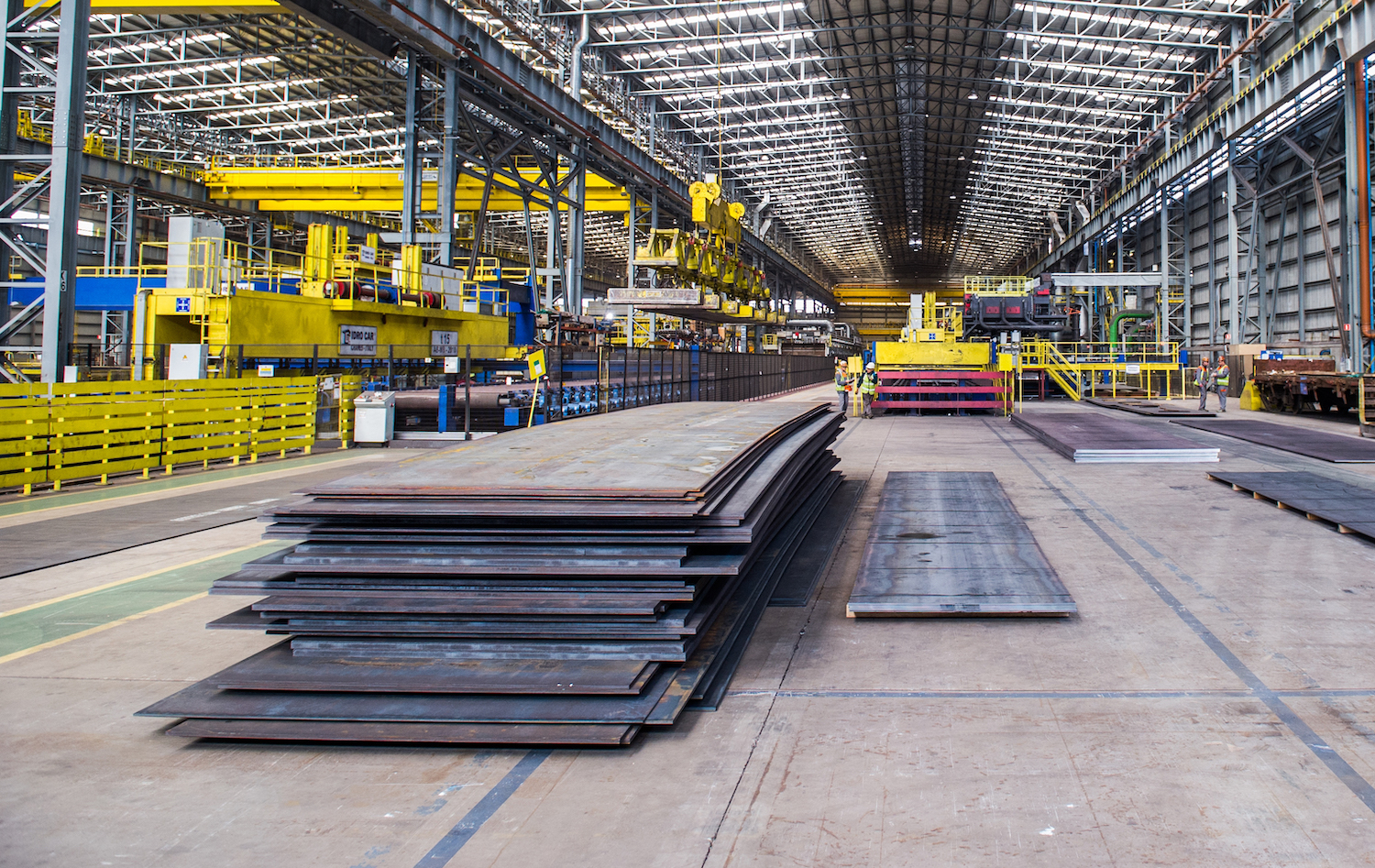
European plate market stable on oversupply, demand uncertainty

The European plate market saw prices relatively stable over the week to Oct. 16, with market participants still apprehensive about future pricing developments despite relatively stable demand from end-users, sources told S&P Global Platts.
The weekly Platts TSI index for plate Southern Europe was down Eur5/mt at Eur485/mt EXW S.EU, while the Northern European weekly index slipped Eur2/mt to Eur498/mt EXW Ruhr Oct 16.
A German distributor said they were getting consistent inquiries from end-users daily but noted that mill prices were not workable at the Eur500-510/mt ex-works Ruhr.
“Producers are more open to negotiation on plate – mills are suffering because slab prices are very high. There is still oversupply of material and there are no long lead times so capacity can easily cover demand,” the same source said.
The increase in raw materials – specifically coking coal – has pushed up costs for mills, said a German plate mill source, who added, “the buying mood has not really been felt since the summer’s end – export is quiet or almost dead.”
Despite this, the same source was optimistic about Q4 business, despite having three weeks off due to maintenance.
“In general, it is very quiet, inquiries are cautious but alright, but there are no significant projects,” the mill source lamented.
He hoped to hold onto Eur500/mt ex-works Ruhr for s235 grade material, but said it looked unlikely due to the declining economic situation.
Growing near-term uncertainty around the coronavirus looms, with one Benelux trader saying he saw the market for plate weaker for the moment.
“Structurally, the market is oversupplied anyway – COVID or not – it’s just that every mill is hungry for business and demand is very weak,” the source said.
A second German distributor source said cheap plate imports were arriving into Europe from Ukraine at Eur460-470/mt CIF Antwerp.
The same source added that while capacity usage for plate was good, it was not sufficient to provide mills with a decent order book, so customers have turned desperate.
“High raw material prices are a big problem for re-rollers – I think some plate producers may need to close, especially those who have to cope with high slab costs,” the distribution source said.
In the Italian market things were more optimistic, with one mill source claiming there was a push towards a Eur500/mt price market for plate which was proving achievable and necessary to cover their expenses.
“Eur500/mt ex-works Italy is more or less the real picture. We’ve learned to live with the oversupply, but prices are nearly at Eur500/mt due to the arrival of more expensive slabs – deals closed when prices climbed on the slab side,” the mill source said.
— Amanda Flint, Laura Varriale
Developing economies to rebound faster from pandemic: worldsteel
Developed economies are expected to see a steeper fall in finished steel demand than developing economies in 2020, with the latter also seeing a stronger rebound in 2021, according to worldsteel.
Demand in developed economies should slump -14.4% on-year in 2020 to 336.7 million tonnes, despite the strong rebound after post-lockdown reopening. Manufacturing in the developed economies, which was only just beginning to recover from the slowdown in late 2019, has been pushed back again by the pandemic.
In the US, recovery from the lockdown has been strong, aided by substantial government support measures. However, the country is still struggling to control the virus’s spread, and the recovery momentum might taper off in the coming months. Demand there is seen dropping -15.8% to 82.3mt this year.
In the EU, the pandemic impact was softened by strong social security schemes and fiscal stimulus. Despite the stronger-than-expected post-lockdown recovery, deep contraction in major steel using sectors, especially automotive, will weigh on growth. EU28 demand is seen down -15.2% in 2020 to 134.3mt.
Demand in Japan and South Korea is seen down -19.6% and -8.2% respectively this year to 50.8mt and 48.9mt, Kallanish notes.
The developing economies excluding China have been less well equipped to absorb the pandemic shock, and the impact has been uneven across countries. It has included lower domestic demand, the collapse of exports and commodity prices, and a free fall in tourism. Demand in developing economies should fall -12.3% in 2020 to 408.3mt.
India and Brazil have suffered most from a failure to effectively control the virus, worldsteel observes. India is set to register its steepest steel demand decline in decades of -20.2% in 2020 to 81.9mt, with Central and South America demand to fall -10.1% to 37.4mt.
In 2021, demand in the developed economies is seen bouncing back by 7.9% on-year to 363.5mt. However, developing economies demand will rise even faster, by 10.6% to 451.6mt, driven by infrastructure investment. India should see a fast recovery next year, but Latin American recovery will be slow.

German economy hit harder than foreseen
The Covid-19 pandemic is causing deeper wounds in the German economy than anticipated in spring, the country’s five major economic research institutes say in their joint autumn forecast.
The institutes are now forecasting a drop in GDP by -5.4%, rather than the -4.2% they assumed in spring. Looking further ahead, they believe in an upswing of 4.7% in 2021, and by 2.7% in 2022. However, the figures might not take into account the recent resurgence in Covid-19 infections, Kallanish notes.
The industries that put the hardest brake on a recovery are those that are based on social interaction, like restaurants, bars, tourism, events, and aviation. Slowing momentum also comes from capital goods industries that have become averse to investment because of lower liquidity. Exports dipped most dramatically in the wake of the crisis, the experts note. “The C-19 effect on the production potential remains critical because long-term damage can be hardly assessed,” they write.
They concede that the uncertain trajectory of the pandemic remains the biggest risk for the forecast. At the time of the compilation of the data, the institutes assumed a record loss for the public budget of €183 billion ($215 billion) this year.

Worldsteel Association: Deutlich optimistischer Ausblick

Für das laufende Jahr 2020 prognostiziert Worldsteel, dass die Stahlnachfrage aufgrund der COVID-19-Pandemie um -2,4 % schrumpfen und auf 1.725,1 Mio. t sinken wird. Im Jahr 2021 erwartet man bei der Stahlnachfrage einen Anstieg auf voraussichtlich 1.795,1 Mio. t was einem Plus von 4,1 % gegenüber 2020 entspricht. Eine starke Erholung in China wird den Rückgang der weltweiten Stahlnachfrage in diesem Jahr abmildern. Die Erholung der Stahlnachfrage in der übrigen Welt nach dem Einbruch war stärker als erwartet, obwohl sich für 2021 in den Industrie- und Schwellenländern nur eine teilweise Erholung abzeichnet.
Die Prognose geht davon aus, dass sich trotz des derzeitigen Wiederauflebens von Infektionen in vielen Teilen der Welt die landesweiten Sperrungen nicht wiederholen werden. Stattdessen werden selektive und gezielte Maßnahmen in der Lage sein, diese zweite Welle einzudämmen.
Quelle: Worldsteel Association / Vorschaufoto: fotolia

EUROMETAL: Rückgang bei EU-Stahllieferungen
Basel/Luxemburg – Wie EUROMETAL mitteilt, gingen in den ersten acht Monaten des Jahres 2020 die Lieferungen von EU-SSC um -18,7% zurück.
Im gleichen Zeitraum gingen die Lieferungen von Lagerbeständen aus EU-Mehrprodukt- und Proximity-Stahlbeständen um -13,2% zurück.
Das Marktüberwachungssystem von EUROMETAL verfolgt die Stahlvertriebslieferungen und -bestände der EU für seine beiden Hauptgeschäftsbereiche:
Flache SSC-Verteilung und Verteilung von EU-Mehrprodukt- und Proximity-Stahlbeständen.
EU Flat SSC Distribution
In den ersten acht Monaten des Jahres 2020 gingen die Lieferungen von EU-SSC im Vergleich zum Vorjahr um -18,7% zurück.
Im August 2020 gingen die Lieferungen von Strip Mill Products im Vergleich zum August 2019 um -1,5% zurück, verglichen mit -11,8% im Juli.
In Liefertagen ausgedrückt, erreichten die Lagerbestände bei EU SSC im August 2020 108 Tage, verglichen mit 124 Tagen im August 2019.
Für August 2020 fiel der Index der Aktienvolumina und notierte bei Index 98, verglichen mit Index 115 im August 2019 (Durchschnitt 2015 = Index 100).
Verteilung von EU-Mehrprodukt- und Proximity-Stahlbeständen
In den ersten acht Monaten des Jahres 2020 verzeichnete die EU-Lagerhaltung für Mehrprodukt- und Proximity-Stahlbestände für fast alle Produkte ihres Portfolios niedrigere Lieferungen. Nur die Bewehrung blieb identisch.
Tatsächlich gingen die Gesamtlieferungen in den ersten acht Monaten des Jahres 2020 gegenüber dem Vorjahr um -13,2% zurück.
Im August 2020 gingen die Lieferungen von „All Steel Products“ im Vergleich zum August 2019 gegenüber dem Vorjahr um -12,7% zurück.
Der Aktienvolumenindex der EU-Lagerhaltung für Mehrprodukt- und Proximity-Stahlbestände wurde im August 2020 bei 85 registriert, verglichen mit einem deutlich höheren Index von 95 im Jahr zuvor (Durchschnitt 2015 = Index 100). In Liefertagen ausgedrückt, lag das Lagervolumen im August 2020 bei 81 Tagen der Lieferung, verglichen mit 80 Tagen im August 2019.
Über EUROMETAL
EUROMETAL ist der Europäische Verband für Vertrieb und Handel von Stahl, Rohren und Metallen.
EUROMETAL hat auf EU-Ebene im letzten Jahrzehnt ein repräsentatives und einzigartiges Marktüberwachungssystem für die EU-Stahlverteilung entwickelt. Das EU-Stahlvertriebs- und -Handelskonto in der EU umfasst 5.000 Unternehmen, hauptsächlich kleine und mittlere Unternehmen, die 110.000 Menschen in der EU Arbeitsplätze bieten.
EU-Stahlhändler, SSC und Händler sind systematische Akteure auf den EU-Stahlmärkten und beliefern die EU-Endverbrauchssektoren mit 80 Millionen Tonnen Stahl, Rohren und Metallen. Sie machen mehr als 60% des Angebots an Stahl und Rohren für mehr als eine Million Endverbraucher in der verarbeitenden Industrie der EU und in baubezogenen Sektoren der EU aus.
Quelle: EUROMETAL European Federation of Steel, Tubes and Metals Distribution & Trading / Vorschaubild: fotolia