

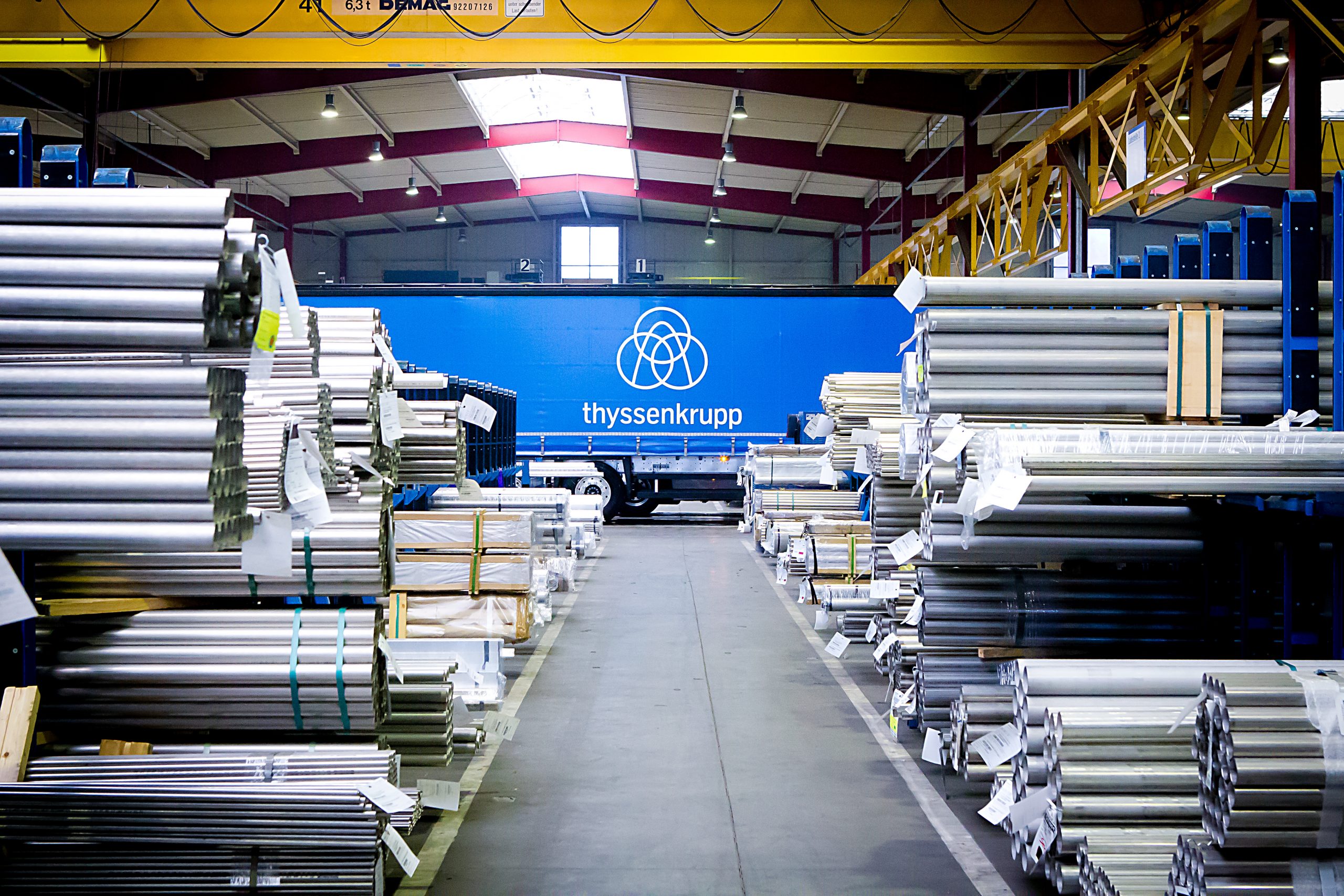
thyssenkrupp markets IoT tool to processors
The Internet-of-Things (IoT) platform “toii,” developed by thyssenkrupp Materials Services, has been adopted by two of its downstream customers, Kallanish hears from the distribution group.
Processing company Steel Service Krefeld is introducing toii.Lights to digitally network analogue machines and collect data for further processing. This means that the production status of all machines can be viewed at any time and operating and maintenance times can be optimised, tk Materials explains. Steel Service Krefeld sells machines, tool steel and metal powder for additive manufacturing.
The other company, GGK, relies on the tool for the production of plastic cable routing systems. The company produces over 3,000 different products at its Greifenstein site in Hesse, Germany, which are sold in 28 countries.
“We are delighted that toii is being used by two new external customers with very different requirements,” says Sebastian Lang, managing director of thyssenkrupp Materials IoT. “It is both an enabler of digital transformation in classic machinery and a scalable complete solution for networking the value chain in the digital factory.”
tk Materials IoT GmbH was founded in September 2019 as a spin-off from tk Materials Services. As part of the strategic further development of “Materials as a Service” the materials distributor and service provider keeps expanding its supply chain service business. This includes the development of innovative, data-driven business models.
Christian Koehl Germany

Iron ore, steel bull markets are supported: SIOF
Decarbonisation, green capital expenditure (capex), and conservative investment by the mining giants are expected to support the iron ore and steel bull markets, according to Nicholas Snowdon, head of base metals and bulks research of Goldman Sachs, Kallanish learns at Singapore Iron Ore Forum (SIOF) 2021 held on 13 July.
Decarbonisation, required by governments, is expected to bring steel demand for new equipment, while output will be under pressure from the move towards net zero emissions. Output will be controlled despite rising global steel capacity and therefore, probable tight supply and new demand can support steel markets, Snowdon believes.
In terms of green capex, environmental policies will drive a capex boom on par with the 1970s and 2000s. Heavy investment is necessary for countries to achieve carbon neutrality. Commodity prices and capex hitorically have roughly the same trend, Nicholas stated.
Although iron ore bull market has entered its third year, global supply/demand balances suggest no material surplus until 2023/24. Meanwhile, the commitment of miners to long-cycle mining developments is falling. The combined mining capex of Glencore, Anglo American, Rio Tinto, and BHP has only recovered to a third of levels a decade ago, and is expected to maintain this level to 2025. Expectations of supply expansion are therefore weakened.
Several speakers also agreed that iron ore prices will continue to be high before next year. “China’s demand for high-quality iron ore that has over 62% Fe will be still strong in the fourth quarter,”said Tracy Liao, vice president of commodities strategy at Citi.
By Kallanish Team
ArcelorMittal steel used to transport hydrogen in EU
ArcelorMittal has announced that it has supplied steel for the manufacturing of pipes specifically designed to transport 100% concentrated hydrogen.
The pipes were manufactured by Greek Corinth Pipeworks using steel supplied from the Fos-sur-Mer and Bremen mills. The tubes were then used in a new 440km high-pressure network in Italy.
“While steel is the best material available to transport hydrogen, a key challenge is the effect that the gas has on the metal,” explains Frederic Bouchaud, ArcelorMittal account manager for oil and gas pipelines. “For this project we have created a robust new steel which will resist embrittlement and transport hydrogen gas safely throughout Europe. The result is a very wide, high-quality steel with low carbon content, excellent cleanliness, a homogenous microstructure, and low levels of sulfur and phosphorous.”
Finished pipes have an outside diameter of 26 inches (660 mm) and thicknesses of 11.1 and 15.9 mm. To meet these specifications, ArcelorMittal produced extra-wide 2,100mm coils. After forming by CPW, the pipes were laboratory tested at maximum pressure and 100% hydrogen.
The possibility to effectively transport hydrogen in Europe is central to the future development of greener steel in the continent, Kallanish notes.
Emanuele Norsa Italy
Chinese exports rebound in June
Chinese steel exports rebounded in June beyond expectations. They remained down from levels earlier in the year, however. Imports meanwhile recovered marginally in June and are now steady on-year, Kallanish notes.
China exported 6.458 million tonnes of finished steel in June, up 22.5% from May and 74.5% higher y-o-y, according to the General Administration of Customs. Over the first half year, exports are now up 30.2% at 37.382mt.
Exports had slumped by a third on-month in May as China removed VAT rebates on most steel products. In June, there were also rumours of a further removal of rebates and new export taxes but these did not materialise. Despite the uncertainty in the market, Chinese mills and traders were more competitive and the summer slowdown brought Chinese prices closer to international levels.
China also imported 1.252mt of finished steel in June, up from 1.206mt in May. Over January-June China imported 7.349mt of finished steel, up 0.1% y-o-y. These figures do not include semi-finished steel. Some traders had been booking in material for import in June amid expectations that Chinese steel output would be reduced at the end of July for the 100th anniversary of the Chinese Communist party.
ArcelorMittal Sestao to become zero CO2 emissions plant
ArcelorMittal`s Spanish Sestao plant is set to become the first global steel producer with zero CO2 emissions across its entire production process, Kallanish learns from the company. This will be possible by using green hydrogen and electricity from renewable energy sources.
The project is part of the memorandum of understanding that ArcelorMittal and the government of Spain signed on 13 June. The plan contemplates an investment of €1 billion ($1.18 billion) in the construction of a direct reduction plant with green hydrogen as well as a new hybrid electric furnace at the Gijón mill.
“This plan depends on supplying huge quantities of hydrogen at affordable prices, access to sustainable financing and a favourable legal framework that allows us to be competitive on a global scale,” company` ceo Aditya Mittal comments.
The Sestao plant – which manufactures a wide range of flat steel products for the automotive, construction and general industry sectors – is estimated to produce 1.6 million tonnes of zero-carbon steel by 2025. This will be possible by modifying the metallic charge in the two existing electric arc furnaces, increasing the proportion of recycled scrap and using pre-reduced iron produced with green hydrogen in Gijón. The electricity supply in all steel installations of the plant is set be from renewable energy sources, ArcelorMittal explains.
Todor Kirkov Bulgaria

Italy’s Acciaierie d’Italia to produce below 5 mil mt crude steel in 2021: sources
Acciaierie d’Italia, the largest Italian flat steel producer, is likely to close the year below its previous planned production output of 5 million mt, sources told S&P Global Platts on July 13.
The steel unions said that Acciaierie d’Italia is likely to produce 3.5 mln of crude steel this year. When contacted by S&P Global Platts, Acciaierie d’Italia’s spokesman said that the company targets an output of 4.5 million mt of steel by the end of 2021 and that to achieve this, “production will increase to 15,000 mt a day in the second half of the year.”
According to the unions, the company is producing around 10,000 mt of pig iron a day at the moment as only two blast furnaces — No. 1 and No. 2 — are working, while the No. 4 furnace was temporarily shut for maintenance in June. The No.4 furnace was supposed to restart production in the beginning of July but is still temporary offline due to ongoing environmental and technical issues.
The unions and the company spokesperson said that the blast furnace No. 4 was linked to the coke battery number 12, which was directed to be put on idle by Italy’s Transition Ecology Ministry until it met certain standards to make it environment friendly.
“The company appealed at a court in Rome against the minister’s directions and ask for three month extension to meet the environmental requirements, amid COVID-19-related lockdowns that delayed the requisite changes. The tribunal of Rome has already asked to the ministry to reconsider its order to idle Battery 12.” Acciaierie d’Italia’s spokesman said.
The company has a total of five blast furnaces, blast furnace No. 1 and No. 2 each have a designed production capacity of 1.8 million-1.9 million mt/year of crude steel, but they are not operating at capacity. Blast furnace No. 5, the largest in Europe with a production capacity of around 3.5 million mt/year, was idled in 2015. Blast furnace No. 3 has a capacity of about 2 million mt/year of crude steel, but was idled in 1994 and is set to be dismantled.
The steel unions have planned a strike for July 20 to demand more clarity and commitment from the government, union sources told Platts.
The Italian market consumes around 12 million-13 million mt of coils annually, market sources told Platts. In 2020, the country produced about 20 million mt of crude steel and was the second largest European steel producer, according to Federacciai, the Italian federation of steel companies.
Acciaierie d’Italia is the largest Italian flat producer, followed by Arvedi. Arvedi is set to produce 3.6-3.8 million mt of hot-rolled coils this year, close to its installed capacity, Platts reported earlier.
Arvedi has two electric arc furnaces at its headquarters in Cremona. The No. 1 furnace has 1.4 million mt/year of crude steel capacity and the No. 2 furnace was upgraded and expanded in 2020 to increase its capacity to 2.6 million mt/year.
The Italian coils market is going strong, with prices reaching historical levels in June. Prices were softening amid the summer holidays and attractive imports, but domestic prices were still high, Platts reported earlier.
— Annalisa Villa