

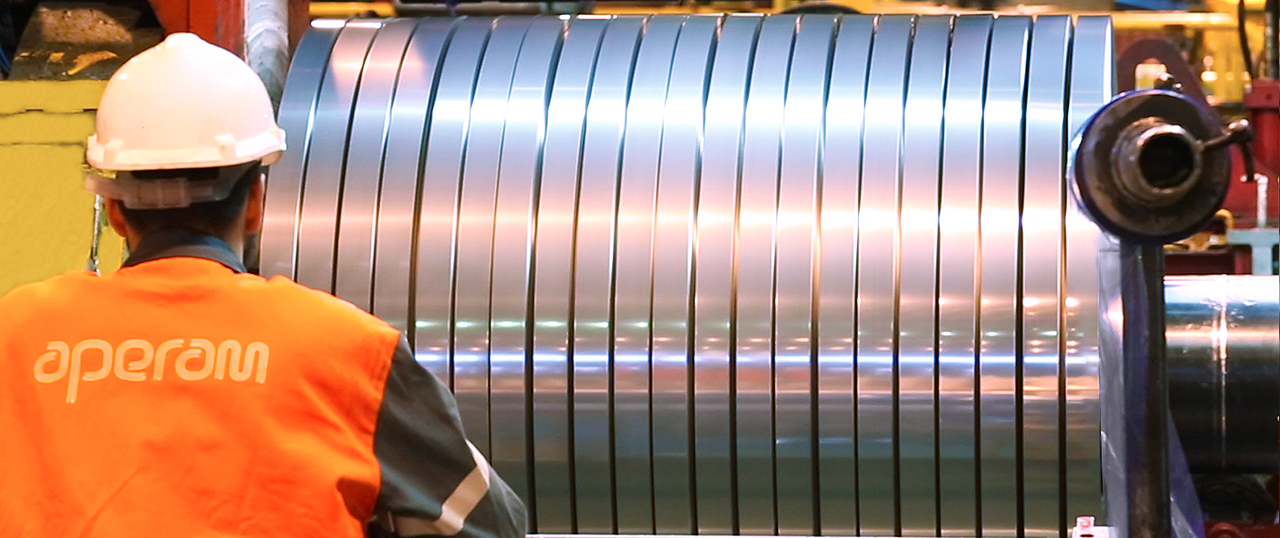
Aperam launches new rolling line at Genk
Aperam has commissioned the new annealing and pickling line for cold strip at its Genk unit, in Belgium, Kallanish notes.
The new line was supplied by SMS Group and secures an enlarged product range for Aperam. It adds material grades for the most demanding application and improves lead time and flexibility to meet market standards, the technology supplier claims. The line processes both austenitic and ferritic grades.
“This new annealing and pickling line represents the second line at Aperam’s Genk works supplied by SMS,” the supplier concludes.
Emanuele Norsa Italy


European demand supports Turkish mills’ July HRC exports
European demand, especially from Italy, supported Turkish mills’ HRC export volumes in July. This was despite the European Commission’s announcement Jan. 7 of provisional anti-dumping duties of 4.8%-7.6% on imports of HRC from Turkey for six-months, followed April 23 by definitive duties of 4.7%-7.3%, effective July 1.
Turkish mills’ overall HRC export volumes however, remained 80,000 mt lower than the same month the previous year, as exports to some of Turkey’s main HRC export markets remained below last year in July, amid trade barriers, S&P Global Platts observed from the latest monthly Turkish Statistical Institute (TUIK) data.
Turkish mills exported 43,500 mt of HRC to Italy in May, up by 16% on year, while exports to Spain totaled 26,300 mt, 20,000 mt lower on year.
Turkish mills’ July HRC exports to Portugal reached 27,100 mt, fourfold higher year on year, while exports to Belgium totaled 19,700 mt, around double on year.
Turkish mills also exported 17,600 mt of HRC to Greece in July, while exports to Egypt reached 15,400 mt.
Turkey’s other HRC export destinations in that month were: US (11,800 mt), Israel (8,600 mt), Canada (6,800 mt) and Albania (6,000 mt), the latest data showed.
Turkish mills’ hot-rolled coil prices, which reached as high as $1,200/mt EXW as of end-May, fell gradually week on week since that day. Some Turkish mills have pulled down their offers to as low $950-$960/mt in recent days, on slow demand, cheaper imports and lower raw materials pricing.
— Cenk Can


Acciai Speciali Terni to find buyer by end-September
A buyer for Italian stainless steel producer Acciai Speciali Terni (AST), part of thyssenkrupp, should be announced by the end of September, maybe earlier, according to Italian economic development minister Giancarlo Giorgetti. He was speaking earlier this week at a televised hearing at Italy’s parliament, Camera dei Deputati.
“As a government we are following the procedure in full transparency and have a good relationship with Thyssen … We have highlighted our expectations regarding the future of such an important and strategic company … The expectations are of a business plan that respects both employment and complies with all environmental standards, which for steel are significant in terms of impact,” Giorgetti said at the hearing watched by Kallanish.
Two Italian companies have been shortlisted for the purchase of AST, Italian steelmaker Arvedi and re-roller Marcegaglia. Both visited the facility in Terni in July. The interest shown from Posco and Baosteel seems to have faded, sources say.
In April, thyssenkrupp started the first phase of the sale, where buyers had access to some of AST’s production, sales and financial documents. This phase, which lasted two months, has been handled by JP Morgan, which is overseeing the entire process (see Kallanish passim).
Natalia Capra France

Supply catches demand, higher prices ‘new normal’: Irepas
Supply has caught up with demand in the global long products market, with lead times shortening, although prices higher than at the beginning of the fourth quarter of 2020 will be the new normal, says the International Rebar Exporters and Producers Association (Irepas). Moreover, freight rates are still significantly elevated.
Despite the return of market equilibrium, Section 232 and EU safeguards remain in force, and protected markets will continue enjoying their positions until measures are terminated, Irepas adds in its September short-range outlook seen by Kallanish.
“The slowdown in the Far East has dealt the market a strong body blow,” Irepas comments. “The Asian markets are making adjustments, but most would say that everyone is happy over there. The Indian and Vietnamese mills are exporting, while new plants in Indonesia as well as the Japanese mills are making historic profits. South Korean mills most likely will do the same.” There is strong competition between Turkish long product exports to Asia and Asian-produced material.
EU cut-and-benders’ stock levels are rising, as an increasing number of projects are being put on hold due to high prices for construction materials, including rebar. “The cut and benders are feeling a significant drop in order income and are holding their breaths to see how the EU mills will react to fewer order entries,” Irepas says. With summer holidays over, demand is however expected to recover and EU mill prices are therefore not expected to fall significantly, especially amid a lack of import alternatives.
US demand remains high but supply is gaining, although some shortages remain, especially on the West Coast. Imports cannot fill the gap due to shipping constraints. Costly freight is seeing mills offer on an fob basis. “Importers who buy on fob basis on all occasions are in for a surprise when cargoes are ready to ship. To add to the problem, most ports are full and do not wish to receive more cargoes,” Irepas observes. Credit has become an issue, with many buyers unable to insure the receivables.
Costly freight is discouraging international trade transactions, which will create short-term downward pressure on prices and long-term shortages in importing countries. Regionalisation is the current trend.
Chinese output cuts will spur the country’s demand for billet, which should support other regions, especially ASEAN producers, and could also buoy up steel pricing.
Almost all countries are looking at some type of stimulus plan and infrastructure spending, in particular, looks to continue for several years in Europe and North America.
Going forward, “some downward adjustments in the North American market may be seen and negativism is bound to spread and may affect other markets,” Irepas concludes.
Adam Smith Germany
Demand, prices lift Stalprodukt earnings
Strong demand and higher prices boosted Stalprodukt’s earnings in the first half of 2021, but the firm says it was squeezed by limited feedstock availability and logistical problems, Kallanish notes.
Electrical sheet segment revenue rose 17% on-year in H1 to PLN 452.7 million ($119m) and segment profit surged 36% to PLN 59.2m. Deliveries rose 6%, the firm says without providing tonnages.
Although electrical sheet prices rose, the growth was not as steep as seen in hot and cold rolled coil prices. The prices could still catch up with a delay, but it is difficult to say with certainty, the Polish producer says.
The firm says it is pleased with the level of demand in H1, which was boosted by constant purchases from customers in Spain and Italy, despite some restrictions in domestic activity. High permeability (HiB) grain-oriented electrical steel accounted for 27% of the Bochnia site’s production, thereby boosting Stalprodukt’s margins.
Profile segment revenue surged 55% to PLN 435.6m and segment profit soared 635% to PLN 9.9m, with shipments up 6.5%.
Polish imports of the cold-formed sections and pipe produced by Stalprodukt rose 32% on-year in H1 to 179,000t, the firm says citing Polish Steel Association (HIPH) figures. Ukraine provided the lion’s share of supply.
Stalprodukt, like other firms in the European tube sector, suffered in H1 from limited supply of feedstock, historically-high feedstock prices that were passed on to customers, and logistical problems.
Adam Smith Germany