

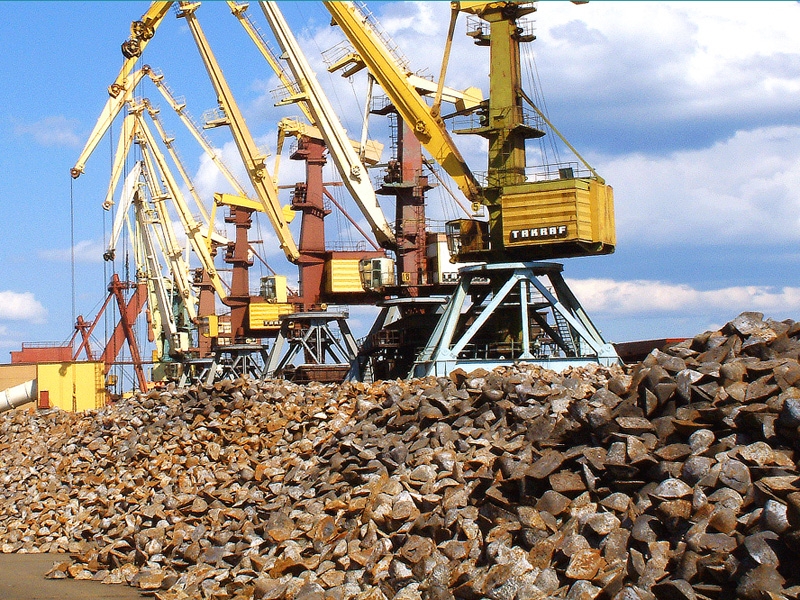
Iron ore jumps on government support
Seaborne iron ore prices jumped on Tuesday, supported by smaller increases for other ferrous sector products. China’s return to economic support amid a slowdown has reassured ferrous markets.
The Kallanish KORE 62% Fe index gained $5.23/t to $106.70/dry metric tonne cfr Qingdao, the highest since October. The Kallanish KORE 65% Fe index increased $5.50/t to $123.49/dmt cfr, and the KORE 58% Fe index appreciated $2.39/t to $77.06/dmt cfr.
On the Dalian Commodity Exchange, May iron ore settled CNY 31/t higher at CNY 649/t ($101.72/t), while on the Singapore Exchange January 62% Fe futures settled up $8.45/t at $112.55/t. The same contract for 65% Fe and 58% Fe futures settled up $9.02/t at $130.43/t, and down $0.08/t at $78.25/t respectively.
Both scrap and billet prices also continue to push higher. 6mm+ heavy scrap delivered to mills in the Yangtze River Delta gained another CNY 8/t to 3,386/t. In Tangshan, billet prices gained another CNY 20/t to CNY 4,360/t.
Ferrous markets have been buoyed by the cut in the banking reserve requirement ration announced on Monday, which should release some CNY 1.2 trillion in credit. There were also officially reported statements that China would push affordable housing construction and support the real estate sector.
These actions and statements contradict China’s longer-term goals of reducing dependence on cheap credit flowing into low-return investments, and of reducing the importance of the housing sector to the overall economy, but have become necessary because of the broad economic slowdown China currently faces.

EU stainless scrap demand to sustain
European stainless scrap purchase volumes will remain significant in December, as they were in November, Italian steel trade association Assofermet says in its monthly market report sent to Kallanish.
The association forecasts good demand for stainless scrap in Europe despite the impending Christmas holiday break. Prices, however, will be impacted by external factors such as nickel quotes from the London Metal Exchange (LME) and the global pandemic, with restrictions in activity seen possible.
In November, Assofermet noted significant demand for stainless scrap from European and non-European stainless steel mills. Prices in Europe have been in line with Italian values, which prevented imports of stainless scrap into Italy. Quotes for stainless scrap have been related to LME trends characterised by weekly fluctuations, the association adds.
In December, stainless scrap grade 304 and 316 in Italy and France increased by almost €100/tonne ($112) on high nickel prices, particularly for grade 316 that remains in short supply (see Kallanish passim).
Natalia Capra France


India: Nov finished steel exports slump 32% from Oct as demand slows
India’s finished steel exports posted their fourth straight month-on-month fall in November, tumbling 31.6% from October, data from the Joint Plant Committee showed Dec. 6, as overseas demand slowed.
Year on year, however, the November exports were up 20.7% compared with the corresponding month of 2020. The annual rise was due to lower comparison figure seen in November 2020, when exports for the month sank 31% versus November 2019.
As for finished steel imports in November, they were both down 11.1% year on year and 17.5% month on month.
The lower exports came as European buyers waited for automotive contracts to be finalized for hot-rolled coil as local HRC stocks rose due to canceled orders by the automotive industry as demand fell for vehicles.
Passenger vehicle registrations in the European Union sank 30.3% in October to 665,001 units, marking a fourth straight month of declines and the weakest October since record-keeping began “due to the ongoing impact of the semiconductor supply crisis,” the European Automobile Manufacturers’ Association (ACEA) had said.
Also, the EU’s import quotas for Indian flat steel from October to December had been exhausted early fourth quarter, data from the European Commission had showed Oct. 7. Belgium and Italy were among the leading destinations for Indian-made HRC.
The EU’s steel industry could see some firmness, according to S&P Global Platts Analytics, due to an easing of restrictions on EU steel exports to the US because of changes to the tariff regime, effective Jan. 1, which combined with recovering automotive demand, could potentially support another, milder price rally in 2022.
As for finished steel production in November, it fell 3.3% from October to 9.19 million mt but was up 1.7% against November 2020.
Similarly, crude steel output in November increased a slight 0.3% year on year but dipped 1.6% year on year.
Production of hot metal reached 6.38 million mt in November, both up 1.2% from November 2020 and 0.5% from October 2021.
Indian Steel Data (million mt)
| Oct 2021 | Nov 2021 | Change (%) | Nov 2020 | YOY Change (%) | Nov 2019 | Nov 2021/2019 Change (%) | Apr-Nov 2020 | Apr-Nov 2021 | YOY Change (%) | |
| Crude Steel Output | 9.79 | 9.64 | -1.6 | 9.61 | 0.3 | 8.93 | 7.9 | 63.13 | 76.44 | 21.1 |
| Finished Steel Output | 9.50 | 9.19 | -3.3 | 9.03 | 1.7 | 8.57 | 7.2 | 57.44 | 72.07 | 25.5 |
| Finished Steel Imports | 0.38 | 0.31 | -17.5 | 0.35 | -11.1 | 0.43 | -27.3 | 2.697 | 3.063 | 13.6 |
| Finished Steel Exports | 1.06 | 0.72 | -31.6 | 0.60 | 20.7 | 0.87 | -16.7 | 7.697 | 9.531 | 23.8 |
Source: Joint Plant Committee
– Clement Choo

High costs in UK steel sector a barrier to decarbonization: UK Steel
UK steel producers pay 61% more for electricity than their competitors in Germany and 51% more than in France, creating a barrier to the sector’s decarbonization, a new report released by industry body UK Steel shows.
UK Steel is calling on the government to act alongside the industry as higher electricity prices are eating in to capital expenditure and reducing the sector’s ability to achieve the transition to carbon neutrality.
The report, titled “A Barrier to Decarbonisation”, says higher electricity prices have cost UK steelmakers an extra GBP90 million this year, and GBP345 million over six years, “the equivalent of almost two years of capital investment in the sector.”
“All solutions for decarbonising the steelmaking process will increase electricity consumption,” the report said. “Converting the UK’s blast furnace steel production to hydrogen-based steelmaking could increase electricity consumption by 250%, while a complete shift to electric arc furnace production would increase consumption by 150%.” At current power prices it is estimated it would cost almost GBP300 million more to run a hydrogen-based steel plant in the UK than in Germany.
In the report, UK Steel recommends using UK state aid for energy-intensive industries and to follow the example of the French and German governments in providing network cost reductions. Another key suggestion is to introduce an industrial wholesale cost containment mechanism to prevent damaging price spikes.
“The UK steel sector is a big user of power, consuming as much electricity as 800,000 homes annually. We are also highly trade intensive, importing 70% of our steel needs and exporting 45% of everything we make,” said Gareth Stace, director general of UK Steel.
“The recent public recognition by the prime minister that the price gap needs to be tackled is hugely welcome,” he said. “But the proposed solution of investment in new nuclear will simply not have the immediate impact on electricity prices that the steel sector needs. I hope the government recognises the need to implement the steps set out in the report in addition to their long-term plans for investment.”
— Annalisa Villa