

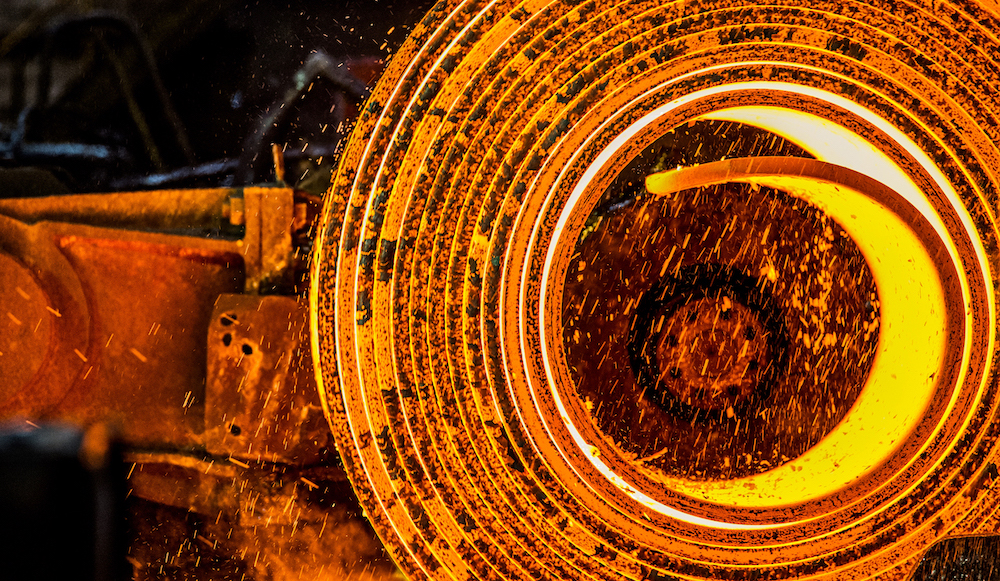
Fagersta Stainless starts up new soaking furnace
An electrical soaking furnace for long products supplied by Danieli Centro Combustion has reached full operation four weeks after installation at Swedish long products maker Fagersta Stainless.
The facility equalises billet temperature between induction heater reheating furnace and the rolling mill, Kallanish understands. It was engineered, manufactured and assembled on site in seven months following order signature. According to Danieli, this kind of furnace finds its best application in mills with differentiated rolling temperature demands due to material characteristics.
In combination with induction heating, it maximises yield by minimising temperature setting stops in the reheating furnace – still providing a fully equalised temperature profile of billet, Danieli explains. It may also be applied in layouts that foresee long distances between reheating furnace and stands, or in plants operating with hot charge, for zero emissions.
To achieve the process requirement, and at the same time pursue the ambitious target of decarbonisation, the furnace is fully powered by electrical resistance, Danieli notes.
Resistance coils developed and tested in Danieli Research Center are installed along the entire length of the furnace roof and walls maintain the furnace chamber at temperatures up to 1,250 °C. This was never reached before with this heating system, the planbuilder claims.
Fagersta Stainless is a unit of Outokumpu.
Christian Koehl Germany


Beltrame welcomes new shareholder in Swiss plant
Italian Simest, part of state financial institution Cassa Depositi e Prestiti (CDP), is investing €15 million ($16m) in Italian merchant bar maker Acciaierie Beltrame’s Swiss subsidiary Stahl Gerlafingen AG to support the company’s international growth and energy transition.
“The funds, which also include the intervention of the Venture Capital Fund, will be used to consolidate the company’s presence in the Swiss market and to carry out the modernisation of the production plant,” Simest explains in a joint note seen by Kallanish. It adds it has become a minority shareholder in Stahl Gerlafingen AG.
Beltrame is dedicating this year a total of €58m in investment to its Swiss division to improve energy and production efficiency with the aim to cut 20% emissions and lower energy spending. The funds injected by Simest will also help the steelmaker boost its commercial presence in Switzerland and other neighbouring countries.
The steelmaker says that its main objective is to maintain high equipment standards and guarantee a qualitative finished product capable of meeting ESG criteria. The installation of a new furnace in the rolling mill at the Stahl Gerlafingen site, including the modernisation works planned for the entire production plant, “will allow us to be more competitive in an increasingly competitive steel market,” AFV Beltrame Group cfo Raffaele Ruella concludes.
Natalia Capra France

Iron ore hits 4-month high
Seaborne iron ore prices have continued to move higher as China’s week-long New Year holiday approaches. The threat of supply disruption from Covid in Australia helped fuel the rise, but a surge in position-taking was driven by optimism over Chinese demand.
The Kallanish KORE 62% Fe index increased $1.17/tonne to $139.31/dry metric tonne cfr Qingdao, the highest since September last year. The Kallanish KORE 65% Fe index gained $1.17/t to $168.40/dmt cfr, and the KORE 58% Fe index grew $1.06/t to $110.78/dmt cfr.
On the Dalian Commodity Exchange, May iron ore settled up CNY 27/t at CNY 797.5/t ($125.25/t), while on the Singapore Exchange February 62% Fe futures settled up $9.16/t at $147.03/t. The same contract for 65% Fe and 58% Fe futures settled up $8.94/t at $177.19/t, and up $9/t at $114.97/t respectively. Tangshan billet increased CNY 20/t to CNY 4,500/t.
Across 35 ports, iron ore stocks dropped another 1.07 million tonnes to 149.02mt last week, according to SMM. Deliveries into ports have slowed sharply and are expected to remain low thanks to the holidays reducing port efficiency in the coming week.
Supply uncertainty was one reason for the higher spot and futures prices. Atlas Iron has reportedly been struggling with the negative impact to its shipments from labour shortages. Covid restrictions have made it increasingly difficult for miners to transport sufficient workers to their mines to maintain normal operations.
The key driver however remains growing expectations that the Chinese market will push steel prices higher in the coming weeks as demand recovers from a very weak H2 2021. This led to a surge in position taking in both iron ore and steel futures markets on Friday, the last trading day before the holiday for Chinese exchanges.
China is attempting to bring forward local government spending and is allowing developers greater access to funds. This could mean plenty of funding for construction once the weather and worker availability improves after the New Year holiday.

LME scrap contracts mostly higher, trading volumes jump
Most near-term scrap futures contracts on the London Metal Exchange saw strong gains over the week to Jan. 27, while trading volumes jumped on the week.
Platts assessed the January scrap contract down $1.75/mt to $468/mt Jan. 27, while the February contract rose $6/mt week on week to $472/mt. The March contract gained $7.50/mt to $472/mt, and the April contract jumped $13.50/mt to $472/mt.
The backwardation structure for the January-February portion of the forward curve shifted into a soft contango week on week, while the backwardation over the February-April portion was flat. The trend suggested that futures traders expect physical scrap prices to increase in the near term, while maintaining firm levels over the remaining first quarter.
Spot prices for physical imports of premium heavy melting scrap 1/2 80:20 rose 25 cents/mt week on week to $470/mt CFR Turkey Jan. 27, after a drop to $467.50/mt CFR Jan. 24 at the start of the week, as sell-side sources held firm at workable levels.
“In Turkey, I think we can see an increase of $20/mt soon, but it just depends on whether it is by mid-February or towards the end of next month,” a UK trader said. Winter conditions have slowed scrap collection rates in the key exporting regions to Turkey.
Mill sources were less bullish, however. “The only concern is euro-US dollar parity, which is coming down, so buyers will push down [scrap prices],” one Turkish mill source said. Turkish mills have also temporarily reduced production utilization amid high energy prices and natural gas supply cuts, which may limit their scrap demand in the short-term.
Weekly LME scrap futures trading volumes over the week to Jan. 27 totaled 69,740 mt, up sharply from trading volumes of 27,550 mt last week, reaching the highest weekly trading volume total since Oct. 7, 2021, when 92,320 mt was traded.
Most near-term rebar futures contracts also saw strong gains over the week to Jan. 27. Platts assessed the January contract up 50 cents/mt at $705.50/mt, while the February contract increased $13/mt to $720/mt. March gained $24.50/mt to $720/mt and April jumped $30/mt to $714.50/mt.
The contango structure over the January-February portion of the forward curve strengthened significantly week on week, suggesting that futures traders expect strong upside for physical prices in the near term.
The backwardation over the February-March portion of the curve turned flat, while the backwardated structure over March-April softened.
Turkish physical rebar export prices increased $10/mt to $710/mt FOB Jan. 27, as the market reported a fresh 55,000 mt deal to Singapore along with some significant deals to Europe, leading to mills holding firm at their minimum workable levels.
Rebar futures’ weekly trading volumes in the week on the London Metal Exchange totaled 31,020 mt Jan. 27, up from 16,650 mt the previous week, to reach the highest weekly trading volume total since Oct. 7, 2021, when 40,950 mt was traded.
The daily outright spread between Turkish export rebar and import scrap was assessed at $240/mt Jan. 27, up $9.75/mt week on week.
— Rabia Arif, Viral Shah


Sweden’s SSAB crude steel production up 8.5% in 2021
Sweden-based SSAB said Jan. 28 its output of crude steel in 2021 rose 8.5% to 8.2 million mt, with rolling production 9.1% higher to 7.6 million mt and steel shipments up 7.1% to 6.9 million mt.
Looking at 2022, SSAB said it expected higher shipments in all three divisions in the first quarter of 2022, with demand for steel estimated to be good, albeit with continued uncertainty associated with semiconductor shortages and logistical bottlenecks. It expected realized prices to be stable for the Special Steel and Americas divisions and somewhat lower in Europe.
The company’s Special Steels division produced 0.2% more crude steel in 2021 at 2.3 million mt, while its rolling production edged 1.2% lower on the year to 1.7 million mt. The division’s shipments for the year climbed 30% to 1.5 million mt.
Special Steels markets all the company’s quenched and tempered steels and hot-rolled, advanced high-strength steels from the Raahe and Borlange operations, is responsible for steel and rolling production in Oxelosund, Sweden and took over responsibility for the Mobile mill in Alabama from SSAB Americas in the third quarter of 2021.
“All SSAB Special Steels’ customer segments had good underlying demand,” it said, adding that the strongest trend was in customer segments with exposure to the aftermarket, while demand from the heavy transport sector was stable, despite the semiconductor shortage at OEMs.
Record shipments to auto industry
SSAB Europe, which includes the Raahe and Hameenlinna operations in Finland and the Lulea and Borlange operations in Sweden, increased crude steel output by 15% in 2021 to 4.6 million mt, with rolling production also up 15%, to 4.7 million mt. SSAB Europe’s shipments increased 8.3% to 3.6 million mt in 2021.
“Demand during the fourth quarter was affected by a shortage of semiconductors, but despite this, SSAB’s shipments of high-strength steel to the car industry reached a new record level for the full-year,” SSAB said.
It said demand had been good in the construction, heavy transport and construction machinery segments, while the steel service center segment had had a “wait-and-see attitude” during Q4, partly due to low visibility for auto production levels.
The SSAB Americas division’s crude steel output rose 4.3% to 1.2 million mt, with rolling production up 1.7% to 1.2 million mt.
The division’s shipments, however, dropped 7.9% year on year to 1.9 million mt in 2021, with SSAB attributing this to a planned maintenance outage in Mobile, bad weather conditions and lack of transport capacity in Q4.
SSAB Americas produces plate in North America, as well as steel in Montpelier.
Record results
Financially, SSAB said 2021 was the best in its history, with record results posted by all divisions.
“Most of this improvement was driven by high steel prices. Internal performance was good during the year, with high production stability and improved safety results.
The company had revenue of SEK 95.9 billion ($10.1 billion) in 2021, up 47% year on year, with EBITDA up to SEK 22.1 billion from SEK 3.4 billion in 2020, which was hit by COVID-19.
SSAB’s operating profit for full-year 2021 was SEK 18.8 billion, up from a loss of SEK 325 million in 2020.
Green steel
SSAB rolled out its first fossil-free steel in 2021, which was delivered to automaker Volvo.
The company’s green steel is based on HYBRIT technology, which replaces the traditional coal and coke with fossil-free electricity and hydrogen, virtually eliminating carbon dioxide emissions in steelmaking.
SSAB also said it planned to increase green steel production in the Nordic regions to go virtually carbon free by 2030, rather than the initially planned 2045.
— Jacqueline Holman

European HRC prices climb as new offers come to fruition
European hot-rolled coil prices rose Jan. 28 as market participants assess the pricing reality of a swiftly accelerating market, mills announce price hikes met with some buy-side resistance, sources told S&P Global Platts.
A leading European mill announced a Eur50 increase for hot-rolled coil spot deliveries across Europe. Following suit of similar announcements for cold-rolled coil and galvanized material two weeks ago. Sources described the price hike as unsurprising and said other mills are likely to follow with similar increases.
Multiple market participants reported the Northern European workable level at Eur970/mt, almost an 8% increase to the level it was reported earlier this week.
A Benelux service center predicted further price hikes were coming from rising raw material costs and uncompetitive import offers rather than newly found demand. Steelmakers continue to operate at a low level of capacity utilization, following several production cuts in Europe in the last few months.
A German service center expressed cautious buying behavior, “it is a question of time. Who moves first…mills or buyer.” The source said. “We have postponed our decision [until] mid- February.”
Platts assessed North European HRC prices at Eur945/mt ex-works Ruhr, up Eur25, and in Southern Europe, HRC prices were assessed at Eur860/mt EXW Italy Jan 28, up Eur20.
— Catherine Brown

Aciers Grosjean joined as member of EUROMETAL
We are pleased to inform you that the company Aciers Grosjean joined as member of EUROMETAL.
The Aciers Grosjean Group (based in Belgium and France) specialises in the distribution and production of finished and semi-finished products in steel, stainless steel, aluminium, fencing, ironwork, hardware, cladding and metal roofing.

More information on www.aciersgrosjean.be.