


Stahl aus recyceltem und erneuerbarem Material bald online
02.02.2022 von Hubert Hunscheidt
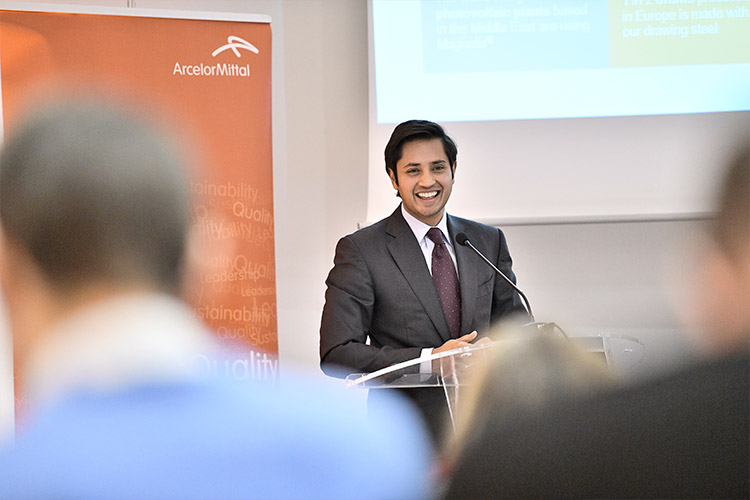
ArcelorMittal Downstream Solutions wickelt in der Regel Großaufträge für deutsche Großprojekte von einem Zentrallager in Essen aus ab. Ab sofort wird auch die Nachfrage nach XCarb®-Trägern bedient. Oliver Menrath, Geschäftsführer von Downstream Solutions Deutschland, freut sich über den ersten Verkauf von XCarb®-Produkten : „Als wichtiger Marktteilnehmer ist es unsere Pflicht, den Vertriebskunden unsere neuesten Innovationen anzubieten. Das gilt sowohl für den Bereich der Nachhaltigkeit als auch bei jeder anderen Produktentwicklung. Die Menge, die wir jetzt auf Lager haben, wird uns helfen, gemeinsam mit unseren Kunden einen weiteren entscheidenden Schritt in Richtung Nachhaltigkeit zu gehen.“
Im Laufe des Jahres werden die CO2-armen Stahlträger der Marke XCarb® auch in das Angebot der Online-Plattform e-steel aufgenommen. ArcelorMittal wird damit der erste Anbieter auf dem Markt sein, der emissionsarmen Stahl online anbietet.
ArcelorMittal leistet Beitrag für emissionsfreie Stahlerzeugung
In Deutschland wächst die Nachfrage nach CO2-armen Produkten, da die Bekämpfung des Klimawandels die wichtigste Herausforderung des 21. Jahrhunderts ist. Downstream Solutions beliefert vor allem Stahlbaukunden, Händler sowie baunahe Partner und bietet über sein Vertriebsnetz fast alle Stahlprodukte auf Lager an. Das gewährleistet eine “just-in-time”-Lieferung. Mit nur 333 Kilogramm CO2-Emissionen pro Tonne sind die recycelten und erneuerbar hergestellten XCarb®-Träger die ersten mit einer Garantie für 100 Prozent recycelten Stahlschrott und 100 Prozent erneuerbaren Strom aus Solar- und Windprojekten. Durch den Verkauf von XCarb® recycelten und erneuerbar produzierten Trägern, die bei ArcelorMittal Differdange in Luxemburg hergestellt werden, leistet ArcelorMittal Downstream Solutions Essen einen Beitrag zum Engagement der Gruppe für eine Netto-Null-Stahlerzeugung. Gleichzeitig hilft ArcelorMittal seinen Kunden so, ihre eigenen Dekarbonisierungsziele zu erreichen.
Quelle und Foto: ArcelorMittal Deutschland


Materialmangel in der Industrie etwas entschärft
31.01.2022 von Hubert Hunscheidt
Der Materialmangel in der deutschen Industrie hat sich im Januar etwas entspannt. 67,3 Prozent der Firmen berichteten über Engpässe und Probleme bei der Beschaffung von Vorprodukten und Rohstoffen. Im Dezember waren es noch 81,9 Prozent. Dies geht aus einer Umfrage des ifo Instituts hervor. „Trotz dieser Entwicklung bleiben viele Sorgenfalten bei den Unternehmen“, sagt der Leiter der ifo Umfragen, Klaus Wohlrabe. „Es ist noch nicht abzusehen, ob dies eine Trendwende ist.“
Weiterhin angespannt ist die Situation bei den Herstellern von elektrischen Ausrüstungen. Dort sank der Anteil nur leicht von 93,8 auf 89,6 Prozent. Ähnliches gilt für den Maschinenbau, wo 80,6 Prozent der Unternehmen von Problemen berichten, nach 91,0 Prozent im Dezember sowie für die Autoindustrie mit 77,9 Prozent, nach 92,9 Prozent. Die Hersteller von Bekleidung hingegen haben deutlich weniger Probleme mit ihrer Lieferkette als im Vormonat. Dort fiel der Wert von 87,0 auf 44,6 Prozent. Die Getränkehersteller berichten sogar nur noch zu 12 Prozent von Behinderungen. „Die leichte Entspannung gibt Unternehmen die Chance, ihre hohen Auftragsbestände abzuarbeiten und ihre Produktion zu steigern“, ergänzt Wohlrabe.

Quelle und Grafik: ifo Institut / Foto: marketSTEEL

FUTURES WRAP: LME scrap sees strong gains, trading surges
Near-term scrap and rebar futures contracts on the London Metal Exchange saw strong gains over the week to Feb. 3, while scrap trading volumes increased.Platts assessed the February and March scrap contracts both up $23/mt to $495/mt on Feb. 3, while the April contract gained $15.50/mt to $487.50/mt.
The forward curve over the February-March contracts remained flat, suggesting that futures traders expect physical scrap prices to remain stable at high levels over the period, while the March-April portion of the curve reverted to backwardation on the week to Feb. 3.
Spot prices for physical imports of premium heavy melting scrap 1/2 80:20 jumped $22/mt week on week to $492/mt CFR Turkey on Feb. 3, amid fresh deals booked from the UK, the US and the Baltic regions.
Turkish mills were indicating higher workable levels for scrap imports by the end of the week on Feb. 3. One Turkish mill source noted that $500/mt CFR could be possible in the very near term if buyers can’t hold “their finger [above] the panic button.”
“$490-$495/mt CFR [for Baltic-origin HMS 1/2 80:20] is more realistic for today – expectations are still up to $500/mt CFR, which was the psychological limit in the past,” a Turkish agent source said.
Weekly LME scrap futures trading volumes over the week to Feb. 3 totaled 86,940 mt, up from trading volumes of 69,740 mt last week, reaching the highest weekly trading volume total since Oct. 7, 2021, when 92,320 mt was traded.
Near-term rebar futures contracts also saw strong gains over the week to Feb. 3, in line with scrap. Platts assessed the February contract up $18/mt on the week to $738/mt on Feb. 3. The March contract jumped $15.50/mt week on week to $735.50/mt, and the April contract gained $10/mt to $724.50/mt.
The flat structure over the February-March portion of the forward curve shifted into soft backwardation over the week, while the backwardation over the March-April portion of the curve strengthened on the week, suggesting that futures traders expect near term physical rebar prices to soften, albeit remaining at sharply higher levels.
Turkish physical rebar export prices increased $15/mt to $725/mt FOB on Feb. 3, as mills increased offers during the week starting Jan. 31 after selling strong volumes to Europe. Market participants reported that mills were quite firm in their minimum workable levels as they were waiting to see if any fresh deals can be booked to the Far East market after the Chinese Lunar New year holidays.
Rebar futures weekly trading volumes in the week on the London Metal Exchange totaled 12,780 mt on Feb. 3, down from 31,020 mt the previous week.
The daily outright spread between Turkish export rebar and import scrap was assessed at $233/mt Feb. 3, down $7/mt week on week.
— Rabia Arif, Viral Shah

ArcelorMittal Germany launches carbon-free beams
ArcelorMittal Germany has expanded its range of low-emission steels under its proprietary “XCarb” product range.
From its distribution hub in Essen, ArcelorMittal Downstream Solutions now offers beams in the sizes of HE100 to HE300, and IPE180 to IPE600, in grades S235JR+M and S355J2+M, Kallanish learns from the company. In the course of this year, it will also start offering the range via its online-platform e-steel, it says.
At only 333kg of CO2 per tonne of steel produced, the recycled XCarb beams are the first with a guarantee for 100% recycled scrap and 100% electricity from solar and wind power, the company claims. The beams are produced at its mill in Differdange, Luxembourg, and approved by certification body DNV GL. Downstream Solutions primarily serves the construction industry, other distributors, and companies serving construction.
ArcelorMittal’s XCarb brand encompasses all the company’s activities in low-carbon and carbon-free steels as well as further initiatives and innovation projects.
Christian Koehl Germany


Supply disruptions, energy costs undermine EU recovery: Eurofer
After rebounding strongly in 2021, European steel consumption is expected to grow much slower in 2022 and 2023, by 3.2% and 1.7% respectively on-year, says Eurofer. End-use demand, from the automotive sector in particular, will be seriously impacted at least till mid-2022 by global supply chain issues and soaring energy prices.
EU apparent steel consumption in the third quarter of 2021 rose on-year for the fourth consecutive quarter, by 14.3% to 36 million tonnes, although this was down from 40mt in Q2.
“The positive trend in steel-using industries and in steel demand observed since the end of 2020 continues, but the outlook is becoming gloomier,” Eurofer director general Axel Eggert says in a note sent to Kallanish. “Ongoing supply chain disruptions, skyrocketing energy and carbon prices as well as persisting inflation are putting the recovery of the steel sector at risk. Combined with the current EU climate and energy policies, these are the ingredients of a dangerous cocktail that may drive Europe into a structural crisis and industry out of Europe.”
EU domestic deliveries also rose in Q3, by 6.6% on-year, but slowed from 40% growth in Q2. EU steel imports surged 47.7% in Q3 following 45% growth in Q2. Steel end-use sector output growth slowed to 3.2% in Q3 from 29.2% in Q2.
“The current situation jeopardises the recovery and casts substantial uncertainty on the overall steel-using industries’ outlook, at least until the first half of 2022,” Eurofer concludes.
Adam Smith Germany
Turkey’s HRC imports rise to 5.6 mil mt in 2021, CIS mills top suppliers
Turkish buyers imported 5.6 million mt of HRC in 2021, 1.5 million mt higher than the previous year, according to the latest monthly Turkish Statistical Institute (TUIK) data sent to S&P Global Platts.
Turkey’s traditionally top HRC suppliers, CIS countries, increased their shipments considerably in 2021 amid strong demand and some supply issues in the country, especially in the first half of the year.
Russian mills’ HRC exports to Turkey increased by 57% year on year and this country became Turkey’s largest HRC supplier at 1.93 million mt in 2021, while imports from Ukraine totaled 1.17 million mt, notably higher than the 707,700 mt imported in the same period the previous year.
As a Free Trade Agreement (FTA) was signed between Turkey and Ukraine Feb. 3, imports from Ukraine could rise further in 2022, sources said.
Although full details of the agreement are expected to be announced later, according to a statement on the website of the Ministry of Economy of Ukraine, Turkey will lower import duties for most of the Ukrainian metallurgical products under the FTA.
The Ministry also said that quotas of at least 411,000 mt are offered for 167 metallurgical products.
It wasn’t clear on Feb. 4 which steel products will be subject to lower import duties and quotas.
A Turkish industry source told Platts Feb. 4 that the details will be announced following the approval of the FTA at the grand national assembly of Turkey within this month.
A manager of a Turkish coated coil producer also told Platts that import duties for Ukrainian materials could gradually be reduced to zero, as in the FTA with South Korea.
Turkey’s imports of HRC from some Asian countries, particularly India, also showed a notable year-on-year surge in 2021 due to competitive offers from the country.
Turkish imports of HRC from India reached 614,800 mt in 2021, up from zero in the same period the previous year, while imports from Japan totaled 392,000 mt, stable on the year.
South Korea exported 225,200 mt of HRC to Turkey in that period, 21% lower on the year. Turkish mills also imported 176,300 mt of HRC from China in 2021, up from just around 1,000 mt imported in 2020.
Turkey’s HRC imports from European countries, traditionally among its top suppliers, declined in 2021. France shipped 315,000 mt to Turkey in 2021, 130,000 mt lower on the year, while Romania’s HRC exports to Turkey totaled 157,700 mt, down 28% on the year.
One of the sharpest declines in HRC imports was seen in imports from the Netherlands. The country shipped 23,500 mt of HRC to Turkey in 2021, significantly down from 155,000 mt in the same period of 2020.
— Cenk Can

ArcelorMittal replaces blast furnaces with EAFs in France
ArcelorMittal will install an electric furnace at its French steelmaking site in Fos-sur-Mer, with the aim to boost production of greener and lower-CO2 steel. At the same time, in Dunkirk, a new 2.5 million tonnes/year capacity direct reduced iron unit will be built to process iron ore using hydrogen to feed two new EAFs, Kallanish learns from ArcelorMittal.
The new equipment will be operational from 2027 and will replace two blast furnaces in Dunkirk and one in Fos-sur-Mer by 2030. At present, ArcelorMittal has three blast furnaces in Dunkirk and two in Fos-sur-Mer.
The French government will support the project with an investment of €1.7 billion ($1.9 billion). ArcelorMittal and the French government have signed a strategic partnership for these investments. The project is subject to the agreement of the EU, which is expected by the second quarter, as well as the availability of economically viable infrastructure and energy supply.
“These investments will make it possible to profoundly transform steel production in France and to achieve a total reduction of nearly 40% of ArcelorMittal’s CO2 emissions by 2030 in France,” ArcelorMittal says.
Natalia Capra France