

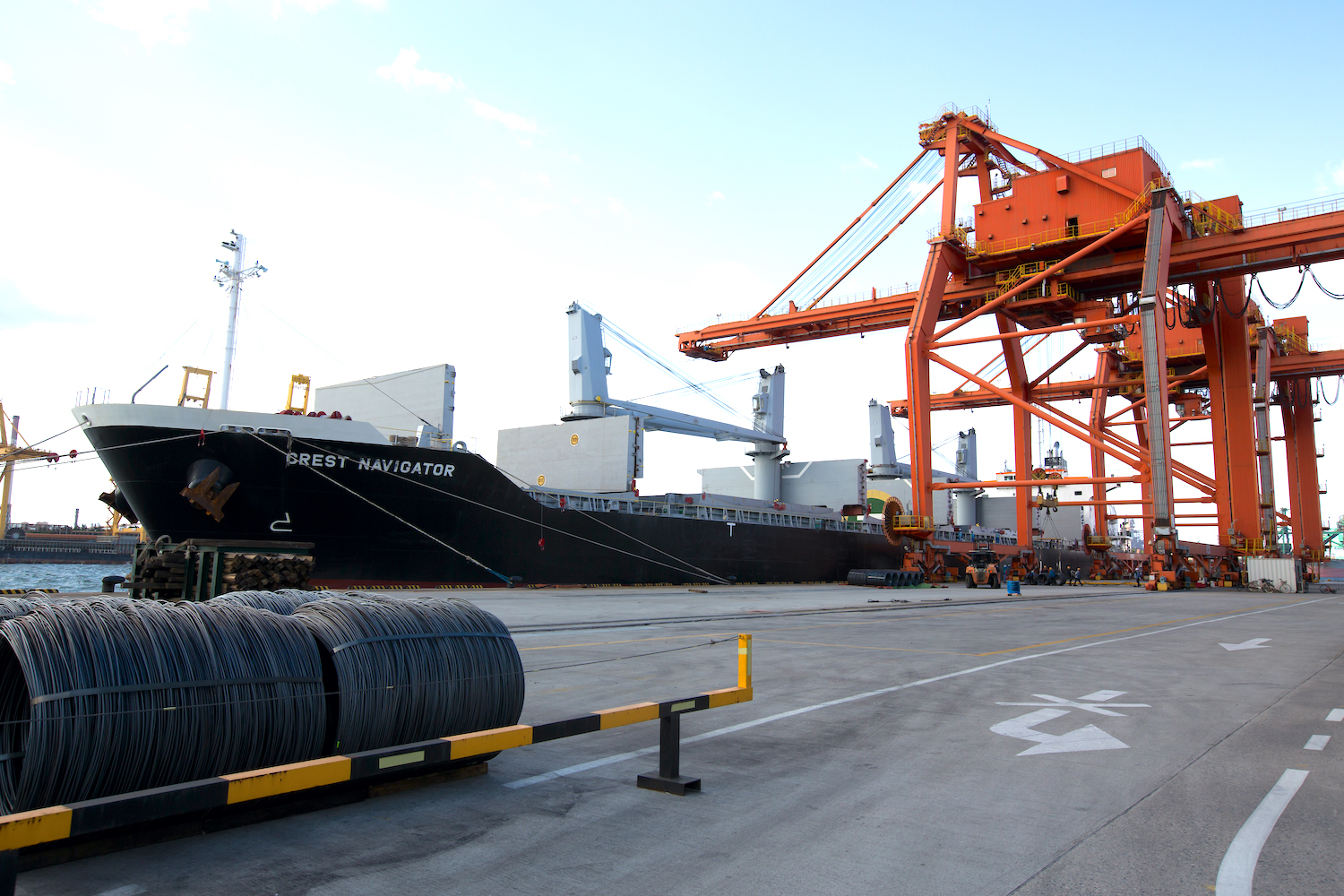
Port of Antwerp expects strong steel traffic
The Port of Antwerp expects steel traffic to remain strong for at least the first half of 2022, a port spokesman tells Kallanish.
In 2021, steel throughput rose by a massive 81% year-on-year, totalling 9.38 million tonnes. Steel is the most important product group within conventional break bulk, which totalled 11.5mt, up 74%. Steel was also the product that saw the strongest y-on-y growth in 2021, following the low in 2020.
According to the spokesman, incoming steel volumes rose significantly more – by 128% to 5.85mt – than outgoing volumes – by 36% to 3.53mt. In 2020, the volume of imports was nearly identical to that of exports, with both around 2.58mt.
For this year, growth is expected due to adjustments to the USA’s Section 232 tariffs. This means that 3.3mt of steel melted and forged in the EU could be imported tariff-free. Also, the exemptions that had been in place for certain steel products will be in force for another two years.
He also refers to other indirect factors which will affect future throughput. These are the recovery of the automotive sector, investment regarding the CO2 footprint, higher energy costs, the EU’s safeguard review in June, magnesium shortages, and higher export duties on Chinese steel.
Christian Koehl Germany

Logistics hub opens in Duisburg port
Haeger & Schmidt Logistics (HSL) started operating its new steel warehouse on 1 February, located on the “Stahlinsel” (Steel Island) in the Port of Duisburg.
The company invested €12 million ($14m) in the multifunctional warehouse with a heated 9,000m² hall that has a capacity for about 60,000 tonnes of steel products. The new building will be connected to the large existing hall with a covered water connection via a coil ferry.
The new hub complements HSL’s terminal with covered and heated space suited for storage of high-quality products in particular, HSL steel manager Jörg Thielen tells Kallanish. “The new warehouse will bring a shift towards higher-quality products, and to some extent also add volume,” he says.
The company handles around 1 million tonnes/year of steel at its Duisburg terminal. HSL is a subsidiary of Austria’s Felbermayr Group and also owns storage capacity in the Port of Antwerp. Its additional facilities in Duisburg will be largely dedicated to coils.
According to HSL managing director, Heiko Brückner, the response on the market has been very good. “More than half of the storage space has already been booked,” he says.
In addition to classic handling and storage, HSL’s activities also include seaworthy stowage of containers and expert unloading of coils and sheets from boxes.
Christian Koehl Germany

Benelux scrap prices jump on strong demand
Scrap prices in the Benelux recorded another sharp increase last week amid strong Turkish demand.
With the dollar at 1.1432 per euro, dock prices on Monday were mostly at €390-395/tonne ($446-452) delivered, up from €365-370/t a week ago.
Despite prices approaching €400/t levels, scrap flow is not strong in the EU, as bullish suppliers are targeting higher prices and thus withholding material. On the other hand, increasing Covid-19 cases are causing them to follow a cautious stance.
Turkish mills’ demand for imported scrap remained strong last week. As a result, EU-origin HMS 1&2 80:20, which stood at $461/t cfr the previous week, climbed to $484-485/t cfr in the first half of last week. It then reached $490/t cfr Turkey on a booking concluded on Friday.
Netherlands-origin material was offered at $494/t cfr on Friday. This level, however, was not accepted by Turkish mills.
One Turkish mill tells Kallanish: “A $29/t rise in a week is a lot. Besides higher prices here, Benelux exporters are benefiting from lower freight prices.”
A Benelux exporter points to the strengthening euro, adding: “The exchange rate has climbed from 1.11 to 1.14 in a very short period. This, coupled with the sharp rise in dock prices, is increasing our costs.”
In the Indian subcontinent, Indian scrap demand is seen to have slowed following the sharp rise seen in prices, while Indian mills have sufficient inventory. Offers for containerised shredded were unchanged on-week at $540-545/t cfr Nhava Sheva. Dubai-origin HMS 1&2 80:20 prices, however, have reached $495/t cfr on the latest bookings.
This week, scrap prices are likely to increase further following China’s strong return to the market after the Lunar New Year holiday, as well as its plans to boost the use of steel scrap. China, the world’s top steel producer, said on Monday it aims to boost utilisation of steel scrap, as part of a plan to develop a higher-quality, greener ferrous industry.
Burcak Alpman Turkey
Iron ore jumps on return from holiday
Seaborne iron ore prices jumped again on the return of China from its New Year holiday. Prices have spiked on strong expectations for domestic steel markets, despite continuing issues surrounding real estate.
The Kallanish KORE 62% Fe index gained another $2.93/t on Monday to $147.33/dry metric tonne cfr Qingdao, after increasing $5.08/t over the week of the holiday. The Kallanish KORE 65% Fe index was up $2.77/t to $176.75/dmt cfr, and the KORE 58% Fe index appreciated $0.47/t to $123.36/dmt cfr.
On the Dalian Commodity Exchange May iron ore settled up CNY 15/t at CNY 812.5/t ($127.82/t) on the first trading day of the new year. On the Singapore Exchange, meanwhile, March 62% Fe futures settled up $2.40/t at $147.45/t. The same contract for 65% Fe and 58% Fe futures settled up $2.43/t at $176.75/t, and up $0.23/t at $124.66/t respectively.
While Chinese scrap prices continue to be capped by weak demand, billet prices are rising on improved steel market optimism. 6mm+ heavy scrap delivered to mills in the Yangtze River Delta was flat from before the holiday at CNY 3,627/t. Tangshan billet prices however jumped CNY 100/t to CNY 4,600/t, the highest since November.
Cold weather and weak real estate sales over the holiday have done little to stop steel futures prices from increasing (see separate article). Spot markets however remain quiet. Construction workers typically do not return to work on a large scale for another week, so it is too early to tell for sure how strong steel demand will be in the coming weeks.
Both central and local governments are however encouraging financing for projects to be put in place and economic stability has become a core focus for policy in the short term. If this money flows into buying steel through the rest of the first and second quarters, then prices for both steel and iron ore could be driven even higher.

US steel groups welcome TRQ deal with Japan
US steel industry organizations welcomed an agreement between the US and Japan Feb. 7 to replace the US 232 tariffs with a tariff-rate quota on imports of Japanese steel, set to take effect April 1.
Under the terms of the deal, 1.25 million mt of Japanese steel across 54 product categories will be allowed into the US duty-free, with the 25% Section 232 tariff to take effect for any imports above that level. While similar to the deal the US reached with the EU in October, under the agreement struck with Japan, steel products that are granted a specific product exclusion will still count toward the overall quota.
“[This] shows that the US government is committed to negotiating alternative schemes to the 232 tariffs on a case-by-case, country-by-country basis,” Philip Bell, president of the Steel Manufacturers Association, said in a statement. “We are particularly glad to see that that exclusion-based imports of Japanese steel products will count against the quota volumes.”
In 2021, 58% of Japanese steel imports came to the US as exclusions, representing about 550,000 mt of steel products, according to Bell.
The establishment of a TRQ will help to prevent an import surge that would undermine the domestic industry as the US and Japan look to expand their cooperation on addressing global steel excess capacity, Kevin Dempsey, CEO of the American Iron and Steel Institute said in a statement.
“Proper implementation and enforcement of the TRQ will be essential to the ongoing success of the Section 232 program, as will continued vigorous enforcement of our laws to prevent circumvention and evasion of US trade remedy measures on steel,” Dempsey said.
In order to establish more market-oriented conditions for steel, Japan has agreed to implement “appropriate domestic measures, such as antidumping, countervailing duty, and safeguard measures or other measures of at least equivalent effect, with a view to initiating formal processes for such measures within six months,” according to a joint US-Japan statement.
Additionally, the inclusion of a melted and poured requirement will help to prevent circumvention and transshipment, Bell said.
“Overall, this is a strong deal for American steelmakers, and it shows that we should not take a one-size-fits-all approach when it comes to our jobs, environment and economic growth,” he said.
Following the agreement with the EU in October, countries have been petitioning the US to negotiate alternate arrangements to the Section 232 duties, first put in place by former President Donald Trump in March 2018. The US officially entered bilateral negotiations with the UK Jan. 19 concerning the Section 232 tariffs.
— Justine Coyne
