

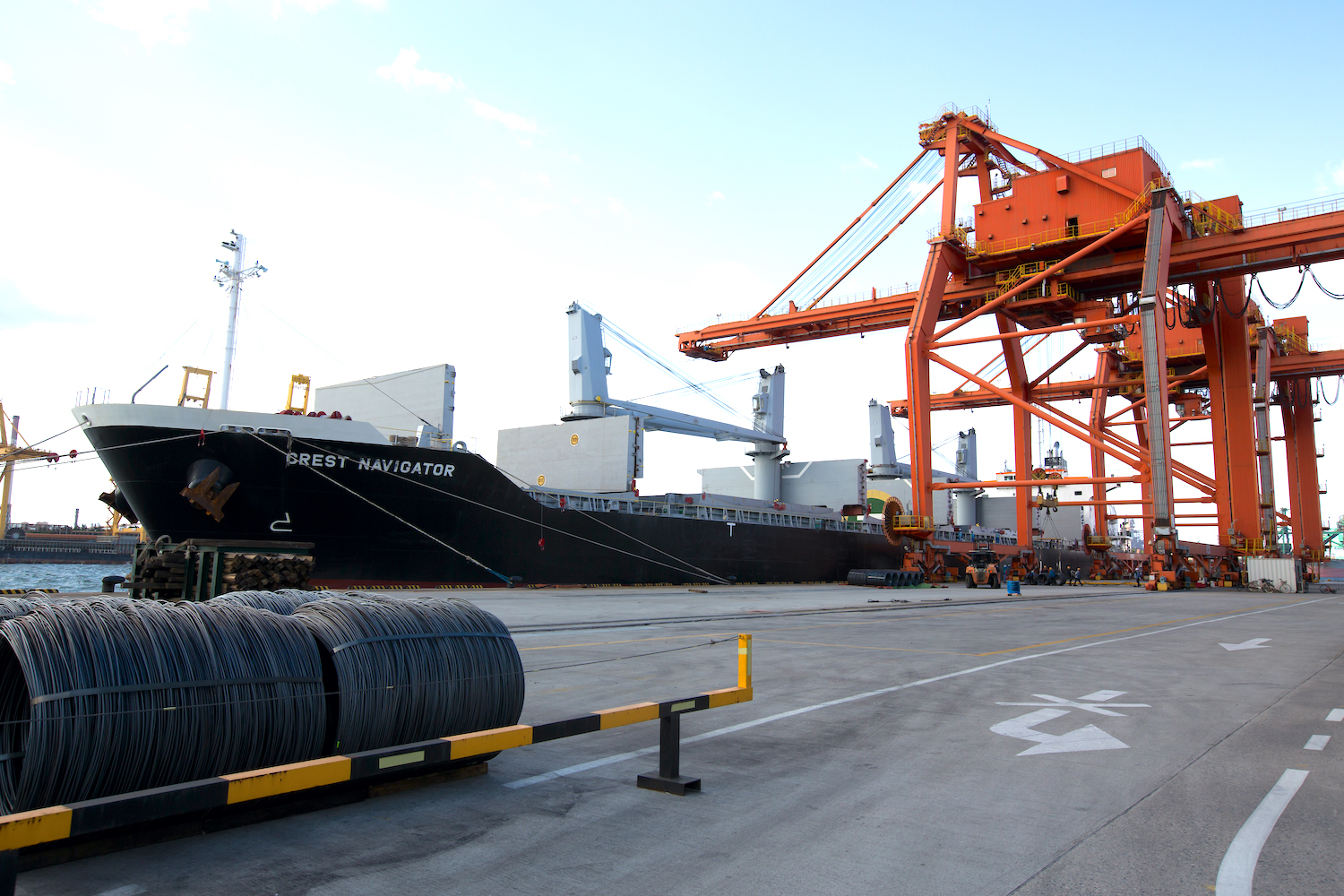
Brazil flat steel distributors’ shipments fall 3.7% on year to 312,300 mt in February
Shipments by Brazilian independent flat steel distributors and service centers fell 3.7% on the year to 312,300 mt in February, according to data released March 22 by the national flat products distributors association Inda. Shipments remained fairly stable during the month from 298,500 mt in January
Purchases from associated distributors fell 8.7% on the year and 2.8% on the month to 293,800 mt in February.
Flat product inventories in the Brazilian distribution network totaled 811,300 mt, down 0.8% from January. The average inventory turnover was 2.7 months of supply.
Finished flat steel imports rose 48.6% on the year to 151,520 mt in February, excluding slab, mostly from China (81.3%), followed by South Korea (8.3%).
Imports of slabs stood at 441 mt in February. In January, slab imports reached 578,200 mt, mostly from Russia.
According to Carlos Loureiro, executive president of Inda, mills should enforce the price increase on flat steel expected for April, set at about 20% divided throughout the month, as the exclusion of Russia and Ukraine from the market affected prices.
“Either prices rise or mills would be selling below direct costs [of purchasing slabs]. Although the domestic market demand is not high, mills have no difficulties exporting,“ said.
— Jose Guerra


Turkish HRC producers focus on exports as EU quotas rise, home demand slows
Offer prices by Turkish mills for hot-rolled coil have remained relatively stable in recent days, as domestic demand has slowed and buyers focus on lower-priced import options, after HRC climbed by $400/mt in a month in the wake of Russia’s invasion of Ukraine.
Turkish mills have instead focused on the export markets, as the increase in EU quotas is expected to support Turkish mills’ export volumes and prices in the coming weeks, sources told S&P Global Commodity Insights March 22.
The European Commission decided to allocate Russia’s quota to other countries on March 15 after it banned Russian steel imports. As a result, Turkey’s quota for hot-rolled sheets and strips rose to 430,246 mt for the second quarter of 2022 from 323,200 mt in the first quarter.
The sharp rise in HRC prices at Turkish mills, however, spurred notable buying interest in Chinese-origin HRC in Turkey. Turkish buyers booked around 400,000 mt of HRC from China in the last three weeks at competitive prices as low as $980-$1,010/mt FOB, sources said.
“Turkish mills’ HRC offer prices, which rose to $1,300 mt EXW as of the previous week, aren’t yet accepted by the domestic market, as lower imported offers are available,” a manager at a major Turkish pipe producer told S&P Global March 22.
“We also heard that Turkish mills’ HRC offers at around 1,300/mt FOB haven’t yet been accepted by European buyers, as Indian- and Japanese-origin HRC offers are competitive,” he said.
However, he said he is expecting these levels to be accepted in the coming weeks as some availability issues could emerge.
A manager at a Turkish HRC producer said EU buyers who booked some cargoes in previous weeks have refrained from booking new position cargoes in recent days.
A level of $1,250/mt FOB has already been accepted by EU buyers amid an antidumping duty on Turkish HRC, he said, while $1,300/mt FOB has also been accepted in some markets outside the EU.” Indian, Japanese, Koeran, Taiwanese and Egyptian producers are effectively in the EU market, while Chinese mills are actively selling to Turkish and Egyptian markets, he said.
Highlighting that traders had begun to face problems getting letters of guarantee from banks, a service center manager told S&P Global March 22 that trade activities have remained very slow in recent days.
“I don’t think that HRC prices over $1,250/mt could be easily accepted by the domestic market,” he said.
— Cenk Can

Global output drops further in February
Global crude steel production fell 5.7% on-year in February to 142.68 million tonnes due to reduced output in Asia, the EU and CIS. Production also fell 9% versus January, Kallanish notes.
Chinese production is estimated to have dropped 10% on-year in February to 74.96mt, but Indian output was confirmed up 7.6% to 10.06mt. Japanese and South Korean output fell 2.3% and 6% respectively to 7.3mt and 5.16mt. Vietnamese output rose 2.6% to 1.84mt.
EU27 production inched down 2.5% to 11.67mt. Although German output rose 3.8% to 3.22mt, Italian production fell 2% to 2.05mt. French output inched up 0.5% to 1.13mt but Spanish production plunged 13.5% to 941,000t.
Turkish output dropped for a third consecutive month, by 3.3% to 2.95mt.
US production nevertheless continued to increase but growth slowed further to 1.4%, giving 6.4mt, while Brazilian output fell 6.9% to 2.68mt.
CIS output fell an estimated 5.8% to 7.72mt, with Russian output estimated down 1.4% to 5.8mt and Ukrainian production confirmed down 18% to 1.37mt. CIS output figures, especially for Ukraine, will be drastically impacted from March onwards following Russia’s invasion of Ukraine on 24 February.
Global crude steel output in January-February thus fell 5.5% on-year to 299.43mt.
Adam Smith Germany

Increased production, safeguard suspension would ease pressure: PUDS
Pressure on the market from disrupted supply can be eased only by increasing European steel production, temporarily lifting safeguard measures to allow more imports, and ending the war in Ukraine, says the Polish Union of Steel Distributors (PUDS).
Steel supply has been notably disrupted in the EU in recent weeks, both as a result of limited imports and domestic production. Even before the outbreak of war in Ukraine, the cost of inputs – electricity, gas and raw materials – saw unprecedented growth. This led some producers to limit production to periods of lower electricity rates or stop altogether and bring forward planned maintenance.
At the same time, automotive industry buyers have curbed their offtake. If this trend were to reverse, this would put even more pressure on supply, PUDS observes.
The war in Ukraine has exacerbated this situation. As a result, EU steel imports have ceased from Ukraine, Russia and Belarus, which combined account for 25% of the Polish import market. There is a big question mark over how this supply gap is to be filled. Ukraine meanwhile accounts for almost 50% of EU slab imports, and their ceased supply is already translating into reduced rolling mill output in Italy, France and Belgium.
Poland imported 13 million tonnes of steel in 2021 amid apparent steel consumption of 15mt, exports of 5.4mt and crude steel production of 8.1mt. The majority of imports came from EU countries, “but amid the same problems for the steel industry all over Europe, there is no possibility to quickly compensate for the supply gap with other origins,” PUDS chief executive Iwona Dybal says in a note seen by Kallanish. “Also not known are the consequences of changing global steel and raw material trade flows, which the war will cause in the long term.”
Steelmakers and therefore later distributors temporarily stopped taking new orders and offering product. They are now trying to wait out the uncertainty by “offering a future steel price based on hedged cost positions”, Dybal observes. “Both mills and distributors are primarily focused on the fulfilment of long-term contracts, meaning the availability of steel for spot purchases in recent weeks has been limited.”
Soaring steel prices could see distributors as well as end users experience problems in fulfilling long-term contracts, and could lead to further problems with steel availability, since many buyers “will likely increase orders due to fears over future availability and prices of material,” Dybal concludes.
— Adam Smith Germany

Indian steelmakers to renegotiate contracts on costlier feedstock
More Indian steelmakers could retrospectively increase prices in existing contracts after one major steelmaker did just that this week due to raw material supply shortages that have significantly increased costs, Indian market sources tell Kallanish.
Owing to surging coking coal and ferroalloys prices, Indian mills are planning to invoke force majeure clauses and renegotiate short and long-term contracts with customers. The recent hike in coking coal prices has made it difficult for mills to supply finished steel at January/February contract prices.
“Due to the global geopolitical situation, there is a problem of short supply of raw materials and that too is at a very high price,” Bhushan Power and Steel informed its customers in a note. “This is a force majeure situation … The net impact of this coal and iron ore price increase is coming to INR 25,250/tonne ($331). We request you to accept [the price hike] and continue the same [contract].”
The steel company has requested its customers to finalise their decisions by 25 March, after which the firm will procure raw materials and start contracted production accordingly.
It could not be contacted for comment before deadline on Tuesday.
The coking coal crisis has also impacted production at other major steel producers. One local trader says: “Other steel companies might invoke force majeure in the coming days on soaring coking coal prices.”
The force majeure is expected to impact all bookings done by Indian steelmakers in January and February for April shipment. Bookings for hot rolled coil were done in January at around $730-740/t fob India and in February at $830-870/t fob India. There majority were destined to Turkey, the Gulf Cooperation Council and Europe.
Hard coking coal quotes are currently hovering at around $670-675/t fob Australia.
Sayed Aameer India
Increased production, safeguard suspension would ease pressure: PUDS
Pressure on the market from disrupted supply can be eased only by increasing European steel production, temporarily lifting safeguard measures to allow more imports, and ending the war in Ukraine, says the Polish Union of Steel Distributors (PUDS).
Steel supply has been notably disrupted in the EU in recent weeks, both as a result of limited imports and domestic production. Even before the outbreak of war in Ukraine, the cost of inputs – electricity, gas and raw materials – saw unprecedented growth. This led some producers to limit production to periods of lower electricity rates or stop altogether and bring forward planned maintenance.
At the same time, automotive industry buyers have curbed their offtake. If this trend were to reverse, this would put even more pressure on supply, PUDS observes.
The war in Ukraine has exacerbated this situation. As a result, EU steel imports have ceased from Ukraine, Russia and Belarus, which combined account for 25% of the Polish import market. There is a big question mark over how this supply gap is to be filled. Ukraine meanwhile accounts for almost 50% of EU slab imports, and their ceased supply is already translating into reduced rolling mill output in Italy, France and Belgium.
Poland imported 13 million tonnes of steel in 2021 amid apparent steel consumption of 15mt, exports of 5.4mt and crude steel production of 8.1mt. The majority of imports came from EU countries, “but amid the same problems for the steel industry all over Europe, there is no possibility to quickly compensate for the supply gap with other origins,” PUDS chief executive Iwona Dybal says in a note seen by Kallanish. “Also not known are the consequences of changing global steel and raw material trade flows, which the war will cause in the long term.”
Steelmakers and therefore later distributors temporarily stopped taking new orders and offering product. They are now trying to wait out the uncertainty by “offering a future steel price based on hedged cost positions”, Dybal observes. “Both mills and distributors are primarily focused on the fulfilment of long-term contracts, meaning the availability of steel for spot purchases in recent weeks has been limited.”
Soaring steel prices could see distributors as well as end users experience problems in fulfilling long-term contracts, and could lead to further problems with steel availability, since many buyers “will likely increase orders due to fears over future availability and prices of material,” Dybal concludes.
Adam Smith Germany