


EU coil buyers question crisis price hikes
Many coil buyers in northwest Europe have been wondering if the recent international crises really have an immediate effect on the availability and the prices of steel products.
What started off with the coronavirus two years ago last year led to an enormous surge of energy prices and to bottlenecks of transportation capacities. On top of this, the war in Ukraine plus embargoes against products from Russia have added to shortages, and consequently, produced higher prices, Kallanish notes.
Still, Germany’s federation of steel fabricators, WSM, in a recent call to member companies and customers to stand together, expressed doubts.
“The enormous price leaps can not generally be explained with the crises and conflicts,” it stated. More concretely, it said that “often, there is no relation between price increases and the Ukraine war as the reason that is given.”
Some consider the recent price dip for coil, on the heels of an unprecedented sudden price rally in March, as symptomatic for a try that’s gone too far. An Austrian manager points at the energy costs cited often by mills, and notes that the skyrocketing spot prices make up only a minor part of the mills’ demand, while most supplies are in fact based on long-term contracts that are left untouched.
A Dutch manager points at an unconventional way one mill has chosen to face the extra burden in alliance with its customers.
“The sky-high energy costs have prompted a European mill to write to its customers, asking them to voluntarily pay an extra per tonne to compensate for these increased costs,“ he tells Kallanish.
Christian Koehl Germany

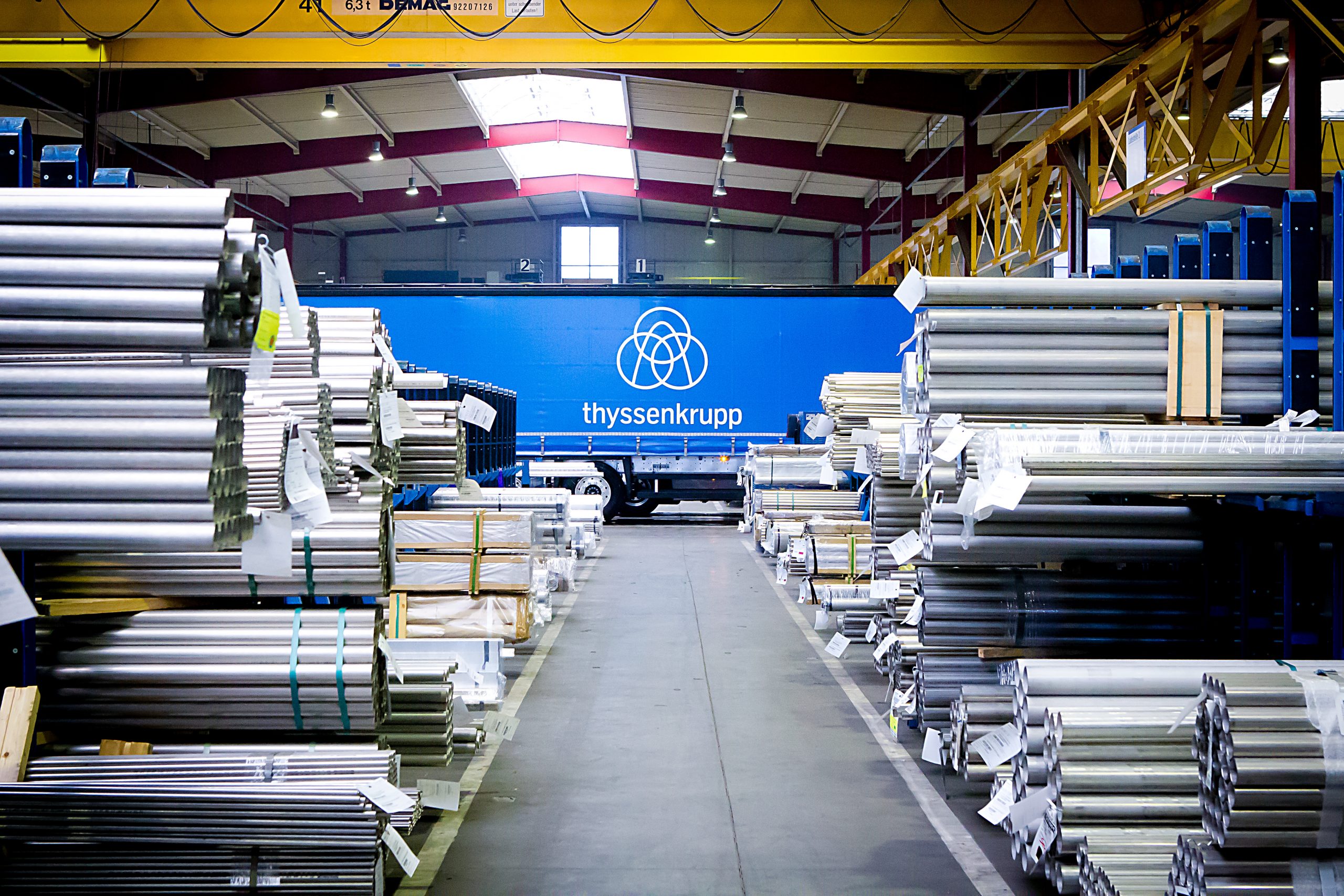
Steel scrap processing plant at Duisberg, Germany, to supply thyssenkrupp furnaces
The construction of a steel scrap processing plant by TSR Recycling GmbH at Duisburg, Germany, broke ground April 21, with the facility set to produce high-quality recycled raw material to be used in thyssenkruup’s local blast furnaces, the steelmaker said.
The use of recycled products in the blast furnace would lead to a reduction of CO2 intensity and support the production of thyssenkrupp’s bluemint steel range of CO2-reduced and certified steel, the company said. Once the plant is completed, up to 260,000 mt of bluemint recycled steel could be produced per year, it added.
“This project enables us to make rapid progress in the reduction of CO2 emissions,” thyssenkrupp Steel’s chief technology officer Arnd Köfler said in a statement following a ground breaking ceremony at the Schrottinsel, or Scrap Island, site at the inland port of Duisberg, which stands at the junction of the Rhine and Ruhr rivers. “Aside from the long-term transformation of our plant and equipment to hydrogen-based direct reduction, we are already doing everything possible to avoid CO2 in the conventional blast furnace process as well. The use of scrap-based recyled material in the blast furnace is an important step in this direction which also benefits our customers.“
The new processing plant meets the special material properties of the high-quality recycled product (TSR40) required for thyssenkrupp’s Duisburg furnaces through the use of special shredder and separation technology.
“Apart from the positive effects for environmental protection and resource conservation, the construction of the new plant and the novel product are also representative of sustainable and reliable raw material supply in Germany and Europe,” Bernd Fleschenberg, TSR’s Managing Director, said. “TSR40 enables us to cover a large part of future raw material requirements of the industry. Particularly in view of interrupted supply chains, our plant at the Duisburg location is a lighthouse project that can serve as a model for other material flows.”
The processing plant is part of the REDERS project (reduced CO2-emissions through increased recycling quota in the steelmaking process) funded by the state of North Rhine-Westphalia to the tune of Eur6.4 million ($7 million). The project partners in the initiative are TSR, thyssenkrupp Steel, Hüttenwerke Krupp Mannesmann GmbH and VDEh Betriebsforschungsinstitut.
In Northern Europe, S&P Global Commodity Insights’ April assessment for domestic shredded scrap was at a record high of Eur570/mt delivered April 11, up sharply from Eur525/mt in March. Shredded scrap prices have risen sharply since 2022, as steel demand recovered following the initial stage of the coronavirus pandemic, with increasing interest in low-carbon steel prompting stronger interest in scrap-based steel production.
— Annalisa Villa, Viral Shah


Hi-end coil material pulls standard products down
A lack of demand from carmakers for coil products typically used for automotive purposes is tracing through to standard products, pulling down prices in that segment as well, market players tell Kallanish.
Just after recovering from the coronavirus shock, carmakers reduced their production last year due to the lack of semiconductor chips. This has been badly aggravated by the Ukraine war and the many supply shortages it has caused. According to an Austrian manager, demand for hot-dip galvanized coil is weak, and he doubts that prices of more than €1,500/t ex-works ($1,634/t) as called by mills earlier have lived long. High availability is one indicator here, with delivery times “that feel like it is only a couple of days until you get it.”
Another Austrian notes that especially high-end galv typically used in cars is low in demand.
“When carmakers need a lot of, for example, organic coated strip, less material is left for standard galv and cold-rolled coil, which keps prices up in that segment, too,“ he says. “We felt a shortage temporarily last year, but not any more now.”
Prices for cold-rolled seem to be more stable than for galv, and in Benelux is seen around or above €1,450/t. In Austria, buyers are more doubtful. They believe that mills have to sell hot-rolled coil definitely for less than the €1,350/t lately called by the market leader, and cold-rolled coil will be hardly €100/t above that.
According to all observers, inventories are relatively full, and buyers confine themselves to the most necessary, especially after being deterred by the former peak values.
On top of this, a German trader dares people to look at the international price levels, to see why German prices can only go down from where they are: “German prices just don’t fit in the global picture.”
Christian Koehl Germany