


LME scrap contracts fall again on week, trading volumes drop
Near-term scrap futures contracts on the London Metal Exchange saw losses over the week to May 19, while trading volumes also decreased dropped.
Platts, part of S&P Global Commodity Insights, assessed the May contract down $2/mt on the week at $480.50/mt May 19. The June contract fell $18.50/mt to $451/mt, July lost $9/mt to $455/mt, and August dropped $13.50/mt to $445.50/mt.
The backwardated structure over the May-June portion of the forward curve strengthened on the week, suggesting that futures traders on May 19 continued to expect physical scrap prices to soften in the near term.
The backwardation over the June-July portion of the curve shifted into a slight contango, while the backwardation for July-August strengthened slightly.
Spot prices for physical imports of premium heavy melting scrap 1/2 (80:20) dropped $15/mt week on week to $465/mt CFR Turkey on May 19, as market sources heard of a fresh Baltic-origin cargo deal.
“There were some scrap offers around $460-$470/mt CFR over the last few days on the back of a slight upturn in domestic rebar, billet demand but we need to see if that continues — otherwise we’ll see below $750/mt FOB for rebar and below $450/mt CFR for scrap soon,” a Turkish mill source said.
“Under these market conditions and big competition [among recyclers], I do not need to go around with an offer,” one Turkish agent source said. “The problem now is not to negotiate for scrap, but that the mills have to sell [finished products].”
Weekly LME scrap futures trading volumes over the week to May 19 totaled 43,340 mt, down from 86,510 mt last week.
Most near-term rebar futures contracts also saw losses over the week to May 19.
Platts assessed the May contract up 50 cents/mt on the week to $801.50/mt. The June contract fell $8/mt to $744.50/mt, July lost $15/mt to $740/mt, and August dropped $19.50/mt to $730.50/mt.
The backwardation over the May-June portion of the forward curve strengthened over the week, suggesting that futures traders continued to expect prices to fall sharply in the near term.
The contango structure over the June-July portion of the curve shifted into slight backwardation, while the backwardation over July-August strengthened.
Turkish physical rebar export prices fell $55/mt on the week to $765/mt FOB May 19, as weak demand in the export market, along with weakening scrap import prices, kept pressure on the market. Market players heard of limited export deals for rebars booked to Africa and Middle East at softened levels, but the sales were not deemed significant enough.
“Yes, something is happening, however demand is not big enough to make up for all the steel sector in Turkey,” one Marmara mill source said. He noted that price levels were currently not that important in the market and that the important factor was that the market wanted to see some positive indications.
Rebar futures weekly trading volumes in the week on the London Metal Exchange totaled 1,010 mt May 19, down from 24,970 mt the previous week.
The daily outright spread between Turkish export rebar and import scrap was assessed at $300/mt May 19, down $40/mt week on week.
— Rabia Arif, Viral Shah

Turkey’s Q1 wire rod exports rise 7% on year on strong EU demand
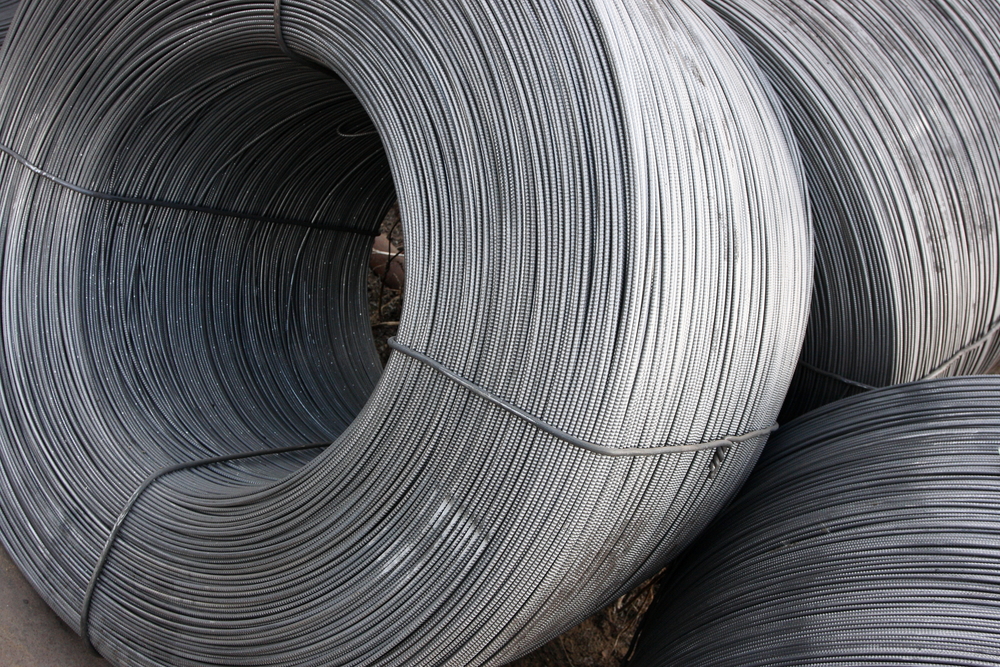
Turkish mills’ wire rod exports in the first quarter of 2022 rose 7% year on year to 300,000 mt on higher EU demand, according to the latest monthly Turkish Statistical Institute data seen by S&P Global Commodity Insights May 20.
According to the latest data, despite a 12% year-on-year decline, Israel remained Turkey’s top wire rod export destination in January-March at 74,500 mt.
Israel was also Turkey’s top wire rod export market in 2021, with shipments totaling 273,200 mt, down 16% on the year.
Turkey’s Q1 wire rod shipments to some EU countries also rose year on year.
Exports to Romania were 53,500 mt, up by 40,000 mt on the year, while exports to the Netherlands totaled 38,700 mt, up 25% on the year.
Shipments to Italy were 20,500 mt, up 66% on the year, while exports to Canada totaled 15,000 mt, up from zero in Q1.
Turkish mills also exported 11,800 mt of rod to Peru in Q1, down 52% on the year, the latest data showed.
Revenue generated from these exports jumped by 48% on the year to $242 million on globally higher steel pricing in the period.
Although prices were strong in Q1, Turkish mills’ wire rod offer prices have fallen in recent days on low demand and bearish scrap pricing, sources said.
According to major long steel producer Kardemir’s new price list seen by S&P Global, the company’s 6-27 mm (SAE 1008-1010) grade wire rod prices fell a further $40/mt on the week to $845/mt EXW May 17, while the price for its 6-27 mm (SAE 1006) grade wire rod fell to $855/mt EXW. These prices remain unchanged as of May 20.
Kardemir’s 10-20 mm (B420C) grade rod price also declined by the same amount to $865/mt EXW, while the list price for its 5.50 mm (SAE 1008-1010) grade fell to $880/mt EXW.
The European Commission’s decision March 15 to allocate Russia’s steel quota to other countries following a ban on Russian steel imports is expected to support Turkey’s wire rod exports in the coming quarters of the year.
— Cenk Can

EU producers accept lower HRC prices on low demand, decreasing import offers
Domestic prices for hot-rolled coil in Europe decreased further day on day May 20 due to weak demand and pressure from declining import offers.
Platts assessed domestic HRC prices in Northern Europe at Eur1,065/mt ex-works Ruhr, down Eur10/mt day on day.
Buyers have made some deals for smaller tonnages on HRC to restock certain specifications at Eur1,050-1,070/mt ex-works. The prices have not reached bottom yet, market sources said. Achievable prices have been estimated by market participants at Eur1,050-1,100/mt ex-works Ruhr, and offers have been reported at Eur1,100/mt ex-works Ruhr.
In Southern Europe, Platts assessed domestic HRC prices at Eur990/mt ex-works Italy, down by Eur10/mt day on day.
Following another decline of import prices and to stimulate buyers’ interest, Italian producers were ready to sell HRC at Eur980-1,000/mt ex-works Italy. One source also reported unconfirmed information that a domestic Integrated mill has already made deals at Eur980-1,000/mt, delivered, to Italian buyers.
Lower import prices have contributed to the domestic price slide, particularly in the south of Europe due to higher exposure to overseas coil.
Offers of HRC from India have been heard at Eur850/mt CFR Italy; from South Korea and Egypt at Eur870/mt CFR Italy; and from Turkey at Eur850/mt CFR Italy, including anti-dumping duties. This compared with import prices of about Eur900/mt ex-works in the start of the week.
“Import is moving down by Eur10-20/mt every couple of days,” an Italian trader said. “Naturally, buyers are not willing to risk and book. This threatens domestic prices. And as domestic demand is low, Italian mills have to adjust their prices down.”
Demand has remained low for flat steel across the EU because of a combination of high stocks across the supply chains and low demand from key end-consuming industries, including automotive.
“Everyone’s stocks are full — mill, distributors, end-users,” a Northern European distributor said. “And the volumes moving in the supply chain are so small that the mills have no opportunity to sell. They will have to cut capacities. That is discussed in the market, but no additional information was provided by either of the mills.”
“Demand is low, automotive is in big trouble due to components shortage,” an Italian service center source said. “But automotive is not the entire market. I think that we are in the period when panic buying earlier this year that resulted in extremely high stocks and weak automotive have been helped to drag prices down.”
Despite the bearish mood in the EU market, some sources believe that stabilization of prices in China might be a sign that the downtrend might end soon.
“Import prices from Asia need to stabilize,” a Southern European trader said. “I think we already see signs of stabilization in China, and then buyers will see that the freefall ended and they might book some volumes.”
“It seems that prices in China started to stabilize, so I think that is the first sign that European coil prices will stop falling too soon,” a producer said.
— Maria Tanatar, Benjamin Steven

Thyssenkrupp extends Merz’s ceo tenure to 2028
Thyssenkrupp’s supervisory board has decided to extend Martina Merz’s tenure as chief executive by a further five years to March 2028, Kallanish notes.
Merz became acting ceo of the troubled conglomerate in 2019 following the ousting of Guido Kerkhoff, who had been in the position for only one year. She was made permanent chief in 2020.
Under her leadership, and following the failed merger between thyssenkrupp Steel Europe and Tata Steel Europe in 2019, thyssenkrupp decided to spin-off its steel business into a standalone unit. However, this plan was suspended in March amid the outbreak of war in Ukraine.
In the six months through March 2022 the steelmaking unit lifted revenue by 46% on-year to €6.06 billion ($6.42 billion) despite a drop in tonnages. Pre-tax profit (Ebit) saw a massive turnaround from a loss of €137 million a year earlier to a plus of €607m.
“On behalf of the entire Supervisory Board, I would like to thank Martina Merz for the resolute approach to the transformation of thyssenkrupp,” says thyssenkrupp supervisory board chairman Siegfried Russwurm. “We are pleased that Ms. Merz has agreed to continue to drive forward this change process in her role as Chairman of the Executive Board of the Company.”
Adam Smith Germany


Spanish scrap corrects from highs, further falls unpredictable
Scrap prices in Spain have continued falling in May. The market saw a new €20/tonne ($21.15/t) correction on Friday, with sources forecasting the downward trend will continue until June, although without being clear about the extent of the drop.
“The correction has followed the international market deceleration. Prices have come back to levels seen in March, but should continue to fall in the short term,” one source tells Kallanish.
Another market participant confirms that large steelmakers remain focused on maintaining a good level of raw material in stocks, while also trying to be prudent about their purchases.
“Mills have their inventories back to normal, but falling scrap prices make the market very cautious when buying material,” he notes. “The decrease in levels is considered unpredictable now since prices decrease day by day.” Although there has been a material shortage as a result of the war in Ukraine, Spanish scrap collection activity and domestic volumes offered look to be improving, the source adds.
The recent fall in global scrap prices has resulted in an almost €90/t ($95.19/t) decline for the new arisings grade in Spain since the beginning of May. E8 scrap is now offered in Spain at €540/t delivered. Demolition quality grade E3 stands at €465-470/t, while E40 is priced at €490/t, both delivered. E1 quality is at €445/t on the same basis.
Todor Kirkov Bulgaria