


NLMK to launch new coated steel in 2023
NLMK Group is improving the quality of its steel offering with a zinc-aluminium-magnesium coating of increased resistance, the company says.
The firm says it carried out successful tests of rolled products with increased corrosion resistance with a paint and varnish coating. The results showed virtually zero impact of aggressive environments on the metal surface, it claims.
The launch of the new product in the market is scheduled for the first half of 2023, Kallanish notes.
Steel with a corrosion-resistant zinc-aluminium-magnesium coating has advantages over standard galvanized steel. It is recommended for use in medium and highly aggressive environments, for the production of light-weighted materials, girders, the frame of the supporting structures of partitions, the frame of floors and wall elements, NLMK observes.
In addition, steel with this anti-corrosion coating will be used as the basis for the production of polymer-coated rolled products. These products ensure the durability of the operation of buildings located in central Russia for at least 50 years, NLMK says.
NLMK has also improved the stability of galvanized steel by applying a thin layer of organic coating, providing a threefold increase in the resistance of the metal.
The company also completed the modernisation of the APP-1 polymer coating unit. The unit with a capacity of 130,000 tonnes/year is designed to apply high-tech coatings with high performance characteristics to sheet up to 2mm thick and 1,600mm wide.
Earlier, NLMK said that Russian steel exports will fall further due to sanctions against the country following its invasion of Ukraine (see Kallanish passim). It expects exports of steel products from Russia to decline by 23% in 2022, with rolled products accounting for the bulk of the decline by 40-45%.
The steelmaker also expects that Russia will reduce this year steel production by more than 11 million tonnes, down by 15% on-year.
Svetoslav Abrossimov Bulgaria


Metinvest establishes additional markets for coal in Europe
Metinvest’s Pokrovske mine continues to produce coking coal and is currently operating four mining sites, the group’s chief executive, Yuri Ryzhenkov, said during a trip last week to the Donetsk region, where he visited the assets of Metinvest Pokrovskvugol.
“Today, we have proven sales channels and we also managed to find additional markets not only in Ukraine but also in other countries – Slovakia, Hungary, Poland,” the company tells Kallanish. “We are considering the possibility of cooperation with Western European plants.”
The company is ready to increase production and penetration rates, and make additional investments in the development and modernisation of the enterprise, Ryzhenkov added.
“We continue to work and understand that in the next 10-15 years our coal will be in demand, because it is too early to talk about clean technologies and green steel,” he concluded. “Although I am sure that the transition to green steel is inevitable, it will take time. Therefore, we intend to implement our plans for the development and modernisation of the Pokrovske mine.”
Earlier, Metinvest said it has reoriented its exports of steel products, due to the Russian military aggression against Ukraine, to the markets of Central and Eastern Europe (see Kallanish passim).
However, the group’s overall capacity utilisation has been reduced by more than 40% due to the loss of its Mariupol plants, logistical problems and other restrictions caused by the war.
Metinvest is also looking at options to produce more steel at its subsidiaries in the EU using Ukrainian commodities.
The company has asked steel buyers not to purchase steel products from Ilyich Steel and Azovstal that it says have been stolen by Russian forces from the port of Mariupol.
Svetoslav Abrossimov Bulgaria

EuG bestätigt Fusionsverbot von Tata Steel und Thyssenkrupp
Hubert Hunscheidt
Thyssenkrupp, ein deutscher Industriekonzern, und Tata Steel, ein Unternehmen mit Sitz in Indien, sind u. a. in der Herstellung und Lieferung von Erzeugnissen aus Kohlenstoff-Flachstahl und Elektrostahl tätig. Ihre Produktionsstandorte befinden sich in Deutschland bzw. im Vereinigten Königreich und in den Niederlanden. Die Unternehmen besitzen auch Endbearbeitungswerke in anderen Mitgliedstaaten.
Am 25. September 2018 meldeten die beiden Unternehmen ihr Vorhaben zur Übernahme der gemeinsamen Kontrolle über ein neu gegründetes Gemeinschaftsunternehmen nach der Fusionskontrollverordnung1 bei der Kommission an. Die Kommission war der Ansicht, dass der geplante Zusammenschluss ernsthafte Zweifel an seiner Vereinbarkeit mit dem Binnenmarkt aufwerfe und beschloss, eine eingehende Prüfung einzuleiten. Das Vorhaben betraf hauptsächlich metallbeschichtete und laminierte Verpackungsstahl-Erzeugnisse sowie
feuerverzinkte Stahlerzeugnisse, die in der Automobilindustrie verwendet werden.
Die Kommission nahm eine Mitteilung der Beschwerdepunkte an, mit der sie vorläufig zu dem Schluss gelangte, dass der geplante Zusammenschluss den wirksamen Wettbewerb in einem wesentlichen Teil des Binnenmarkts erheblich beinträchtigen würde. Nach einem Austausch mit den in Rede stehenden Unternehmen und der Übersendung von Auskunftsverlangen an eine Reihe von Marktteilnehmern, insbesondere Wettbewerber und Abnehmer, erklärte die Kommission mit Beschluss vom 11. Juni 20192 das Vorhaben für mit dem Binnenmarkt und dem Europäischen Wirtschaftsraum (EWR) unvereinbar.
Die Kommission war der Auffassung, dass das Vorhaben insbesondere wegen horizontaler nichtkoordinierter Effekte infolge des Wegfalls eines starken Wettbewerbsdrucks einen wirksamen Wettbewerb erheblich beeinträchtigen würde. Daher hätten sich die Abnehmer einer verringerten Zahl von Anbietern und höheren Preisen gegenüber gesehen. Nach Ansicht der Kommission räumten die von thyssenkrupp und Tata Steel angebotenen Abhilfemaßnahmen die zum Ausdruck gebrachten Wettbewerbsbedenken nicht vollständig und dauerhaft aus. Daraufhin erhob thyssenkrupp beim Gericht der Europäischen Union Klage auf Nichtigerklärung des Beschlusses.
In seinem heutigen Urteil weist das Gericht das gesamte Vorbringen des Unternehmens zurück und bestätigt den Beschluss der Kommission.
Quelle: Europäischer Gerichtshof / Foto: Fotolia


UK begins review of trade barriers to steel coils, bars from five countries
The UK’s Trade Remedies Authority has begun reviews of existing antidumping and anti-subsidy measures on two steel products and an investigation on whether to suspend antidumping measures for Ukraine.
The TRA said it initiated on June 24 a transition review into antidumping measures on hot rolled flat and coiled steel from Russia, Ukraine, Brazil and Iran.
It also opened a transition review into anti-subsidy measures on imports of stainless steel bars and rods from India, it said.
The TRA said the review is needed to ensure the antidumping and anti-subsidy measures the country inherited from the EU are still suitable for the UK’s needs.
HRFC steel is used primarily in the mechanical and electrical engineering, construction and automobile sectors.
The measures on stainless steel bars and rods cover those used across various industries, including the automotive, aerospace and food processing industries. These products can be easily cut and machined and are often used to manufacture tools, machine parts and components.
The period of investigation for both transition reviews will be April 1, 2021 to March 31, 2022, while the injury period will be April 1, 2018 to March 31, 2022.
Suspension investigation
In addition to the initiation of the transition reviews, the TRA has opened an investigation into whether to suspend antidumping measures on HRFC from Ukraine.
“Following a request from the government of Ukraine we will investigate whether a suspension of measures on certain Ukrainian steel products is justified because of changed market conditions after the Russian invasion,” TRA CEO Oliver Griffiths said in a statement.
S&P Global Commodity Insights assessed DDP West Midlands UK hot-rolled coil at GBP800/mt ($1,080/mt) on June 24, down GBP75, or 8.5%, week on week.
— Ekaterina Bouckley


EU HRC producers willing to give discounts to incentivize orders
Suppliers were heard to be withholding offers June 24, preferring to negotiate with buyers on receipt of firm bids, though ready to grant additional discounts in order to secure volumes.
Platts assessed hot-rolled coil down Eur5/mt June 24 at Eur855/mt ex-works Ruhr.
In the Northern market, price indications on tradable value were heard on a range of Eur850-860/mt ex-works Ruhr, from both buy- and sell-side sources. A service center source reported offers at Eur860/mt ex-works Ruhr, alongside a lower offer from the Benelux region at Eur830/mt ex-works Northern Europe.
“Demand remains very poor,” a trader source said. “Mills are begging for orders and aim to reduce production as much as possible.”
Alongside the idling of blast furnaces by ArcelorMittal, US Steel Kosice reportedly mothballed the smallest of their three blast furnaces, in line with source expectations of further production cuts for the near term.
Production cuts have been repeatedly stressed by sources as necessary to match output levels to currently cratered demand.
In the South, prices were stable on the day, assessed at Eur790/mt ex-works Italy, according to S&P Global Commodity Insights data.
— Benjamin Steven, Maria Tanatar

US issues Buy America requirements for Defense Department
The Defense Acquisition Regulations System and the US Department of Defense have received a final rule amending President Joe Biden’s executive order for maximizing use of American-made goods, products, and materials – including steel.
According to the executive order, a product is considered to be foreign if its components consist of greater than 45% foreign materials. However, iron and steel products are foreign if the cost of iron and steel equals more than 5% of the cost of all components. The rule is designed to strengthen domestic preference.
The analysis of public comments revealed responders fall on all sides. Some seek specific waivers, others feel their procurements are out of the scope of the executive order, and still others are greatly in favour of the order and show support for having more Buy American procurements in motion.
By some accounts, the federal market for iron has already undergone significant retooling to meet the demand increases to come from the department.
The department ultimately decided to uphold their initial assessment that the rule on the executive order is primarily a positive force and that cost impacts are not significant.
During the American Iron and Steel Institute conference attended by Kallanish in Washington, DC, on 25 May, the director of the Made In America department Celeste Drake suggested that steel producers be involved in the roll-out of the procedures for their industry. She explained new policies around limiting the number of waivers the office was willing to permit.
The latest ruling appears to be aligned with her message about integrating the use of American steel in federal departments.
Kristen DiLandro USA

UK HRC market awaiting certainties before restocking
The UK HRC market was in wait-and-see mode June 24, as high stock levels in the market delayed restocking activity to July.
Some buyers were heard as ready to return to the market, though were reluctant to resume purchasing on uncertainties as to price direction and relevant floors.
A mill source said production cuts would give buyers a degree of reassurance as to price stability, with initial indications of capacity reductions already heard in the European market, such as ArcelorMittal’s idling of blast furnaces in France and Germany. The source predicted further announcements of output cuts in the near-term, effective from mid-July.
Downstream, service centers were reportedly down 30%-50% on day-to-day demand, the mill source added.
Prices for sales from stockholders to end-users were heard to have fallen sharply in recent weeks, a trader source said.
“The simple answer is that current price levels are a correction, though people are a bit concerned it’ll continue to fall below pre-war levels,” said the trader. “Demand is poor everywhere right now. This kind of situation doesn’t have much to do with price specifically – people stop buying until they realize where prices are going.”
Platts assessed hot-rolled coil in the UK June 24 at GBP800/mt DDP West Midlands.
A stockholder source reported mills offering at around GBP800/mt DDP, putting tradable value at the same level. A trader considered tradable value at GBP850/mt DDP UK, though characterized said indication as the high end of the workable price range.
A mill source saw prices as falling below GBP800/mt DDP in the near-term, reinforced by an offer reported by another mill source on the day at GBP730/mt DDP West Midlands. The source said the offer could be a special deal for a larger tonnage or to undercut import offers, doubtful whether that level was representative of market price.
Said doubts were reinforced in circulating the offer to other sources in the market, with one stockholder describing the offer as “far too cheap” and non-sensical against competing mill offers heard much higher at GBP800/mt DDP West Midlands.
— Benjamin Steven, Maria Tanatar
Slovakia’s steelmaker US Steel Kosice idles blast furnace on weak demand: sources
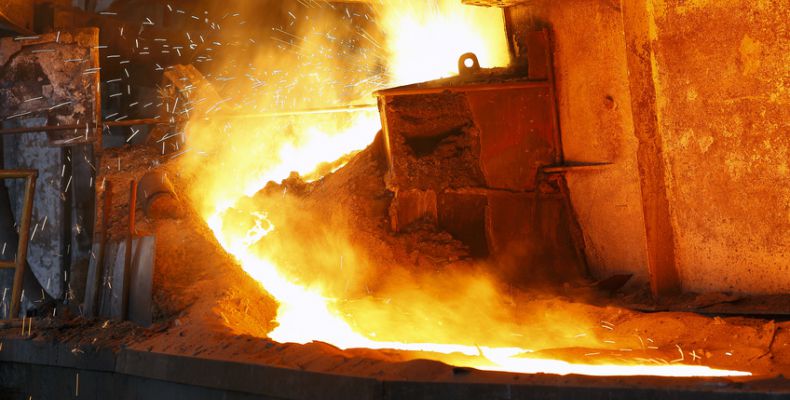
Slovakia’s flat steel producer US Steel Kosice idled one of its three blast furnaces, or BFs, in an attempt to balance supply with low demand, and to preserve prices from dropping further, market sources told S&P Global Commodity Insights.
The steelmaker closed its “smaller BF,” several sources said.
US Steel Kosice did not reply to S&P Global’s multiple requests for comments.
The costs are really high and it is better to idle an asset and sell lower volumes, a big buyer of US Steel Kosice’s HRC said. “Every producer needs to play their part in restricting capacity to control prices,” the buyer added.
“Takes a lot of discipline for a mill to completely mothball an asset. The moves will serve to draw a floor on the market, will bring certainty back, and some demand will come back if certainty comes back,” the buyer said.
The mill had to close a furnace as it relies heavily on automotive sector due to the its location, a German source said. “And demand from carmakers is minimal.”
Demand for flat steel has been weak across the EU due to a combination of lower sales of vehicles on the back of component shortage and high stocks with distributors.
Majority of market participants anticipated announcements of the steelmaking equipment stoppages in the EU due to weak demand and gloomy outlook on consumption.
The mills were expected to try to tackle oversupply and put an end to the downtrend in the EU market by cutting output.
European coil producers were reported running at substantially reduced capacities, in line with ArcelorMittal’s recent announcement to idle its 1.5 million mt/year blast furnace in Dunkirk, France, as well as another furnace in Eisenhuttenstadt, Germany.
Domestic prices for HRC have been declining in Europe since the second half of March due to weak demand. Platts daily assessments for HRC in Northern Europe declined to Eur860/mt ex-works Ruhr on June 23, down by 41% since March 18 when the prices reached their peak, according to S&P Global Commodity Insights data.
— Maria Tanatar, Benjamin Steven

EC confirms definitive measures for global steel safeguard quotas
The European Commission has released official definitive plans to introduce global quotas for some products and continue steel safeguard measures to 2024, it said in an official journal document dated June 24.
After an annual safeguard review, the EC sent a draft of proposed reviewed safeguard measures to the World Trade Organization on May 30, which said it planned to introduce global quotas for some products and prolong steel safeguard measures to 2024.
Yearly import quota volumes were increased to 4% from 3%, with all the definitive measures to come into effect July 1 following the traditional yearly safeguard review cycle.
For product categories 7, which includes quarto plates, and 17, including angles, shapes and sections, the EC has decided to substitute country-specific quotas with global quotas to increase flexibility for users to import the steel needed from any source to combat the loss of supply from Ukraine.
Ukraine historically represents around 33% of total volume imports in each category, but since Russia’s invasion of Ukraine, the EC said it there had been virtually no imports of the two categories from Ukraine into the EU, suggesting that “Ukraine is currently unable to produce and/or export these product categories in any meaningful volumes to the Union market.” This had resulted in a risk of potential shortage of supply for EU users in these categories if action was not taken.
The adjustment would be reassessed if there were changes in trade flows in the two categories or if undue crowding out effects were identified, the EC said.
On May 24, the EU adopted a regulation allowing for temporary trade liberalization for some Ukrainian products in the wake of the ongoing war, which has halted the application of the steel safeguard measure for the time being.
The EC updated the list of developing countries and added Vietnam to the other countries quotas.
It said all developing countries were included in the category 4A, or hot-dipped galvanized steel imports quotas list, because the sum of all imports in 2021 that were below 3% was higher than 9%.
Egypt, Ukraine and Vietnam were added to category 1 (hot rolled flat steel), and China was included in category 2, namely cold rolled flat steel, while Brazil and Vietnam were excluded in category 2.
Turkey was added and Egypt excluded from category 8, namely stainless hot-rolled flat steel, while China was added to category 9 (stainless cold rolled flat steel), while Malaysia and Thailand were excluded.
Moldova was added to category 12 (merchant bars and light sections), the United Arab Emirates to category 16 (alloy wire rod) and Brazil to category 6 (tin mill products), among other changes.
The EC also concluded that the recent changes to the US Section 232 import tariff of 25% into a tariff-rate quota for the EU would not affect the functioning of the EU steel safeguard and did not alter the basis underpinning its assessment regarding the risk of trade diversion.
In March 2018, the US imposed a 25% duty on imports of certain steel products under the US Section 232 measure.
Earlier in June, the European Steel Federation Eurofer welcomed the adoption by EU member states of the EC’s proposal to continue steel safeguard measures, saying it supported the stability of the EU steel market and ensured smooth supply flows.
Domestic prices for HRC have been declining in Europe since the second half of March due to weak demand. Platts daily assessments for HRC in Northern Europe declined to Eur860/mt ex-works Ruhr on June 23 and in Italy to Eur780/mt ex-works, both down 6.7% since the start of 2022, according to S&P Global Commodity Insights data.
— Jacqueline Holman

ArcelorMittal CLN sells French subsidiary
ArcelorMittal CLN, the Italian joint venture between ArcelorMittal and large service centre CLN, has sold its 70% stake in France’s AcierPlus, a flat products service centre and distributor with two facilities in Hericourt and Ancenis, Kallanish learns from the company.
“ArcelorMittal CLN sold 45% of the shareholding to Mr. Angelo Cazzolla, manager of the company who already holds 30% of the shareholding in AcierPlus, and the remaining 25% to MA S.r.l., company belonging to the CLN Group,” the seller says.
AcierPlus performs cutting, shaping and welding services on steel products, and supplies the yellow goods, railway and construction equipment markets.
In 2016, ArcelorMittal CLN took full control of Acierplus, a company created in 2015 to incorporate the plants dedicated to steel processing for the yellow goods and railway industries (see Kallanish passim).
Natalia Capra France