


EUROMETAL attended the Portugal-Canada Steel webinar
Industry experts discussed investment, business collaboration, and public procurement opportunities in steelwork and infrastructure sectors in both Portugal/EU and Canada during Portugal-Canada Steelwork / Construction / Public Procurement Opportunities Webinar + B2B Event that took place on the 29th of June.
This initiative allowed participants (construction companies, steel processing companies, contractors, consultants, public entities, and trade associations) from both Portugal and Canada to meet online and to discuss potential business collaboration opportunities, current R&D projects, new industry trends, implementation of innovative technologies, as well as, exchanging information about various steelwork/infrastructure projects on both continents.
In this weblink you can find and download the presentations of the event.

EU steel sections prices continue to drop amid quiet demand
European domestic steel sections prices continued to soften in the week to June 29 as buyers held back from booking orders, expecting prices to move down further.
Platts’ European medium sections price (category 1, S235 JR) assessment was at Eur1,240/mt delivered June 29, down Eur60/mt week on week.
One Benelux-based distributor source put a tradable value for beams around Eur1,180/mt delivered, adding that purchasing activity was still halted as customers continued to hold back, expecting prices to move down further. Mills were also not reporting any sales, the source noted.
Another distributor in the Benelux region noted that tradable value for category 1 medium sections was around Eur1,180/mt delivered Benelux.
“I think there is demand, but people are waiting until they need the material because they think prices will move down,” he said, adding, “Mills are also under pressure because order books are not good.”
The source reported that most mills were scheduled to go on maintenance breaks after mid-July for one month.
“Everyone is talking about very low prices, but there are no transactions in the market,” one European mill source said, adding that the market was hearing levels around Eur1,180/mt delivered, but those seemed more like buyers’ targets. He also reported that the mill sold small tonnages around Eur1,340/mt delivered, adding that the general workable level in the market seemed to be around Eur1,300/mt delivered.
Elsewhere, Northwest European domestic rebar prices also softened in the week to June 29. S&P Global Commodity Insights’ assessment of Platts’ TSI Northwest Europe Rebar was down Eur65/mt to Eur1,020/mt ex-works June 29.
One European trader noted that offers in Germany for rebars were reportedly as high as Eur1,080/mt delivered. One Benelux-based distributor source indicated a tradable value at Eur1,045/mt delivered Benelux. One Italian mill source indicated workable levels in Germany around Eur1,030/mt delivered, adding that the mill was offering rebars to German customers around Eur980/mt delivered.
One seller source, however, noted that realistic workable levels for rebars in the Northwest European market were around Eur1,030-Eur1,040/mt delivered.
— Rabia Arif, Staff


EU HRC producers resist lower prices despite poor demand
European producers tried to avoid domestic hot-rolled coil price cuts on June 29 despite weak demand from both end consumers and distributors, sources said.
Platts assessed HRC in Northern Europe at Eur840/mt ex-works Ruhr, unchanged day on day, according to data from S&P Global Commodity Insights.
HRC prices targeted by the Northern European steelmakers have been reported at Eur850-880/mt ex-works. Transactions have been settled between local producers and buyers at Eur840-850/mt delivered. Deals for Italian HRC have been reported at the equivalent of Eur840-850/mt ex-works Ruhr. Achievable prices have been heard at Eur830-850/mt ex-works.
Buyers in the region have been nodding at Eur800/mt ex-works level for HRC. Such prices could only be achieved in special deals settled at Eur800-850/mt ex-works that do not reflect the market level, a mill source said.
Offers of HRC from Central European mills have been reported at Eur780-790/mt delivered Ruhr.
Weak flat steel demand across Europe were caused by a combination of high stocks of distributors, logistics problems in ports, and lower steel demand from end consumers, including the automotive segment.
Negative trends settled in the European market have also continued to buyers’ decisions to avoid purchases, as they believe that prices could drop further.
HRC in Southern Europe was assessed at Eur780/mt ex-works Italy June 29, stable on tje day.
Offers and tradable values have been reported at Eur780-800/mt ex-works Italy.
As a result, European mills have been avoiding discussing prices unless they were sure that the negotiations would end up with a deal, and they also tried to maintain prices stable, as offer cuts failed to stimulate buyers’ interest in the past. Demand, however, might pick up in mid-July when distributors will start restocking for September, a producer said.
“There is no point for mills to cut prices now, that would not make buyers to make deals,” the producer said. “Prices are not the issue now, demand is. And the truth is that the end users are inactive, and they do not consume much; and distributors have a lot of material in stocks.”
As a result, transactions remained scarce in the European HRC market, and market participants have been struggling to determine actual market price due to low number of deals.
“There are almost no transactions in the market, so very difficult to tell if any of the sporadic deals done for very specific coil to restock is an actual market representation,” a trader said. “Mills try not to actively offer, as that only results in higher number of bids, price discussions and price decline without any volumes traded.”
Adding uncertainty in the market, some steelmakers were reported adding clauses in their contracts that would allow them to either increase coil prices retroactively or to cancel orders in case of natural gas supply disruption from Russia.
Import offers of HRC in Northern Europe have been reported at Eur740/mt CFR Antwerp. Additionally, Turkish material has been available to Southern European buyers at Eur700/mt CFR Italian ports, including anti-dumping duties. Despite competitive price interest overseas, coil has been limited due to long lead times compared to the domestic mills and due to risks related to safeguard measures and problems in the EU ports.
— Maria Tanatar, Benjamin Steven

Energy, scrap supply top priorities for Italian steelmakers: new Federacciai leader
Energy and ferrous scrap supply are at the top of the agenda for the Italian steel association Federacciai, the association’s new president, Antonio Gozzi, told S&P Global Commodity Insights June 29, the first day of his mandate.
Gozzi is replacing Alessandro Banzato as president until 2024, and this is his second time at the helm after serving as president over the 2012-2018 period. He is also the chairman and CEO of Duferco Italia Holding, a company active in steel production, energy, engineering, logistics and shipping.
“Italy is the second-largest European steel producer and is very much unique as 80% of its crude steel output is produced via electric furnace, which means its steel is mostly green, but it also means that the industry needs to have a lot of energy and scrap,” Gozzi said.
“My priority will be to be focus on working on new green energies contracts, looking into new contracts from renewable energies as well as from nuclear sources from outside Italy.”
Italian steel producers are facing high energy costs after Russia’s invasion of Ukraine.
“I am working also to stabilize energy prices as we have created a consortium for scouting for the possibility to build some direct reduced iron plants outside of Italy, where gas is cheap,” Gozzi said.
Familiar with energy industry
Gozzi is familiar with the energy industry, as he is also president of Interconnector Energy Italia, a consortium of high-energy-use private Italian based companies, and through his work with the University of Genoa as an associate professor on issues relating to industry, energy and shipping.
“I will be also focusing on trying to keep scrap inside our borders,” he said.
According to Eurostat, Italy imported 6 million mt of scrap in 2021 from European countries and exported 600,000 mt. Overall, European countries exported 49 million mt of scrap and imported 37 million mt.
“To achieve the European Commission’s CO2 reduction target, some blast furnace-basic oxygen furnace steelmaking in Europe is expected to be converted to electric arc furnace production, a move that will make scrap even less available and more important, so we have to act together with European partners to keep our important raw materials within the border,” Gozzi said.
Scrap as critical raw material
In March 2022, Italy classified scrap as a critical raw material for the first time and its export is subject to a notification obligation 10 days before to be exported toward a first step to recognize scrap as a strategic resource.
In 2021, Italy increased crude steel production by 19.8% to 24.41 million mt amid strong demand for both long and flat products, surpassing 2019’s 23.192 million mt, which was the last full year before the pandemic.
“In 2021 we saw a rebound from such a low level reached due to all the COVID restrictions,” Gozzi said.
“I think this year the demand is still very good, but not as much as last year, when it was very much an extraordinary year,” he said.
Turkish deepsea import ferrous scrap prices were unchanged on the day June 28, as sellers raised offers and buyers remained hesitant amid slow finished steel demand, sources said.
Platts Turkish imports of premium heavy melting scrap 1/2 (80:20) was assessed June 28 at $332.50/mt CFR, unchanged on the day.
— Annalisa Villa
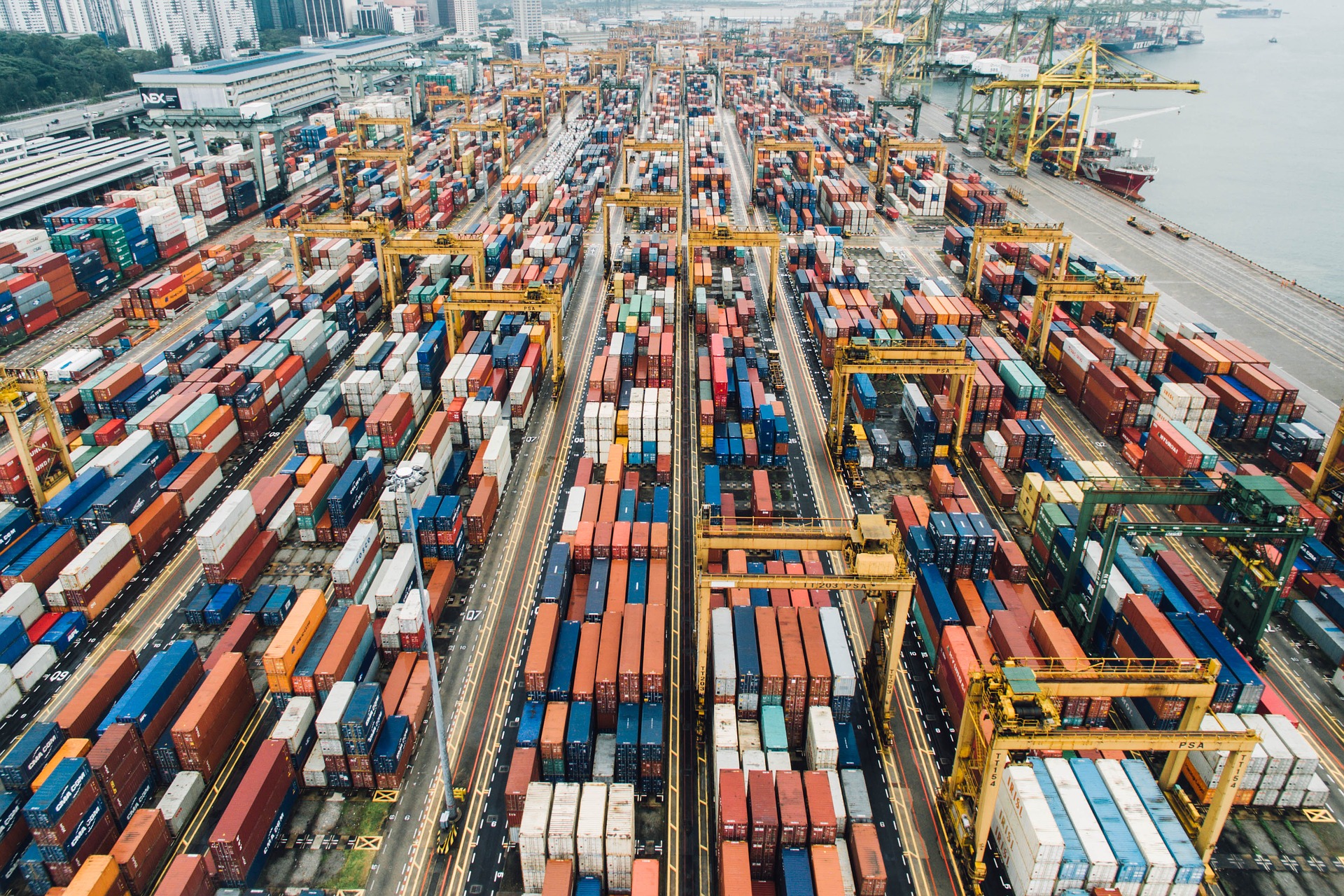
UK formally extends steel import safeguards despite WTO-related concerns
International trade secretary Anne-Marie Trevelyan told the UK House of Commons June 29 that the UK government had made a “final” decision to extend the nation’s steel import safeguards for a further two years “in the national interest,” despite this possibly breaching World Trade Organization rules.
“These are unusual times,” Trevelyan told parliamentarians from various political parties, who were generally supportive of protecting UK producers as they invest in decarbonization. She cited “persistent global overcapacity” and “a threat of serious injury” to UK producers should the safeguards not be prolonged.
Safeguards using quotas and tariffs will therefore be extended on imports of products from 15 categories from July 1 until June 30, 2024, after which time they can no longer be extended, the trade secretary said. The extension on five of these product categories is controversial, as the government had originally said it would phase out these controls June 30: the further extension is moreover seen to target products coming from certain developing nations and particularly China.
“The government wishes to make it clear to Parliament that the decision to extend the safeguard on the five product categories departs from our international legal obligations under the relevant WTO agreement, as relates to the five product categories,” Trevelyan told the House of Commons. “However, from time to time, issues may arise where the national interest requires action to be taken which may be in tension with normal rules or procedures.”
International consultations are “ongoing”
The UK trade department clarified in an email that “the final decision on the steel safeguard has been made. International consultations are ongoing. The most up-to-date data has been used in determining the tariff rate quotas, including on the developing country exemptions.”
Trevelyan noted that she has been and continues to be in consultations with the WTO on the matter and that she “stand(s) ready to take up any concerns.”
The WTO declined to comment when S&P Global Commodity Insights contacted it June 29.
Categories
The five product categories that will be granted a further extension are category 6, tin mill products; 7, non-alloy and other alloy quarto plates; 12, merchant bars and light sections; 16, non-alloy and other alloy wire rods; and 17, angles, shapes, and sections of iron or non-alloy steel.
Following consultation with downstream users who have raised concerns about product sourcing, Trevelyan, however, said she had enlarged the tariff rate quota on category 12a.
The 10 categories on which the safeguards extension had already been expected are 1, non-alloy and other alloy hot-rolled sheet and strip; 2,non-alloy and other alloy cold-rolled sheet; 4, metallic coated sheet; 5, organic coated sheet; 13, rebar; 19, railway material; 20, gas pipe; 21, hollow section; 25, large welded tube; and 26, other welded tube.
Trevelyan also said the government has decided to suspend the safeguard measure for steel goods coming from Ukraine for the next two years. This follows an earlier removal of all tariffs under a UK-Ukraine trade accord to support Ukraine’s economy in the wake of Russia’s invasion of that country.
Steelmakers’ association UK Steel welcomed the trade secretary’s statement, saying it will give UK steelmakers “the stability required to plan, invest and work with the government on the major challenges we now face—not least the decarbonization of the industry.”
The association recently estimated that weakening the controls could bring damages of GBP150 million ($184 million) to the UK steel industry amid continuing global market distortions.
“The decision to maintain the UK’s steel safeguard in full once again shows that the government is backing Britain’s steel industry,” commented UK director general Gareth Stace.
Platts assessed steel hot-rolled coil in Northern Europe at Eur840/mt ex-works Ruhr, unchanged day on day, according to data from S&P Global.
European producers tried to avoid domestic HRC price cuts June 29 despite weak demand from both end consumers and distributors, sources said.
New steel trade deal with the US
The UK steel safeguards system had been under review since late 2021. It mirrors the EU safeguards system, put in place in mid-2018 in response to the US’s imposition of Section 232 import tariffs of 25% on steel imports in March 2018. The EU recently renewed its steel safeguards until mid-2024.
Trevelyan, however, also noted that the UK government has recently secured “an expansive removal of Section 232 tariffs on imports of UK steel and [aluminum] products into the USA, which came into effect earlier this month. The tariff-free volumes we have secured mean that UK steel and [aluminum] exports to the US can return to levels not seen since before 2018.”
UK industry is partly dependent on imported steel, as it produces only around 70% of its annual requirement of around 10.2 million mt crude steel, according to UK Steel.
— Diana Kinch

Outokumpu divests service centres in Italy, Netherlands
Outokumpu says it will divest two plate service centres, in Italy and the Netherlands.
In the Netherlands, the company is selling its Aalten unit to Roba Metals, a family-owned business. The deal should be closed by the end of September. Outokumpu will thereafter continue to supply plate produced at Degerfors to the unit, Kallanish notes.
“The divestment does not affect our other coil and plate operations in Europe. We continue to work together,” says Outokumpu’s Antti Maununiemi.
In Italy, the Castelleone plate service centre is being taken over by the Mariotti stainless steel group, the biggest costumer of Outokumpu in Italy. Outokumpu’s other coil service centre in the same area will remain under the group’s control.
“Mariotti is looking to complete their offering on the market and in special products. For Outokumpu, Mariotti has been a very good customer of ours, and the cooperation continues with Outokumpu as a supplier and Castelleone service centre as a part of our customer’s operations. We are glad to have found Mariotti Group as the best owner to further develop the business in Italy,” says Marc-Simon Schaar from Outokumpu.
Emanuele Norsa Italy


UK trade secretary confirms five-product safeguard extension
UK International Trade Secretary Anne-Marie Trevelyan has confirmed the government will extend steel safeguard quotas for a further two years to end-June 2024 on five categories of steel products.
This follows the publishing last week of the Trade Remedies Authority (TRA)’s findings on steel safeguards (see Kallanish passim).
“Today’s decision on safeguards provides our steelmakers with the stability required to plan, invest and work with the Government on the major challenges we now face – not least the decarbonisation of the industry,” UK Steel director general Gareth Stace said on Wednesday.
In June 2021 the TRA recommended to extend safeguard measures on ten products for a further three years, with nine slated to be revoked. The government then used emergency legislation to extend measures for one year on five of the categories that were proposed to be revoked. These were categories 6, 7, 12, 16 and 17 – tin mill products; quarto plate; merchant bar and light sections; wire rod; and angles, shapes and sections.
In a separate review of developing countries’ safeguard exemptions, TRA has recommended that five countries will no longer have exceptions from the measure but will be subject to it and have access to the residual quota. These countries are: India (category 1, 5, 13, and 17), Tunisia (category 2), Vietnam (category 5), Turkey (category 16), and Ukraine (category 16).
Adam Smith Poland
Turkish producers anticipate EU, Korea HRC anti-dumping duty
The Turkish Ministry of Commerce is expected to make an announcement next week on the imposition of an anti-dumping duty on hot rolled coil imports from the EU and South Korea, Kallanish learns from market participants.
The investigation, initiated in January 2021 following a complaint filed by the Turkish Steel Producers’ Association, has been completed. The ministry found that European and South Korean producers made sales at less than normal value during the review period. The period investigated was one year through 30 September 2020.
“What we are looking for is a proper answer to the EU after all that they have done towards Turkey for the last four years,” Turkish Steel Exporters’ Association (CIB) vice chairman and Colakoglu chief executive Ugur Dalbeler tells Kallanish. “We all knew that EU mills are selling their products with huge dumping margins; now, the authorities also found the same, and, therefore, they have to act immediately to stop this unfair action.”
The ministry established weighted-average dumping margins for ArcelorMittal at 39.83%, for Tata Steel at 30.64%, and for Liberty Steel and thyssenkrupp at 23.30%, with all other European exporters being found to have had a dumping margin of 49.84%. South Korean exporters’ weighted-average dumping margins were found to have been 14.62% for Posco, 14.08% for Hyundai Steel and 18.59% for others.
“Our demand is for AD duties for EU and South Korean producers to be set at the same level of dumping margins calculated by the authority,” Dalbeler adds.
The European Commission implemented definitive anti-dumping duties on imports of Turkish HRC in July 2021. Slightly reduced from the provisional measures implemented in January 2021, they were imposed at 4.7-7.3%, depending on the supplier, as compared to provisional measures at 4.8-7.6%. Although relatively low, the implementation of duties has affected the flow of Turkish material into EU, as it competes with other, often lower-priced suppliers from Asia.
Turkish hot-rolled flat product exports in April amounted to 163,631 tonnes, down 17.2% on-month and 18.8% on-year, with year-to-date shipments inching up 0.6% on-year to 639,406t. The majority went to the Middle East and North Africa.

‘Toxic’ prices see German rebar distributors offload volumes
Rebar prices in Germany have dropped quickly and heavily after mills had succeeded for weeks in keeping them far above average European levels into June. The sudden fall has triggered some panic selling among German distributors, Kallanish is told by observers.
The drop has brought the local base price to €900/tonne ($943) and less, from nominally €1,100 offered far into May. According to an observer, some distributors are already launching volumes onto the market at loss-making prices, before their inventories “get really toxic” amid falling mill prices, and bring even stronger losses. “We have heard of competitors that are booking orders on the basis of existing contracts with mills, in which they concede losses of between €300 and €400,” he says.
According to a Dutch observer, prices thus far in Germany have still been the most stable, and have dropped more steeply in the Netherlands, and yet more strongly in Belgium
Regarding the view across borders, players have little to say about imports from overseas. Deliveries from Italy could be an option in Austria and southern Germany. An Austrian observer saw prices for straight rebar delivered to Austria a week ago at €950, then only €50 above the domestic Italian value. Given that Italian domestic prices are seen falling further, deliveries to northern customers could increase.
“I think prices will fall by another €50 before the floor is reached,” he says. This has already happened in Italy in the course of one week, and remains to be seen in Germany.
Christian Koehl Germany
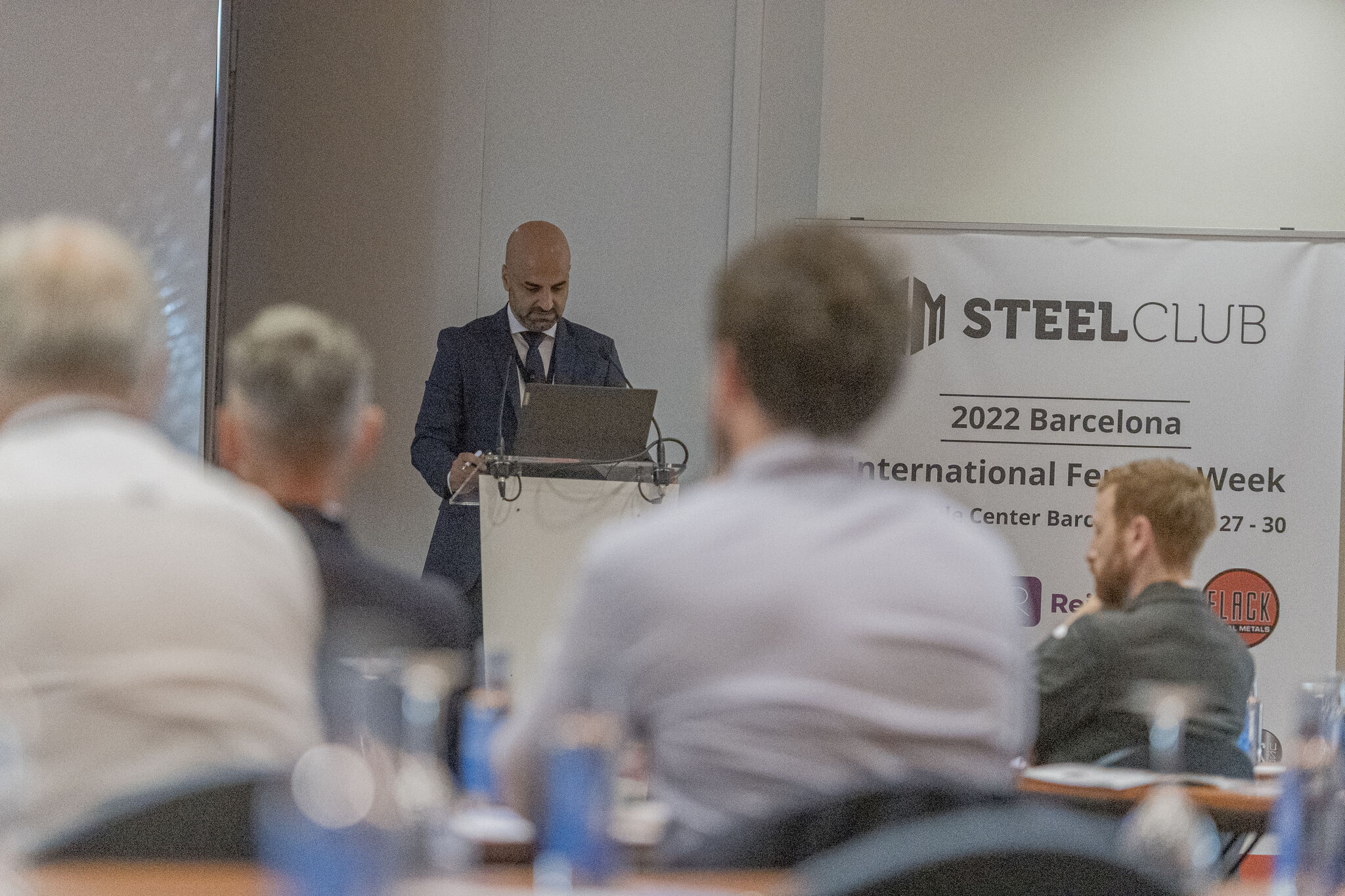
EUROMETAL president at MMSteelClub conference in Barcelona
EUROMETAL President Fernando Espada participated this Tuesday 28. June at the MMSteelClub UK & Europe Steel and Raw Materials Conference in Barcelona.

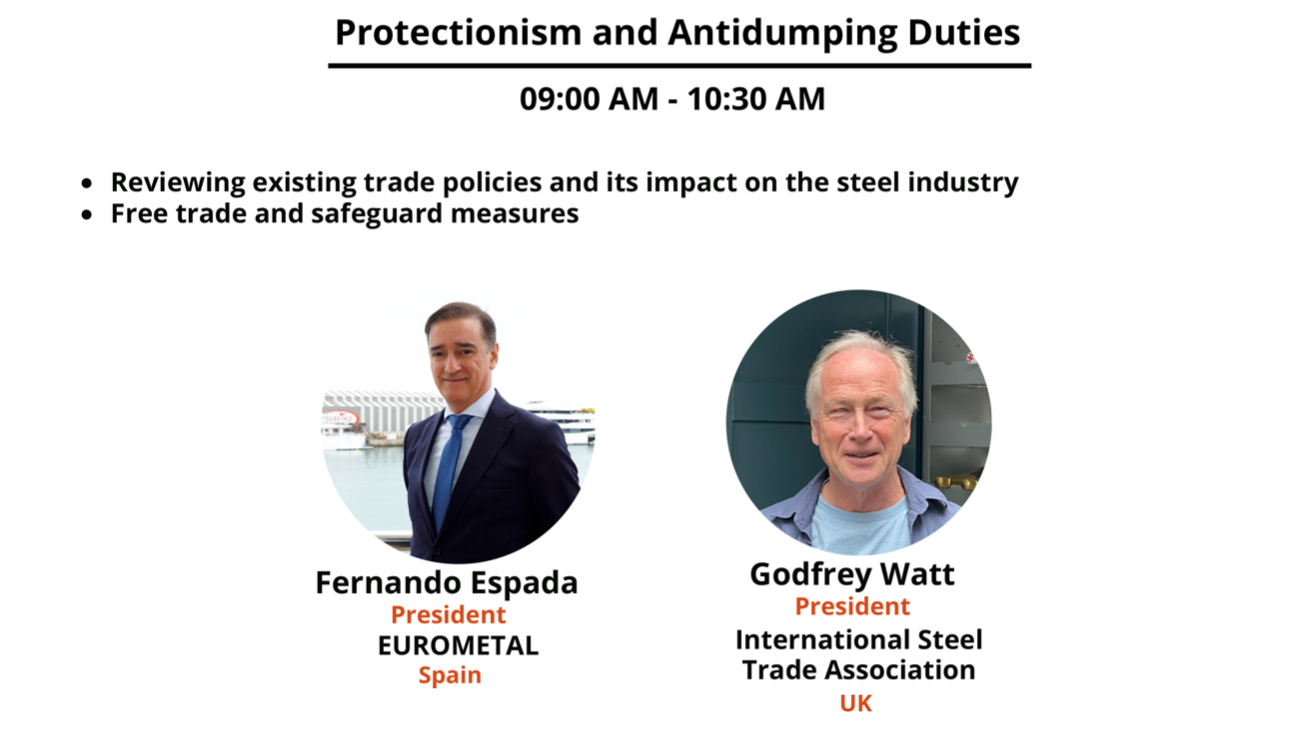

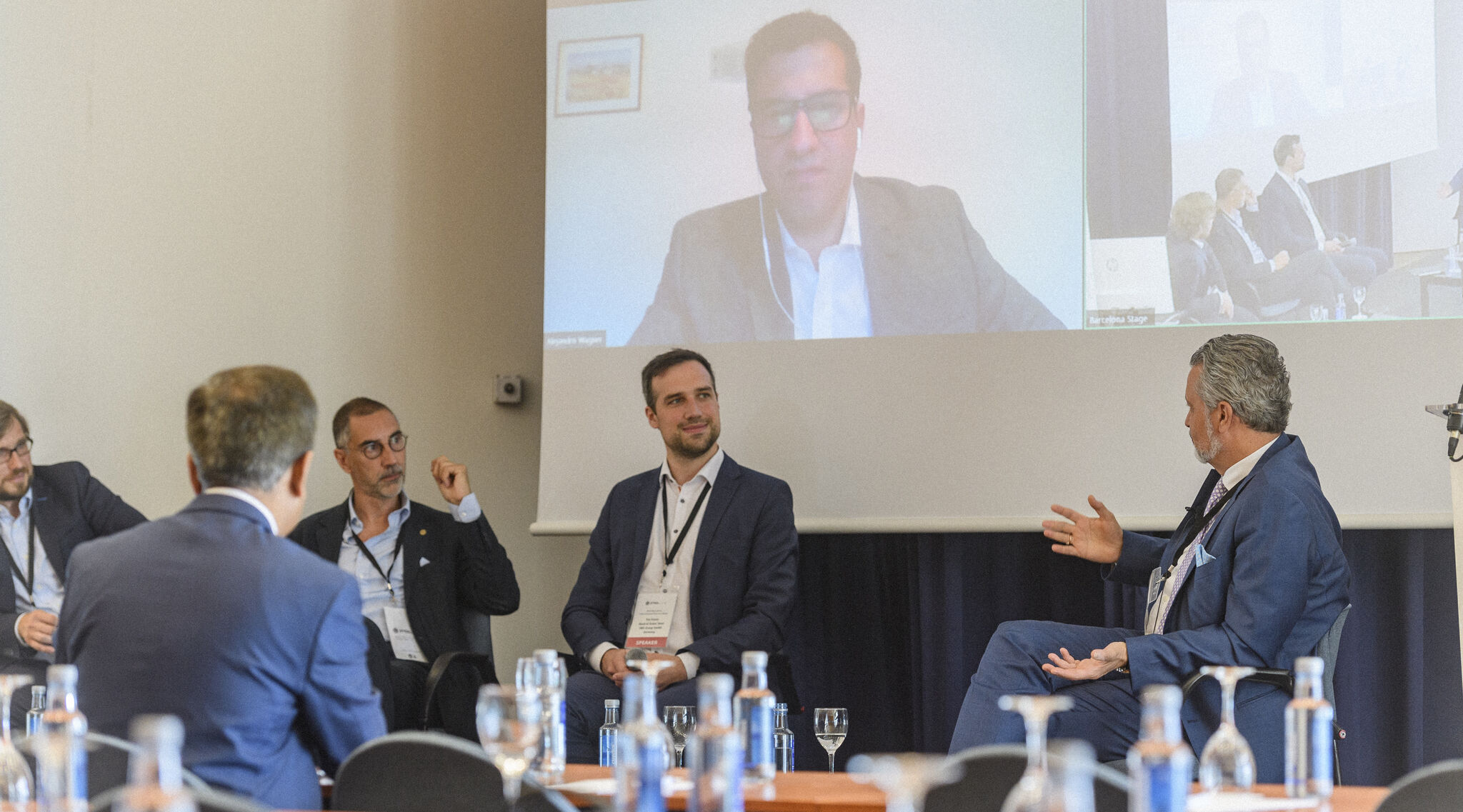

This conference integrated in the Barcelona International Ferrous Week discussed decarbonization of the steel industry, AI for steelmaking, green steel technologies, DRI making, UK and Europe Steel and Raw Materials markets, imports, exports figures, anti-dumping and safeguards and many more.
Fernando Espada participated in the session Protectionism and Antidumping Duties accompanied by Godfrey Watt, president of the International Steel Trade Association (ISTA).