


Buyers willing to pay higher prices for rebar in Italy and Spain amid surging energy costs
Rebar prices rose in Spain and narrowed upward in Italy in the week ended Wednesday July 20; energy cost increases combined with continuing uncertainty around potential energy shortages in the fourth quarter have compelled mills to raise prices, sources said.
Solid demand has made buyers more accepting of higher prices, thus reversing the price downtrend for rebar in Southern Europe.
Italy
Demand remained good in Italy, with some buyers stocking up before summer holidays begin in August. However, a wait-and-see attitude continued to prevail, Fastmarkets heard.
Fastmarkets price assessment for steel reinforcing bar (rebar) domestic, exw Italy was €860-880 ($878-898) per tonne on Wednesday, narrowing up by €30 per tonne from €830-880 per tonne the previous week.
Despite demand remaining solid, significant uncertainty remains, Fastmarkets heard.
“Demand is still good these days, but it seems to decrease a little day by day. It is possible that customers are waiting to understand what the price will be at the end of July or the beginning of August before deciding to buy,” a source said.
The same source said mills are holding off taking large volume orders, fearing that energy costs will begin to rise in August.
“We think that the price could increase again before the holidays, and maybe it will remain high till the first half of September,” the source said.
However, with so many extenuating factors – including extreme weather situations and energy cost surges – the rebar market in Italy may not follow a conventional pattern, Fastmarkets heard.
Energy rationing, proposed by the European Commission on July 20, would add further upward pressure to energy prices, forcing mills to increase prices and potentially cut production, sources told Fastmarkets.
Emergency legislation, designed to protect countries from the possibility of Russia weaponizing gas supplies over the coming months, would enable the EU Commission to impose 15% binding gas consumption restrictions on EU countries over the next two years.
If passed, each country would have to decide how these cuts would be imposed.
Despite the fact that domestic scrap prices declined significantly in Italy month on month in July due to lower demand from mills, these decreases were not nearly enough to offset energy costs, a second source told Fastmarkets.
Spain
Buyers have become more accepting of price rises amid surging input costs, sources told Fastmarkets.
Fastmarkets’ price assessment for steel reinforcing bar (rebar), domestic, delivered, Spain was €780-800 per tonne on Wednesday, up by €20 per tonne from €760-780 per tonne the previous week.
Spanish mills have begun to raise prices to compensate for increasing energy costs, sources told Fastmarkets.
Offers from mills were heard at €820-850 per tonne, indicating mills plan to continue raise prices, although buyers are not currently accepting this price level, sources said.
Decreasing international scrap prices since mid-April have been a major factor in the falling rebar market. Despite prices surging in early July, they have recently fallen again.
Fastmarkets’ daily calculation of the index for steel scrap, HMS 1&2 (80:20 mix), North Europe origin, cfr Turkey was $382.50 per tonne on Tuesday July 19, down from $398.49 per tonne the week before.
Published by: India-Inés Levy


Stalprofil boosts performance despite price correction-related write-downs
Stalprofil expects first-half-of-2022 steel shipments to have risen 12% on-year and revenue to have soared 69% amid volatile steel prices and demand, Kallanish notes.
Prices and demand began to correct downwards from mid-April after skyrocketing in March as buyers make “precautionary” purchases en masse amid supply disruptions caused by the outbreak of war in Ukraine, the Polish distributor says.
Distributors’ prices for many steel products returned to pre-Ukraine-war levels at the turn of the second and third quarters, it adds. When calculating Q2 earnings, the firm took into account the ongoing price correction in the steel market. Asset write-downs in Q2, mainly concerning the revaluation of steel inventories to their current market value, slashed PLN 22.7 million ($4.9m) from the company’s forecasted H1 net profit.
Stalprofil’s consolidated revenue, including its pipeline infrastructure segment, rose 47% in H1 to PLN 645.6m ($138.1m), while net profit was up 11% to PLN 61.4m.
The firm will release its full H1 report at the beginning of September.
In 2021, Stalprofil’s steel product sales rose 12% on-year to 207,721 tonnes, with steel structures sales up 9% to 2,216t.
Adam Smith Poland


Northwest European coil nears crossroads, automotive outlook improves
An increasing number of northwest European coil market players believe prices are close to bottoming and will soon rebound. However, this belief is not without doubts.
According to a manager at a Benelux service centre, “more and more customers have come to realise that steel prices seem to have bottomed out.” He is convinced that “northern EU steelmakers seem determined not to accept further price cuts.”
The assumptions are that distributors cannot wait too much longer before replenishing stock, and that the automotive industry will have its comeback in the second half-year, now that semiconductor chip shortages are seemingly easing.
“In the second half-year, the OEMs mean to catch up on the dry spell of the first half, and then we could see shortages of coil and sheet,” a buyer at a German automotive supplier tells Kallanish. “That’s what we hear from the tier-1 suppliers with direct contact to the OEMs. And service centres confirm what we see in rebounding call-offs.”
By means of anecdote, he tells how he saw 5,000-6,000 Mercedes Sprinter units parked on a lot by a Düsseldorf sports stadium for months and months, waiting for missing parts to be completed. “When I came there last week, they had nearly all disappeared, apparently now completed for the market,” he observes.
A mill source essentially shares the optimism for recovering carmaking activity. But he warns that looming energy shortages suggest activity will go the opposite way, and could halt business at OEMs and their suppliers, as they have done to mills already.
While buyers refrain from making predictions on price developments, the mill source gives some rough values, with hot rolled coil pointing over €850/tonne ($867) ex-works, cold rolled coil over €900, and galv over €1,000. Market observers anticipate hikes in offer prices by €50 soon (see Kallanish 19 July).
Christian Koehl Germany

Hitachi Energy to work with Swedish H2 Green Steel
Sustainable energy company Hitachi Energy is to collaborate with Swedish company H2 Green Steel on technology to be used in low carbon steel production and green hydrogen projects, the companies said July 20.
Hitachi Energi will make an undisclosed equity investment in H2GS, which is developing a low-carbon steel plant in Boden, northern Sweden, which includes a green hydrogen plant as an integrated part of the steel production facility with initial production volumes of 2.5 million mt/year from 2025, increasing to 5 million mt/year by 2030.
Hitachi will provide the products and services needed to construct, operate, maintain and improve the power infrastructure required for steel production and giga-scale electrolyzer plants, the companies said.
Under their deal, Hitachi will also offtake low-carbon steel from H2GS once it starts production.
Platts assessed domestic HRC prices in Northern Europe at Eur855/mt ex-works Ruhr July 19, down 11.2% since the start of 2022, according to S&P Global Commodity Insights data.
“Achieving carbon-neutrality globally requires efforts from all industries to speed up the energy transition through collaboration,” Hitachi Energy Head of Europe, Middle East and Africa Johan Soderstrom said.
“We are supporting H2 Green Steel’s electrification project and at the same, we are able to secure green steel for our products which is in line with our purpose of advancing a sustainable energy future for all,” he said.
In July, H2GS received environmental approval for the planned low-carbon steel plant in Boden, northern Sweden and in June it signed a 14-TWh power purchase agreement with Norway’s Statkraft for the plant.
— Annalisa Villa

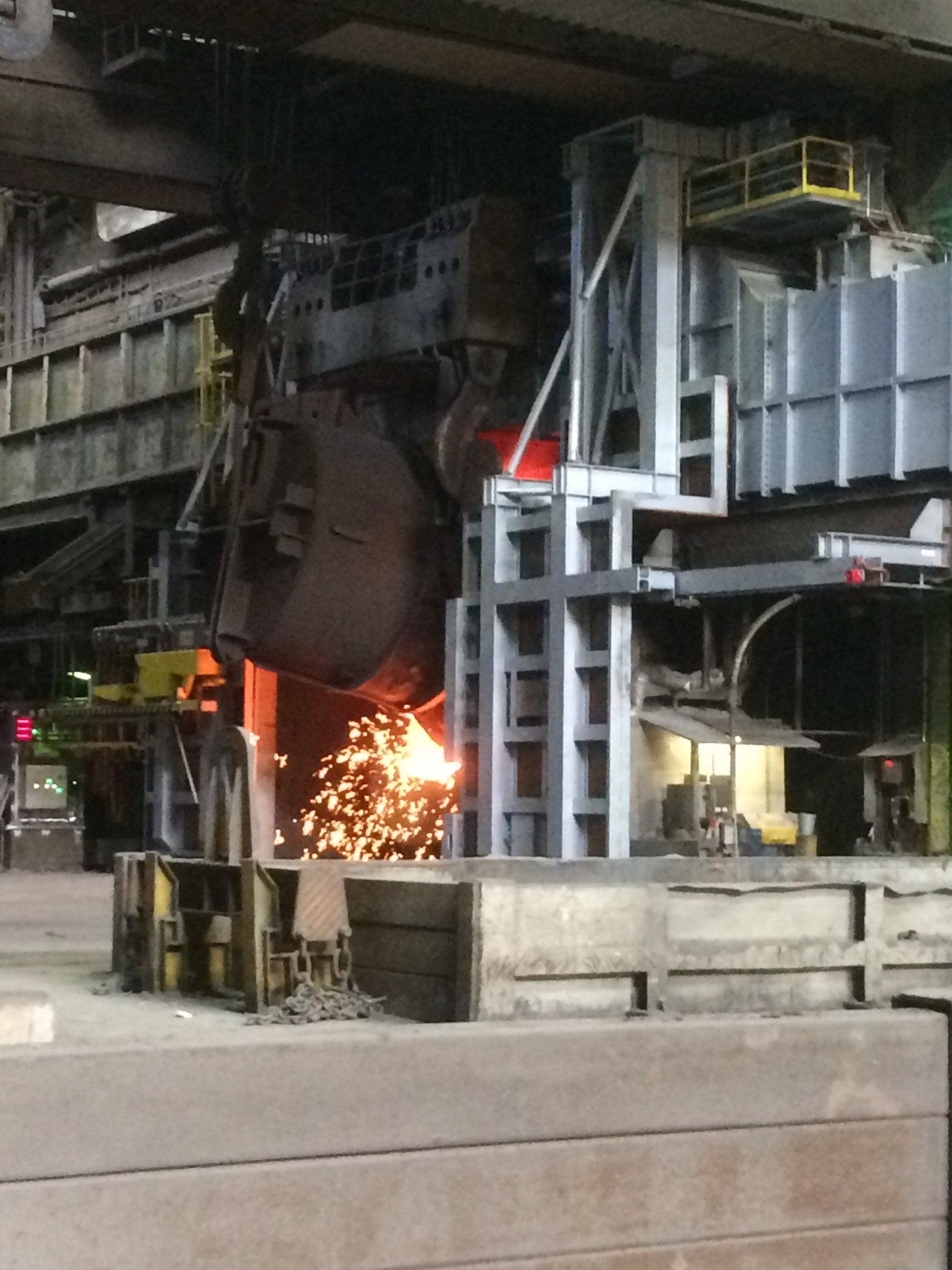
Primetals starts basic oxygen steelmaking converter at ArcelorMittal’s Gent plant
UK-based engineering and plant manufacturing company Primetals Technologies has started up a new basic oxygen steelmaking, or Linz-Donawitz, converter at steelmaker ArcelorMittal’s steel plant in Gent, Belgium, the company said July 20.
At a heat size of 330 mt the Gent plant’s LD converter is one of the largest globally, with average LD converter heat sizes at around 180 mt, the company said.
The LD converter also had an optimized converter shape to increase yield and energy efficiency of the steelmaking process, Primetals said.
The new LD converter was installed within a 35-day timeline without any interruption to ongoing production at the plant’s LD converter No. 3 during the shutdown.
Most of the pre-assembly works were done at Primetals’ manufacturing site in Poland to avoid possible delays.
Overall, Primetals also supplied ArcelorMittal Belgium with 1,000 mt of equipment while installing the LD converter.
ArcelorMittal Belgium is part of ArcelorMittal Europe’s flat products division and produces high quality flat products to serve several markets, including the automotive and construction industries.
Platts assessed hot-rolled coil in Northwest Europe at Eur855/mt ex-works Ruhr July 20, down 7.3% from the start of the year.
— Jacqueline Holman, Annalisa Villa

EU CRC rises on automotive recovery, HDG stays down
Prices for cold-rolled coil in the European market rose alongside recovering demand from the automotive sector July 20, while galvanized material continued the downward trend.
For cold-rolled material, Platts assessed North European CRC up Eur5/mt at Eur955/mt ex-works Ruhr. In South Europe, CRC was also up Eur5/mt, assessed at Eur890/mt ex-works Italy.
In the Northern market, a deal was heard at Eur980/mt delivered ex-Northern Europe, normalized to Eur960/mt ex-works Northern Europe by the mill source.
Other mill sources agreed to the ex-works price level, citing tradable value at a range of Eur950-960/mt ex-works Ruhr.
In South Europe, offers for CRC were reported at Eur920/mt ex-works Italy — though negotiable prices were considered lower by mill and distribution sources at Eur880-900/mt ex-works Italy.
Cold-rolled prices edged up across Europe, stimulated by recovering automotive demand.
Availability of value-added coils was inflated in recent weeks given reduced demand from the automotive sector, allowing mills to push additional volumes into the spot market. However, a degree of recovery was reported on the day, with a mill source saying automotive buyers had returned to take planned volumes with a particular uptick in CRC demand.
Increased demand has not yet manifested for galvanized products, with HDG assessed down on the day across Europe.
In North Europe, HDG moved down Eur15/mt to Eur1000/mt ex-works Ruhr. Italian HDG was also down Eur15/mt on the week, assessed at Eur900/mt ex-works Italy.
A deal was heard done in the Northern market at Eur1,000/mt delivered ex-Northern Europe, the equivalent of Eur980/mt ex-works. Mill sources saw workable levels as higher, at around Eur1,000/mt ex-works Ruhr.
In the Italian market, an offer was heard at Eur930/mt ex-works Italy — sources saw tradable value at a range of Eur880-920/mt ex-works Italy, with the majority of indications concentrated at the Eur900/mt mark.
— Benjamin Steven, Maria Tanatar