

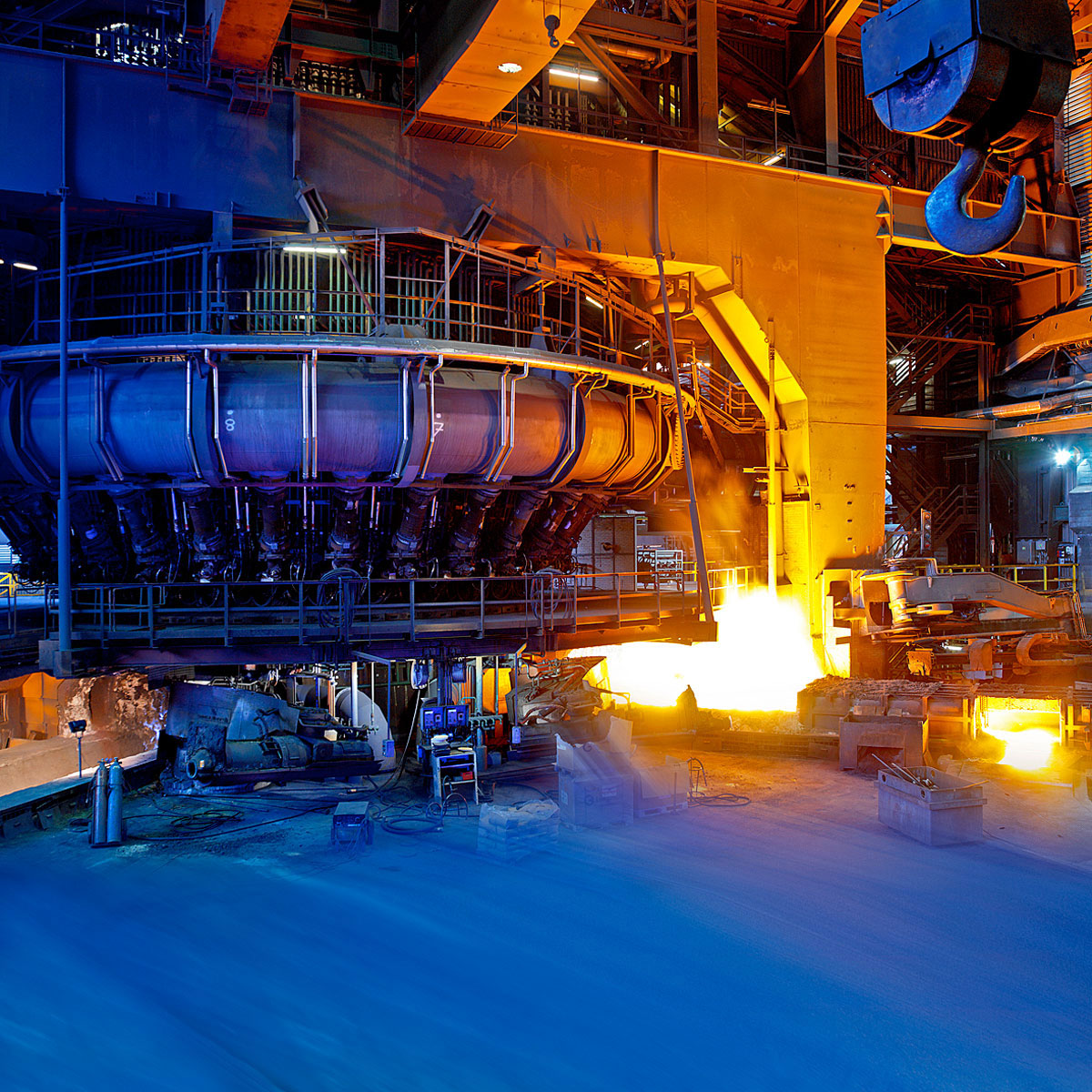
Voestalpine implements new control system in steel shop
Primetals Technologies is modernising the entire process control system at voestalpine’s LD3 steel plant in Linz, Austria.
Voestalpine has just completed the first modernisation phase, Kallanish learns from the company. The first phase covered control systems for the three converter lines and for the higher-level converter area. Upgrading systems for secondary metallurgy, slab treatment, and dedusting units will follow in coming phases.
Before a new process control system goes into operation, a system test is carried out using a digital twin, which is a digital test and simulation environment with all the functions of the production system.
Updating the entire process control system will lead to improvements in both investment security for the steelworks and process automation availability, Primetals claims. Involving more than 100 individual process control systems, the project will be completed in 16 phases and will run until the end of 2022.
Christian Koehl Germany


German market supply remains subdued T
he many factors affecting industries and markets this year have put notable pressure on steel supply in Germany, says the country’s steel federation WV Stahl in its half year review.
As the federation reported earlier, crude steel production by German mills from January through June came to 19.56 million tonnes, 5.5% less than in H1 2021 (see Kallanish 20 July). Meanwhile, the federation has come up with downstream figures echoing that trend until the end of May.
Order intake for rolled products in the first five months saw the steepest fall of 16%, to an annualised value of slightly below 34mt. In 2021, the intake had recovered from the shock of the first coronavirus year, catching up on the loss of 2% that incurred in 2020. However, a downward trend was already reported in 2019, with 2.5% loss on-year.
The overall market supply, which includes imports that are not detailed, shows a similar but not identical trend. In both 2019 and 2020, the volume fell by around 10% y-on-y, likely affected by the safeguard measures introduced earlier. Last year then saw a resurgence of 12%. The first five months of 2022 brought again an on-year drop by 4% to a tonnage of somewhat below 35mt, annualised.
Christian Koehl Germany

First vessel arrives at new EMR dock
The first deep-sea vessel has arrived at EMR’s new deep-sea dock at King George V West Quay in Glasgow, the UK scrap merchant says in a note seen by Kallanish.
MV Elpis has a 33,000-tonne capacity and will ship scrap to EMR’s international customers, it says.
The new dock, opened in April, is designed to lower logistics costs, cut carbon emissions and result in more competitive prices for customers (see Kallanish passim). EMR announced the multi-million-pound investment in 2021.
The operation will target eight deep-sea ships with capacity to carry cargo up to 30,000t each in the first 12 months. Each ship will transport sustainable, recycled material to markets around the world.
At almost eight acres, the site will also house an End-of-Life Vehicle (ELV) facility capable of depolluting and recycling high volumes of vehicles each week.
Adam Smith Poland

Italy could inject €1 billion into Acciaierie d’Italia
The Italian government may inject between €500 million ($509m) and €1 billion into troubled steelmaker Acciaierie d’Italia, formerly known as Ilva, the minister for economic development Giancarlo Giorgetti has announced.
The funds will be released thanks to a new decree called “Aiuti Bis” prepared by the Ministry for economic development (Mise) to save the company, a joint venture between ArcelorMittal and state-owned Invitalia, from its current liquidity crisis. The steelmaker is heavily reducing output due to the current deteriorated market conditions and also a lack of liquidity to buy raw materials, sources close to the company tell Kallanish.
Acciaierie d’Italia mothballed BF No.2 until the end of August amid the downturn in prices and demand in the global coil market. At present, Acciaierie d’Italia’s Taranto facility is operating BFs Nos.1 and 4, one of which sources say will be mothballed. In June, two galvanizing lines were also idled due to deteriorating demand for coil. At the end of 2021, the steelmaker mothballed blast furnace No.4 because of a technical issue. In October 2021, BFs Nos. 1 and 4 were restarted. The latter was idled for about seven months and the company spent €70 million on upgrade works (see Kallanish passim).
Chief executive officer Lucia Morselli told the Italian press the production target for this year at 5.7 million tonnes is confirmed. In 2021 the company reached a turnover of €3,3 billion and 4 million tonnes of steel production, sources say.
Natalia Capra France

‘Sink or swim’ in mostly stable UK HRC market
The UK hot-rolled coil market was reported as mostly stable on week, with prices edging down slightly on minimal demand.
Distribution sources said Aug. 5 they were focused on moving stocks but had to work harder to obtain orders – both due to the summer slowdown and wait-and-see sentiments characterizing the market in recent weeks.
“Things are tough at the moment and everyone’s chasing buyers for cash flow reasons. We have to keep stock turning – it’s sink or swim,” said a trader source.
Offer levels from domestic and European mills were heard as largely stable, at GBP700-710/mt DDP West Midlands.
Stock levels were still reported as high, however, restricting potential for restocking.
“Luckily the mills are less aggressive this week, the market doesn’t seem to have gotten any weaker, but there’s still too much material in the system,” said a stockholder source. “We’re hearing more positivity from Europe in terms of volumes shifted, so hopefully the UK follows soon.”
Another trader agreed, seeing price as largely irrelevant in the current market.
“It’s not really a question of price at the moment,” the source said. “Everyone has too much material – often purchased much higher than current outsale prices to customers – so we need to see stocks go down further before purchasing resumes.
“I think all agree we’re close to the floor now, so hopefully prices rebound soon. It’s not entirely doom and gloom, restocking will have to happen at some point.”
A distributor source reported the same, saying sales to end-users had continued to slide despite upstream stability in mill offers.
Platts assessed HRC in the UK down GBP5/mt Aug. 5, at GBP705/mt DDP West Midlands.
— Benjamin Steven, Maria Tanatar


Heavy steel plate prices down in Germany, stable in Italy
A German steelmaker made deals at lower prices in the week to Aug. 5 to fill order books, while another producer there has kept offer high, market sources said.
The producer has made few deals at Eur1,225-1,250/mt ex-works Ruhr, a source said.
Another steelmaker, however, kept offers at Eur1,400/mt ex-works and above due to strong order books. The producer has been focused on sales to projects and fulfilment of long-term agreements and has limited volume for spot market.
Platts assessed heavy plate prices in Northern Europe down by Eur100/mt week on week at Eur1,250/mt ex-works Ruhr, according to S&P Global Commodity Insights data.
Offers of heavy plate from Central European mills have been reported at Eur1,000-1,050/mt delivered Germany.
In Italy, prices have stabilized as producers have either stopped production or are planning to go on summer maintenance.
Buyers have restocked, although booked volumes have been below usual levels, and are likely to remain inactive until September.
Import offers, one of the main drivers allowing buyers to negotiate lower prices with Italian producers in July-August, have stabilized at around Eur850/mt CFR ex-Asia.
Italian rerollers have settled a few deals this week at Eur980-1,020/mt ex-works, and buyers estimated achievable prices within the same range.
As a result, Platts assessed plate in Southern Europe at Eur1,000/mt ex-works Italy on Aug. 5, unchanged over the week.
Prices for imported slab in Southern Europe have also been heard at stable prices – $650-$670/mt CIF Italy from Asia.
Demand is likely to improve in September, sources said, as buyers are likely to resume restocking and the restart of some projects is expected.
“Demand is low, but fine for summer and forecast for September remains positive,” an Italian reroller said. “All in all, I’d consider the current level as a bottom price and the forecast to be stable/up in September.”
— Maria Tanatar, Benjamin Steven

German HRC producers offer discounts to spur buying
German hot-rolled coil producers have been offering substantial discounts to generate sales and cash flow, market sources told S&P Global Commodity Insights.
Platts assessed Northern European HRC stable on the day at Eur800/mt ex-works Ruhr Aug. 5, according to S&P Global data.
Deals and tradable value were at $800/mt ex-works Ruhr.
A distributor said a German mill sealed a deal with a Northern European buyer at a price below Eur750/mt ex-works Ruhr. The information was not confirmed widely, but another distributor said they “would not be surprised” to see such a transaction.
Official offers were at Eur850/mt ex-works Ruhr. A source calculated base prices from effective offers they received at Eur800-Eur840/mt ex-works Northern Europe.
North European steelmakers were driven by the need to fill order books and generate cash flow, sources said. Demand from distributors has remained weak due to a combination of high inventories and big volumes of imported coil that are expected to arrive in the EU over September-October.
The situation in Italy was similar but the country’s steelmakers have not been offering discounts to generate orders. That was due to significant production cuts, with flat steel producers either halting production for several weeks or stopping some blast furnaces.
HRC in Italy was stable on the day at Eur770/mt ex-works Aug. 5. Official offers were at Eur780-Eur 800/mt ex-works Italy.
“Italian market is more balanced compared with Germany,” an Italian source said. “When German mills notice a buyer that cautiously shows any signs that they might be interested in material, producers attack the buyer as vultures ready to cut prices.”
“In Italy, mills have stopped for August, while in Germany buyers have high stocks and the mills struggle to sell,” the source said. “Producers ready to cut prices, going below cost to make a deal and generate cash flow.”
Market sources said prices are most likely to recover in September.
Automotive manufacturers have shown increased interest in steel purchases after buying lower volumes earlier in 2022 due to a shortage of semiconductor chips and other components.
“Carmakers started to contact steel suppliers saying that they would need more material than they booked last year,” a North European distributor said. “This is a good sign, but we will see if the demand rise will be sustainable.”
— Maria Tanatar, Benjamin Steven