

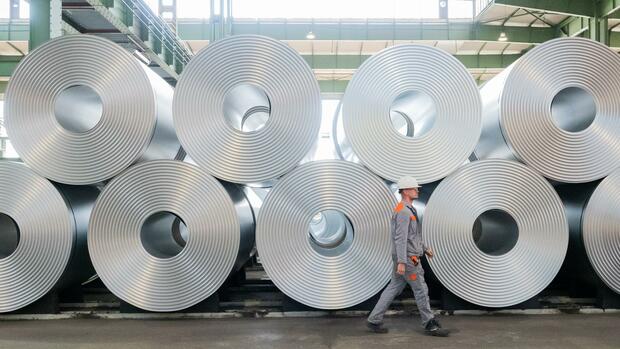
Germany’s Salzgitter approves largest investment in low-carbon steelmaking
German steelmaker Salzgitter posted record-high earnings over January-June amid robust steel prices despite marginally lower output over the period, the company said Aug. 11. This also enabled Salzgitter to approve the largest investment — on low CO2 steelmaking — during its time as a public company.
The company’s crude steel output fell 1.1% on the year to 3.34 million mt in January-June, but H1 revenue from the company’s external sales rose 50% to Eur6.6 billion ($6.8 billion) amid record rolled steel prices. EBITDA grew to Eur1.1 billion and Eur781 million after-tax profit increased 3.4 times.
“We are reporting by far the best operating result for a half-year in the history of Salzgitter. The company’s supervisory board has approved funds of more than Eur700 million for the first development stage of the SALCOS [Salzgitter low CO2 steelmaking] program, marking the largest investment since the company’s listing in 1998,” Salzgitter CEO Gunnar Groebler said in a statement.
The company expects to place the first contracts for the SALCOS plant with engineers in the July-September quarter and aims to deliver first volumes produced via this route to customers toward the end of 2025.
The complete transition of the integrated steelworks in Salzgitter to low-carbon crude steel production is to be completed by 2033.
Once this happens, Salzgitter will cut carbon emissions by 95%, or by around 8 million mt/year, approximately 1% of Germany’s carbon emissions, the company said.
It added that it was not untouched by the risks emerging from Russia’s invasion of Ukraine and was particularly concerned about a further escalation of the gas crisis that it triggered.
Salzgitter is currently producing over 80 km of line pipe that will connect the Wilhelmshaven and Brunsbüttel LNG terminals to Germany’s gas grid, said Salzgitter’s CFO Burkhard Becker.
Through this commissioning, Salzgitter is contributing to putting in place infrastructure needed for the society and the economy to function smoothly, according to Becker.
Salzgitter continues to anticipate Eur13 billion in sales and Eur1.4 billion-1.6 billion EBITDA for full year 2022, but this is based on the assumption of unrestricted natural gas supplies to maintain production.
— Ekaterina Bouckley

Steelmaker Thyssenkrupp cutting 2021-2022 capex by Eur200 million
German steelmaker Thyssenkrupp said Aug. 11 that its 2021-2022 fiscal year capex, estimated at Eur1.4 billion, will be reduced by Eur200 million from the prior year’s level due to uncertainty.
In light of the increased uncertainties, and depending on business performance, further investments will be approved on a restrictive basis.
Focus of the investments at Steel Europe will be in conjunction with the Steel Strategy 20-30; investments for targeted growth initiatives will continue to be made in the other businesses
Thyssenkrupp’s ongoing strategic transformation is now focused on the expansion of production capacity in technology provider for submarines and ships Marine Systems and the fast development of hydrogen business Thyssenkrupp Nucera.
The acquisition by Marine Systems of ship manufacturer MW Werften Wismar and evaluation of a joint venture in the automotive business are going to be further steps in that transformation.
The agreement to acquire MV Werften Wismar that Thyssenkrupp signed in June is going to extend its strategic options to the construction of submarines and surface vessels.
A stock market listing remains the preferred choice for Thyssenkrupp Nucera, the order backlog of which has grown to Eur1.4 billion supported by the chlor-alkali new plant business and the award of a major hydrogen project in the Netherlands. A decision on the timing of a possible initial public offering will depend on the state of the capital markets.
In the automotive business, Thyssenkrupp is considering a possible joint venture with Japanese industrial group NSK. Also, the company is in talks with potential buyers for the Automation Engineering unit and has launched preparations for an M&A process for Springs & Stabilizers operation.
High steel prices helped Thyssenkrupp show good performance in the April-June quarter despite a difficult market and inflationary pressure.
Despite the persistent challenges caused by the war in Ukraine, the COVID-19 pandemic and the disruption of global supply chains, the company raised its April-June revenue by 26% to Eur11 billion.
Alongside the improvement in performance and efficiency, the main drivers of this were Materials Services and Steel Europe units.
Although Steel Europe was impacted by supply shortages and weaker demand from the automotive industry, strong steel prices offset the negatives.
Thyssenkrupp also noted higher demand from the wind energy sector, and its Automation Engineering operations benefited from higher demand in its battery and powertrain businesses.
By contrast, the ongoing supply chain problems and higher factor costs had a marked adverse impact on Automotive Technology and Industrial Components businesses of Thyssenkrupp.
Cost-cutting and efficiency measures, but mainly restructuring, which included the deconsolidation of the stainless steel and infrastructure businesses, and the closure of the heavy plate mill, curbed losses significantly in almost all businesses, although a substantial rise in material, energy and freight costs somewhat offset the full upside effect.
— Ekaterina Bouckley

EU metal-shipping crisis worsens after Rhine River water levels plummet
An alarming drop in water levels in Germany’s Rhine River and other key waterways in Europe has led to massively strained logistics in shipping commodities across Europe, driving up costs and exacerbating material supply, sources told Fastmarkets.
The Rhine is one of Europe’s largest rivers, stretching from Switzerland in the south up to the Netherlands in the north. It is a vital artery for the shipment of metal across western Europe.
Dramatic disruption to trade
Record-breaking heat in Europe and a stark lack of rainfall on the continent this summer has led to water in the Rhine sinking to a level that is impeding shipping activities.
A Rhine water-level marker west of Frankfurt was forecast to drop to 40cm early on August 12, according to the German Federal Waterways and Shipping Administration, as reported by Bloomberg on Wednesday August 10.
“River water levels are extremely low, so river transport is hampered and is slowing down [steel] deliveries. Some of this also affects raw materials deliveries, such as iron ore and coal transported by river barges,” a trading source in Germany said.
“We have to load barges less than 50% [capacity] to make it work. But I’m afraid in the upcoming day, the water levels [in the Rhine] will fall more, making river transport impossible,” a trading source in the Benelux region told Fastmarkets.
Steel scrap flows drop
Much like the Rhine’s water levels, inflows to some German scrapyards have been drying up of late due to greater difficulty in shipping, sources said.
“A shortage of scrap in Europe is becoming very real. Rivers have dried up and there is no barge movement – they could even close the [Rhine] river next week,” a major steel scrap exporter said on Thursday August 11.
“There is very little scrap inflow to German yards now, some yards are usually receiving material by barge. Scrap sellers are scared to offer material for shipment in the first half of September,” he added.
In Germany, barges are more commonly used for transporting scrap from the yard to the steel mill, a German scrap industry source said.
Because of the low water level, barges are only able to take around one third of their usual cargo, which means three barges are required for every one that would ordinarily be used, thus raising freight costs sharply, the source said.
If using the Rhine becomes impossible and freight must be transferred to the road, around 80 truckloads of scrap would be needed to replace a barge, they added.
A major Bangladeshi steelmaker source said on Thursday he was fearful of the short-term future of scrap availability from Europe.
“There is some shakiness in the scrap markets and low river levels in Europe and the UK mean that they are [potentially] not going to be able to supply scrap,” he said.
Furthermore, in an environment of increasingly tight transport availability, scrap suppliers have had to compete with coal suppliers to get space on barges in Germany, Fastmarkets heard.
Russia has recently reduced gas supply to Europe dramatically, so the German power industry has increased its reliance on coal.
“Since July, Russia supplied only 20% of normal gas supply through Nord Stream 1, so Germany has to reactivate mothballed coal-fired power plants,” a Germany-based distributor told Fastmarkets.
Prices for steel scrap to bellwether import market Turkey have already risen in the week-to-date amid higher local steel demand in that country, but scrap suppliers have also pointed to the transport problems in Europe as another reason for prices to keep rising.
Fastmarkets’ calculation for its daily index for steel scrap HMS 1&2 (80:20 mix) North Europe origin, cfr Turkey was $387.81 per tonne on Wednesday, up from $351.19 per tonne one week before.
Freight costs soar
Difficulty traversing the river has jacked up freight costs in Germany for alternative transport methods this week. Notably, the interruption to deliveries by river has resulted in increased competition for trucks and railway deliveries, leading to an increase in logistics costs.
River freight rates exploded over the last weeks, meaning it has become cheaper to deliver by truck now, Fastmarkets heard. Another problem is that there is a shortage of truck drivers in Germany with many workers on holidays, sources said.
Costs for shipping hot-rolled coil by truck were quoted at a minimum of €70 ($71) per tonne in Europe in the week to August 11, up from €20-30 per tonne earlier this year, according to the German steel trader.
A similar trend is also being reported for aluminium in Europe, now that demand for trucks has risen.
“It’s causing logistics headaches. A 5,000-tonne shipment that would go down the Rhine in a week or two now needs to be divided up into 25 tonnes per truck, and you can’t deliver and unload that many trucks in a day compared with a barge. For some of the larger plants, who take not just [aluminium] ingot but also slab, it’s definitely a concern, but the majority of those have sufficient material on ground to weather this,” said a third European trader.
“But costs are going up, and this is probably going to continue. These days it happens every year and starts in July. Come September, when metals need to start flowing again and plants want to start, it will cause headaches on the roads; it’s logistically a nightmare,” they added.
The plethora of logistical issues across European ports and trucking shortages have kept premiums supported since early 2022 despite increasingly bearish macro sentiment.
Fastmarkets assessed the aluminium P1020A premium, in-whs dp Rotterdam at $520-550 per tonne on August 9, down from its record high of $600-630 per tonne in May but up from $320-345 per tonne one year earlier.
Meanwhile Fastmarkets assessed the aluminium 6063 extrusion billet premium, ddp North Germany (Ruhr region) at $1,170-1,250 per tonne on August 5, down from the all-time high of $1,500-1,600 per tonne on April 29.
This compares with $900-950 per tonne on April 30, 2021.
In July, wildfires close to Trieste port in Italy blocked highways and passenger and freight trains in and out of the port, while strikes at a German port in June also caused further challenges.
Published by: Julia Bolotova, Lee Allen, Carrie Bone, Elina Virchenko


EU, Turkey agree deadline for safeguard adjustment
The EU and Turkey have agreed that 16 January 2023 is the deadline for the reasonable period of time for the EU to implement the recent WTO recommendation to adjust its steel safeguard measure.
In May, the WTO’s Dispute Settlement Body recommended the EU should bring its definitive safeguard measure into conformity with the Agreement on Safeguards and the General Agreement on Tariffs and Trade (GATT 1994). This followed the conclusion of an investigation carried out by a WTO panel set up in 2020 at the request of Turkey.
The panel found that the safeguard measure is inconsistent with Article XIX:1(a) of the GATT 1994 and inconsistent with Article 4.1(b) of the Agreement on Safeguards (see Kallanish passim). The day of adoption of the recommendations and rulings was 31 May.
Adam Smith Poland


Polish transport congestion pushes up scrap prices
Polish scrap prices are increasing by as much as €60-70/tonne ($61-72/t) in an on-month comparison, both for the domestic and export markets, market participants tell Kallanish.
Prices are being driven up by the latest Turkish hikes, but they are also being inflated by heavy transport disruptions. Prices for trucks, railway, and sea transports are increasing sharply. Shipping companies and forwarding agencies are now prioritising the transport of grains, coal, and weapons in and out of Ukraine, with the result that deliveries for all other non-sensitive commodities such as scrap are experiencing delays.
The war in Ukraine is congesting all transport routes in Poland and other countries like Romania. Polish mills are paying steep increases to make sure they will receive scrap on time. Port congestion is reported in Poland and Romania, causing delays to scrap export shipping. In Poland, two trading sources confirm that port gates are often closed due to heavy traffic. Sellers in the country are lamenting a lack of empty sea boxes for scrap as transport costs for containerised scrap continue to soar.
Costs for 400km of truck transport in Poland from or to the city of Poznan have doubled to about €1,000/t since the war in Ukraine started. Booking railway transport is similarly complicated and pricey, with delays certain. The holiday season is further slowing activity.
Traders who sell containerised scrap are particularly hard-hit by the transport disruption. One seller says he will strive to deliver all his current orders, but will stop quoting because the market has become too unpredictable.
This month, the popular grade E40 shredded in Poland has surpassed the level of €400/t delivered. Companies are asking as much as €390/t ex-works and about €50-60/t more for new arisings E8. E40 is at €340-360/t delivered in countries such as Italy, France, and Germany. This month, Italian and Spanish mills are having difficulties finding scrap in Eastern Europe.
Natalia Capra France