

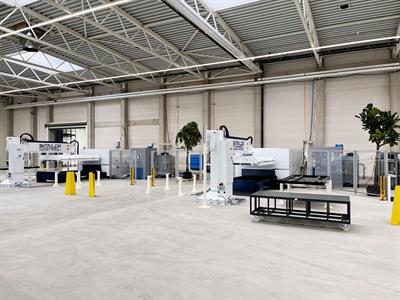
247TailorSteel starts production in Langenau
247TailorSteel, a strip processing centre group with operations in the Netherlands and Germany, has started operating its new site in Langenau, Germany, Kallanish has learned.
Langenau is located between Stuttgart and Munich, and has initially been equipped with four laser machines, three tube laser machines, four bending machines, and two machines for smoothing edges. The 15,000 square-metre facility was built on a site of over 36,000 square-metres and initially employs 100 people.
According to plans announced earlier, the total capacity will be brought to 12 laser machines, 10 tube laser machines and 12 bending machines. The company confirmed that it plans to eventually have work 250 people at the site.
Langenau will mainly serve customers in southern Germany as well as Austria. It is the third German site of 247TailorSteel, after Oyten near Bremen, and Hilden near Düsseldorf. Only this summer, the company announced that it projects further sites in the Netherlands and Belgium.
Christian Koehl Germany


HRC market stagnation persists in Italy
The Italian hot rolled coils market remains in a lull this week, with weak demand from re-rollers and service centres. Producers, however, are not in a rush to sell. Italian steelmakers are heavily reducing or shutting down production due to unsustainable energy costs.
Acciaierie d’Italia, the joint venture between ArcelorMittal and state-owned Invitalia, is reducing utilisation at its Taranto steelworks. The steelmaker, formerly known as Ilva, mothballed blast furnace No.2 in August amid the downturn in prices and demand in the global coil market. At present, Taranto is working with two BFs. Italian steelmaker Arvedi is restarting production at its plant in Cremona this week after a week-long stoppage. Another halt should be implemented next week, but the firm refused to comment.
While energy costs are eroding margins, sales are only happening back-to-back and for small volumes. The pressure from competitive imported material from Asian countries is also contributing to the low domestic sales. Material from countries such as Japan, Korea, and Taiwan could be found at $660/tonne cfr at the beginning of September, but import quotes are now around $680-690/t cfr.
Producers from Asian countries are quoting December boarding and many local buyers prefer not to commit for such a long time with the deep uncertainty of the moment. Domestic HRC quotes are at €800/t ($810/t) base ex-works, but contracts hover at €750-780/t base ex-works, sources tell Kallanish.
Local buyers have been purchasing a mix of domestic material and imported. September is considered a month of transition as the industry awaits the EU decision on energy caps, put off until October. HRC asking prices are seen increasing by another €50/t in the coming weeks, but the almost total lack of demand is spreading fear.
Natalia Capra France

EU rebar offers rising, mills lure customers
Offers from northwestern European rebar mills have seen a move upward, following a gentle buying spree that might not be quite over.
Towards the end of August, at least one German mill in a letter advised its customers to make bookings for September to replenish inventories before costs for energy, scrap, and transport surge further.
According to a Ruhr-based distributor, many buyers have heeded the call and made bookings, although not for big volumes. Given the uncertainty over surging energy costs, the tonnage offered was anyway limited, he believes.
“In any case, mills have secured their production, and the next round would be for October, November, at new prices,” he tells Kallanish.
According to him and other sources, the new base prices offered now by German mills are at €800-840/tonne ($810-850/t), up from a bottom line that undercut €750/t during summer.
“Those who order now will have to pay the new prices,” the Ruhr distributor says.
However, a buyer for a particularly big distributor sees the current spot price still at €750/t, and competitors are reluctant to make orders.
Although he does not confirm prices around €800/t, he himself believes in the stability of prices going forward.
“But others are not,” he says, which is why some remain reserved, betting on falling prices. This logic, however, might only apply to big players, who in the summer lull enjoyed low base prices of down to €700/t.
Christian Koehl Germany

Italian raw materials market quiet persists, Assofermet
The Italian scrap market remains particularly uncertain. The long summer stoppages implemented by steelmakers in August and extended this month continue to impact scrap deliveries and prices, Italian steel trade association Assofermet says in its monthly market note received by Kallanish.
The market’s hot topic at the moment is the cost of energy throughout the value chain, the evolution of which is hard to predict. The entire European industry is now holding its breath for the expected EU decision on an energy cap.
In Italy, domestic scrap prices registered some increases for the lower grades in the last days of August and first days of September, but sales volumes have been very limited so far. The suppliers’ main concern is now the weak level of demand from steelmakers rather than low scrap prices. While availability remains at good levels the series of price increases announced by mills on finished products may cause scrap purchased by merchants to become more expensive, Assofermet forecasts.
“From the last week of August onwards, we have witnessed several attempts by all European, Northern African and Turkish steelmakers to push up the prices of finished products driven by the inflationary wave and expensive energy. We wonder if demand, even if not brilliant, will be able to absorb part of these increases,” the note says.
Meanwhile, the pig iron market in Italy and internationally is still quiet. Neither transactions nor a demand revival have been registered since the last week of August and the attempted price increases in the Turkish market last month have not been successful. In Italy the mills’ focus is now on energy, heavily impacting all production plans. Despite weak demand, pig iron availability is also good, Assofermet concludes.
Natalia Capra France

European HRC producers fail to secure increases; prices edge down
European hot-rolled coil prices edged down on Monday September 12, with mills struggling to achieve higher prices amid a persistent lack of interest in buying and with the widespread production cuts yet to have an impact, sources told Fastmarkets.
Traded volumes of HRC remained low in both Northern Europe and Italy amid high inventories at buyers, weak end-user demand for coil and a looming recession in Europe.
“The market is still weak and there [have been] no big transactions,” a distributor in southern Europe told Fastmarkets.
Integrated mills in Europe are struggling with surging energy costs and have recently been gradually reducing output.
But the impact of these output cuts has yet to be felt in the market, according to sources.
“Despite [steel] output cuts at European mills, there is no shortage of [HRC], or fear of short supply in the short- or mid-term because of low demand and the high stocks at SSC [steel service centers],” a trading source said.
Fastmarkets calculated its daily steel HRC index, domestic, ex-works Northern Europe at €768.33 ($772.01) per tonne on Monday, down by €5.42 per tonne from €773.75 per tonne on Friday.
The latest calculation of the index was up by €6.66 per tonne week on week, but down by €5.84 per tonne month on month.
HRC offers in the region were reported between €800 and €850 per tonne exw for October and November delivery.
But where there was potential to secure a deal, some mills were ready to reduce prices to €780-790 per tonne exw, sources said.
Most buyers, however, indicated that the tradable HRC price was closer to €750-770 per tonne exw.
Fastmarkets’ calculation of its daily steel HRC index, domestic, exw Italy, meanwhile, was €762.50 per tonne on Monday, down by €5.00 per tonne from €767.50 per tonne on Friday.
The latest calculation of the Italian index was up by €17.50 per tonne week on week, but down by €7.50 per tonne month on month.
Buyer estimates of achievable prices were reported at €750-770 per tonne exw.
At the same time, mill sources reported transactions at €780 per tonne exw, but only for limited volumes, sources said.
Official HRC offers in Italy were heard at €800-820 per tonne exw.
Trading in Italy’s market was also quiet on Monday, sources said.
Imports
HRC offers from Turkey, Japan and India were reported at around €730-740 per tonne cfr to Italy, sources said.
There were no fresh transactions reported, but several buyers said that current import prices were workable, given the gap to domestic offer prices.
Long lead times were cited as the major risk factor for overseas bookings.
Published by: Julia Bolotova


ArcelorMittal, SigmaRoc launch venture to set up net-zero lime producer
Steelmaker ArcelorMittal and quarried materials group SigmaRoc have formed a new joint venture to produce net-zero lime, the companies said Sept. 12.
The new company — in which each founder will own a 47.5% stake — will aim to produce 900,000 mt/year of a high-quality lime, with permitting approval expected by the end of 2023 and commissioning in 2025.
Lime is a key purifying additive used in steel production as well in other industrial applications.
The site will be located close to Dunkirk’s harbor in north France and ArcelorMittal’s steelworks, which produces flat products and will be the new company’s main consumer, with the joint venture partners due to sign long-term supply and offtake agreements.
In order to produce lime free of CO2 emissions, the new company will reuse heat recovered from ArcelorMittal’s plant and use biofuels to replace natural gas in the production process.
“We are securing our supply of high-quality lime, a key element in our current and our future steelmaking processes and together with SigmaRoc, we will work to achieve net-zero lime production processes, in line with our CO2 reduction targets,” ArcelorMittal France CEO Matthieu Jehl said.
ArcelorMittal aims to reduce its CO2 emissions in Europe by 35% by 2030 and to reach carbon neutrality in 2050.
The agreement also represents an important step towards SigmaRoc’s company policy of reaching net-zero emissions by 2040, SigmaRoc CEO Max Vermorken said.
Platts, part of S&P Global Commodity Insights, assessed hot-rolled coil in Northwest Europe at Eur760/mt ($762.74/mt) ex-works Ruhr Sept. 9, down 18% since the start of 2022.
— Annalisa Villa


Energy crisis in EU could create some advantages for Turkish mills: IDDMIB
Output cuts by steel and aluminum producers in the EU could generate advantage for Turkish mills looking to boost exports to the region, the head of the Istanbul Ferrous and Non-Ferrous Metals Exporters’ Association, or IDDMIB, told S&P Global Commodities Insights.
The European energy crisis and associated spiraling costs that are forcing European producers across the region to drastically cut back output could put Turkish mills in a strong position to address any subsequent availability issues, with Turkey not expected to face energy shortages, IDDMIB CEO Cetin Tecdelioglu said in a statement sent to S&P Global Sept. 10.
“As Turkey isn’t expected to face any energy shortage in the coming period, Turkey could find some opportunities to raise its export volumes to the EU region with its logistical advantage,” Tecdelioglu said.
European steel industry association Eurofer was among a few associations to send a joint letter to European Commission President Ursula von der Leyen Sept. 7 urging decisive EU-wide action on gas and electricity prices.
Recent weeks have seen a significant number of industrial plants suspending operations or reducing production in Europe, with further curtailments expected in the weeks to come, Eurofer said.
In the first eight months of 2022, the Turkish ferrous and nonferrous metals sector raised its export volumes by 30.4% year on year to $10.1 billion, according to IDDMIB data, with the EU becoming the top export region.
The US and EU have imposed sanctions on Russia following its invasion of Ukraine, but Turkey has so far adopted a neutral approach.
Gas flows from Russia to Turkey are expected to continue as normal in the coming months, although input costs at Turkish mills have also jumped due to a 50% increase in electricity and natural gas prices for industrial use announced Aug. 31.
This and low demand have resulted in some steelmakers reducing output in recent weeks, while others have paused output temporarily.
Platts assessed Turkish domestic HRC at $680/mt ex-works Sept. 9, up $40/mt week on week, according to S&P Global data.
— Cenk Can

German scrap associations call gvt to be included into energy subsidies
Germany’s recycling industry wants to be put on the government’s list of sectors eligible to have energy subsidies, Public Relations and Public Affairs Officer Bernd Meyer told S&P Global Commodity Insights Sept 12.
In a joint statement, Germany’s four main recycling associations — BDE Bundesverband der Deutschen Entsorgungs-, Wasser- und Kreislaufwirtschaft, BDSV Bundesvereinigung Deutscher Stahlrecycling- und Entsorgungsunternehmen, bvse Bundesverband Sekundarrohstoffe und Entsorgung and VDM Verband Deutscher Metallhandler und Recycler — have called on the government to include them in the so-called “energy containment program”.
They referred to a decision last year that saw the recycling industry removed from the list of eligible sectors as part of an update of the “Guidelines on State Aid for Climate, Environmental Protection and Energy 2022”.
Meyer said it was not clear why recyclers have been removed from the program as it was “completely contrary to the German government’s commitment to support recycling”.
Germany’s Ministry for Economic Affairs and Climate Action was not available for comment.
According to the companies’ joint statement, being removed from the program was wrong because the raw materials require energy to be collected and processed as not everything is done manually and because they are an important part of the circular economy key to cutting emissions as well as energies in the chain process to make steel.
The high energy costs are hitting the heavy industry with Eurofer, the association representing the European steel industry, that was among a few associations to send a joint letter to European Commission President Ursula von der Leyen on Sept. 7 urging her to take decisive EU-wide action on gas and electricity prices.
Earlier this month the largest European steelmaker, ArcelorMittal said it would temporarily shut three blast furnaces at its mills in Bremen, Germany, in Gijon, Spain, and in Dunkirk, France, also citing among the issues the surging energy costs.
Domestic ferrous scrap prices across Europe weakened on the month in September as recyclers pushed for flat prices during the month, but domestic mills demand remained weak, sources told S&P Global Commodity Insights Sept. 9. In Northern Europe, the Platts assessment for domestic shredded scrap was at Eur360/mt for material delivered to the mill Sept. 9, down from Eur362.50/mt in August.
— Annalisa Villa

EU mills offer discount on HRC amid low demand
Prices remained stable in the European hot-rolled coil market Sept. 12, with discounted volumes available from Northern mills given low-demand.
Platts assessed HRC in Northern Europe stable Sept. 12, at Eur760/mt ex-works Ruhr.
Distribution sources reported tradable value on a range of Eur750-800/mt ex-works Ruhr and Northern Europe, with small tonnage deals concentrated on the low end. A deal was talked at below Eur700/mt to a German distributor, but this could not be confirmed by end of assessment.
Buyers were in doubt for how long the cheaper deals would be available however, with mills increasingly firm on higher offers.
“I’m still hearing of some low deals but not to the same level,” said a trader source. “While buyers don’t seem to have fully accepted the price increase, those who need material will pay higher, and others will need to come back to buy eventually.”
A trader source expected tradable value to rise to Eur800/mt ex-works Northern Europe in the near- to mid- term.
In Italy, offers were limited given production cuts in the region, with transactional activity similarly muted.
While transactional activity remains low, deals have settled as low as Eur750/Mt ex-works Italy, with buyers increasingly looking to January delivery import material in order to satisfy purchasing requirements for next year. As European mills are restricting offerings to Q4 and price direction is uncertain, market participants have highlighted the arbitrage opportunity in locking in competitive forward pricing.
Platts assessed hot-rolled coil in Italy stable Sept. 12 at Eur750/mt ex-works.
Platts is part of S&P Global Commodity Insights.
— Benjamin Steven