


Polish rebar mills cut offer prices to stimulate buying activity
Steel rebar prices in Poland declined modestly in the week to September 16, with producers starting to give discounts to try and encourage buying activity, sources told Fastmarkets.
Fastmarkets’ price assessment for steel reinforcing bar (rebar), domestic, exw Poland, was 4,200-4,300 zloty ($889-910) per tonne on Friday, down by 50 zloty per tonne from 4,250-4,350 per tonne on September 9.
Rebar offers from two local producers came in at 4,200-4,300 zloty ($922-932) per tonne delivered exw during the assessment week, down from 4,300-4,350 zloty per tonne exw the previous week.
Deals, however, were done closer to the lower end of the price range, sources said.
In the secondary market, rebar was offered and traded at 4,350-4,400 zloty per tonne delivered, down from about 4,400 zloty per tonne delivered seven days ago.
Weak demand for rebar from end-users continued to undermine buyer confidence, sources said.
“The problem is that the real demand [for rebar] is very weak – there are no big projects under construction,” one trader said.
He also suggested, however, that the impact of surging energy costs on the steel sector might not be as dramatic as expected, due to anticipated aid from the Turkish government.
“There are [suggestions] that energy consuming industries will get some aid from governments to make up for surging energy prices,” he said.
In addition, falling scrap prices in Europe and elsewhere have been putting pressure on rebar prices in Poland.
Market participants told Fastmarkets they expect domestic rebar prices in Poland to sink even lower in October.
“We expect to offer October rolling rebar at 4,150-4,250 zloty per tonne [delivered],” another trading source in Poland told Fastmarkets.
Published by: Julia Bolotova


German pipemaker Europipe wins contract to supply sub-sea line in Gulf of Mexico
German steel pipe maker Europipe has been awarded a contract by Canadian firm TC Energy (TCE) to supply material for the Southeast Gateway Pipeline in the Gulf of Mexico, it announced on Friday September 16.
TCE is building the offshore gas pipeline in partnership with Mexican state-owned power utility company Comisión Federal de Electricidad (CFE).
The Southeast Gateway Pipeline will be a 715km-long offshore natural gas line and will cost an estimated $4.5 billion. It was scheduled to come onstream in mid-2025.
Europipe, based in Mülheim in Germany’s Ruhr steelmaking hub, will supply around half of the 36in diameter, thick-wall pipe the project will require. The parties supplying the remainder of the total volume were not disclosed.
Steel plate, the raw material for the pipe production, will be supplied by Europipe stakeholders Salzgitter Group and Dillinger Hüttenwerke.
Europipe subsidiary Mulheim Pipecoatings will be responsible for the external coating and internal lining of the pipes.
Europipe was also heard to be busy with EU-based projects. To a large extent, these were in response to the current energy crisis, with Germany intending to become less dependent on imports of Russian gas.
Such projects included new receiving terminals for liquid natural gas, onshore infrastructure, and new interconnectors.
A new LNG terminal was expected to be operating in Stade, Germany, by the end of 2023.
Published by: Elina Virchenko

Bulgarian steel performance improves in second quarter
Bulgaria’s steel industry saw its main indicators improve during the second quarter, Kallanish notes. Crude steel and finished products output each rose compared to the previous three months and year-on-year, the Bulgarian Association of Metallurgical Industries (BAMI) says in its latest quarterly report.
Crude steel output reached 150,000 tonnes in Q2, up 8.6% over January-March and 7.2% higher compared to the same period of last year. First-half crude steel production reached 288,100t, up 1.3% over January-June 2021.
Meanwhile, finished products output rose by 11.6% on-quarter to 317,300t, and was also 35,100t more year-on-year. Of this volume, long steel production was 249,200t, up 13.5% over the previous quarter and 14.7% higher y-o-y.
Q2 flat steel output reached just 68,100t, an increase of 8.8% and 1.6% over Q1 and on-year, respectively.
Six-month rolled products output totalled 601,600t, a growth by 7.5% y-o-y.
Bulgaria’s April-June steel exports rose by 13.2% on-quarter to 226,400t and were also 4.4% higher when compared to the 216,900t shipped abroad in Q2 2021. Long steel exports represented 167,900t of overall shipments. H1 exports reached 426,900t, up 4.2% y-o-y.
Domestic demand, meanwhile, slowed in the period. Q2 steel sales were down by 6.2% q-o-q and 10% on-year to 61,800t. Six-month sales totalled 130,500t, or 2,200t more over H1 2021, BAMI confirms.
Todor Kirkov Bulgaria

Thyssenkrupp supplies ‘Bluemint’ steel for truck wheels
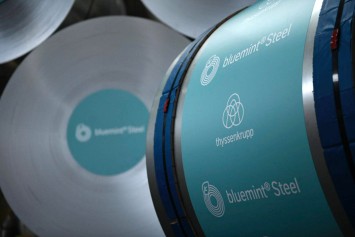
Thyssenkrupp Steel Europe will be supplying its CO2-reduced “Bluemint” steel to wheel manufacturer Accuride for the production of truck wheels, Kallanish hears from the steelmaker.
The wheel, which can exploit the advantages of the new material concept over its entire lifecycle, will now be presented for the first time at the IAA Transportation trade fair in September.
To improve the carbon footprint of the wheel for Accuride, several parameters in flat steel production have been optimised with regard to sustainability, tk Steel explains. Compared with conventional steel, Bluemint offers emission savings of 70% up to the hot strip production stage, achieved by using hot-briquetted iron in the blast furnace. This enables less coal to be used for the reduction process.
In this way, the CO2 intensity of each tonne is reduced by 1.5t to 0.6t. This calculation methodology as well as the produced quantity of Bluemint has been confirmed by international certifier DNV. The weight-optimised Bluemint wheel can also score points in terms of sustainability compared to a much lighter forged aluminium wheel of the same size, tk claims.
Christian Koehl Germany

Köckner launches sustainability label ‘Nexigen’
Klöckner & Co has launched a new brand, “Nexigen”, under which it combines its portfolio of sustainable products and services, Kallanish learns.
The company says Nexigen provides transparent, carbon-reduced solutions in the three categories of materials, processing and logistics. In this way, the distribution group assists customers with the reliable procurement of “green” steel and metal products, providing transparency about their carbon footprint from resource extraction to production.
In addition to green products, Nexigen also includes the company’s sustainable logistics solutions, circularity solutions and sustainable advisory services. Klöckner is also investing in further training of the workforce, and has already trained 700 sales staff to advise on sustainable products and services. With the new brand initially being rolled out in the EU, customers in the USA, Switzerland and the UK will also be able to purchase initial quantities of green steel from the company before the end of this year.
To mark the brand launch, Klöckner subsidiary Becker Stahl-Service handed over the first coil of green steel to longstanding customer Mercedes-Benz AG.
Christian Koehl Germany

Ukraine’s semis exports hit highest since war outbreak
Ukrainian exports of semi-finished products decreased in January-August due to the ongoing Russian invasion of Ukraine and blockade of seaports, according to customs data monitored by Kallanish.
The country exported 1.59 million tonnes of semis, down 66.7% on-year. Revenue generated by these shipments decreased by almost 63.6% to $1.1 billion.
The main buyers of Ukrainian semis in January-August were Bulgaria with a 21.9% share in exports, followed by Italy with 14% and Turkey with 12.22%.
However, in August alone, Ukraine increased exports of semis by 17.8% compared to the previous month to 87,600t, the largest tonnage since the beginning of the war.
Eight-month pig iron exports decreased by 60% to 877,600t, with revenue down 57.8% to $475.5m. The main consumers were the US with a 40.4% share, Poland with 33.2% and Italy with 9.3%.
In August alone, Ukraine reduced pig iron exports by 30% compared to the previous month to 100,400t.
Ukraine’s exports of iron ore decreased in January-August by 32.8% to 20.1mt and revenue was down 53.8% to $2.53 billion. Slovakia became the main consumer with a 19.8% share, followed by Poland with 16.5% and Czech Republic with 16%.
In August alone, Ukraine exported 1.44mt of iron ore, down by 7.8% compared to the previous month.
Ukrainian ferroalloy exports in January-August fell by 43% to 260,000t and revenue fell 27% to $462.5m. The main export destinations were Poland with a 55.5% share, followed by the Netherlands with 14% and Romania with 6.47%.
In August alone, Ukraine’s ferroalloy exports increased by 61.6% compared with the previous month to 16,900t.
ArcelorMittal Kryvyi Rih (AMKR) previously said it finds Europe trans-shipment unprofitable and could close the plant if the blockade of Ukraine’s Black Sea ports is not lifted or global steel prices do not start to rise (see Kallanish passim).
Svetoslav Abrossimov Bulgaria
EU passenger car registrations rise 4.4% on year in August: ACEA
New passenger car registrations in the European Union rose 4.4%% year on year in August to 650,305 units, the first year-on-year increase since June 2021, according to European Automobile Manufacturers Association (ACEA) data released Sept. 16.
However, August’s volume was 11.9% lower than the previous month and a nine-month low, and far below pre-pandemic levels, ACEA said.
Total sales for the first eight months of 2022 were 6 million units, down 11.9% year on year, the data showed.
The auto market has been facing supply issues due to the ongoing semiconductor shortage, which in turn has affected production.
This has also somewhat impacted steel demand, with Platts, part of S&P Global Commodity Insights, assessing domestic hot-rolled coil prices in Northern Europe at Eur745/mt ex-works Ruhr Sept. 15, 19.2% lower than it was at the start of 2022.
All three top European markets – Germany, France and Italy – saw year-in-year increases in August.
The largest EU car market, Germany, saw new car registrations increase 3% year on year to 199,183 units, although this was 3.3% down on the month and at a four-month low.
German car registrations for the January-August period totaled 1.6 million units, down 9.8% on the year.
In second largest market France, sales for the month rose 3.8% on the year, but fell 15% on the month to 91,403 units, a one-year low.
Similarly, car sales in Italy climbed 9.9% on the year to 71,190 units, but dropped 35% from July to the lowest volume since August 2021.
January-August car sales in France totaled 970,930 units, down 13.8% on the year, while sales in Italy dropped 18.4% to 864,821 units.
In Spain, 51,907 units were sold in August, rising 9.1% on the year, but down 29.3% on the month to a seven-month low, bringing the total for the January-August period to 533,025 units, down 9.4% year on year.
— Jacqueline Holman


OEMs start asking for low carbon steel in auto contracts: service centers
Demand for low carbon or “green” steel is growing, mainly from the automotive sector, said Cesare Vigano, managing director of ArcelorMittal CLN Distribuzione Italia, at an event Sept. 15.
Procuring low carbon steel products was a sensitive issue for some original equipment manufacturers, Vigano said at the European steel distributors’ association Eurometal Regional Meeting event held in Milan.
“Already in the 2022 negotiations for automotive, some mills have been asked to consider at the moment only some Eur20-30/mt of additional premium to the normal cost of steel if you need some special steel grades produced under the green brands,” Vigano said. “But I think that step-by-step we will see an increment in the supply chain of green steel demand,” he added.
Vigano explained that steelmakers had planned billions of Euros in capital expenditure to reach low carbon steel standards and this would be recovered gradually from mills increasing production of these products and a price premium.
Paolo Sangoi, president of Assofermet Acciai Flat, also told S&P Global Commodity Insights on the sidelines of the event that he had seen an increase in demand for low carbon steel, but not too much yet from buyers of steel commodity grades.
Steelmakers were working with local governments, as they had warned multiple times that the cost of decarbonization for the steel industry could not be borne by companies alone and governments would have to foot part of the bill.
Meanwhile, steelmakers were also closing transactions, mainly with the automakers, for offtake deals and in some cases, large steel transformers were becoming minority shareholders in low carbon steelmakers to secure their procurement, such as with Italy’s Marcegaglia buying an undisclosed stake in Sweden’s H2 Green Steel.
According to the International Energy Agency, if the international community is to meet its pledges to limit warming to near 1.5 degrees Celsius, the steel industry needs to reduce its CO2 emissions by more than 90% by 2050. According to worldsteel, 1.86 billion mt of steel was produced in 2020, with total direct emissions from the sector of about 2.6 billion mt, representing between 7% and 9% of global CO2 emissions.
Platts assessed hot-rolled coil in Northwest Europe at Eur745/mt ex-works Ruhr Sept. 15, while HRC in South Europe was assessed at Eur760/mt ex-works Italy, down 19.2% and 9.1%, respectively since the start of the year, according to S&P Global data.
— Annalisa Villa

EU heavy plate prices supported by absence of cheap imports, healthy demand
Improved buyer interest and an absence of cheap heavy plate from Asia have been supporting domestic prices in Europe in the week to September 16.
Platts assessed plate in Northern Europe at Eur1,175/mt ex-works Ruhr on Sept. 16, unchanged on the week.
Tradable value for German heavy plate has been reported at Eur1,100-1,200/mt ex-works with the majority of sources indicating a range of Eur1,150-1,200/mt ex-works as achievable prices.
“Demand is fine, not brilliant but stable at good level, lead times are at one-month minimum now,” an Italian re-roller said.
Platts assessed plate in Southern Europe at Eur1,000/mt ex-works Italy on Sept. 16, down by Eur10/mt week on week.
The assessment was based on deals heard at Eur980-1,020/mt ex-works Italy and tradable value estimated by market sources at Eur950-1,050/mt ex-works Italy.
The accident at South Korean rolling mill earlier this month resulted in withdrawal of cheap heavy plate offers from the EU market and the producer focused on slab sales instead.
Offers of heavy plate from Japan and Taiwan been reported at Eur900-910/mt CIF at both Antwerp and Southern European ports, compared with the latest offers from a South Korean supplier of Eur820-830/mt CIF Italy.
The producer has made several deals for slab with the European buyers, including Italian re-rollers, at $610-$620/mt CIF. After the sales the exporters stopped offering material and market sources believe that it will keep prices low only until excess slabs are available during rolling line reparation.
Offers and tradable values for other origin slab have been reported at $650-$700/mt CIF Italy.
“I think that the price around $650/mt CFR is a more realistic number,” an Italian source said, noting low South Korea prices would likely not last.
Platts assessed import slab in Southern Europe at $635/mt CIF Italy on Sept. 16, down $15/mt week on week.
— Maria Tanatar, Benjamin Steven
ArcelorMittal Spain in talks with workers’ unions to lay off most workers until end 2023
ArcelorMittal Spain has proposed a national level layoff program which could potentially halt production at all of its plants in the country until the end of 2023 with the exception of its tube-production works, a company spokesperson told S&P Global commodity Insights Sept. 16.
Talks with workers’ representatives to assess the application of the program started Sep. 14 and would continue for 15 days, the spokesperson said.
The company cited Sept. 16 an “adverse situation in the market, with low demand and a high volume of imports from outside the EU trading bloc,” which already led it postpone the restart of its 2 million mt/year electric arc furnace at Sestao after concluding maintenance in August and a partial closure at its 4.5 million mt/year Gijon plant at the end of September.
The company has made a temporary layoff proposal to workers at these and nine other sites in Spain with the exception of the Condesa tube plant it purchased in 2021, which covers for a period through to Dec. 31, 2023.
These types of layoff plans, known as ERTEs in Spain, can usually be reversed if market conditions change, allowing individual plants to restart independently.
A total of 8,300 employees would potentially be affected by the ERTE.
ArcelorMittal Spain said Sept. 1 that it is facing unfair competition in the steel market from “non-EU producers that are not affected by the increasing costs linked to the EU Emissions Trading System,” and supports a “carbon border adjustment mechanism that sets a framework in which each region, each country, must contribute in an equitable manner.”
Platts daily assessment for HRC in Southern Europe has declined 9.1% since the start of 2022 to Eur760/mt ex-works Italy Sept. 15, according to S&P Global Commodity Insights data.
According to a demand index from grid operator Red Electrica, power demand from the iron, steel and alloy sector fell 27% year on year in July and was down 9% for the year to July.
Besides ArcelorMittal, silicon metal and silicon and manganese ferroalloys producer Ferroglobe told S&P Global Sept. 1 it had temporarily shut down the furnaces at all its plants in Spain – Sabon (Galicia), Boo (Cantabria) and Monzon (Aragon).
Meanwhile, stainless steelmaker Acerinox had temporarily laid off workers for 15 days from Sept. 1 at its 1 million mt/year Los Barrios facility, affecting the melting shop, hot rolling mill and hot annealing line, but was unavailable Sept. 16 to confirm if the halt would be extended.
— Gianluca Baratti