


Southeast Europe steel output rebounds in September
Southeast Europe (SEE) crude steel production decreased in September compared with the same month last year, according to the latest worldsteel data monitored by Kallanish. Regional output amounted to 368,602 tonnes, down by 15.6% year-on-year.
However, output was more than in August, when SEE production was 345,950t, down by 21.8% on-year (see Kallanish passim).
In January-September, regional production was almost flat on-year at 3.63 million tonnes.
Serbia was again the largest steel producer among the seven countries of SEE, which also include Bulgaria, Croatia, Slovenia, Bosnia, North Macedonia and Moldova.
Serbia’s production of crude steel totalled 1.36mt in January-September, up by 18.6%.
Second-largest producer in the region Bosnia and Herzegovina saw crude steel output almost flat on-year at 680,000t.
Third-largest steel producer Slovenia saw nine-month production drop by 7.8% at 479,560t.
Fourth-largest Bulgaria’s production was flat on-year at 438,100t.
Fifth-largest steel producer Moldova saw its crude steel output down by 0.9% on-year at 423,400t.
North Macedonia produced 182,374t, less by 5.7% on January-September 2021, but Croatia produced 126,607t, almost flat on-year.
Special steelmaker Slovenian Steel Group (SIJ) said earlier it will reduce production by a third in September due to extremely high energy costs and customers being unlikely to accept still higher steel prices (see Kallanish passim). It anticipated a 40% reduction in production volumes in the fourth quarter.
HBIS Group Serbia Iron & Steel’s production in January-September was stable and the firm has increased exports to the EU, despite the energy crisis and global logistical problems. In July, the plant nevertheless idled blast furnace No.1 at its Smederevo works due to low global demand for steel products (see Kallanish passim).
Svetoslav Abrossimov Bulgaria


ArcelorMittal, DB open rail terminal at Eisenhüttenstadt
ArcelorMittal Eisenhüttenstadt has started operating the new freight train terminal it designed together with DB Cargo. The steelmaker highlights it as being particularly environmentally friendly, calling it a “milestone of green logistics”. The official launch was marked by German transport minister Volker Wissing.
With partially automated, state-of-the-art unloading facilities at the steelworks, the environment is protected better from fine dust and emissions, Kallanish learns from the companies. At the same time, lighter wagons and special containers ensure even more efficient utilisation of goods trains, they claim.
For modern rail logistics, DB Cargo has invested in multifunctional double wagons and special containers from Austrian manufacturer Innofreight, which also designed the unloading facility. The new equipment optimises the loading volume and increases the payload per train by up to 20%. Fewer goods trains need to run for the same transport volume, DB Cargo says.
The terminal costs millions of euros, ArcelorMittal says without giving the precise figure. From now on, it will be served by 18 back-and-forth transports from Hamburg, and 13 from Poland. “The new unloading facilities are tangible proof that these investments are money well spent for the future,” says ArcelorMittal Germany chief executive Reiner Blaschek. “With our transformation plan, we can save more than 3.5 million tonnes of CO2 per year in Eisenhüttenstadt by 2030.”
Christian Koehl Germany
Eurofer revises down automotive outlook, 2023 rebound possible
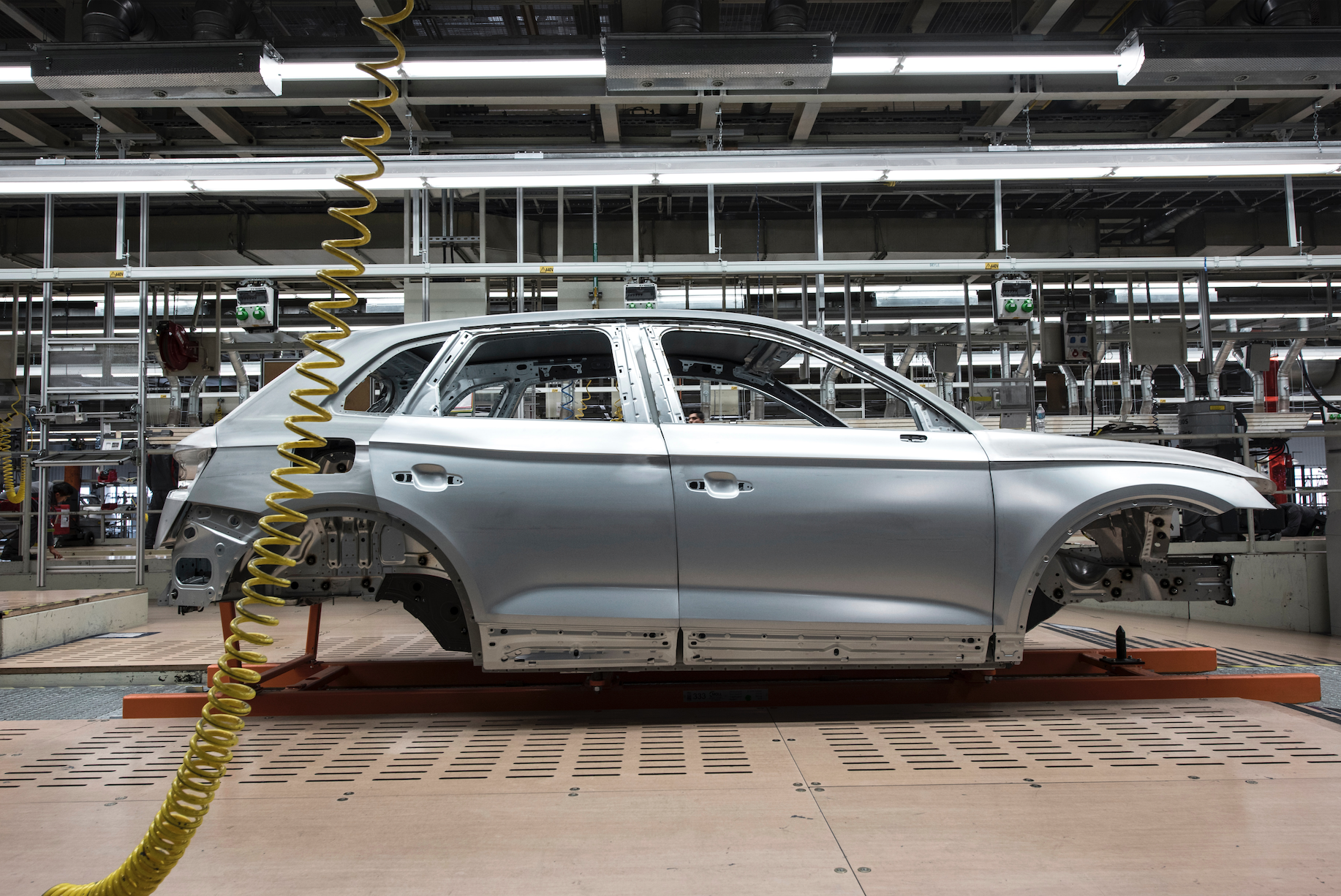
EU automotive sector output should rebound by 1.1% on-year in 2023, following a projected 1.7% drop this year, provided that war-related disruptions and economic uncertainty ease substantially, says Eurofer. The 2022 forecast has been revised down from the previous 0.5% contraction due to ongoing supply chain disruptions and the war in Ukraine.
Automotive output returned to growth, albeit modest, in the second quarter, following three consecutive quarters of decline due to severe supply chain issues. Output nevertheless remains well below both pre-pandemic and pre-2019 recession levels, Eurofer points out.
Supply chain issues and war-related disruptions, coupled with low consumer confidence and squeezed incomes due to high inflation, have kept on weighing on vehicle output.
The latest monthly passenger car registrations data show that in August and September passenger car registrations reversed their downward trend in the EU. This increase, however, is largely due to the comparison with the very low figures of September 2021, when the semiconductor shortage seriously hindered vehicle production.
Demand is expected to remain weak until the macroeconomic picture and consumer disposable income substantially improve – “which has become now less likely given the worsening economic outlook and more subdued economic growth perspectives”, Eurofer says in a report seen by Kallanish.
Adam Smith Poland

EU end-use activity to stutter till mid-2023: Eurofer
EU steel-consuming sector output is expected to contract by 0.9% on-year in 2023 as the economic deterioration seen since summer spills over into the first half of next year, says Eurofer. The economic and industrial outlook is expected to improve only from the second quarter of 2023 onwards.
This would be the second Steel Weighted Industrial Production (SWIP) recession since 2013, after the one due to the pandemic in 2020, while output was flat in 2019, Kallanish notes.
Output in H1 2022 saw only limited impact from the outbreak of war in Ukraine, rising 4.9% and 5.7% on-year in the first and second quarters respectively. The growth trend started as a result of the strong rebound following the easing of Covid restrictions in H1 2020.
Growth this year was driven by positive developments in the construction, mechanical engineering and transport sectors, while domestic appliances faltered. Moreover, automotive sector output returned to growth. However, progress has been hampered since summer due to energy prices and production costs rising to nearly unsustainable levels, Eurofer points out.
Steel-using sectors’ output is expected to expand by 1.9% in 2022 versus the previous forecast of 1.1%.
Construction and mechanical engineering output are forecast to rise 5.6% and 3.3% respectively in 2022 but decline 1% and 1.7% respectively on-year in 2023. Conversely, automotive and domestic appliances output are projected to fall 1.7% and 4.5% respectively this year but rebound 1.1% and 1.8% respectively in 2023.
Adam Smith Poland

European hot-rolled coil market takes holiday breather from bearish trend
The European hot-rolled coil markets remained quiet due to holidays Nov. 1, with tradable levels seen stable on the day.
In Northern Europe, market participants viewed the Eur650/mt price level as well-established, ex-works Ruhr, despite an ongoing lack of transactional activity.
Buyers remain largely out of the market, sources said, adding that they were still suffering from high levels of expensive stock purchased earlier in the year and unable to deplete inventories at usual rates due to poor end-user consumption.
Tradable value indications were heard lower on the day, with some expecting prices as low as Eur620/mt ex-works Northern Europe could be settled with larger buyers.
Indeed, buy-side sources expected prices to continue to decline, even into the Eur500s, as demand has little reason to pick up in the near term with most distributors rejecting any intention to restock before the year’s close.
In Italy, sources reported tradable value in a range of Eur650-660/mt ex-works, with the Platts assessment stable at the mid-point, Eur655/mt ex-works Italy.
Platts is part of S&P Global Commodity Insights.
— Benjamin Steven


ArcelorMittal supplies steel for Spanish railway network
ArcelorMittal will supply steel for railway infrastructure projects in Spain, Kallanish learns from Spanish state-owned company Adif.
“Adif’s board has approved the award to ArcelorMittal of six contracts for the new railway supply that includes the Mediterranean Corridor, as it passes through Valencia and Catalonia, and some high-speed connections in the national railway network,” Adif says. The combined value of the contracts is €163 million ($161.6m).
ArcelorMittal will fulfil the agreement by supplying 81,200 tonnes of rails, profiled bars or rolled steel from its plant in Gijón, northern Spain, the railway infrastructure company adds.
Todor Kirkov Bulgaria