


Turkey’s vehicle sales rise 5% on year over Jan-Oct
Turkey’s vehicle output increased 5% year on year to 1.08 million units over January-October despite temporary output cuts caused by microchip supply problems and revision works, showed the latest Turkish Automotive Manufacturers’ Association, or OSD, data published Nov. 12.
Turkey’s passenger car production fell 0.3% year on year to 633,369 units in the nine-month period, while commercial vehicle production increased by 12.6% on the year to 443,496 units.
Turkey’s vehicle exports rose 2.7% on the year to 779,317 units, while domestic sales declined 3.7% to 618,723 units, the data showed.
Turkish automakers have revised year-end export targets down by 30,000-40,000 units to around 1 million units, due to lower European demand expectations amid a recession risk, OSD Chairman Cengiz Eroldu said, adding that high special consumption tax on automobiles had a negative effect on domestic sales.
High inflation rates and climbing input costs, such as for energy, increased Turkey’s automobile prices in 2022.
Turkish HRC prices exceeded $1,200/mt mid-March, but have since declined on low demand and cheaper import offers. Platts, part of S&P Global Commodity Insights, assessed Turkish HRC at $655/mt ex-works Nov. 11.
— Cenk Can

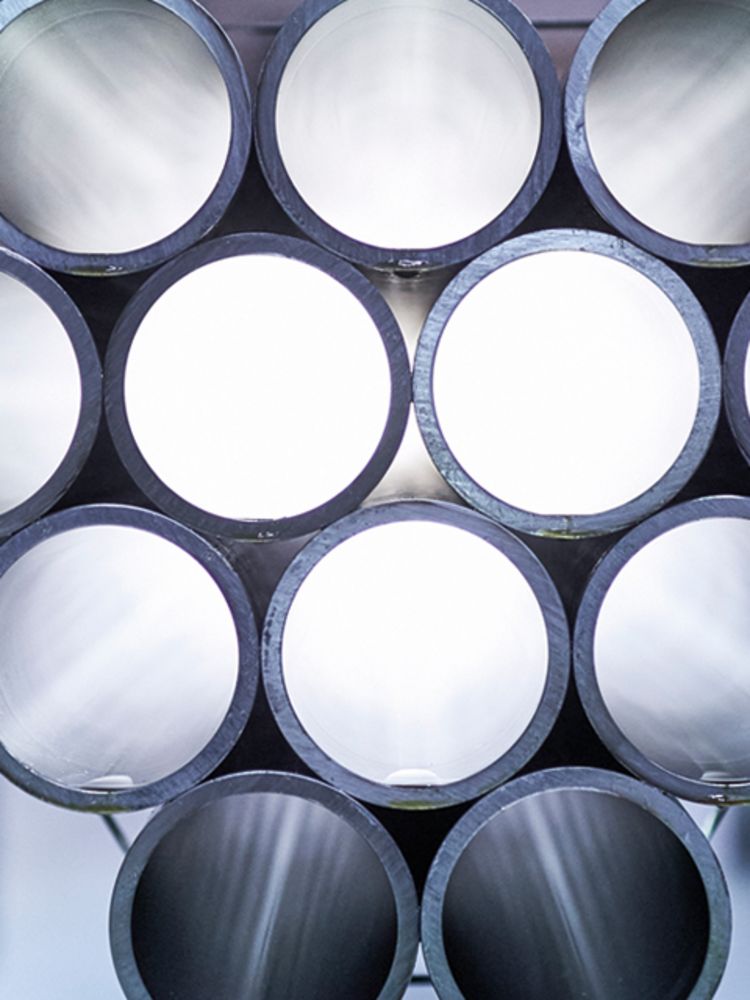
Benteler introduces pipe from free-cutting steel
Benteler Steel/Tube says it has succeeded in producing seamless tube from free-cutting steel for the first time, Kallanish hears from the company.
Free-cutting steel has been used for a long time as a solid material, mostly in the form of steel bar in the machining industry. Its high sulphur concentration offers advantages in machining operations such as turning, milling or drilling, with better chip formation and longer tool life.
Benteler claims that its proprietary product Benteler Smartcut combines the advantages of highly machinable free-cutting steels with the geometry advantages of a tube and thus optimises machining. The product line of seamless steel tubes in hot-rolled as well as cold-drawn types offers optimised solutions for various applications. In this way, economical machining can be realised for both smaller and larger quantities, the company says.
“Due to its material properties, Benteler Smartcut offers greatly improved, short chip formation,” says sales director says Jan Schwarzer. “The material concept enables faster machining and, as a result of the stable process, also automated machining, which can reduce costs by up to 40%.”
Christian Koehl Germany


ArcelorMittal expands Magnelis production in Spain
ArcelorMittal says it is finishing the €10 million ($10m) upgrade of galvanizing line No.1 at its Avilés plant in Spain, Kallanish learns from the company.
The project includes the implementation of technology for the manufacture of “Magnelis”, the firm’s product with anti-corrosion metallic coating. The plant has already been producing this at galvanizing line No.2 since 2017.
“ArcelorMittal estimates it could end the upgrade of galvanizing line No. 1 for the manufacture of Magnelis as from January 2023,” the company explains. The new corrosion resistance steel products, whose characteristic is a composition coating with a higher content of aluminium and magnesium, will be in thicknesses of 2mm and 3.5 mm, something that is not feasible at line No2.
ArcelorMittal thus expects to meet most demand for Magnelis in the Iberian market. This specific product is manly supplied to the solar energy sector for the construction of photovoltaic park infrastructures. Magnelis offers a substantially lower environmental impact than that of alternative materials, ArcelorMittal claims.
Todor Kirkov Bulgaria

Barrett Steel to build distribution centre on Humber
Barrett Steel plans to build a 200,000-square-feet dedicated steel distribution centre at its Groveport site in North Lincolnshire, supported by additional investment from PD Ports to double the size of its dedicated transport fleet on the Humber, the port operator says.
The £10 million ($11.8m) facility will support the expansion of Barrett’s footprint on the estuary and also strengthen the distributor’s national distribution network and allow for just-in-time deliveries to be made across the UK.
Groveport, a 190-acre site and the largest in PD Ports’ Humber Cluster, has continued to act as a central steel distribution hub for Barrett Steel and serves as the ideal location for the new facility, PD Ports observes.
“The new Barrett Steel facility is a huge milestone for PD Ports at Groveport. This marks the largest single piece of investment in the site since we first acquired it back in 2015 and demonstrates our intentions to position Groveport as the UK’s leading steel handling hub for steel sourced both domestically and internationally,” PD Ports chief commercial officer Geoff Lippitt says in a note seen by Kallanish.
The warehouse will be the first building in the UK to be constructed using ArcelorMittal’s “XCarb” steel and is primed to be upgraded with the addition of solar panels in the future, the firm concludes.
Adam Smith Poland

Salzgitter presents galv line amid rising German capacity
The newly-built hot-dip galvanizing line No.3 at Salzgitter has achieved operational readiness since last month, Kallanish hears from the German steelmaker.
The new production plant with an annual capacity of 500,000 tonnes supplements the two existing hot-dip galvanizing lines. It will shortly be producing high- and ultra-high-strength steels for vehicle body and chassis applications, and for the domestic appliances sector, in applications such as sophisticated surface components, Salzgitter states.
The line will produce sheet with thicknesses of 0.7-2.5mm, in widths of 900-1,700mm. The coils of strip will have a maximum weight of 32 tonnes. This is Salzgitter Group’s largest single investment of the past ten years, with around €200 million ($206m) spent on the complex, built by SMS.
“Even as planning and construction stages progressed, we were already engaged in close discussions with our customers regarding material concepts. The ramp-up phase is now in full swing,” says Michael Brühl, operations director for cold rolled products at Salzgitter Flachstahl, the group’s strip making unit.
Only one month ago, Germany’s other big national steelmaker, thyssenkrupp, inaugurated a new galvanizing line with an annual capacity of 600,000t. Market players have long made Kallanish aware of this foreseeable jump in capacity, noting that it will likely affect pricing of hot-dip galvanized coil.
Christian Koehl Germany

European HRC buyers question price floor
European hot-rolled coil buyers were testing the market with inquiries and questioning the price floor, Fastmarkets heard on Tuesday November 15.
Fastmarkets calculated its daily steel HRC index, domestic, ex-works Northern Europe, at €630.00 ($650.31) per tonne on November 15, down by €11.25 per tonne from €641.25 per tonne on November 14.
The latest calculation of the index was down by €20.00 per tonne week on week and down by €70.00 per tonne month on month.
Producer sources reported indications of achievable prices at €640-650 per tonne EXW for December rolling coil.
At the same time, several distributors reported sales in the region at €620-630 per tonne EXW.
Also, transactions for small tonnages of Italy-origin HRC were heard at €650-670 per tonne delivered to Germany.
Producer sources said that they heard an increased number of inquiries from buyers this week for HRC with January delivery dates.
“Buyers are testing the market. Normally, they would have been restocking for [first-quarter] volumes now, but there is lack of clarity on whether the [HRC] prices have touched the floor,” a mill source told Fastmarkets.
A distributor in the region said that the levels of HRC inventory at some buyers were starting to reduce.
But two big steel service centers reported having sufficient levels of inventory.
Most mills in Northern Europe still have December-rolling HRC to sell. Offers for January production have yet to be announced, but several mills said that they would target at least €700 per tonne EXW.
In general, sources were not ruling out further downward price corrections for fourth-quarter-production HRC, because order books at producers were thin.
Fastmarkets’ calculation of its daily steel HRC index, domestic, exw Italy, was €620.63 per tonne on November 15, up by €0.63 per tonne from €620 per tonne the previous day.
The latest calculation of the Italian index was down by €40.75 per tonne week on week and down by €79.37 per tonne month on month.
Trading was also slow in Italy’s market, sources said.
Offers from local mills were reported at €630-650 per tonne delivered, which would net back to €610-630 per tonne EXW, sources said. The lower end, however, was not widely confirmed by mill sources.
Alternatively, several buyers reported a transaction at €620 per tonne delivered (€600 per tonne EXW).
Import HRC offers from Japan and South Korea were heard at €570-590 per tonne cfr. Southeast Asian suppliers could offer material for January shipment.
Despite the attractive price, the demand for import coil was limited by safeguard risks and long lead times.
“European buyers largely prefer to secure [HRC] tonnages at home,” a distributor source said, “considering the unpredictability of the market.”
The complimentary Fastmarkets webinar “European Flat Steel in 2022” will take place at 10am UK time on November 22.
