


Tata Steel technology cuts coke consumption, CO2 emissions
Tata Steel has installed “Topscan” technology at its two Port Talbot blast furnaces that will reduce the amount of coke required in the furnaces as well as CO2 emissions by at least 50,000 tonnes/year.
The technology captures 1,000 data points every ten seconds, giving Tata Steel technicians an uninterrupted 3D view of the material being laid into the top of the furnaces. It will be installed at blast furnace no.5 by end-November, following its rollout on blast furnace no.4 last year.
The Topscan system consists of a set of radars which take a full surface scan of the iron ore and metallurgical coke being laid into each furnace. Computer modelling then provides a clear, finite view of the raw materials at the start of their journey through the furnace.
“That’s really important to us because the specific way in which we lay materials in the furnace is our main method of controlling gas flow up from the hot air blast through the raw materials,” blast furnace technical manager Aaron Parsons says in a note seen by Kallanish. “Over time, we can make tweaks to the distribution allowing us to make the most efficient use of the hot gases and yield really big savings, both in terms of coke usage and CO2.”
Tata Steel UK has the ambition to reduce all CO2 emissions by 30% by 2030 and be a CO2 neutral steelmaker by 2045 – in support of the UK’s ambition to be net-zero by 2050.
Last month Tata Steel UK installed laser technology at two of its Port Talbot-based slab re-heating furnaces, to improve product quality and consistency, as well as cut carbon emissions (see Kallanish passim).
Adam Smith Poland


German service centre provides low-carbon steel blockchain tracker
German service centre provides low-carbon steel blockchain tracker
Stahlo, a group of German steel service centres, has come up with a product carbon footprint (PCF) demonstrator to substantially strengthen confidence in supply chains for low-carbon steels. The technological basis of its “Stahlo SteelGate” project is a blockchain application.
Stahlo has collected knowledge on the various approaches to creating carbon profiles for steel products in its database. This forms the basis for its classification label, which generally classifies the products according to the emissions produced and makes it easy for customers to compare them.
Information about the respective emissions generated is added at each stage of production and passed on along with the product. Users at the end of the supply chain thus have a complete set of information on the product carbon footprint of precisely the steel they have ordered, Stahlo says.
Thanks to highly secure cryptographic procedures, a blockchain protects such information
chains against unauthorised access. This is made possible by the decentralised distribution of the data records across many instances. “The steel manufacturer is one instance, the processor a second, and so on,” says chief executive Oliver Sonst, explaining the methodology to Kallanish. He highlights that this path is open and independent, which it would not be if offered from the side of a mill, for example.
The cryptographic chaining of the information blocks ensures that no manipulation is possible at any point. If one data record of a single instance were changed illegally, all the other distributed data records would automatically register this due to the cryptographic link, Stahlo claims.
Christian Koehl Germany

Metinvest diversifies feedstock supply to Europe assets: ceo
Metinvest has diversified the supply of semi-finished products for its foreign assets in Italy and Britain, which were left without feedstock from Ukraine due to Russia’s occupation of Mariupol, says the company’s chief executive, Yuri Ryzhenkov.
“They’ve had some disruptions in the beginning, mainly because they were relying on semi-finished goods from Azovstal to run,” Ryzhenkov said on Sky News’ Ian King Live show. “Since then, we’ve diversified the sources of semi-finished goods we are using. For example, here in the UK we have slabs that are being supplied by British Steel now, by Thyssenkrupp. In Italy, it’s ADI. We found various suppliers that can provide us with the necessary volumes.”
Metinvest’s steel plants in Zaporizhzhia and Kamianske are meanwhile running at 50-60% capacity, he added.
According to the ceo, Metinvest expects to receive full compensation from Russia for the damage caused to the company’s assets due to the invasion. The firm plans to “reinvest it in the Ukrainian plants to restore them to operations”, he explained.
Earlier, Ryzhenkov said the company’s EU assets suspended production in May due to the lack of slab previously supplied from Azovstal (see Kallanish passim). They then however ramped up to 75-100% of capacity. Metinvest’s US mine, while remaining part of the group, operates as an autonomous subdivision.
Svetoslav Abrossimov Bulgaria
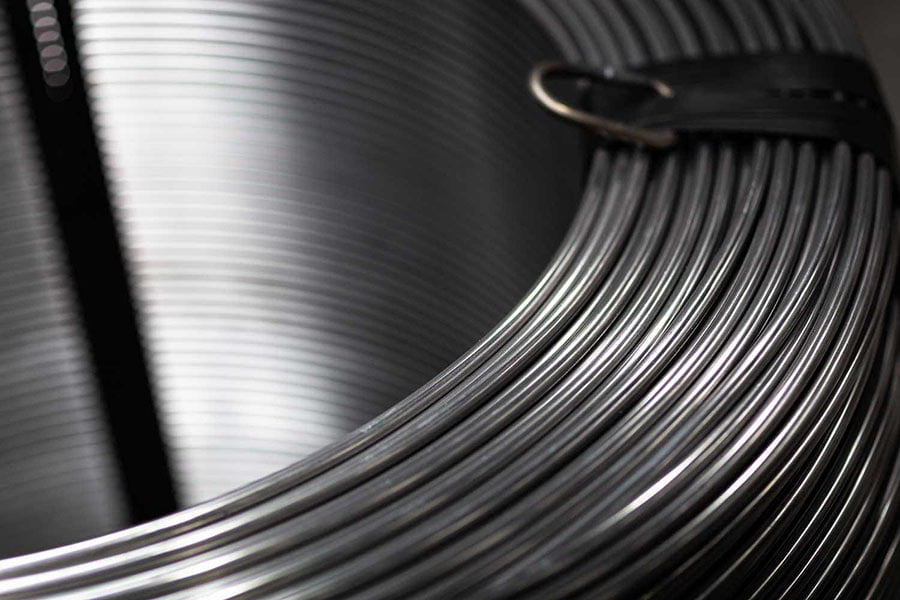
Pittini boosts output, product range
Pittini Group is to boost output at its SiderPotenza mill in southern Italy.
In the second quarter of 2024, the steelmaker will start operating a new rolling mill supplied by local equipment maker Danieli for the production of spooled bars in coils. The investment will give the company the opportunity to increase production and boost product range, Kallanish notes.
The project will be developed in two stages. Initially, the new line, to be installed at the existing bar mill, will be equipped with A Multistage Soft Quenching (SQ2) and will produce 10-16mm spooled bars in coils weighing up to 2 tonnes. This will increase to 5t “in future” with the addition of a K-Weld machine, Danieli explains.
In the second phase, a new two-pass, multi-drive block will be installed to enlarge the product range up to a diameter of 25mm.
Pittini recently started a new K-Weld machine at its Ferriere Nord facility in Osoppo, northern Italy, also supplied by Danieli.
Pittini employs around 1,800 workers and has a yearly production capacity of approximately 3 million tonnes across 18 production and logistic facilities. In Italy, the group includes Ferriere Nord, Acciaierie di Verona, Siderpotenza, Pittarc, La Veneta Reti and Siat.
Natalia Capra France

Italian HRC seen rebounding as destocking ends
A wind of change is blowing through the Italian hot rolled coil market, with prices and volumes expected to rebound this week.
After a long period of destocking, service centres and re-rollers are now in need to buy for the first quarter. Service centres’ customers are also beginning to order for Q1 and are reporting improving order intake.
Since Thursday last week, some Chinese, Korean and Japanese exporters of HRC, particularly to southern Europe, have decided to withdraw from offering into Europe. In their hunger for volumes, Far Eastern steelmakers have been exporting material at cheaper-than-domestic prices.
Until last week, HRC imported from Taiwan, Vietnam, Korea and Japan went well below the level of $600/tonne cfr Italy, as buyers reported offers from these regions at $555-580/t cfr. “The level of $515-520/t fob [East Asian origin] is not sustainable. These steelmakers are losing money and giving ground to the European Union to accuse them of dumping material. On their domestic markets, they are at least at $700/t base ex-works, so it was only a matter of time until they stopped selling in Europe at below $600/t cfr,” a large buyer tells Kallanish.
While some large service centres are lamenting a stagnating market in Italy, others see some customers being ready to place new orders and say they will buy this week.
Following the withdrawal of Asian offers, Italian producers are expected to increase their prices.
“This is a breeze of change rather than a wind. We expect some increases but not skyrocketing prices,” another large buyer says, tempering any optimism.
Import prices are seen increasing by at least $100/t, but in an uneven way, making imported material far less competitive.
Some Italian producers are officially quoting at €650-660/t ($665-676) base ex-works, while others are undercutting at €600/t. So far, domestic contract prices are hovering at €580-650/t base ex-works, Kallanish notes.
Natalia Capra France

UK plug-in vehicle registration slowdown set to continue into 2023: Pod Point
This year’s slowdown in the UK plug-in electric vehicle market is expected to continue into 2023, EV charging infrastructure company Pod Point Group said in a market update Nov. 21.
UK plug-in vehicle registrations grew by 76% between 2020 to 2021, fell to 26% in the first half of 2022 and slowed to 7% in the four months to Oct. 31, according to SMMT data.
The trend indicated a total market for of plug-in vehicles of 350,000 in 2022 and 375,000 in 2023, Pod Point said.
“Whilst it is today difficult to predict the outcome for 2023, we are prudently assuming that these supply chain and macroeconomic issues extend into 2023,” it said.
Domestic charging equipment orders had benefited from a rush to install ahead of the suspension of government-funded grants on March 31. This change remained a factor in the market, it said.
Longer term, the company expects UK plug-in vehicle registrations to return to rapid growth as supply chain restrictions ease and the general economy recovers.
“We fully expect the UK to achieve its goal of banning new internal combustion engine cars by 2030, and hence foresee strong growth in demand for charging infrastructure over the next decade and beyond,” it said.
Year to end-October data from SMMT show total UK vehicle sales of 1.343 million, of which 43% were gasoline, 5% diesel, 19% “mild hybrid EV” (gasoline and diesel) and 15% battery electric vehicles.
S&P Global Commodity Insights’ monthly EV Essentials report showed EU electric vehicle sales rebounding in September from two months of decline, growing from 145,000 vehicles sold to nearly 225,000, an all-time high.
“This near-term sales strength has pushed the market share of plug-in vehicles in Europe to slightly above 20%. Key markets that continue to see extremely high EV penetration rates in terms of share of new car sales include Norway (89.0%), Germany (32.0%), and France (28.3%),” it said.
— Henry Edwardes-Evans


ITALY DATA: October crude steel output falls 9.3% on year
Italian crude steel production in October fell 9.3% year on year to 2.014 million mt, the sixth consecutive month of year-on-year falls, according to data from Italian steel federation Federacciai released Nov. 21.
However, the volume was up 7.5% month on month and at a five-month high, the data showed.
Of the October volume, 1.103 million mt was long products, down 14.2% year on year and slipping 5.2% from September.
Flat production for the month also dropped 22% year on year to 821,000 mt, although this was up 14.3% from September to a five-month high.
For the January-October period, Italy, which is Europe’s second-largest steel producer after Germany, produced 18.48 million mt of crude steel, dropping 10.9% year on year, due to summer closures caused by maintenance works, low demand and high energy prices.
Long product output for the 10-month period was also down 11.7% year on year at 10.24 million mt, while flat product output slipped 11.8% to 8.16 million mt.
A number of European steelmakers are still not working at full capacity, as energy prices remain high, combined with high stocks and low demand.
Domestic prices for HRC have been declining in Europe since the second half of March due to weak demand.
Platts, part of S&P Global Commodity Insights, assessed daily HRC in Italy at Eur580/mt ($593.94/mt) ex-works Nov. 18, down 30.6% since the start of 2022.
— Jacqueline Holman

GERMAN DATA: Oct crude steel production falls 14.4% on year: WV Stahl
German crude steel production fell 14.4% year on year to 3.14 million mt in October, the eighth straight year-on-year decline, according to data published Nov. 21 by German steel federation WV Stahl.
However, the volume was 10.6% higher on the month and at a four-month high, according to the data.
January-October crude steel production from German mills totaled 31.39 million mt, down 6.9% year on year.
Of the total October volume, 2.12 million was produced from blast furnaces, falling 16.3% year on year, but up 7.4% from September.
This brought the total for the 10-month period to 21.73 million mt, falling 6.5% on the year.
According to WV Stahl, German crude steel production from electric arc furnaces dropped 10.1% on the year to 1.02 million mt but rose 17.7% from the previous month to the highest monthly level since June.
Output from EAFs for the January-October period also decreased 7.8% year on year to 9.66 million mt.
October pig iron production fell 20.4% on the year and 3.5% on the month to 1.83 million mt, bringing the 10-month volume to 19.89 million mt, down 6.2% year on year.
Meanwhile, output of hot-rolled steel products in October dropped 13.2% year on year, but was stable on the month at 2.65 million mt, with the January-October volume down 6.5% to 27.65 million mt.
High energy costs and low demand have been impacting European steel output.
Platts, part of S&P Global Commodity Insights, assessed domestic HRC prices in Northern Europe at Eur625/mt ex-works Ruhr Nov. 18, down 32.2% since the start of 2022.
— Jacqueline Holman

European HRC outlook bearish as market digests import developments
Developments in the import market caused concern for European hot-rolled coil market participants Nov. 21, as they expressing wariness of further price declines.
Platts assessed hot-rolled coil in Northwest Europe down Eur10 on the day at Eur615/mt ex-works Ruhr.
Tradable value indications were largely cited between Eur600-Eur625/mt ex-works Ruhr and Northern Europe, although some perceived opportunity to settle deals as low as Eur575/mt ex-works with North European mills.
Overall, however, transactional activity remained thin, with most distributors focusing on hand-to-hand deals between mills and end-users, restocking specific dimensions, or refraining from buying entirely due to expectations of further downtrend.
“Our customers aren’t willing to pay higher prices, and everyone is expecting further reduction which is slowing the market down,” a service center source said. “Mills are really under pressure but there seems to be a psychological barrier to prices below Eur600/mt – if this breaks, I think we’ll see a Eur550/mt soon after.”
Indeed, buyers – often holding their own volumes of expensive stock – reported concern on the day that prices could be additionally pressured by new duty-free Indian import offers. While third country offers to Europe were signaled to increase during week ended Nov 18, speculated as relating to potential new European duties on Far East-origin imports, sentiment was that any uptrend in the import market would be undermined by the re-entry of competitive Indian exports.
However, an Italy-based trader said Japanese and South Korean producers were wary of “pushing too much,” rejecting high volume bids so not to “highlight their material.”
Despite allegations of over-competitiveness, the trader said imports would have to move to Eur500-520/mt CIF to compete with declining domestic prices. Platts assessed import prices stable at Eur580/mt ex-works Italy Nov. 21.
One Italy-based producer was taking what volumes were advertised, settling deals below other producers at Eur600/mt delivered, or the equivalent of Eur580/mt ex-works Italy.
Import HRC into South Europe was assessed at parity with the domestic market at Eur580/mt CIF.
Platts is part of S&P Global Commodity Insights.
— Benjamin Steven