


German federations name new top personnel
German steel federation Wirtschaftsvereinigung (WV) Stahl has appointed Kerstin Maria Rippel its new managing director.
Rippel has many years of experience in the energy industry, Kallanish learns from WV Stahl. The federation recently stated it will split the positions of managing director and president, which so far have been filled jointly by Hans Jürgen Kerkhoff, who is retiring at the end of the year. The new president was recently announced as thyssenkrupp Steel chief executive Bernhard Osburg, for a period of two years.
Commenting on her appointment, Rippel highlights her commitment to the technological transition of the German steel industry. “We are working to remain a strong industrial nation with green steel Made-in-Germany as the trademark, and we need to set the sails for that,” she says. In the team with her, Martin Theuringer will remain deputy managing director, as he has been for many years.
Separately, technical organisation VDEh (Iron and Steel Institute) has announced that Henrik Adam of Tata Steel will be its new chairman of the executive board as of 1 January. That position, too, has been held for the last 14 years by Kerkhoff. Earlier this year, Adam transferred from Tata Steel Europe to the Indian parent group as vice president European Corporate Affairs. He is also a member of the executive committee of European steel association Eurofer.
Christian Koehl Germany


Cognor acquires electrode, ferroalloy supplier
Cognor has acquired Czech graphite electrode producer JAP Industries and its dedicated logistics provider Spedex for a combined CZK 280 million ($12.2m).
JAP Industries produces electrodes from imported feedstock, as well as trading in ferroalloys. The products are both key input materials for electric arc furnace-based steelmaking, which Cognor employs.
JAP is a long-standing supplier of Cognor, which had a circa 15% share in JAP’s overall sales in each of the last three years. Its acquisition is in line with the steelmaker’s strategy of shortening its supply chains and reducing risk of raw materials procurement delays.
JAP posted revenue of CZK 879m and net profit of CZK 115m in 2021.
Cognor saw crude steel production plummet 25% on-year in the third quarter due mainly to longer-than-usual maintenance stoppages, which were timed to coincide with weakening demand, although revenue and profit rose (see Kallanish passim). In the nine months through September, revenue surged 39% on-year to PLN 2.74 billion, while net profit doubled to PLN 476.9m.
Adam Smith Poland

European HRC market slows ahead of holidays
The European hot-rolled coil market has slowed ahead of the year-end holiday period, leaving prices close to flat, sources told Fastmarkets on Tuesday December 20.Fastmarkets calculated its daily steel hot-rolled coil index domestic, exw Northern Europe at €653.50 ($693.46) per tonne on Tuesday, down by €0.50 from €654.00 per tonne on Monday.
The latest calculation of the index is up by €17.79 per tonne week on week and up by €27.67 per tonne month on month.
Offers from mills in the region were reported at €660-680 per tonne EXW for February delivery HRC, while buyer estimates of an achievable price were heard at €630-650 per tonne EXW.
Market participants reported transactions for limited tonnages at €650-660 per tonne EXW in the region.
But several sources said that European producers were not accepting bids below €650 per tonne EXW.
HRC from Italy was on offer in southern Germany at €670-680 per tonne delivered late last week, but Italian mills were said to be out of the market this week.
Trading activity was slow in the region due to the approaching winter holidays and distributors have mostly booked the necessary tonnages for early first-quarter delivery and were largely out of the market, Fastmarkets understands.
Some buyers were questioning the sustainability of the apparent uptrend in the first quarter of 2023.
“We booked tonnages [of HRC] at €600 per tonne EXW about four weeks ago and we do not see any reasons for prices to move up by €50 per tonne,” a German stockholder said. “It is a question of the demand in the first place and we don’t see end-user demand as sufficient to back a price rise.”
Producers, meanwhile, increased their offers late in the week to December 16 and have no intention of cutting prices, mainly because of their high production costs, but also because they hold a different view about the demand situation for the first quarter of next year.
“We see apparent steel demand picking up on restocking in recent weeks [and] in the first quarter, we expect real steel demand to improve as well,” a mill source told Fastmarkets.
In fact, several integrated producers in the region told Fastmarkets the target price level for HRC in January-February 2023 was €700 per tonne EXW.
Fastmarkets’ calculation of its daily steel HRC index domestic, exw Italy was €645.00 per tonne on Tuesday, up by €1.67 per tonne from €643.33 per tonne on Monday.
The latest calculation of the Italian index is up by €18.33 per tonne from a week earlier and up by €45.00 per tonne month on month.
The Italian HRC market was also quiet on Tuesday, with local mills preparing for holiday stoppages.
Italian producers were offering €650-680 per tonne EXW for February-delivery HRC.
Buyers estimated that the workable level was about €640-650 per tonne EXW, with some deals reportedly concluded within that range.
Overseas HRC offers to Europe were scarce and largely considered unworkable for EU buyers because of the long lead times and, in any case, most buyers have been out of the market this week.
“We booked everything we wanted to from imports about five or six weeks ago,” a buyer in Southern Europe said.
Offers for coil imported from Japan were heard at €630-640 per tonne CFR Italy, while Turkey-origin coil was on offer to Italy at €650-655 per tonne CFR, duty included.
Sources also reported an offer from Indian mills at €610-620 per tonne CFR Italy.
Published by: Julia Bolotova

Slab supplies from Russia to Europe may shrink in 2023 amid lobbying against transition quotas
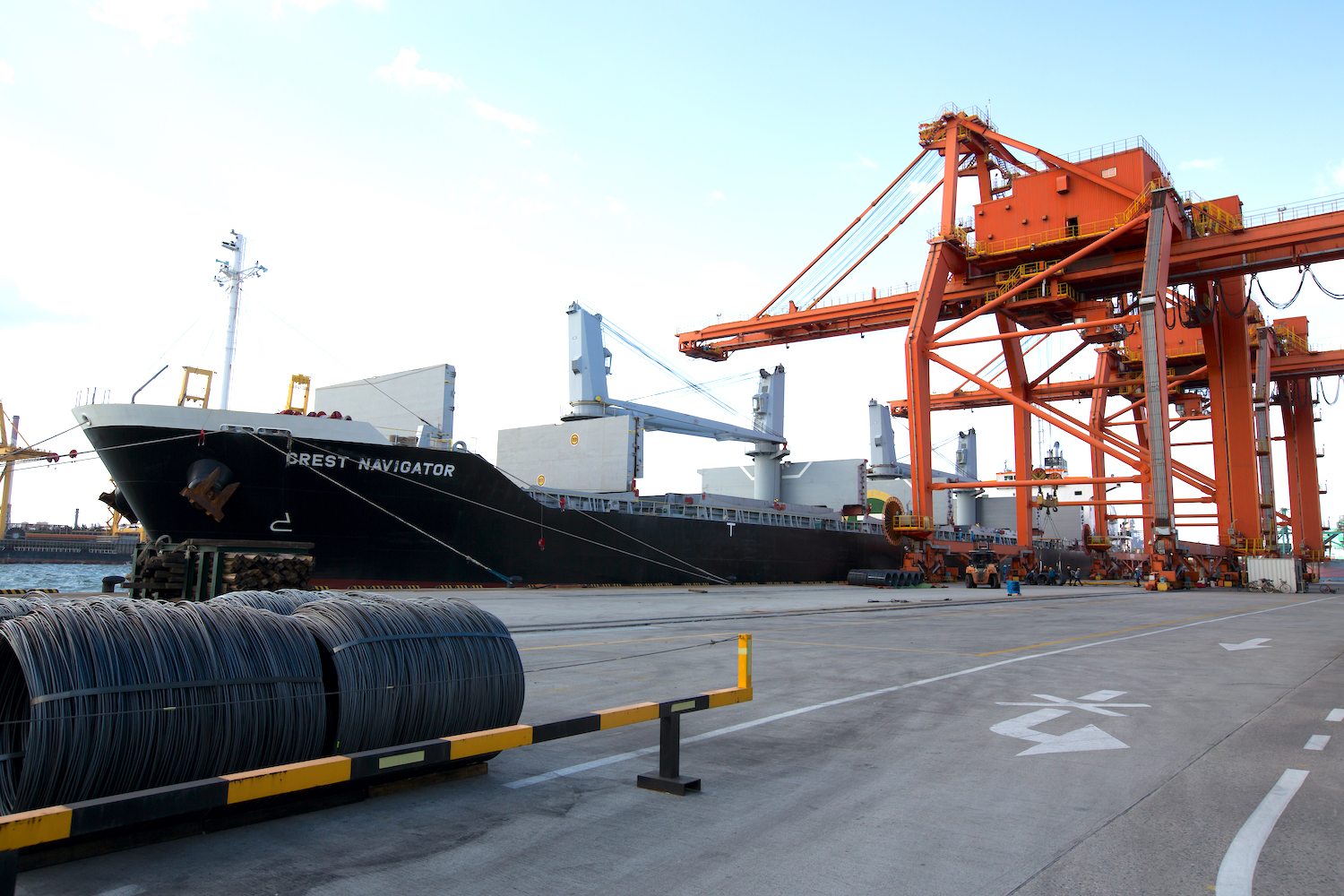
Slab supplies from Russia to the European Union may shrink in 2023 amid opposition to a two-year transition period introduced in October, sevearl sources told Fastmarkets.
In October this year, the European Council voted in favor of an eighth package of sanctions against Russia in response to its unprovoked invasion of Ukraine in late February this year.
Among other things, the package included a ban on Russian semi-finished steel imports, with a transition period, including quite generous quotas, for a two-year period.
Between October 7, 2022 and September 30 2023, 3.75 million tonnes of semi-finished steel products under CN code 7207 12 10 (steel slab) would be allowed to enter the EU market without restrictions, with another 3.75 million tonnes allowed to enter the EU between October 1, 2023, and September 30, 2024.
The quota is almost equivalent to the historical slab volumes imported from Russia to the EU, with Russia having exported about 3.98 million tonnes of steel slab to the region in 2021, according to the International Steel Statistics Bureau (ISSB).
Since the quota was opened, however, some companies booking Russian slab, have been selling finished steel products – hot-rolled coils (HRC) and steel plate – at really aggressive prices, unsettling the market, several trading sources told Fastmarkets.
“Russia origin slab has recently been available at $490 per tonne CFR to Italy, so $55-110 per tonne lower than from all other [regions],” a trading source in Italy said.
Because of this, sources said, several European flat steel producers were lobbying for a reduction in the slab quota or, at least, a shorter transition period.
“It is quite scandalous that Russia was given two years to figure out slab deliveries; one year would have been more than enough,” a mill source in Europe told Fastmarkets.
Market participants agreed, however, that any changes to the semi-finished quotas would not happen quickly.
“The decision [about Russian slabs quotas] has been taken by the EU authorities in October, now they will need to start a review, which will take 6 month in best case scenario,” a source close to familiar with the matter, said.
Alternatively several sources said there had been rumors about the possible introduction of sanctions against NLMK – one of Russia’s major slab producers – and exporters, which is currently the sole steelmaker not subject to sanctions.
The latter variant was considered very unlikely, however, because NLMK owns a number of re-rolling mills across Europe (in Denmark, Belgium, France and Italy), so employment levels in those regions could be affected by any punitive actions. In addition, sources said it would not be easy to replace such substantial slab volumes.
In Belgium NLMK Clabecq has the capacity to produce 750,000 tpy of steel plate and NLMK La Louviere has a 1.8-million-tpy hot-strip mill.
In Denmark, NLMK Dansteel produces more than 700,000 tpy of steel plate.
In the first half of 2022 NLMK slab sales to third parties increased to 2.31 million tonnes, up 40% from 1.65 million tonnes in January-June 2021, according to a company report.
A European trading source suggested that at least 20% of these volumes were destined for Europe.
Slab sales to NLMK’s group companies and NLMK Belgium Holdings (NBH) reached 1.9 million tonnes in the first quarter of 2022, a decrease of 5% from 2.04 million tonnes in the first half of 2021.
NBH includes producers of plate NLMK Clabecq (Belgium), NLMK Verona (Italy) and producers of strip products NLMK La Louvière (Belgium) and NLMK Strasbourg (France).
NLMK group companies outside Europe include US-based NLMK Indiana, NLMK Pennsylvania and Sharon Coating.
Impact of quota opening on the European steel market
Market participants said the introduction of the quota had practically legalized the import of Russian semi-finished steel to Europe for some buyers.
“Before the 8th sanctions package there was some uncertainty: was it actually legal to book Russian semis, or would there be penalties? The introduction of the measures in October has paved the way for Russian semis to come into the EU,” a source in Italy said.
Sources pointed out that NLMK mills in Belgium, Italy and Denmark as well as some Italian re-rollers have been offering HRC and plate aggressively in November-December, because they were using Russia-origin slab and could, therefore, able to be quite flexible with offers.
Notably, sales of plate from Italy were reported at €810-830 per tonne CPT to the south of Germany at the end of November and in early December.
And NLMK Dansteel was said to be offering steel plate at €740 per tonne ex-works.

European Parliament agrees 2034 ETS free allocation deadline
The European Parliament and Council have reached an agreement to further delay the planned phasing out of free CO2 allowances as part of the Emissions Trading System (ETS), Kallanish learns from official statements.
On 18 December, authorities confirmed in statements that a final agreement was reached. As a result, the complete phase-out of CO2 allowances is set for 2034, two years later than previous indications. Between 2026 and 2034 (as ETS allocations are phased out), the new Carbon Border Adjustment Mechanism (CBAM) will be gradually phased in.
The extension of free allowances was nevertheless counterbalanced by the decision to reduce emissions from the EU ETS sectors by 62% by 2030 – compared to 2005 levels. This is higher than the previous target set at 43%.
Eurofer, the European steelmakers association, welcomed the fact that in the final agreement there are stronger incentives for the uptake of low-carbon technologies such as DRI using green hydrogen. Nevertheless, the association reiterated that a lack of framework for European exports from 2026 could put the steel sector at risk.
“We are highly concerned by the lack of a concrete solution to counter carbon leakage risk on export markets, while a pre-defined free allocation phase-out trajectory is set at this stage. If no concrete solution is found before 2026, €45 billion steel exports are at existential threat, due to the exponentially increasing carbon price in the EU that has no equivalent in the domestic markets of our major trading partners. It is essential that EU institutions revert to this issue as soon as possible in the foreseen review process to deliver an effective measure,” says Axel Eggert, director general of Eurofer.
Emanuele Norsa Italy

Italian downstream coil prices follow HRC
Italian cold rolled and hot-dipped galvanised coil prices are increasing month-on-month by some €40/tonne ($42), in line with the hot rolled coil price hike, Kallanish hears.
Domestic HDG contracts are now climbing to €750-760/t base ex-works on average, while CRC prices start at €730-740/t.
In line with increasing HRC values, producers are considering pushing up prices further for HDG and CRC. One large steelmaker is already quoting HDG at €800-820/t base ex-works for February delivery, while others are slightly lower at €760-770/t base. Some demand has returned to the Italian market in December after a long period of quiet and neighbouring European countries such as Germany and France are also ordering material, sources suggest.
Meanwhile, Italian HRC prices are increasing in quotes and contracts by €50/t on average compared to last month. Producers are quoting end-February and March delivery at €650-680/t base ex-works, up from €610-630/t base at the beginning of the month. These quotes however are expected not to last, as most European steelmakers are mulling €700/t base ex-works for January (see Kallanish 19 December).
Natalia Capra France

EU coil contract talks accelerate
Negotiations over annual coil supply contracts between mills and large customers in 2023 in north-western Europe appear to have gained momentum prior to the Christmas break.
Little noise has been made on that front so far. In late November still, an executive of a large German steelmaker said that talks were scheduled for January. This was fairly in line with the mood at the Euroblech sheet fair in late October, which was more reserved than in pre-Covid years. Most representatives there stated it was much too early to think about annual talks.
Such statements were little surprising given the continuing downward movement of spot market prices, and reservation of buyers who were unwilling to replenish inventories in an environment of low demand.
Meanwhile, a well-connected observer of Germany’s steel using industries tells Kallanish that negotiations are already in full swing, and could be inked in early January. This acceleration could be an echo of the changing sentiment on the spot market, that prices have reached bottom, and that signs are showing up now.
The other main indicator is the price of previous settlements, which for hot rolled coil was around €1,000/tonne ($1,062) in January, reflecting a natural premium of contracts over spot prices, which then stood at €900+. In October, mills indicated that they sought to maintain the prices of contracts signed in mid-year. By July, spot prices were trending towards, and effectively below, €850.
According to a Dutch buyer, the figure of “at least” €850 was last heard from the mills’ side for 2021 contracts, while, earlier, a figure of €800 was reported. “Contract offer prices are rising, and several steelmakers have meanwhile released their bids for the automotive sector with fixed prices for the next six months,” he says. This shows that mills are encouraged now, and that buyers need to surface to secure a price before values move up.
Christian Koehl Germany

€45 billion of EU steel exports at risk despite EU’s ETS revision: Eurofer
Some €45 billion EU steel exports are still at risk despite a revision to the EU’s Emissions Trading System which sets stronger incentives for the uptake of clean technologies, European steel association Eurofer said Dec. 19.
EU institutions agreed Dec. 17 on the revision of the ETS following an earlier agreement on the Carbon Border Adjustment Mechanism.
The final agreement requires the ETS’ 10,000 covered installations to reduce their carbon emissions by 62% on 2005 levels by 2030, one percentage point more than what was proposed by the European Commission 18 months ago.
Negotiators also agreed that free carbon allowances to sectors exposed to carbon leakage would be phased out over a nine-year period from 2026-34, allowing for the gradual introduction of the Carbon Border Adjustment Mechanism. CBAM-relevant sectors, including iron and steel, will see their free allowances phased out at a slower rate at the beginning of the period, with decarbonization support on offer via the EU’s Innovation Fund.
The upcoming years until 2030 will therefore constitute a critical period for the uptake of low carbon technologies at industrial scale.
“While the ETS revision introduces some stronger incentives for carrying out technology upgrades to decarbonize industry, a free allocation phase-out trajectory risks wiping out a large part of EU steel exports worth €45 billion [$48 billion] if no concrete export solution is found before 2026,” Eurofer said in a statement.
“We welcome the revised measures on steel benchmarks providing stronger incentives for the uptake of low-carbon technologies such as direct iron reduction using green hydrogen, while preserving the need for effective carbon leakage protection in the transition from the current technologies,” Eurofer Director General Axel Eggert said.
While the revision of the ETS — the cornerstone of EU climate policy — provides the overall framework rules, much work remains on their implementation and interaction with the recently adopted carbon border adjustment mechanism to ensure the latter is well-functioning and watertight, the association said.
“We are highly concerned by the lack of a concrete solution to counter carbon leakage risk on export markets, while a pre-defined free allocation phase-out trajectory is set at this stage,” said Eggert.
If no concrete solution is found before 2026, this will put €45 billion of steel exports at existential threat, due to the exponentially increasing carbon price in the EU that has no equivalent in the domestic markets of the major EU trading partners, said Eggert.
Preserving the competitiveness of EU industry on both internal and export markets, and implementing urgent measures to boost cleantech investment and speed up low carbon energy carriers, electricity and hydrogen availability and affordability is crucial to avert de-industrialization of Europe, according to Eurofer.
The European steel sector had launched an unprecedented number of low carbon projects to reduce its emissions by 55% by 2030 and become carbon neutral by 2050, but capital investment in new technologies of this scale make sense if CO2-low electricity and hydrogen are being supplied in sufficient volumes and at affordable costs, Eggert said. As neither condition is currently in place, steel industry leaders see these investments as too risky, and the EU and its member states urgently need to secure the relevant energy infrastructure and supply to the steel industry to help those projects along, he added.
This is more urgent now that EU industry is challenged by the energy crisis and more supportive industrial policy measures taken by third countries such as the US Inflation Reduction Act, Eurofer said.
— Ekaterina Bouckley


Salzgitter signs green steel supply agreement with German service center
German steelmaker Salzgitter said Dec. 19 that it has signed a deal with service center Stahlo to provide green steel from its Salzgitter Flachstahl works from the end of 2025, adding that by then the facility will be fully converted to producing low carbon products.
Under its SALCOS low-carbon steelmaking program, Salzgitter will gradually convert steelmaking at Flachstahl to hydrogen-based processes, enabling output of low-CO2 steel from 2025 and almost CO2-free supply from 2033.
Salzgitter is already producing low-CO2 steel products using scrap-fed electric arc furnaces. Stahlo, part of Friedhelm Loh Group, has included these products in its own production program.
The company said that, as a result of the deal, the service center’s customers will be able to buy processed SALCOS steel at all three of its manufacturing locations in Germany -– Dillenburg, Gera and Nordhausen.
— Ekaterina Bouckley