


Air Liquide completes hydrogen pipeline for thyssenkrupp
Industrial gas company Air Liquide has completed a pipeline leading to thyssenkrupp Steel in Duisburg. The approximately 4km pipeline connects the Duisburg steel mill site with Air Liquide’s hydrogen network in the Ruhr district, Kallanish learns.
The line is part of the H2Stahl laboratory sponsored by the German Federal Ministry for Economic Affairs and Climate Protection. Mona Neubaur, state minister for economy and energy in North Rhine-Westphalia, attended the inauguration of the pipeline.
Air Liquide’s 200km long hydrogen pipeline network in the Rhine and Ruhr region connects hydrogen production plants and major customers in Marl, Oberhausen, Duisburg, Krefeld, Leverkusen, Dormagen, Düsseldorf and other cities.
In autumn 2023, the “Trailblazer” in Oberhausen is scheduled to become the first 20MW industrial-scale water electrolysis plant to be connected to Air Liquide’s H2 network. In the first stage, this will allow customers to be supplied with up to 2,900 tonnes/year of renewable hydrogen via pipeline.
Christian Koehl Germany

Mannesmann supplies pipe to Wilhelmshaven LNG terminal
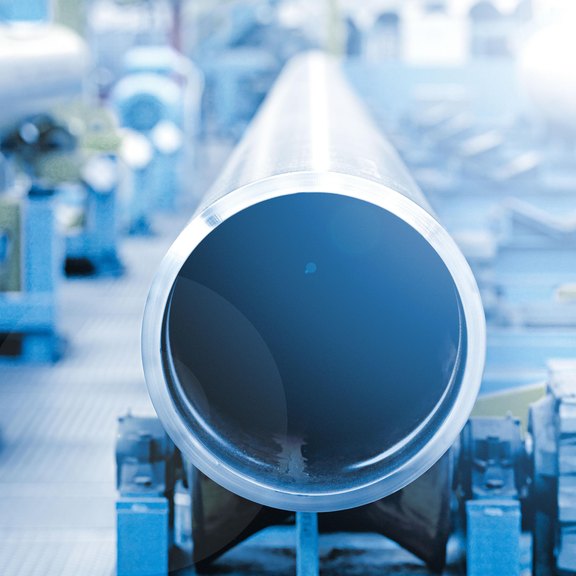
Mannesmann Line Pipe has booked an order from northern German energy network operator EWE NETZ for the delivery of around 16,000 tonnes of H2-ready pipe, Kallanish learns from parent Salzgitter. The pipeline is scheduled to be commissioned at the end of 2023.
The 70km-long line will connect to the “WAL” pipeline running from Wilhelmshaven to Etzel, which is currently under construction. Along the route, natural gas is transported from the Wilhelmshaven LNG terminal to EWE’s cavern storage facilities, and to industrial and household customers via the downstream gas networks. Germany’s first LNG terminal was inaugurated on 17 December by chancellor Olaf Scholz and economy minister Robert Habeck.
The new pipeline has a capacity of up to 6 billion cubic meters of natural gas from the LNG terminal. Given sufficient liquefied natural gas is delivered to Wilhelmshaven, this could supply around four million households in the Ems-Weser-Elbe region with LNG.
All in all, Mannesmann Line Pipe is supplying a total of around 4,100 pipe units in the DN 600 size range, in lengths of 18 and 12 metres. Earlier this year, sister company Mannesmann Grossrohr reported an order for large-diameter pipe for a line along the same route.
Christian Koehl Germany

Global output returns to decline in November
Global crude steel production in the 64 countries reporting to the World Steel Association (worldsteel) returned to decline in November, dropping 2.6% on-year to 139.15 million tonnes. It also dropped 5% on October.
Global output rose in September for the first time since July 2021, and then remained flat in October. But a decline in EU and North American output, coupled with sluggish Asian growth brought down production in November, Kallanish notes.
Chinese production rose 7.3% on-year to 74.54mt, while Indian output grew 5.7% to 10.44mt. However, Japanese and Korean output fell 11% and 18% respectively to 7.18mt and 4.78mt, with Vietnamese and Taiwanese output also estimated down considerably. This meant Asian output grew only 2.8%.
EU27 production slumped 18% in November to 10.49mt, with German and Italian output down 18% and 15% respectively to 2.77mt and 1.85mt.
Turkish output meanwhile fell 31% to 2.38mt.
US and Brazilian output fell 10.5% and 16% respectively to 6.35mt and 2.62mt.
Russian output was estimated down 10% to 5.57mt and Ukrainian production was confirmed down 82% to 313,000t.
Global production in January-November thus fell 3.7% on-year to 1.69 billion tonnes.
Adam Smith Poland

Polish rebar market enters quiet period, price rises expected early nex year
Polish rebar market slows for holidays, with price rises likely in January, sources told Fastmarkets on December 23.
Fastmarkets’ price assessment for steel reinforcing bar (rebar), domestic, exw Poland was 3,400-3,450 ($776-787) zloty per tonne on Friday, up by 50 zloty per tonne from 3,350-3,400 zloty per tonne the previous week.
The assessment was based on a few deals, the lower end of offers and buyer estimations of achievable prices.
One producer in Poland was firmly offering rebar at 3,700 zloty per tonne CPT. This equates to about 3,650-3,670 zloty per tonne ex-works. No bookings have been reported at this price level so far.
Another Polish producer was reportedly selling rebar in the local market at 3,400 zloty per tonne CPT (3,350 zloty per tonne EXW).
Buyer indications of achievable prices, meanwhile, were heard at 3,350-3,450 zloty per tonne EXW.
Trading was slow in the nation during the assessment week due to approaching holidays.
Sentiment was cautiously optimistic for January, with higher offers expected to be at least partially accepted in deals due to a moderate pick-up in end-user demand and tighter supplies.
Local electric-arc furnace-based mill, Cognor, has been out of the market since mid-December to modernize its equipment and is only expected to be back in the market with offers early in the second quarter of 2023.
“There has not been much demand [in the week to December 23] but buyers are [beginning to believe] that price increases [for rebar] are inevitable,” the trading source said.
Published by: Julia Bolotova


European HRC prices edge higher, mills eye further increases for 2023
Hot-rolled coil prices edged higher in Northern Europe on increased offers, with mills also expecting to seal deals at higher prices early next year because of short supplies and the potential for a pick-up in demand, sources told Fastmarkets on Friday December 23.
European steel makers have gradually pushed their HRC offer prices for January above €700 per tonne EXW, up from €650-680 per tonne EXW in December several sources added.
One integrated mill in Germany was testing the market with an offer price of €740 per tonne EXW.
And even though the higher levels have not yet been sealed in deals, steel mills said they were optimistic because they have good order books, while production cuts and the potential pick-up in end-user demand were also supportive.
During the third and the fourth quarter of 2022, a number of European producers have either stopped steelmaking or trimmed output to balance supply and demand.
An integrated mill in the Benelux area claimed to be nearly sold out for first quarter 2023 rolling HRC volumes.
Transaction levels and buyer estimates of achievable prices in Northern Europe in the week to December 23 were reported at €650-670 per tonne EXW, with some sources indicating that even €680 per tonne EXW was an achievable level.
As a result, Fastmarkets calculated its daily steel hot-rolled coil index domestic, exw Northern Europe at €668.75 ($709.93) per tonne on Friday, up by €11.50 from €657.25 per tonne on Thursday.
The latest calculation of the index is up by €23.96 per tonne week on week and up by €47.14 per tonne month on month.
Mills and automotive industry end users have been making progress with long-term contract negotiations at higher prices than initially targeted, sources said.
“In early November [long-term contracts] prices were discussed [at around] €700-750 per tonne EXW, now we are talking €800-850 per tonne EXW,” the trading source said.
Fastmarkets’ calculation of its daily steel hot-rolled coil index domestic, exw Italy meanwhile, was €652.50 per tonne on Friday, unchanged from Thursday.
The latest calculation of the Italian index is up by €14.17 per tonne week on week and up by €64.77 per tonne month on month.
Italy’s mills were largely out of the market and are not expected to come back until January 9, but mill indications for the new year were reported at around €670-680 per tonne EXW.
Overseas suppliers were mostly not offering coil to Europe in the pre-holiday lull, but import offers for coil from Southeast Asia were heard at €630-640 per tonne CFR Italy – although, so far, the price has been considered too high by local buyers.
India-origin coil was reportedly offered at €620 per tonne CFR Italy earlier this week.
Sources said that overseas suppliers from Southeast Asia were cautious about the possibility that the EU authorities might start an anti-dumping investigation, particularly into imported HRC and in November and early December they were very aggressive, offering material at €570-600 per tonne CFR.
Published by: Julia Bolotova