

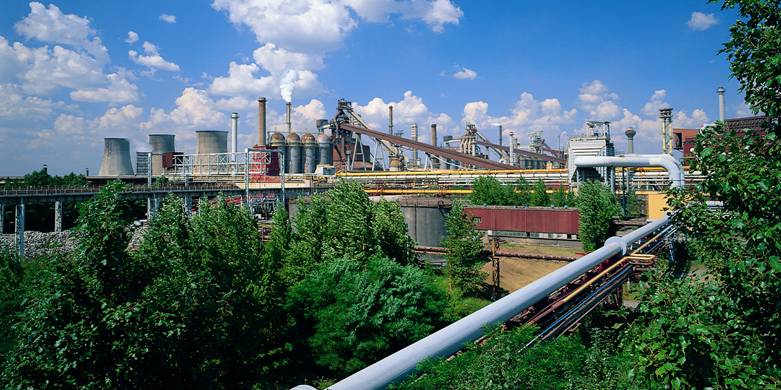
ArcelorMittal Poland contracts slag, coke infrastructure maintenance
ArcelorMittal Poland (AMP) has contracted a consortium of Remak-Energomontaz and Zarmen to carry out maintenance on its Dabrowa Gornicza slag granulation units and Zdzieszowice coke plant boiler and gas tank. The total value of the three contracts is PLN 71.4 million ($16.4m), says Remak-Energomontaz.
The revamp of the pumping station and technological pipelines for slag granulation units no.3 and no.4 at blast furnace no.2 at the flagship Dabrowa Gornicza steelworks is scheduled for completion by September 2023, Kallanish notes.
The repair of the K3 – ECII boiler at Zdzieszowice should be completed by January 2025, while gas tank no.3 at the coke plant should be repaired by December 2025.
Last month, AMP pushed back the restart of blast furnace no.3 at Dabrowa Gornicza beyond the end of the year after a recovery in European steel demand failed to materialise (see Kallanish passim). The steelmaker has guaranteed it will restart BF3 before BF2 begins its long-awaited maintenance, most likely next February or March.
Adam Smith Poland


German fabricators begin 2023 on pessimistic note
Germany’s steel and metals fabricating companies have expressed concern over order activity towards the end of the year 2022, and will carry their reservation into the new year.
Order intake in the third quarter for upcoming deliveries was 5% below the preceding quarter, according to association Wirtschaftsverband Stahl- und Metallverarbeitung (WSM). While this appears logical at first sight in the wake of the Ukraine invasion, the quarter-on-quarter drop in production was only 0.7%. This implies that the full impact of the war, and other negative factors, was yet to arrive. “The figures do not give reason to expect a promising last note to the year,” economist Holger Ade said in WSM’s latest statement on the matter.
In a year-on-year comparison, production in Q3 was actually 1% up on the corresponding 2021 period, which, however, had been particularly weak due to the semiconductor shortage. And, in fact, order intake was down a considerable 7% y-on-y, Kallanish learns from WSM. It therefore anticipates that the final figures for 2022 will show another drop of business, as they did already in 2021. “The lining on the horizon is not silver, and it is even greyer than it was in 2021,” the federation says in its statement.
Christian Koehl Germany

Belgian re-rolled coil exports increase: Benelux source
Exports of coil from Belgium rose notably in 2022, quite likely because of Russian slab rolled in the country and then sent overseas, says a source.
According to a Benelux market observer, exports of hot rolled coil from Belgium to Turkey increased fivefold last year. “This remarkably increased export was mainly originating from a Belgian steel rolling mill with Russian roots, which makes it from slabs supplied from Russia,” he tells Kallanish.
In another example of Russian steel indirectly coming to Europe, the observer says, some 40,000 tonnes of Turkish coils recently came to the UK, for which the base material is believed to have originated from Russia.
“Russia is reportedly trying to supply rolled steel to Europe via stealth routes, thus circumventing sanctions on various products,” the observer says. The European Commission has meanwhile become aware of the issue and prepared the way for banning Russian material processed in third countries.
In its eighth round of sanctions on Russia, the Commission said steel products processed in third countries using steel originating from Russia will not be accepted in Europe as of 30 September 2023 (see Kallanish passim).
A German distributor of plate adds that German warehouses have volumes of Russian material – finished as well as semi-finished – in stock which they cannot use. Much of it has not been fully paid, and will not be, he adds. “All that benefits Russia’s economy and businesses is banned now, and that includes residual payments,” he explains.
Christian Koehl Germany