

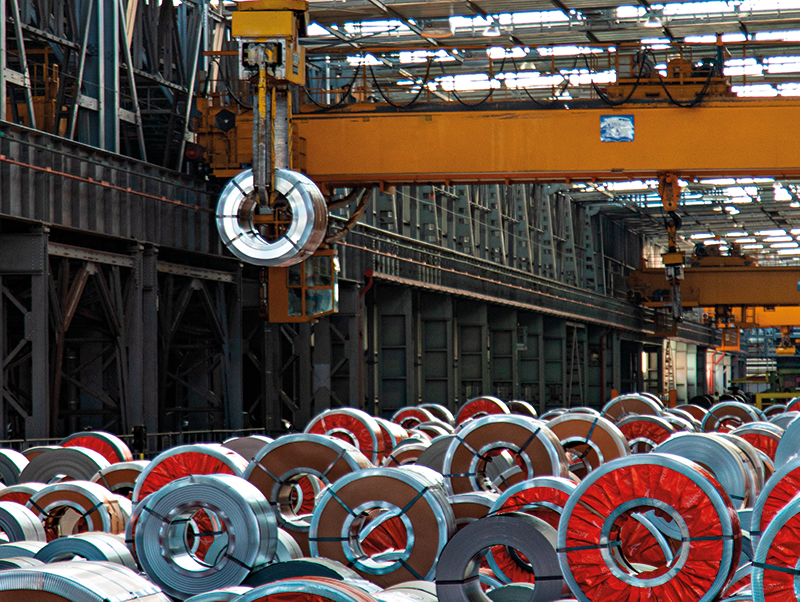
EU HRC: Mills hike offers further
European hot-rolled coil (HRC) prices climbed today as more participants returned to the market and mills hiked offers further.
The market leader tabled an offer of €760/t for March delivery HRC, up €30/t on last week. As a result, some smaller producers said they would be targeting €780/t delivered base into Germany and the Benelux. One seller suggested the market was around €715/t today, while a German buyer said several thousand tonnes was at €700/t on an index equivalent basis from domestic mills.
There was an expectation some of the rises would stick with costs for raw materials scrap and coking coal firming in recent days.
With slab sales into Turkey expected around $580/t cfr, plus rolling costs, freight and duties, this would equate to around €680/t cif Europe for HRC. Indian offers were also heard at a similar level from traders. Some said this made €780/t seem slightly aggressive, despite the apparent momentum in the market.
There was more talk of half-yearly contracts into the automotive supply chain being finalised around €800/t from one large producer.
Argus‘ daily northwest EU HRC index rose by €19.25/t to €708.25/t today, while the daily Italian index also surged by €19/t to €669.25/t ex-works.
An Indian mill offered at €680/t cfr south Europe today for HRC, €710/t for pickled and oiled material and €735-740/t cfr for cold-rolled coils (CRC). Other Asian mills were not yet offering, but were mulling increases, which traders said would be achievable, especially if domestic mills hold firm. A Korean producer was not offering HRC, but the price idea for CRC stood at around €740-750/t cfr south Europe. In any case Asia-Pacific producers may offer April shipments, which would mean early June consumption — too far in time for many buyers, which prefer to purchase on shorter lead times.
Some CRC was heard last sold from India at €715/t cfr south Europe. A bid for CRC to an Asian supplier was heard at €720/t cfr Italy. Traders reported that in the last week of December buyers had the option to purchase top-up HRC volumes on previous orders — done at €630/t cfr — at €650-660/t cfr. Some buyers were now looking to purchase at these prices, whereas others were waiting for offers from Egypt and Turkey. Late today some higher Turkish HRC offers were heard at $715-720/t fob, up from $700/t fob on Friday. Egypt last was on the market at €650/t cfr.
Domestic Italian producers appear to have lengthened their lead times, with material available for March deliveries, although one claimed it was sold out for the first quarter for some products, with offers at €700/t delivered for HRC and €800/t for HDG, which marked a €30-50/t increase on December. Participants said they expect the market to reach that level in the near future, but prices were not there yet. One sell-side source said customers were seeking more tonnages than previously agreed. Another sell-side source said they have achieved sheet sales at €70-80/t increase compared to the lowest levels in December.
Some said the recent uptick was driven by apparent demand from service centres that had not purchased for several months.
In the futures market, February traded at €740/t twice during the London morning on the CME Group’s north European contract. A February-March spread also traded at -€5/t, with the outright priced as at €745 and €750/t. A second quarter/third quarter spread later traded at €-10/t, with the outrights at €755/t and €765/t. Later on January traded at €730/t, after news of physical trades at €700/t spread.
Futures firm later in day
Prices also firmed on screen later in the day amid brisk trade. January traded at €730/t, up marginally, while February and March rose by €16/t to €765/t and €775/t, respectively. Further out, October-December was trading at €775/t, down €5/t from 6 January’s settlement.
Lora Stoyanova, Argus Media


Prices stable in European HRC market amid continued inactivity
Prices in the Northern European hot-rolled coil market remained stable on Friday January 6, reflecting a lack of activity after the Christmas and New Year holidays.
While some sources expect market conditions to improve in the coming year, others remain pessimistic about any significant pick-up in demand from the automotive sector, the key end-use sector for HRC.
Fastmarkets calculated its daily steel hot-rolled coil index, domestic, exw Northern Europe at €669.17 ($707.73) per tonne on Friday, unchanged from the previous day.
Rising contract prices and lengthening delivery times have added weight to the argument that prices will rise in the spot market, some sources suggested. Production cuts that have been in place since 2021 could also bolster prices over in the coming months, they said.
These indications of improved market conditions have resulted in mills targeting higher contract prices. With significant tonnages previously booked and deals with large customers still involved in contract talks, mills remain unlikely to drop prices to fill gaps in order books.
While sentiment appears to be recovering, uncertainty remains about whether demand will significantly improve over the coming year.
Contracts have been fixed based on price but not tonnage, meaning that mills may struggle to fill order books if customers only book minimum quantities, sources said.
Slow consumption in the automotive sector could pressure prices downward if mills are forced to lower prices to fill gaps in their order books.
A worsening recession that constrains demand in the automotive sector could in turn result in worsening market conditions over the coming year, one source indicated earlier this week.
Christmas holidays and Epiphany Saints Day resulted in no activity reported in the Italian HRC market on Friday.
As a result, Fastmarkets’ calculation of its daily steel HRC index, domestic, exw Italy was unchanged on Friday at €652.50 per tonne.
Published by: India-Inés Levy


CO2-armer Stahl: EMW und ArcelorMittal beschließen Kooperation

Die EMW Stahl Service GmbH und ArcelorMittal gehen den Weg Richtung Dekarbonisierung Hand in Hand. Der weltweit führende Stahlhersteller wird dem Stahl-Service-Center aus Neunkirchen im Siegerland ab diesem Jahr emissionsarmen Stahl sowie Zertifikate für CO2-Einsparungen liefern. EMW will bis 2030 klimaneutral in Scope 1 und 2 sein, ArcelorMittal strebt in Europa eine Reduzierung der CO2-Emissionen um 35 Prozent bis 2030 an, weltweit klimaneutrale Produktion will der Konzern bis 2050 erreichen.
Im Zuge ihrer Klimastrategien weiten die beiden Unternehmen 2023 ihre Partnerschaft aus. EMW erhält von ArcelorMittal Commercial Germany Stahl der Dachmarke XCarb® mit einem geringen Kohlenstoffanteil. Die XCarb® recycelt und erneuerbar hergestellt-Stähle werden auf Basis von Schrott (70 Prozent) und erneuerbarem Strom (100 Prozent) produziert. Der reduzierte CO2-Fußabdruck ist mit einer offiziellen Umweltproduktdeklaration (EPD) bestätigt. Die CO2-Emissionen pro Tonne Stahl betragen mit 797 kg pro Tonne Stahl nur noch ein rund ein Drittel im Vergleich zum gleichen Stahlprodukt, das konventionell im Hochofen mit 2,57 Tonnen CO2 pro Tonne Stahl hergestellt wurde.
ArcelorMittal bietet EMW den XCarb®-Stahl in den gewünschten Mengen an und stellt auch die technische Unterstützung bereit. EMW wiederum wird den Stahl mit herstellungsbedingt eingespartem CO2 an seine Kunden und Endverbraucher weitergeben.
„Unser eigenes ehrgeiziges Ziel ist die Klimaneutralität bis 2030. Dafür haben wir bereits zahlreiche Projekte und Aktivitäten in unserer Organisation gestartet. Ebenso wichtig in diesem Zusammenhang sind aber auch die Vereinbarungen mit unseren langjährigen Partnern wie ArcelorMittal zum Bezug von CO2-armenStählen, um den vollständigen Scope abbilden zu können“, sagt EMW-Geschäftsführer Michael Mockenhaupt.
Neben dem physisch gelieferten Stahl wird EMW weiterhin Stahl mit XCarb® Green-Steel-Zertifikaten von ArcelorMittal erwerben und damit nachweislich die CO2-Reduzierung dokumentieren. Die CO2-Minderung in diesen Zertifikaten beträgt 2,11 Tonnen CO2 pro Tonne Stahl und stammt aus bahnbrechenden Projekten an Hochöfen. Die CO2-Einsparungen werden auf einem zentralen Konto massenbilanziert und unabhängig verifiziert.
„Wir freuen uns über die Vereinbarung mit EMW und sehen generell ein erhöhtes Interesse unserer Kunden nach klimafreundlichen Produkten. Dank der XCarb® Green-Steel-Zertifikate können die Kunden, die unsere Zertifikate erwerben, die CO2-Einsparungen direkt in ihren Scope 3 einfließen lassen und so auch ihre Nachhaltigkeitsziele erreichen“, erklärt Jochen Grünewald, Managing Director von ArcelorMittal Commercial Germany.
Die EMW ist ein Stahl-Service-Center innerhalb der weltweit agierenden Schäfer-Gruppe und liefert Coils, Spaltbänder, Zuschnitte und Ronden an die stahlverarbeitende Industrie. Die Siegerländer stellen bereits ein umfangreiches Sortiment an CO2-armen Stählen zur Verfügung.
Für seine Kunden in der weiterverarbeitenden Industrie nimmt EMW unter anderem Magnelis®-Flachstähle von ArcelorMittal ab, die beidseitig beschichtet besonders widerstandsfähig gegenüber Korrosion und vielseitig einsetzbar sind.
Bildtext: EMW und ArcelorMittal beschließen Kooperation zur Lieferung von CO2-armem Stahl (v.l.): Holger Latsch (Einkaufsleiter EMW Stahl Service GmbH), Rainer Böse (CMO Industry North, ArcelorMittal Europe – Flat Products), Beate Schäfer-Henrichs (Gesellschafterin SCHÄFER WERKE), Jutta Schäfer-Hillenberg (Gesellschafterin SCHÄFER WERKE), Michael Mockenhaupt (Geschäftsführer EMW Stahl Service GmbH), Markus Jansen (Senior Key Account Manager, ArcelorMittal Commercial Germany).
Quelle und Foto: ArcelorMittal Germany GmbH
von Hubert Hunscheidt


German steel market expects prices to remain firm: S&P Global survey
German steel traders were more bullish on price trends over January than producers, according to S&P Global Commodity Insights’ monthly steel sentiment survey.
Producers also expected prices to increase but to a lesser extent than traders, the survey found.
The January index for traders’ sentiment was 78.5 points, compared to 75 points in December. The index for producers’ sentiment fell to 68.75 points, from 75 points in December. The overall January index for prices was 74 points, from 75 points in December.
“Expectations are somewhat positive, especially on the sell-side. Mills are increasingly firm on what offers are available, and sentiment is that prices will increase, not to the same extent as last year or the year before but some people do still have those rallies in the back of their minds — they are not looking to restock fully and are keeping some things open for if prices go the other way,” one German flat steel distributor said.
Platts assessed TSI North European Hot-rolled coil unchanged day on day at Eur700/mt ($742/mt) ex-works Ruhr on Jan. 5, according to S&P Global data.
One long steel producer said the mill planned further prices hikes in January.
“Costs are high and with uncertain forecasts for energy and scrap prices, we just cannot produce like this any longer. We are already cutting down production,” the source said.
Platts weekly assessment of TSI Northwest Europe Rebar was unchanged at Eur745/mt ex-works on Jan. 4, according to S&P Global data, while European medium sections (category 1, S235 JR) was unchanged at Eur980/mt delivered.
The overall index for German inventory sentiment stood at 44 points, down from 41 points in December. Traders and stockholders were bullish regarding expected inventory levels during the month, while producers remained firm on their expectations on month.
The index for steel producers for December was stable at 37.5 points. The index for traders’ sentiment stood at 50 points for January compared to 45 points in December.
“A lot of restocking was done in December so activity could struggle in January. The macro picture remains ugly, we see this as a restocking rally following such a brutal sell-off last year,” one flat steel trader said.
One long steel distributor expected inventory levels to increase during January adding that there is a need for restocking in the market.
“Inventories are low,” the long steel producer said. The source noted that, according to the market information, medium section distributors reported low to medium stocks and were awaiting greater clarity on prices.
“They think prices will drop further but I do not see prices bottoming out anymore. So, they will need to restock in January,” the source said.
Production levels
Market participants continued to expect production levels to soften over the month of January. The index for production outlook stood at 27 points for January, compared to 30 points in December. Producers anticipated a stronger decline in production levels with an index of around 12.5 points for the month, compared to 25 points in December.
Traders and stockholders, however, expected production levels to strengthen according to the survey, with a current index of 43 points, compared to 35 points in December.
“A lot of mills are planning extended maintenance … so will be opening late in January, which would mean that production levels will be low for the month,” the long steel producer said.
“Mills have a longer shutdown period and will only start production in the second week of January,” the long steel distributor source said adding it should lead to lower production levels during the month.
— Rabia Arif


Imminent increases indicated for European HRC, lead times extend under improved supply-demand balance
While prices in the European hot-rolled coil market remained stable Jan. 6, market participants were bullish on near-term trading in anticipation of offer increases.
Mill sources confirmed Eur700/mt ex-works Northern Europe as a target price for the week beginning Jan. 2, seeing growing acceptance from buyers to higher price levels.
Buyers were heard as attempting to sustain December prices of around Eur650-660/mt ex-works Ruhr through the week, but gradually increased bids to Eur680-700/mt ex-works toward the week’s end.
However, a mill source reported that even the higher end of said bids were rejected on the day – in a signal of higher prices to come week beginning Jan. 9.
“It seems there’s some momentum in the market,” said the source. “All agree that the lowest of prices are gone, and the mills will follow the same bullish routine in weeks to come to give support to increased offers. Mills, service centers, distributors – no one is profiting at Eur600/mt.”
Market participants expected official increases of around Eur50-100/mt, seeing the tradable level rising to around Eur730-750/mt in the near-term, ex-works Ruhr and Northern Europe.
Higher prices indeed seem more sustainable than in last year’s trading context, with supply and demand better aligned after production cuts across the market.
Lead times from some European mills were heard as now extending into April, though most could still offer March delivery.
Platts assessed hot-rolled coil in Northwest Europe stable Jan. 6 at Eur700/mt ex-works Ruhr.
Platts is part of S&P Global Commodity Insights.
— Benjamin Steven

European plate prices strengthen on new year optimism
The European heavy plate markets moved higher Jan. 6, with bullish expectations for the year given strong spot activity in December and ongoing infrastructural projects.
In Northern Europe, limited tonnage deals were reported at higher levels of around Eur950/mt ex-works for 10-40 mm material — with thinner products and special, project grade material offered at a large premium due to reduced availability.
“For 5-8 mm material and some project-grades we can achieve at least Eur100/mt extra — it seems stockholders are having a lot of difficulty in sourcing thinner material in particular,” said one mill source.
“There are big differences between commodity and project materials at the moment,” a distributor added.
Mill sources said they considered Eur950-1,000/mt as a target price for commodity grades — an increase from indications at around Eur900/mt ex-works reported in previous weeks.
Distributors were slightly less bullish, with tradable value cited at around Eur925/mt ex-works Northern Europe.
That said, there is a large spread of offers available for heavy plate in the Northern market, with one German mill reportedly holding offers above the Eur1,000/mt mark, ex-works Ruhr. Ex-stock plate was heard in a Eur1,000-1,075/mt range in the Northern market for s355 grade.
An offer was also heard on a delivered basis from the Italian market, at Eur960/mt delivered Germany ex-Italy, normalizing to roughly Eur900/mt or below for ex-works.
Indeed, sources considered tradable value for Italian heavy plate on a fairly wide range of Eur840-900/mt ex-works on the day, with producers in the South European market attempting to push prices by Eur30-70/mt on successful December trading.
“Those mills that had lower prices in December saw strong bookings for the first quarter and so are asking for a lot more now,” said a distributor. “Even the mills with higher prices are looking for increases and succeeding with Eur20-30/mt jumps — now they want another Eur30-40/mt.”
“We expect a strong year for heavy plate from a seller’s perspective,” the distributor added.
In terms of input costs for the re-roller-heavy Italian market, slab prices were assessed stable on the day at $640/mt CIF Italy, with offers reported at around $600-650/mt CIF in recent weeks.
Traders said they doubted whether the low end of said range could still be achieved however, with tradable value perceived higher at $630-650/mt CIF on the day.
“It’s hard to say what’s achievable at the moment give the rise in scrap prices,” said a trader. “A week ago I’d have said $600-630/mt was reasonable, but it should probably be higher now.”
Platts assessed heavy plate in Italy at Eur880/mt ex-works on the day, with North European prices assessed higher at Eur925/mt ex-works Ruhr.
Platts is part of S&P Global Commodity Insights
— Benjamin Steven

Lech Stahlwerke gets permission to lift production
Lech Stahlwerke (LSW), a long products mill of Germany’s Max Aicher group, has received permission to bring up its nominal crude steel production by approximately one third to 1.3 million tonnes/year.
The maker of rebar as well as special bar grade was until now legally limited to 1m t/y. It repeatedly achieved higher tonnages in recent years, but for each year needed special permission from the local authorities. Technically, the mill over time has gained the capacity to make up to 1.4m t/y, as it shortened standstill times and melting intervals at its electric arc furnace.
In order to obtain permission for permanent higher production “we have invested massively in environmental protection, and will continue to do so,” spokeswoman Angela Aicher tells Kallanish. The decision provides a legal basis for future investments in the mill, she adds.
The group last year launched its initiative “LOCAS”- Low Carbon Steel from Bavaria, promoting its ambition for environmentally sound production. Based in Meitingen near Augsburg, LSW is the only steel mill with a liquid phase in Bavaria. Also located further southwest in the state is Annahütte, a rolling and drawing mill for special long products, also owned by Max Aicher.
Christian Koehl Germany


Production costs may push up French rebar prices
French rebar prices remain stable compared to December but despite the end of the holiday on 2 January, many buyers are only now reopening and executives are resuming work.
The market has been particularly quiet in the first week of January while the rest of Europe was still on holiday. Before the Christmas break, in December, France finally shook off the long-lasting rebar stagnation. Distributors tell Kallanish that overall, the month of December resulted in good sales after a very slow beginning. Both producers and distributors are expected to post record results.
Some restocking and an improved level of demand is expected in the national and export markets in January. Today the issue carbon and stainless steelmakers are facing is high energy prices which is forcing some to work nights or only a few days per week.
Scrap prices are likely to increase significantly this month in France like in other European countries and energy is expected to remain fairly expensive. If rebar demand surges, some moderate hikes for rebar and other long products may be necessary, some sources believe.
Rebar prices remain steady for the moment. Including size extras, domestic contracts hover at €730-750/tonne ($766-788) ex-works, sources suggest.
Natalia Capra France

Italian rebar demand expected to rise, prices stabilise
Italian rebar prices remain stable compared to last month but producers increased their asking values before shutting down production for the Christmas holiday break. Market activity is expected to resume on Monday 9 January as all Italian rebar makers are restarting production after two weeks’ stoppages, market sources tell Kallanish.
This week, mills are asking for €560/tonne ($588) base ex-works. This is up from last month’s €520-530/t base ex-works after several attempts to increase prices above €550/t base ex-works.
Agents and sales executives expect an increased level of orders in the coming days after a few days of wait-and-see attitude. The buyers which spoke to Kallanish will try to resist all increases. Uncertainty and high prices caused slow sales in Q4 last year with customers in the construction sector refusing to accept any price hikes. So far rebar contracts in Italy are mostly stable in the range of €500-520/t base ex-works. Including size extras, domestic rebar prices have flattened at €760-790/t ex-works. Mesh also remains at €610-620/t ex-works base, sources suggest.
Buyers see a struggling construction sector, and slow demand also caused by subsidy cuts in budget spending this year. The financial support from the European recovery fund has yet to reach Italy and uncertainty is expected to drag on sales in January after a relatively slow December. The national institute of statistics Istat said last month that construction activity in Italy ticked down in October. Scrap and energy prices however are seen supporting rebar values as they are set to increase in all European countries, Kallanish notes.
Natalia Capra France