

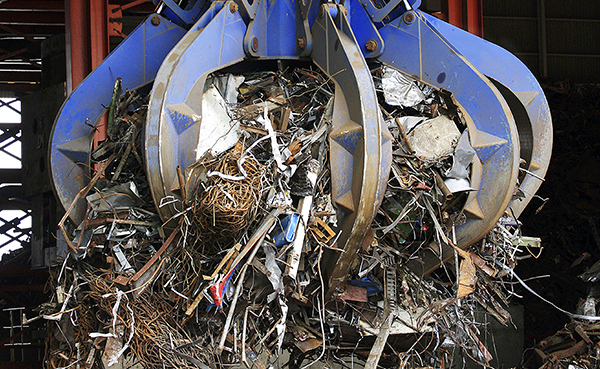
Polish scrap merchants replace Turkey with India exports
Polish scrap exports to the Indian subcontinent surged 76% on-year in January-November 2022 to 517,682 tonnes, according to data from Poland’s Central Statistical Office (GUS) monitored by Kallanish.
Shipments to India saw especially large growth, reaching 236,225t versus 56,364t in January-November 2021, while exports to Bangladesh surged 158% to 144,326t.
Shipments to Pakistan nevertheless dropped 25% to 137,132t.
Scrap exports to traditionally largest market Turkey slumped by two thirds to 176,742t.
Overall Polish scrap exports nevertheless dropped 22% in January-November 2022 to 2.09 million tonnes.
Polish coking coal exports meanwhile slumped 39% in January-November 2022 to 1.67mt, due to halved shipments to Ukraine and almost 500,000t less dispatched to Czech Republic.
According to worldsteel data, Polish crude steel production dropped 8% on-year in the 11 months to 7.16mt.
Adam Smith Poland


French rebar market continues to stagnate
The French rebar market is seeing a prolonged deadlock. After reporting weak sales in January, sellers and buyers say uncertainty remains and sales volumes are low. Since the last quarter of 2022, the country has been witnessing significantly lower consumption both on the domestic and export market, Kallanish hears.
Distributors say the local construction sector has orders in hand, but contractors are refusing to commit to volumes given the current uncertainty. Stock levels are not high at rebar buyers’ yards, who prefer to continue buying back-to-back or are adopting a wait-and-see attitude. Other producers in European countries such as Italy and Spain are dealing with the same stagnating market while trying to keep their prices from falling.
Domestic rebar prices have lost some €40/tonne ($42) on average compared to January and are hovering at €670-710/t delivered, depending on quantity, sources suggest.
Sentiment among French construction companies deteriorated in January. According to the latest l’Institut National de la Statistique et des Études Économiques (Insee) report, the construction firms surveyed were less optimistic than in December regarding their expected and past activity (see Kallanish 31 January).
Natalia Capra France

European HRC producers have no intention of lowering prices despite quiet trading
Steel mills in Europe are still hoping to achieve higher prices for second-quarter-rolling hot-rolled coil, despite buyers making no purchases at all on Tuesday February 14, Fastmarkets understands.
On Monday, leading European steelmaker ArcelorMittal raised its offer prices for May-delivery HRC by €20 per tonne, to €820 ($877) per tonne delivered, but the market participants put the workable price at between €750 and €770 ($802-823) per tonne ex-works.
“Mills have good order books, they are not hungry for orders and there is no pressure from their side,” a trading source in Germany said. “And we see stock levels at steel service centers are getting lower and there are gaps in some dimensions and grades [of HRC].”
Producers in Northern Europe have mostly sold out of April-delivery coil, sources told Fastmarkets.
“The lead time [for HRC] is about seven or eight weeks now,” a second trader in Germany said.
Market participants said they expect European buyers to come back to the market to restock with May-delivery volumes in about two weeks’ time.
“There is a chance that higher offers will be accepted in deals, even though the demand from the automotive and construction sectors is not booming,” a distributor in the Benelux area said. “But mills are in a better position than buyers right now and, of course, there are practically no competitive import offers.”
Fastmarkets calculated its daily steel HRC index, domestic, exw Northern Europe at €765.63 ($818.57) per tonne on Tuesday, down by €2.15 per tonne from €767.78 per tonne on Monday.
But the latest calculation of the index was up by €10.63 per tonne week on week and by €54.92 per tonne month on month.
Fastmarkets’ calculation of its corresponding daily steel HRC index, domestic, exw Italy, was €756.25 per tonne on Tuesday, down by €0.42 per tonne from €756.67 per tonne on Monday.
The latest calculation of the index was, however, up by €6.67 per tonne week on week and by €59.62 per tonne month on month.
Offers of April-May delivery coil from integrated mills were heard at €780-800 per tonne delivered – equivalent to €760-780 per tonne ex-works.
But market participants said that one integrated producer in the south of Italy was overbooked and was, therefore, delaying orders.
Buyer estimates of achievable prices were heard at €770-780 per tonne delivered (€750-760 per tonne ex-works).
Import offers were rare in the market on Tuesday, however, although one trading source in Italy reported an offer from an Indian supplier at €720 per tonne CFR to Italy, albeit for a limited tonnage.
April-shipment HRC from South Korea was on offer to Italy at $810 per tonne CFR.
And an offer of April-shipment HRC from a Japanese mill was heard at €775 per tonne CFR, but this was not considered workable by buyers.
Buyers indicated their idea of a workable price for imports in Southern Europe was no higher than €740-750 per tonne CFR.
Turkish suppliers, who can usually offer short lead times compared with the Asian mills, remained out of the market because of the disruption caused by last week’s earthquakes.
Published by: Julia Bolotova


ArcelorMittal Poland restarts BF No. 3 to replace BF No. 2 during relining
ArcelorMittal Poland resumed operations at blast furnace No. 3 in January to substitute production from furnace No. 2 at the Dabrowa Gornicza plant, the company’s spokesperson told S&P Global Commodity Insights Feb. 14.
The steelmaker currently is preparing BF No. 2 to be stopped in the first quarter for an extended overhaul.
“In order to maintain production and guarantee undisturbed supplies to our customers, we restarted, in early January, BF No. 3 that had been stopped since October,” the spokesperson said. BF No. 3 had been idled in response to declining demand for steel and surging production costs in Europe.
ArcelorMittal’s European operations produced 31.9 million mt of crude steel last year, down 13.3% from 2021.
— Maria Tanatar

INTERVIEW: Steel mills in Turkish earthquake zone may close for a month: TCUD
Turkish steel mills in the regions of the Feb. 6 earthquakes may remain closed for around a month until workforce, logistics and power cut problems are resolved, Turkish Steel Producers’ Association (TCUD) General Secretary told S&P Global Commodity Insights Feb. 14.
No notable damage was reported at production facilities, Veysel Yayan also said.
“Producers in the region have focused on rescue efforts and life support services in recent days, as many workers and their families have been affected by the earthquakes,” Yayan said.
Iskenderun Demir ve Celik (Isdemir), the country’s largest integrated long and flat steelmaker with a liquid capacity of 5.8 million mt, said Feb. 13 it had suspended production until due diligence studies were completed.
At least four other steelmakers in the region issued a joint force majeure notice Feb. 12, citing the president’s decree introducing a three-month state of emergency in the impacted regions.
Large steelmakers in the region produce more than 30% of Turkey’s steel, Yayan said, adding that steelmakers in other regions would be able to meet demand in the interim.
Turkey has enough production capacity to meet the expected rise in steel demand in coming months as reconstruction begins, with producers set to prioritize domestic demand over exports, Yayan said.
“This move will also prevent a sharp rise in steel prices in the country,” Yayan said, adding that increases seen in domestic flat steel prices in recent days were in line with global prices.
Some trade sources have reported increases of around $40-$50/mt in coated flat steel offer prices in recent days, although long steel prices have remained largely stable amid subdued trade.
Platts, part of S&P Global, assessed Turkish imports of premium heavy melting scrap 1/2 (80:20) at $427.50/mt CFR on Feb. 13, and Turkish exported rebar at $700/mt FOB, both unchanged day on day.
— Cenk Can
ArcelorMittal raises coil offers across Europe, other mills follow
ArcelorMittal has increased its offer prices for steel coil in Europe by about Eur20/mt ($22/mt) and some other mills have also increased theirs, supported by a combination of full order books and lack of competitive import offers, market sources said Feb. 14.
New offers from ArcelorMittal were said to be at Eur820/mt delivered for hot-rolled coil and Eur940/mt delivered for hot-dipped galvanized coil in Germany.
“Import offers are limited in numbers, and prices we get are for long lead times,” a European service center said. “Even if someone decides to buy with additional transportation costs by land the price would be similar to those available from European mills. So, more people turn to domestic mills, and it helps the price rise.”
May-June rolling material has been available in Germany and second quarter production in the rest of Europe, sources said.
Platts assessed domestic prices for hot-rolled coil in Northwest Europe at Eur765/mt ex-works Ruhr on Feb. 13.
Prices in Central Europe have been at similar levels on delivery basis, sources said.
An Italian source said offers from ArcelorMittal have moved up to Eur800/mt delivered Italy for HRC.
Some other European steelmakers have also increased offers to the similar rates, according to market sources. An Italian producer said they have already been offering HDG at about Eur940/mt delivered over the past couple of weeks.
Demand
Demand has remained stable and was expected to continue little changed in the near term, according to market sources.
As a result, the price increase is likely to be gradually accepted by the European buyers.
“I think this approach of the mills when they increase prices by about Eur20/mt over the latest deals is smart,” an Italian service center said. “The increase is reasonable. It is both unavoidable in the current market, but it is also manageable.”
— Maria Tanatar