


INTERVIEW: Primetals confident EU steel industry will hit decarbonization targets
The EU steel industry is on track to achieving its decarbonization goals supported by new mechanisms like the Emissions Trading System (ETS) and the Carbon Border Adjustment Mechanism (CBAM), according to Primetals Technologies’ head of green steel.
“The politicians have finally recognized that the steel sector is one of the most important ones to transition to green production if we want to see the pledged CO2 reduction levels in the EU,” Dr. Alexander Fleischanderl told S&P Global Commodity Insights on Feb. 28.
According to the European Commission, carbon emissions and energy use in European steel production have been halved since 1960, and the sector has the ambition to further achieve cuts of between 80-95% by 2050, compared to 1990 levels.
Fleischanderl highlighted the importance of EU funding regulations like the Clean Steel Partnership (CSP) and Carbon Contracts for Difference (CCfD) alongside the adoption of low-carbon steel labelling and the creation of a premium price segment to enable the steel industry to make a successful transition to low-carbon production practices.
In addition, he noted that there have been numerous public decarbonization commitments from leading steel producers such as ArcelorMittal, Thyssenkrupp Steel Europe, and Salzgitter in recent weeks, with the industry clearly moving from pledges to execution.
“Green steel is currently the main facilitator in Europe as most of the established steel producers are now looking for electric arc furnaces, direct reduction plants and other technologies enabling them to reduce their CO2 footprint,” said Fleischanderl.
“This makes Primetals Technologies confident that the EU steel sector will achieve the targets,” he added.
According to the Fleischanderl, demand for low-carbon steel remains limited, accounting for around 1% of the global market, due in large part to ongoing ambiguity surrounding the definition of “green steel”.
The question of how to classify different categories of steel based on carbon emissions is currently being decided under the lead of the European Steel Technology Platform and the European Steel Association, or Eurofer.
According to Fleischanderl, the EU system for categorizing green steel will most likely be determined by scrap content.
“Green steel will likely be classified with the label A, and the threshold value for the carbon footprint will depend on the so called “sliding scale” principle, which means the more scrap used as secondary raw material, the lower the threshold value,” he said.
Fleischanderl said the goal is to eventually create a premium price segment for the green steel label to offset the higher production costs arising from investing in new low-carbon technologies based on renewable electricity and hydrogen.
“The expectation is that green steel will outperform the market, and the public purchasing side could become an accelerator through the construction of green rails, bridges, buildings, etc,” he said.
On existing steel demand, Fleischanderl said that sales in Europe were “fairly high”, particularly to the automotive sector, with demand expected to remain high for the remainder of 2023.
Platts, part of S&P Global Commodity Insights, assessed domestic prices for hot-rolled coil in Northwest Europe stable at Eur805/mt ($859/mt) EXW Ruhr Feb. 28, up 33.0% from a two-year low of Eur605/mt on Nov. 24.
— Euan Sadden


Germany’s ThyssenKrupp Steel orders direct reduction plant in bid to decarbonize
Germany’s ThyssenKrupp Steel said March 1 that it has ordered a hydrogen-powered direct reduction plant from Dusseldorf-based engineer SMS to launch one of the world’s largest industrial decarbonization projects, set to eliminate more than 3.5 million mt/year of CO2 emissions.
SMS will carry out engineering, delivery and construction of the direct reduction plant at ThyssenKrupp’s Duisburg site in western Germany, along with two innovative smelters, and associated auxiliary units, in a Eur1.8 billion project that represents the largest single order in SMS’ 150-year history.
In total, ThyssenKrupp Steel has said it aims to reduce its CO2 emissions by 6 million mt/year — or 30% — by 2030.
At present, the Duisburg site emits over 17 million mt/year — and potentially up to 20 million mt/year — of CO2 because of its coal-powered hot iron production using blast furnaces, the company has said. It is responsible for 2.5% of Germany’s CO2 emissions, although installation of the first direct reduction plant will reduce the facility’s emissions by 20% or by 3.5 million mt/year.
The plant will have 2.5 million mt/year of direct-reduced iron (DRI) capacity and is set to come online by the end of 2026.
ThyssenKrupp said that the hydrogen-based direct reduction furnaces will offer a significant basis for manufacturing carbon-neutral steel in the future, adding that it plans to have completed its move into hydrogen-based steel production by 2045 at the latest.
— Ekaterina Bouckley
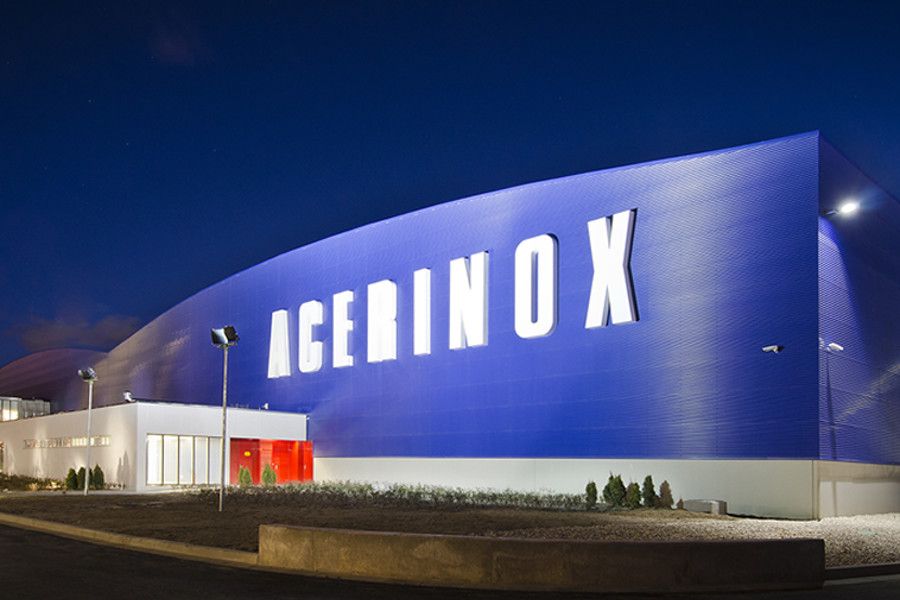
Spain’s Acerinox Q4 steel output down 37% on year
Spanish stainless steel group Acerinox’s melting shop production fell 37% year on year to 397,000 mt in the fourth quarter of 2022 amid low apparent demand and inventory adjustments, it said late Feb. 28.
For the full year production was down 16% at 2.2 million mt.
Q4 volume from its cold-rolling operations was 247,000 mt, down 42% year on year, with the full year volume down 11% at 1.4 million mt.
Longs production was down 24% year on year at 48,000 mt in Q4, with full year volume down 5% at 232,000 mt.
The company operates plants in Spain, the US, South Africa and Malaysia with a combined melt shop capacity of 4.5 million mt/year, as well as production facilities for high performance alloys in Germany.
It did not provide production figures for individual plants.
Platts, part of S&P Global Commodity Insights, assessed hot-rolled coil prices in Northwest Europe up Eur10/mt on the day to Eur805/mt ex-works Ruhr Feb. 28.
From the third quarter onwards, production had been adapted to the needs of the market, Acerinox said. It also carried out maintenance at the melting shop and hot rolling lines in Spain, the melting shop in South Africa and its hot rolling in the US.
In Europe, actual demand declined due to the uncertainties arising from the invasion of Ukraine, which resulted in inventories closing above the average of recent years.
The company said it booked a Eur98 million ($104 million) inventory adjustment at year-end to bring its European inventories in line with the price situation of that market.
Cost inflation, especially energy costs, dented competitiveness in Europe, especially in Spain, it said, while imports into the region remained at high levels at the end of the year, largely due to the price spread with Asia.
The company also booked a Eur204 million impairment at re-roller Bahru Stainless in Malaysia due to weak demand in the Asian market amid oversupply and aggressive pricing strategies by other producers, it said.
The company said it currently expected the dynamics of H2 2022 to continue, with the apparent consumption improving, although still slow.
The North American market was the best performer, it said.
The company’s US unit, Kentucky-based North American Stainless plans to increase production capacity by 20% to 200,000 mt/year with an investment of $244 million to install new cold rolling trains and upgrade its annealing and pickling lines.
— Gianluca Baratti

European domestic rebar, sections market anticipates price hikes
The European longs market was expecting higher price movements on the back of energy and scrap costs and limited import availability for rebar, but the market still had yet to absorb higher offers, sources said March 1.
Several sources said that one mill that had been out of the market over the last week had increased their offer prices by Eur30/mt on March 1 based on energy and higher scrap costs.
“Some mills are catching up so I wouldn’t really see it as a price increase,” a Southern Europe-based producer said. “It is still not clear where the market is, we have to see next week.”
The producer reported a workable level of Eur960-Eur970/mt delivered Northwest Europe for medium sections category 1, adding prices at Eur940/mt were not achievable anymore.
A Benelux-based distributor put workable levels for medium sections category 1 at Eur950-Eur960/delivered Northwest Europe.
A Benelux-based trader said that for rebar, customers were not in immediate need for booking material due to restocking in late 2022 and early 2023. He put offer prices from European mills at Eur710-Eur715/mt delivered Northwest Europe, with some room for negotiation.
Sources said due to the current focus of Turkish mills on the domestic rebar market, import volumes to Europe were expected to be low this year, supporting European mills’ prices on top of increasing scrap costs, while energy costs would remain high.
A Europe-based mill source said they would need to pass on higher production costs to customers, and that prices in Northwest Europe had been subdued for some time.
Platts assessed the weekly assessment for rebar at Eur705/mt EXW Northwest Europe March 1, stable on the week. The weekly medium sections assessment moved up Eur5 on the week to Eur945-Eur955/mt delivered Europe.
Platts is part of S&P Global Commodity Insights.
— Laura Varriale

EU HRC prices set to rise on anticipated restocking, higher offers
European domestic prices for hot-rolled coil are expected to gradually rise as buyers expect to start restocking soon, sources said March 1.
ArcelorMittal has increased its coil offers by Eur20/mt across Europe. New offers for HRC in Germany reached Eur840/mt ex-works Ruhr and in Italy, at Eur820/mt delivered.
The positive mood in the market has been supported by a combination of good order books from the mills, a lack of competitive import offers, and an anticipated rise in demand.
The majority of the European steelmakers have already been offering May shipment HRC. The scheduled restart of some idled furnaces in March-April will not have an immediate impact on supply and prices, sources said.
Import offers have been available only for material from Asia with delivery in July-August, making more buyers turn toward European mills for orders.
“Only import you can get is from Asia and the lead times are long,” an Italian service center said. “Turkey is not exporting and will not export for quite some time after the earthquake. So buyers will focus on domestic purchases and would book limited volumes from overseas.”
Demand from end consumers has remained stable and a significant increase is unlikely in current economic conditions, according to the estimations of market sources. Distributors, however, have lower stocks of flat steel products and they would need to return to the market looking for orders soon.
“Now we do not have many orders, but it seems that the buyers would need to restock in a couple of weeks and then the prices will rise,” a European steelmaker said.
Platts assessed domestic HRC prices in Northwest Europe at Eur805/mt EXW Ruhr March 1, unchanged.
The assessment was based on deals reported around Eur800/mt EXW Ruhr, tradable values heard at Eur800-820/mt EXW Ruhr, and offers at Eur820-840/mt EXW Ruhr.
In Southern Europe, Platts assessed domestic prices for HRC at Eur785/mt EXW Italy March 1, up Eur5 on the day.
Transactions and tradable values have been reported at Eur780-790/mt EXW Italy and offers at Eur800-820/mt EXW Ruhr.
The number of import offers has been limited, exporters from Asia are expected to return to the EU market with higher offers next week.
Offers of HRC from India have been heard at Eur740/mt CIF Italy and from the Far East at Eur750-760/mt CIF Italy.
Platts is part of S&P Global Commodity Insights.
— Maria Tanatar