

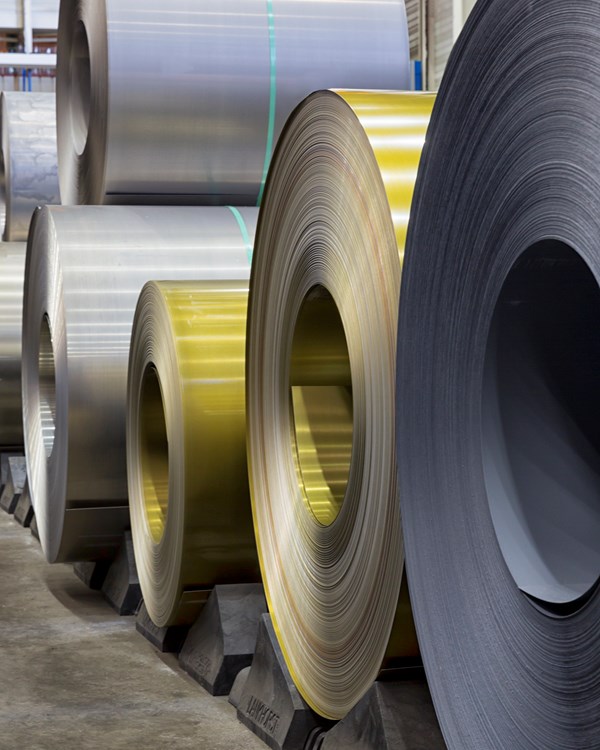
EU CRC, HDG prices rise on reduced availability
Domestic prices for cold-rolled and hot-dipped galvanized coil have increased in Europe in the week to March 8 supported by reduced supply and good order books of the mills.
Platts assessed domestic prices for cold-rolled coil in Northwest Europe at Eur940/mt ex-works Ruhr, up by Eur15/mt on day and up by Eur35/mt on week.
The assessment was based on tradable values reported at Eur930-950/mt ex-works Ruhr.
The assessment for the domestic hot-dipped galvanized coil prices in the region also increased by Eur20/mt on week to Eur950/mt ex-works Ruhr on March 8.
A deal has been reported at Eur950/mt ex-works Ruhr and the average tradable values – at Eur950-970/mt ex-works Ruhr.
One steelmaker also indicated that they were aiming for Eur1,000/mt ex-works Northwest Europe for contracts, but the price was deemed as unworkable by majority of sources.
The price rise has been supported by full order books of the steelmakers. The European mills have been offering late May-July delivery downstream coil and they felt pressure to give discount to sell volumes, sources said.
End user demand, in the meantime, remained stable and end consumers have been rejecting higher prices. As a result, distributors have been focused on purchases of smaller lots of coil.
The technical issues at the cold-rolling mill at Tata Steel in the Netherlands, that made the mill to invoke force majeure, has also contributed to the bullish mood in the market.
“Supply is less due to Tata Steel situation for sure. I heard that they booked a bit volume of CRC from a German mill to be able to produce needed HDG volumes,” a German service center said. “So CRC volumes are down, and it seems that dome HDG specifications will be in shortage.”
European buyers have not been able to substitute domestic supply with import due to longer lead times – arrival late July-August, risks related possible changes in safeguard measures after the review in June and uncertainly in the upwards tend sustainability through summer.
Platts assessed domestic prices for cold-rolled coil in South Europe at Eur900/mt ex-works Italy on March 8 , up by Eur10/mt on day. Market sources estimated tradable values at Eur880-920/mt ex-works Italy and offers have been reported at Eur950/mt delivered Italy.
Platts assessed domestic hot-dipped galvanized prices up by Eur20/mt on week to Eur930/mt ex-works Italy on March 8. The assessment was based on achievable prices heard at Eur910-950/mt ex-works Italy and offers reported at Eur950/mt delivered Italy.
Platts is part of S&P Global Commodity Insights.
— Maria Tanatar


Prices stable in rebar, wire rod markets in Northern Europe amid poor demand
The Northern European long steel market remained quiet in the week to Wednesday March 8, because of a wait-and-see attitude among buyers and weak demand, sources told Fastmarkets.
At the beginning of March, mills were looking for price rises of €30-50 ($32-53) per tonne. But the market has not yet fully accepted such higher prices, Fastmarkets heard.
Market fundamentals remained unchanged in both the rebar and wire rod markets.
Fastmarkets’ weekly price assessment for steel reinforcing bar (rebar), domestic, delivered Northern Europe, was €700-730 ($744-776) per tonne on Wednesday, widening downward week-on-week from €710-730 per tonne.
Market sources were uncertain when, and to what extent, prices would pick up. Scrap prices were increasing and weather conditions were becoming warmer, so some sources forecast an uptrend.
“German mills are trying to raise prices, but the market is extremely quiet. No one really wants to commit to increased prices,” one trader source said.
“Cut-and-bend operators are still undercutting prices unnecessarily to secure work. Sentiment remains negative among [steel service centers], and this is affecting the market,” he added.
“Activity and prices are the same as last week,” another source in Austria said. “Little has changed. We are hoping for prices to rise and I think they will, slowly. The competition is fierce. The question is whether there are [service center operators] who are offering stock below their restocking prices.”
Rebar market
Fastmarkets’ weekly price assessment for steel reinforcing bar (rebar), domestic, delivered Northern Europe, was €700-730 per tonne on Wednesday, widening downward week-on-week from €710-730 per tonne.
Market activity remained slow in the region’s rebar market in the assessment week, with the market not yet digesting the price increases, Fastmarkest heard.
“Mills announced price increases but it is not yet clear whether these prices will be sustainable,” a buyer source said.
“What is clear is that prices are not going to drop any lower. Reduced imports because of Turkey being out of the market, and non-competitive import prices, mean there is increased appetite for domestic stock. We are heading into the warmer months, and March normally is a good month in terms of demand,” he added.
Other market participants were less optimistic. however.
“Scrap prices are rising so we expect [rebar] prices to start rising, and producers are united in saying they will raise prices,” a producer source said. “However, I don’t see demand going up at the moment. The market is unchanged.”
International scrap prices, which have been rising since December 2022, affect the prices of all long steel products. Prices have risen since mid-February.
Fastmarkets’ daily calculation of the index for steel scrap, HMS 1&2 (80:20 mix), North Europe origin, cfr Turkey, was $456.26 per tonne on March 8, up from $445.00 per tonne a week earlier.
Wire rod market
Market activity remained subdued in the Northern Europe wire rod market amid weak demand.
Fastmarkets’ weekly price assessment for steel wire rod (mesh quality), domestic, delivered Northern Europe, was €680-720 per tonne on March 8, stable week on week.
Mills remained unlikely to offer discounts on wire rod due to increasing input costs, such as scrap supplies, and expected improvements in consumption heading into the second quarter.
Published by: India-Inés Levy


HRC buyers in Europe remain unconvinced about latest push for higher prices
Hot-rolled coil producers in Europe are becoming increasingly bullish, pushing up offer prices despite buyers having mixed feelings about the sustainability of any hikes, sources told Fastmarkets on Wednesday March 8.
Offer prices on May-June delivery HRC in Northern Europe were consolidating around €840-860 ($893-914) per tonne ex-works, they added.
Mill sources reported improving order intakes at end users and expect restocking in March to support any price rises.
But buyer estimates put the the workable price at no higher than €820 per tonne ex-works for small tonnages.
Some buyer sources questioned the sustainability of the current uptrend and even referred to it as a “bubble” given the low end-user demand.
“We do not see an increase in demand from the key consuming industries – automotive and construction,” a distributor in the Benelux area said. “And, in the second quarter, most of the idled [steelmaking] capacities [in the region] will be back online, so the availability of HRC will increase.”
Producer sources, however, said that they have been seeing an increased number of inquiries from the automotive sector in recent days, with original equipment manufacturers (OEMs) also looking to restock.
Fastmarkets calculated its daily steel hot-rolled coil index, domestic, exw Northern Europe, at €824.69 per tonne on Wednesday, up by €6.56 per tonne from €818.13 per tonne on March 7.
The latest calculation of the index was up by €22.01 per tonne week on week and by €67.07 per tonne month on month.
Fastmarkets’ calculation of its corresponding daily steel hot-rolled coil index, domestic, exw Italy, was €795.16 per tonne on Wednesday, up by just €0.16 per tonne from €795.00 per tonne the previous day.
The latest calculation of the index was up by €9.98 per tonne week on week and by €42.82 per tonne month on month.
Local producers were able to offer May-delivery coil at €820-850 per tonne delivered, which would be equivalent to €800-830 per tonne ex-works.
One integrated mill in the south of Italy was only able to offer July-delivery coil due to production issues, sources said.
Buyers, however, indicated that the tradable price would be no higher than €780-800 per tonne ex-works, citing weak sales in the secondary market.
Sources said that distributors and steel service centers were struggling to increase their sales prices due to buyer resistance. Notably, HR sheet was still being traded at €850-850 per tonne CPT in the country’s secondary market, unchanged from last week.
Sources said they now expect big buyers to return to the market to restock by mid-March, although they added that volumes might be limited due to surging prices and uncertainty over the sustainability of the uptrend.
Import offers were limited during the week to Wednesday.
Offers of May shipment coil from Japan were reported at €760 per tonne CFR, while HRC from India and Taiwan was available at €750 per tonne CFR.
But buyer estimates of the achievable prices from those destinations did not exceed €730-740 per tonne CFR.
Published by: Julia Bolotova

CRC, HDG prices trending higher across Europe amid reduced availability
European domestic prices for cold-rolled and hot-dip galvanized coil inched up over the past week, driven by good order books at local mills, stretching lead times and limited imports, sources told Fastmarkets on Wednesday March 8.
Reduced availability was the major driver for downstream flat steel price rises in Europe, sources said.
Most mills in Europe could offer May-June delivery CRC and HDG coil, while some German mills were said to be sold out for June delivery already.
On top of this, Tata Steel Netherlands declared force majeure on CRC deliveries in late February, which is supposed to have aggravated the supply tightness, according to sources.
Producers in Northern Europe were offering HDG at €940-950 ($999-1,010) per tonne EXW and CRC at €920 per tonne EXW.
Buyers reported bookings of CRC at €910-920 per tonne EXW and at €930-940 per tonne EXW for HDG coil during the assessment week.
A mill from Central Europe came back to the market with May-delivery CRC offers at €930 per tonne delivered, sources said.
Fastmarkets’ weekly price assessment for steel CRC domestic, exw Northern Europe was €910-920 per tonne on Wednesday, up by €10-20 per tonne from €900 per tonne on March 1.
Fastmarkets’ corresponding weekly price assessment for steel HDG domestic, exw Northern Europe was €930-940 per tonne on Wednesday, narrowing up by €10 per tonne from €920-940 per tonne on March 1.
Southern Europe
Trading remained sluggish in Southern Europe in the week to Wednesday, however, sentiment was rather upbeat.
“Producers are well-booked and feel no pressure to reduce prices, lead times are a minimum eight weeks now for both CRC and HDG coil,” a trading source in the region said.
CRC offers in the region were heard at €920-930 per tonne delivered (€900-910 per tonne EXW), while HDG offers came in at €940-960 per tonne delivered (€920-940 per tonne EXW).
Buyer estimates of achievable prices were reported similar levels during the week.
“We have seen more activity from automotive sector lately. Demand is not booming, but it is there,” a distributor in the region said.
Fastmarkets’ weekly price assessment for steel CRC domestic, exw Southern Europe was €900-920 per tonne on Wednesday, up by €10-20 per tonne from €890-900 per tonne on March 1.
The corresponding weekly price assessment for steel HDG domestic, exw Southern Europe was set week at €910-940 per tonne on Wednesday, up by €10-30 per tonne from €900-910 per tonne on March 1.
Both assessments reflect the lower end of offers, rare deals and estimates of achievable prices.
Import offers to the region, meanwhile, were scarce and quite high, supporting the uptrend in the domestic market.
An offer for 0.5mm HDG with Z100 coating from Vietnam was reported at around $1,045 per tonne CFR for May shipment. That was considered too high by buyers, with bids heard at no higher than $1,020 per tonne CFR for such material.
And a CRC offers from Southeast Asia was heard at €850-870 per tonne CFR for May shipment, compared to the latest bookings at €835 per tonne CFR done from South Korea about three weeks ago.
Published by: Julia Bolotova
Swiss Steel posts higher earnings on lower volumes
Swiss Steel says it achieved solid results in a challenging environment last year, despite an 11% decrease in sales volumes to 1.663 million tonnes, down from 1.863mt in 2021. Revenue was €4.05 billion ($4.28 billion), up 27% year-on-year, while adjusted Ebitda was €217 million, up 13%.
Elevated price levels for raw materials and energy throughout 2022 put pressure on operational performance, Kallanish hears from the maker of special bar quality steels. It responded to these developments by adjusting production volumes to energy availability, costs and lower market demand. Price increases were passed on to markets through energy surcharges.
Following the implementation of these surcharges combined with high raw material prices, average sales price rose sharply, by 42% to €2,438/tonne in 2022. Price increases were spread across all product groups, the company notes.
The war in Ukraine, ongoing supply chain issues amplified by lockdowns in China, and increasing energy prices affected demand from two main customer segments, automotive and mechanical engineering, it says.
In addition, operations were impacted by the stoppage of the Ugine mill following a crane collapse in January 2022, with a severe negative effect on the group’s full-year profitability and cash flow. Melt shop production ramped up to approximately 65% capacity in June, but then dropped, only reaching full capacity again in the first quarter of 2023, Swiss Steel says.
Christian Koehl Germany


German rebar mill keeps production level low
German rebar mill Badische Stahlwerke (BSW) produced less last year than in the preceding year and currently continues production at a reduced level, according to local press reports. Amid a sluggish domestic rebar market, this modus likely applies to other mills in the country as well.
According to local daily Badische Zeitung, the mill’s output in 2022 was 10% less than in 2021, and sales volume dropped by 20%, the report states without providing tonnages. The decline is hardly surprising in the context of the Ukraine war and rising materials prices, with their repercussions on German construction activity.
The mill also points to transport capacity shortages on waterways. For shipping companies, contracts for coal or grain were more profitable than scrap, and the low water on the Rhine River caused an additional shortage of capacities, it says.
Shortly after the Ukraine invasion, BSW idled one of its two electric arc furnaces, which each have a capacity of 1 million tonnes/year. At present, the situation is similar, with again one of the EAFs running at a minimum, Kallanish hears from an observer. Due to low market activity, the mill had already extended its regular maintenance over Christmas, he adds.
BSW provides no official comments and rarely issues fiscal figures. In 2020, it achieved a revenue of €900 million ($950m) and profit of €13.3m, the daily writes, citing a previous annual report of the mill.
Christian Koehl Germany

Europe offers strong zero-emissions DRI/HBI business case: GravitHy
The demand push from the market for zero-emissions steel, coupled with fast-adapting legislation and public incentives make Europe an attractive place for hydrogen-based direct reduced iron/hot-briquetted iron production, says GravitHy chief executive José Noldin.
However, investors must move fast to secure the required raw materials for this production, before competition heats up significantly.
GravitHy, created by a consortium of European energy and steel companies, plans to build a hydrogen-based DRI/HBI plant in Fos-sur-Mer, southern France.
“We see a window of opportunity in Europe to decarbonise the steel industry with this technology. We want to show that if we develop it with the right timing, producing metals in Europe can again become very competitive but if we are too slow, other regions in the world will develop it,” Noldin tells Kallanish in an exclusive interview. His native Brazil, for example, has access to low-carbon electricity but not the market push that Europe has, he adds.
GravitHy will buy electrolysers to produce approximately 120,000 tonnes/year of hydrogen, initially using low-carbon energy from France’s national grid, a mix of renewable and nuclear electricity.
“We are decoupling ironmaking from steelmaking in Europe. Steelmakers will focus on their core business which is making steel and developing new grades for end-users. We will focus on iron production, building iron production hubs with hydrogen as a vital part of our plant,” Noldin continues.
The cost of producing H2 for the plant will depend on several factors. “What will be the cost of electricity? What kind of premium is the market willing to pay [for green steel]? If the premium is very high, we can accept a higher cost of hydrogen production but if it is not, the hydrogen cost needs to go down,” Noldin says.
Government incentives also need to be considered. Blast furnaces have been around for 300 years, so they are fully optimised and modernised, while GravitHy is introducing a new technology that has extra capital and operating expenditure, he adds.
GravitHy is in advanced talks over securing a location for its prospective plant, which will produce up to 2 million tonnes/year of HBI/DRI. “We believe there is a very attractive market that is shaping up in Europe. There will be a global market for us to reach but we will be focusing on Europe for the beginning,” Noldin observes.
Discussions are ongoing with potential off-takers for HBI. The company has not yet secured high-grade iron ore pellet supply as it was only created seven months ago. It is however discussing with iron ore suppliers and has set up a dedicated taskforce. Noldin sees a possible shortage in high-grade pellet supply given the surge in DRI/HBI projects amid decarbonisation.
“There will be limited capacity in the future for iron ore pellets, for HBI, for electricity,” he comments. “Supply is not an issue today, but the market is shaping up. I believe momentum is very important. It will be a race to procure the pellets but there will also be a race for the HBI off-takers. We want to be quick to make the project happen because if we wait too long the competition will be fierce … The projects that take too long to make the final investment decisions will lose out. We have to be frontrunners and that’s why we commit to hydrogen instead of natural gas.”
“There is a market that is ready to pay a premium and the legislation is moving in the right direction. We see strong interest in our business case, even with our extra costs compared to the classic technology,” Noldin adds.
GravitHy aims to start site preparation for construction in 2024 and commission in 2027. Shareholders include EIT InnoEnergy, Engie New Ventures, Forvia, Idec, Plug and equipment maker Primetals Technologies.
Natalia Capra France