

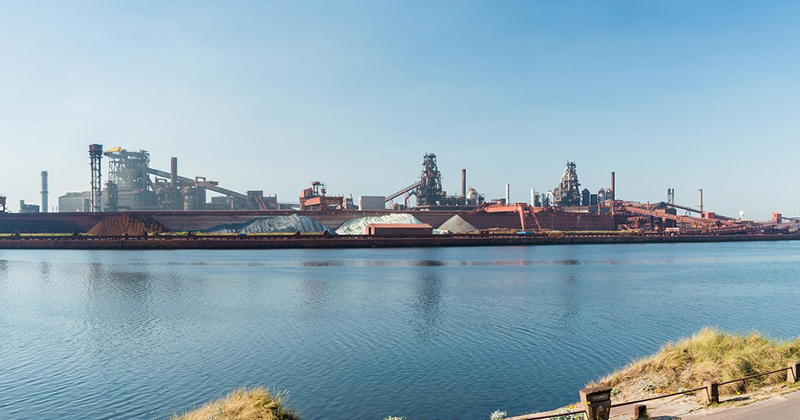
Fire hits ArcelorMittal Dunkirk’s largest furnace
There has been another fire at one of ArcelorMittal’s blast furnaces, this time at its Dunkirk site in France.
The fire started on the floor of blast furnace number four today, but was quickly extinguished and the unit has been made safe.
Dunkirk has three blast furnaces, with a combined pig iron capacity of 7mn t/yr. Blast furnace four has a capacity of about 3.6mn t/yr, according to Argus records. It is not yet clear what the production impact of the accident may be.
The blaze follows another at ArcelorMittal’s Gijon site, where blast furnace A caught fire on 22 March. Pictures of this fire, which started during a nozzle replacement, were widely shared on social media and it is expected that the furnace out of action for some time. The affected furnace is being emptied for assessment, said ArcelorMittal this week. After this furnace fire, which affected slab supply, sources said ArcelorMittal would use slab from one of its other sites, most likely Fos-sur-Mer or Dunkirk.
By Colin Richardson


Tata Steel Nederland to start relining No. 6 blast furnace first week April
Tata Steel Nederland, one of Europe’s largest steelmakers, will start “a massive modernization and reline program” at its IJmuiden steelworks’ Blast Furnace 6 in the first week of April, a company spokesperson said March 29.
During the furnace’s downtime, control systems and all refractories — materials that must withstand temperatures of about 1,500 C — will be replaced, spokesperson Peter van Boesschoten told S&P Global Commodity Insights in an emailed interview.
Various measures to limit environmental emissions under the steelmaker’s Roadmap Plus improvement program will be implemented during this period, including the installation of three additional exhaust hoods to limit dust. The increased extraction capacity should reduce dust emissions during hot metal tapping by about 75%, the spokesperson said.
“In order to protect the overall value chain, as part of preparation for this reline, sufficient stocks of steel slabs have been put in place to continue to operate the rolling assets to meet demand for our steel,” van Boesschoten said.
The length of the downtime was not immediately disclosed.
However, the spokesperson noted that the forthcoming stoppage “will be the last time we perform such a large-scale operation at a blast furnace.”
“As part of our decarbonization journey Blast Furnace 7 is expected to be the first to go out of operation, in 2030,” van Boesschoten said. “Blast Furnace 6 is expected to follow in the next decade.”
Blast Furnace 6’s CO2 emissions/mt of pig iron produced are among the lowest in the world, according to the spokesperson.
Tata Steel Nederland has previously announced it aims to reduce CO2 emissions by 35%-40% by 2030 and be completely carbon neutral by 2045. Across Europe, the company is implementing CO2-reducing measures at its locations, including a switch to green hydrogen-based steelmaking at its IJmuiden steelworks.
Cold mill task force
Tata Steel Nederland has meanwhile put into place a task force to resolve challenges encountered during the steelmaker’s upgrading of its cold rolling mill 21, which resulted in a force majeure being declared Feb. 24. The force majeure is still in place.
“During the process of upgrading Cold Mill 21 at Tata Steel’s IJmuiden steelworks, we encountered unforeseeable challenges that have led to an extended commissioning phase,” the spokesperson said. “We’ve a task force in place — including the involvement of the cold mill upgrade supplier — to resolve the situation.”
The steelmaker has and will continue “to put full focus on all possible mitigation measures to reduce supply risk and disruptions to our customers as much as possible,” van Boesschoten said. “This also includes sourcing of external cold-rolled material and toll rolling at third party cold rolling mills. Furthermore, TSN has worked and is working with customers to bring the order book in line with available capacity.”
The steelmaker will continue to update customers on the situation and when further improvement can be expected, he said.
Tata Steel Nederland had started the upgrade of Cold Mill 21 in August 2022 to further improve the steel surface quality.
The blast furnace-basic oxygen furnace-based IJmuiden plant has capacity to produce up to 7.5 million mt/year of hot- and cold-rolled coil in a variety of finishes, according to Tata Steel Nederland’s website.
The steelmaker denies market talk of the existence of any structural cold mill production problems that could take up to two years to fully recover from, the spokesperson added.
Platts, part of S&P Global, assessed domestic HRC prices in Northwest Europe at Eur860/mt ex-works Ruhr March 29, up Eur5/mt on the week.
Market sources said that mills were in a bullish mood, and lead times for EU material long, meaning buyers have started showing greater interest in imported coil.
Steelmakers across Europe are expected to increase HRC offers to around Eur900/mt ex-works in the week ending March 31, according to market sources.
— Diana Kinch


Heavy steel plate prices edge down in Italy ahead of steady April; prices stable in Northern Europe
Steel plate prices were stable in Northern Europe, but slightly down in a quiet Italian market in the week to Wednesday March 29, with producers in Southern Europe giving discounts for bigger volumes, sources told Fastmarkets.
Italy
Italian re-rollers were offering May delivery plate at around €900-910 ($974-985) per tonne EXW, with transactions for small tonnages reported at the lower end of the range over the past week.
Stockholder prices for bigger volumes, however, could be below €900 per tonne EXW – at about €870-890 per tonne EXW, sources said.
Stockholders in Italy are now looking to book May delivery plate, but traded volumes remained limited in the week to Wednesday, they added.
Fastmarkets’ weekly price assessment for steel domestic plate, 8-40mm, exw Southern Europe was €890-900 per tonne on Wednesday, down by €10-20 per tonne from €900-920 per tonne on March 22.
Market participants said they expect plate prices to stabilize in April.
“Prices for slab, [which is the key feedstock for steel plate production,] have stabilized,” a mill source told Fastmarkets. “Imports are quite expensive [and] there has been some limited restocking, so a rollover [in plate prices] is a very likely scenario.”
A buyer source agreed, but said supply tightness was a key issue.
“The lack of heavy plate-grade slab will keep the market stable in April,” the buyer source said.
Steel plate from Indonesia and South Korea was on offer in Italy at €860-870 per tonne CFR, for June shipment, sources said, which was also largely stable over the past week. No new booking were reported, however, because the Italian buyers did not consider those offer prices “workable” given the long lead times and the fact they are in line with domestic prices.
Northern Europe
In Northern Europe, steel plate prices have been largely unchanged in the week to March 29, with trading in the region slow and buyers maintaining a “wait-and-see” stance, sources said.
The plate volumes held by distributors and stockholders has reduced, however, so a pick-up in activity is expected soon, they added.
“Stock levels for [heavy plate] have sunk to their lowest level for the past six years,” a trader source told Fastmarkets, “so restocking activity is expected, especially for special sizes and grades.”
One integrated mill in Germany was offering May rolling plate to the spot market at €1,050 per tonne EXW, according to some market participants.
Another integrated mill in the nation, traditionally more focused on sales for projects,was maintaining offers at €1,100 per tonne EXW
Offers from France and Denmark to Germany were heard at €1,030-1,050 per tonne CPT for S355-grade plate with May delivery.
Czech re-roller was aiming for €1,085 per tonne CPT to the German market and reportedly had limited allocation.
Several sources also reported that limited tonnages from a Polish producer were on offer in Germany at €1,070 per tonne CPT, but added that the price was not considered workable because the supplier had apparently had problems with production and had delayed previous deliveries.
Fastmarkets’ weekly price assessment for steel domestic plate, 8-40mm, exw Northern Europe was €1,050 per tonne on Wednesday, narrowing from €1,040-1,070 per tonne on March 22 and reflecting the lower offers, deals and buyer estimates of achievable prices.
Published by: Julia Bolotova


Beltrame sees EU funds, green policies to sustain steel market recovery
European steel merchant bar producer AFV Beltrame Group forecast for 2023 a consolidation of the 2021 volumes to 2.2 million-2.3 million mt of finished products, Carlo Beltrame, head of business development and the CEO of France and Romania, told S&P Global Commodity Insights March 28.
The National Recovery and Resilience Plan is the instrument that, using Next Generation Europe funds, will make Italy more sustainable and better prepared for the challenges and opportunities of the green and digital transitions within the EU, of which 37.5% of the plan will support climate objectives and 25.1% will support the digital transition, he spoke on phone during his roadshow to present the company’s low-carbon emission green product Chalibria.
“At the moment, the market is very quiet because the demand is low not only in Italy but also across Europe due to the high interest rates that are slow due to the high interest rates. I think that as soon as we see the EC funds being used, the situation will change in both the private and public sectors. Companies that can provide low-carbon products to the market will do particularly well,” Beltrame said.
The Merchant Bar Europe Domestic monthly went down since the beginning of the year to Eur820/mt delivered from Eur885/mt delivered, with prices that have been stable since February, according to S&P Global data. The Platts TSI Northwest Europe Rebar prices registered a similar path, beginning January from Eur745/mt to Eur710mt base ex-works March 22.
Back in November, Beltrame announced the production of Chalibria. The company at the moment is doing a roadshow in Italy, France, Romania and Switzerland where it has steel production sites. On March 28, the company did a large event in Italy.
Beltrame aims to reduce its CO2 emissions (Scoop 1+2) by 40% by 2030 and to achieve this it has defined a Eur200 million ($185 million) decarbonization plan with a roadmap to accelerate the transition toward climate neutrality.
“Through Chalibria we want to convey the group’s sustainability strategy. The green evolutions at a European level are so fast, the changes so rapid that we need to respond promptly. We are working on this as a company and at the moment we are already the first producer in France to comply with the law against greenwashing, thank you to our zero-emission certified steel,” Beltrame said, although he underlined that the Beltrame Group’s activities are already well below average international and European sectors, reaching 570 kgCO2/mt of rolled steel.
Beltrame produces steel via the electric arc furnace route. “I believe that as EAF producers, we need to focus on Scope 2 and 3, for this reason, we bought hydroelectric plans whose closing will be in May as well as the already announced construction of a photovoltaic park in Targoviste.”
Beltrame confirmed that the 70-55 MW park in Targoviste should be ready to be operative by late October.
In March 2022, Beltrame bought the special steel producer Romania-based Targoviste (COS) for Eur33.3 million to transform COS Targoviste into an important production unit, investing Eur100 million to revamp the mill.
“In April, we will start production in COS and we will produce 15.000 mt of rebars every month and then 20,000 mt a month from 2024,” Beltrame told S&P Global.
Carlo Beltrame also updated about plans to build a 600,000 mt/year greenfield steel plant in Romania and a 100 MW solar power farm.
“We are very much focused also on this project. We have submitted to Romania’s government our environmental impact assessment and we are waiting for the authorizations while in parallel we are working with the creditor’s banks,” he added.
— Annalisa Villa