

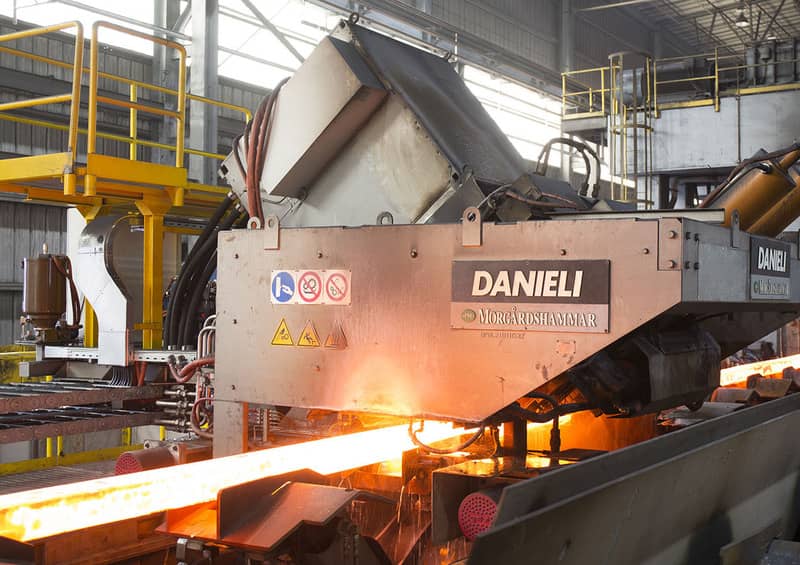
Danieli upgrades NLMK Clabecq plate mill
Danieli has upgraded the plate mill at NLMK in Clabecq, Belgium, the technology supplier tells Kallanish.
The investment is aimed at increasing the quality of thin-gauge steel, to improve plate profiles and mill-flatness performance.
Danieli installed new “hydraulic actuators for gap control (HAGC) for stands 3 and 4, a brand new hydraulic bending system, as well as new loopers for stands 1 to 4 connected to a new hydraulic power unit,” the Italian firm says. It also upgraded the technological control system.
Emanuele Norsa Italy


European construction investment to contract in 2023: FIEC
European construction industry federation FIEC confirms in its latest outlook for investments that 2023 will be a year of contraction, after two consecutive years of growth.
According to the federation, in 2023 overall investments in construction in Europe will decline 2.5% year-on-year, following a recovery of 2.1% y-o-y in 2022 and a jump of 4.8% y-o-y in 2021. Since 2014, construction investments have dropped on-year only once, in 2020, due to the impact of Covid. They fell 3% on-year in 2020.
Sweden will be the market with the largest contraction (-13.7% y-o-y), but all major economies will see investments decelerate compared with 2022. Portugal (+3.4% y-o-y) and Ireland (+2.5% y-o-y) are the only countries expected to see investments increase this year, Kallanish notes.
Overall civil engineering investments in Europe this year should grow 2.2% y-o-y, but both residential and non-residential buildings will contract.
In its latest report, FIEC explains that uncertainties already hit the sector last year, but the full negative impact will only be seen during 2023. “Rising prices and supply shortages for energy and certain construction materials have negatively impacted several contractors in Europe, with many at risk of not being able to fulfil contractual obligations or refraining from participating in public tenders. Overall, the construction sector registered slightly weaker growth than forecasted last year. In 2023, investment in construction is expected to decline at a rate of 2.5%,” the association explains.
FIEC’s outlook is in line with the latest Eurofer view on the construction sector. Output in the construction sector steadily increased in 2022 – by 4.8%, after a buoyant 6.7% growth in 2021 – thanks to EU and national supporting schemes, Eurofer explained referring to construction output, rather than investment.
However, increasing shortages combined with higher prices of construction materials, together with lower residential construction demand due to monetary tightening and higher mortgage rates, are expected to see a 1.6% drop in 2023. A moderate recovery of 1.3% is foreseen in 2024, Eurofer concluded.
Emanuele Norsa Italy

US-EU steel agreement ‘mission impossible’, says trade expert
Significant differences between EU and US climate and trade-policy toolkits and objectives, and the overall prohibitive costs of aligning around a lower US denominator render the proposed transatlantic Global Steel and Aluminium Arrangement (GSA) a “mission impossible and highly undesirable”. So says David Kleimann, visiting Fellow at Bruegel, in a new working paper.
In his “Section 232 reloaded: the false promise of the transatlantic ‘climate club’ for steel and aluminium” working paper, Kleimann says the US proposals would mean the EU would have to shelve its Carbon Border Adjustment (CBAM) regulation, unlink its carbon border adjustment (CBA) policies from its mature and tested Emissions Trading System (ETS), and give way to evidently less-efficient, less-effective, less-legitimate and WTO-inconsistent policy solutions.
The US proposals are “exclusive and coercive club setting, devoid of defined obligations for domestic restrictions”, Kleimann observes in the paper read by Kallanish. “The European Commission proposal, in contrast, notionally and practically reflects the German G7 Presidency’s proposal for open and inclusive climate cooperation, providing for joint ambition of long-term decarbonisation targets, while allowing for climate policy diversity, subject to the constraints of participants’ international legal obligations.”
65% of US steel production is already among the cleanest in the world. This means US proposals for embedded emission benchmarks restricting market access for imports would be expected to accommodate EAF performance standards and blast furnace transition from the outset. This would make for de-facto discrimination, for international trade legal purposes, against imports from non-member countries, Kleimann notes.
Such accommodation of US domestic producer interest would be achieved by using average domestic industry emissions as a benchmark, which is precisely what the United States Trade Representative (USTR) has proposed in GSA negotiations, instead of production-route-specific emission standards, as proposed by the EU.
“The Tucker-Meyer plan (TMP) and the USTR proposal hence appear to cherry-pick an industrial sector for transatlantic climate club cooperation where the US is already comparatively carbon-efficient without having to impose domestic regulatory restrictions at the outset. Viewed in this context, it appears that the plan has one overarching aim and effect: to protect the US national steel and aluminium sectors – and the unionized integrated blast furnace steel mills in midwestern swing states in particular – to a maximum extent and for as long as possible, from the financial and socio-economic burdens associated with industrial decarbonisation,” Kleimann explains.
The US proposals would also effectively grant US exporters an exemption from EU CBAM charges, he adds.
The EU and the US should instead focus their joint efforts on more flexible, pragmatic and fruitful cooperation objectives. “Transatlantic climate and trade diplomacy should be viewed akin to a technical-cooperation opportunity that knows only ‘winners’ (i.e. beneficiaries) as long as it is not loaded with secondary (e.g. protectionist) or tertiary (e.g. global power competition) objectives, which distract from the only two legitimate ends of climate and trade nexus cooperation: emissions abatement and the prevention of carbon leakage,” Kleimann notes.
The least disruptive result for the October 2023 GSA negotiation deadline may well therefore be to prolong the status quo and settle for a more informed, pragmatic and inclusive climate and trade cooperation roadmap for the years to come, Kleimann concludes.
Adam Smith Poland

Northwest European rebar remains soft
The northwestern European rebar market remains sluggish in July and is seen continuing in this fashion into August. The price downtrend has slowed down, and values could bottom, but a recovery is very unlikely for a while.
Late in June, base prices from German mills were largely seen at around €350/tonne ($385), with some lower quotes reported from minor players. This has now seeped through to the major players. “We are easily €20 below that now,” one big buyer tells Kallanish. “Including the size extra, you will get one tonne for €590.”
He is not astonished that particularly low prices are being offered to smaller players as well, in some cases before they land on the tables of the bigger ones. “Big or small does not matter these days. The market is a small cake and mills are vying to obtain a slice for themselves,” the buyer says.
A manager at another big distribution company explains that mills’ sales staff are facing a paralysed market, while purchasing staff are being troubled by relatively stable scrap prices. “In the past weeks, international scrap prices did not fall as much as prices for the finished product,” he observes. In fact, while demolition scrap sort E3 has fallen by some €70/t since April, the drop in rebar values has been twice that, thus painfully crimping mills’ margins.
Christian Koehl Germany
Liberty Steel wins tender to buy Hungary’s Dunaferr steelworks
Liberty Steel has won a tender to purchase Hungary-based flat steel producer Dunaferr, the UK-based company told Fastmarkets on Tuesday July 11.Liberty Steel and Vulcan Steel, a private company registered in Mauritius, were the two main bidders for Dunaferr, industry sources told Fastmarkets.
Liberty won with a bid of €55 million ($60.35 million), submitted through its subsidiary Liberty Steel Central Europe Kft, Fastmarkets heard.
“We are delighted that our offer for the Dunaferr steelworks has been accepted as the approved bid,” a spokesperson for Liberty Steel told Fastmarkets.
“We will now work at pace with the liquidator to sign the sale and purchase agreement so that we can start to provide some certainty about the future of the business to its employees and the local community,” he added.
“The addition of Dunaferr into the Liberty Group, subject to the closing of the transaction and regulatory approval, will create significant positive operational and commercial synergies – by linking Liberty’s high-quality upstream businesses in Romania, Poland and the Czech Republic more closely with Dunaferr’s high-quality downstream business – for the benefit of customers across Hungary and Europe,” he said.
The Dunaferr steelworks was subject to a liquidation order from Budapest’s municipal court in December 2022, but the Hungarian government subsequently secured 16 billion forints ($45.85 million) in funding to cover the salaries of Dunaferr workers for six months.
In February 2023, Liberty signed an operational and commercial agreement to help stabilize the Hungarian company’s operations, and steelmaking at Dunaferr resumed in mid-February, under Liberty’s supervision.
Dunaferr has two blast furnaces with combined capacity for 1.4 million tonnes per year of pig iron, which is used to produce hot-rolled, cold-rolled and hot-dipped galvanized coil steel products.
The design capacity of Dunaferr’s HRC mill is around 2 million tpy, according to Fastmarkets’ company database. Market participants said that Dunaferr’s rolling mills have been idle since mid-June.
Published by: Julia Bolotova


Limited trading keeps European HRC prices largely flat across Europe
Hot-rolled coil prices were largely stable across Europe amid slow trading, with sources not expecting to see a rebound until September, sources told Fastmarkets on Tuesday July 11.Fastmarkets’ daily steel HRC index, domestic, exw Northern Europe was calculated at €680.83 ($747) per tonne on Tuesday, up by €0.83 per tonne from €680.00 per tonne on Monday July 10.
The latest calculation of the Northern European index was down by just €0.63 per tonne week on week, and down by €19.17 per tonne month on month.
Some producers in Germany were trying to push offers to around €720 per tonne delivered (€700 per tonne EXW) for September-October delivery coil, but traded volumes were still very limited.
Most buyer sources estimated tradable values at €670-680 per tonne EXW with transactions reported within that range.
“Trading is very slow, with spot sales are mainly done for small tonnages,” a steel service center in Germany said.
Sources said that prices were unlikely to decline in the short term due to the uptrend in imports and reduced availability caused by technical issues at some European mills. Additionally, most producers take a traditional two-to-three-week maintenance break in August.
Sources added, however, that there was no room for substantial price rises because of insufficient demand from end users.
“We will have to [take] small steps [in implementing any increases]. Maybe in September there will be some pick-up in apparent steel demand, given that buyers do not really restock now and in August the mills have stoppages, but [if] end-user demand does not rebound, major price rises will not happen,” a mill source told Fastmarkets.
Fastmarkets calculated its corresponding daily steel HRC index, domestic, exw Italy at €661.25 per tonne on Tuesday, down by €7.08 per tonne from €668.33 per tonne the previous day.
The Italian index was up by €3.33 per tonne week on week, and up by €6.25 per tonne month on month.
Offer prices from Italian mills were reported at €670-700 per tonne EXW for September delivery HRC.
Buyers have started showing more interest in purchases lately, but their idea of a tradable range was still around €650-660 per tonne EXW and traded tonnages remained limited, sources said.
“Italian mills increased their offer prices, but the increases were nominal and just indicated that the downtrend was over. Some small [price] gains have been achieved in deals, but transactions are still [rare],” a trading source said.
Europe HRC import market has been quiet recently, due to the long lead times offered by overseas suppliers and the shrinking gap with domestic prices.
Asian mills were offering HRC to Italy at around €610-630 per tonne CFR Italy for September-October shipment.
One source reported an HRC offer from a Vietnamese mill at $645 (€590) per tonne CFR for September shipment, but it could not be widely confirmed with other market sources by the time of publication.
Published by: Julia Bolotova