

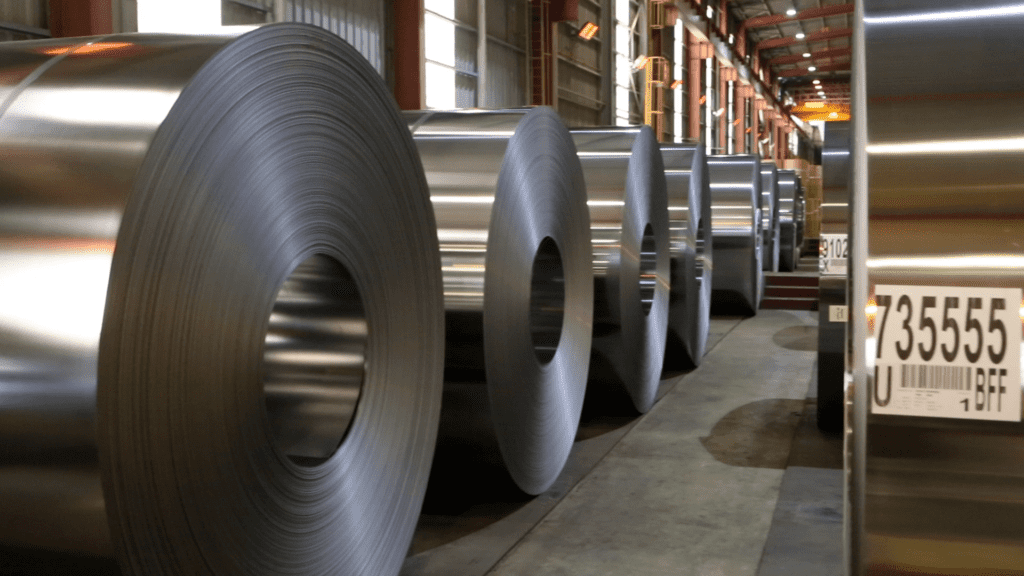
Trading seasonally slow, prices broadly flat in European HRC market
In Northern Europe, only a few suppliers were active with average lead times reported at 6-8 weeks.
One German producer was reportedly aiming for €700 ($774) per tonne EXW for HRC from November production, sources said, but buyers said that level was not workable given the current slow rate of consumption.
“[One integrated German steel mill has faced] heavy delays [on flat steel] deliveries for quite some time due to technical issues, which is why it has such a long lead times,” a trading source said.
Another German mill was not offering coil to the spot market due to force majeure, while another integrated mill in Northern Europe was being quite aggressive, with sales reported at €650-670 per tonne EXW for HRC with lead times in September.
A mill in Central Europe, meanwhile, was offering September-delivery HRC to Germany at €690 per tonne CPT, but only had limited allocations.
And a re-roller in Belgium was offering HRC to Germany at €620-640 per tonne CPT, with deals reported at the lower end of the range late in the week to July 21.
Buyer estimates of tradable values were no higher than €650-660 per tonne EXW.
Slow demand from end users was the major concern for both buyers and mills, with post-holiday expectations largely bearish because of this.
Fastmarkets’ daily steel hot-rolled coil index domestic, exw Northern Europe was calculated at €656.88 per tonne on July 25, up by €1.05 per tonne from €655.83 per tonne on July 24.
The latest calculation of the Northern European index was down by €13.95 per tonne week on week and by €16.42 per tonne month on month.
Fastmarkets calculated its corresponding daily steel HRC index domestic, exw Italy at €640.00 per tonne on July 25, down by €5.00 per tonne from €645.00 per tonne on July 24.
The Italian index was also down by €8.75 per tonne week on week and by €13.75 per tonne month on month.
In Italy, sources described trading as “completely frozen,” with mills starting their traditional summer maintenance stoppages and buyers also largely staying out of the market.
The quiet conditions are expected to prevail for the next four or five weeks.
Buyers in Italy said on July 25 that the achievable HRC price for delivery at the end of September and the beginning of October was €640-650 per tonne EXW.
Import offers were also limited, sources said.
Most overseas supplier were offering end-September/early-October shipment, which would mean end-November/early-December arrival.
HRC from one Japanese mill was on offer at $680 per tonne CFR to Italy for end-September shipment, while another mill from Japan was offering HRC at about $660 per tonne CFR, sources said.
A mill from Vietnam, meanwhile, was aiming for €580-585 per tonne CFR to Southern Europe.
Published by: Julia Bolotova


Dillinger researches into hydrogen damage in pipelines
Scientists at steelmaker Dillinger and Saarland University are working together to find a better standardised method for testing materials for their resistance to hydrogen, Kallanish notes.
The core problem here is so-called hydrogen embrittlement, which primarily affects high-strength materials such as pipeline steel or steel wires in prestressed concrete bridges. When hydrogen accumulates, the strength of the material decreases and minute damage and cracks can occur, which can seriously endanger the pipeline or bridge.
Hydrogen accumulates at weld seams or through corrosion in small quantities that can only lead to damage very slowly. In practice, the problem has not been in the foreground so far. But with the prospect of “green” hydrogen being the energy carrier of the future for industrial processes on a large scale, volumes of hydrogen, which mainly accumulates in pipelines, will soon increase.
“There are test standards for the compressive and tensile strength of steels that a newly developed steel must undergo for pipeline construction,” explains Florian Schäfer of Saarland University. “But there is no comprehensive standardised procedure to test steel for how it reacts with hydrogen.”
Platemaker Dillinger expects to be able to offer steels that are less sensitive to hydrogen and are thus better suited for the transformation to the “hydrogen economy” than steels used to date.
Christian Koehl Germany

Acerinox anticipates stainless order book improvement
Acerinox anticipates its stainless steel order book to improve in the latter half of the year once inventories have normalised across all markets, despite uncertainties and weakened demand.
The high-performance-alloys sector continues to enjoy robust demand, particularly in the chemical, petrochemical, and aerospace industries, the Spanish firm says in a note seen by Kallanish.
It expects good results in the third quarter, although they may be lower than those in Q2.
Acerinox posted a 2% on-year consolidated revenue decline in Q2 to €1.74 billion ($1.93 billion), but Ebitda and net profit were each up 4% to €236 million and €142m respectively.
Melting shop production was down 9% to 486,000 tonnes.
“In the stainless steel sector, the Group strategically benefits from its geographical diversification, enabling optimal operations based on market conditions. Notably, the American market has showcased positive performance, underscoring its significance as our primary market,” says Acerinox chief executive Bernardo Velázquez.
“Furthermore, through the integration of High-Performance Alloys (VDM Metals), our product portfolio has expanded to include higher-value-added products, enriching our offerings,” he adds.
“Secondly, our global production and distribution network will allow us to stay close to suppliers and customers, support the regionalisation process and improve supply chains. This situation will increase the consumption of stainless steel in strategic regions of the world where the appeal of imports has significantly diminished,” the ceo continues.
First-half-of-2023 consolidated revenue dropped 27% on-year to €3.5 billion, with Ebitda and net profit down 51% and 54% respectively to €462m and €278m. Melting shop production fell 21% to 1.02 million tonnes.
All plants in the Stainless Steel division were impacted by the reduced market stocks process and low apparent demand. Additionally, the Spanish plant faced challenges due to high energy costs, while the South African plant compensates for market weakness by continuing with its diversification programme, producing both stainless and carbon steel, the firm concludes.
Adam Smith Poland

Toughest EU industry period over, challenges remain: Eurofer
The toughest period for EU steel end-use sector growth – the fourth quarter of 2022 and first quarter of 2023 – appears to be over. However, the rest of 2023 is expected to be characterised by a combination of uncertainty in energy prices, low industry demand and inflation-driven economic challenges, says Eurofer.
The Steel Weighted Industrial Production index (SWIP) is forecast to grow 1.3% on-year in 2023 – compared to the previous 0.3% growth forecast – and then slow to 0.4% in 2024 due to a downturn in the automotive sector, Kallanish notes.
EU steel-using sector output continued to grow in first quarter, showing unexpected resilience. The SWIP increased 3.7% on-year, driven by the automotive, mechanical engineering and transport sectors, the European steelmakers’ association observes.
However, domestic appliances, tubes and metalware output slumped, while construction grew only 0.1% and is expected to experience recession in 2023.
The deterioration of the overall economic and industrial outlook in the EU – particularly due to high inflation and the subsequent interest rate hike by the ECB – have so far impacted steel-using sectors’ output only to a limited extent, Eurofer concludes.
Adam Smith Poland

EU longs market September recovery unlikely, says Feralpi
The market for long products across Europe – particularly in Italy and Germany – is not sending signals for a rebound in September, with 2024 set to be the year of recovery, Feralpi chief executive Giuseppe Pasini said during a press conference attended by Kallanish.
The executive noted the recovery is expected to happen possibly during the second half of 2024. During the first six months of this year, Feralpi registered sales volumes in line with 2022, while turnover declined some 20% year-on-year due to lower sales prices.
In terms of production, 2023 is expected to finish with similar levels as those registered in 2022. The group, across its mills in Italy and Germany, produced some 2.45 million tonnes of billet in 2022, down 6.4% y-o-y and in line with levels registered in 2021.
Going into more detail, Pasini noted that the Italian market is performing slightly better than the German one at the moment. He added that funds from the Next Generation EU plan assigned to Italy should support the civil engineering sector during the next three years.
Overall, Feralpi registered an unprecedentedly positive financial year in 2022. The group’s Ebitda surpassed €500 million ($553m), almost double that registered in 2021.
Emanuele Norsa Italy

RHI Magnesita completes acquisition of Seven Refractories
RHI Magnesita has completed its acquisition of Seven Refractories, a specialist supplier of alumina refractory mixes, serving customers in the iron and steel, cement, and non-ferrous metals industries.
With the acquisition, RHI will add around 240 employees at three production sites in Slovenia, India and the USA, and at sales offices and service centres in Germany, Italy, the United Kingdom and Cyprus. Seven Refractories recorded revenue of €105 million ($116m) and profit before tax of €11m in 2022.
The acquisition will complement RHI Magnesita’s existing non-basic refractories portfolio, Kallanish hears from the Austria-based company. It will also open new opportunities in the development of low-CO2-emitting manufacturing technologies within RHI’s key customer industries, the firm emphasises.
Christian Koehl Germany

Wuppermann renews supply agreement with Tata
Wuppermann Staal Nederland has signed a new three-year contract to procure hot rolled coil from Tata Steel Nederland for hot-dip galvanized coil production. The agreement is also supported by a new strategic partnership between the companies, the steelmaker says in a note sent to Kallanish.
Tata Steel will continue to be the primary supplier of Wuppermann operations in the Netherlands and will add some quantities of Zeremis Carbon Lite products to the existing supply. This is steel with a CO2 footprint reduction of up to 90%.
The companies are also deepening their relationship through strategic initiatives aimed at reducing scrap production in the processing of coils, as well as scrap buyback by Tata from Wuppermann.
“A strong and long-lasting partnership like the one between Tata Steel and Wuppermann is the right basis for implementing important digitalisation and circularity projects across several stages of the value chain and to realise their full potential,” explains Karsten Pronk, managing director of Wuppermann Staal Nederland.
Emanuele Norsa Italy

July sales disappoint Italian longs sellers
Italian long steel prices are flat compared to the first week of July but distributors and agents are reporting a very slow month. The expected restocking activity has not materialised and consumption this month has been very weak, particularly for merchant bar.
Demand for wire rod and sections has also been quiet. Producers are trying to defend prices because of high production costs, but it is becoming increasingly difficult.
Both steelmakers and distributors will implement longer stoppages this summer. Some are planning to shut down for as long as four weeks. Several sources at distribution companies are taking early holidays due to the quiet activity. Orders for both merchant bar, wire rod and beams are being done only back-to-back, Kallanish notes.
Prices for larger merchant bar volumes are flattening at €340-350/tonne ($376-387) base ex-works, while low tonnages are rumoured to be sold at €360-365/t. Including size extras, domestic values are at €760-780/t ex-works.
Sellers are also reporting lower sales for beams but volumes continue to be better compared to merchant bar. The first category of sections is hovering at €820-850/t ex-works including size extras.
Sellers say July has been worse than June in terms of prices and sales volumes. However, in the first six months of the year, some companies reported increased volumes compared to pre-pandemic levels of 2019, as well as relatively good financial results on average across all long products.
Natalia Capra France