


Inflation, strong dollar challenge steel trade: Celsa’s Gordienko
High inflation is reducing steel demand, while the US Federal Reserve’s monetary tightening has resulted in the strongest dollar in 20 years, hitting the global economy.
This has reduced emerging market GDP growth rate by 2 percentage points and advanced economies growth by 0.65pp, with the impact on the latter to disappear within a year, according to Celsa Group export director Alexander Gordienko.
Germany, Europe’s largest economy, has entered recession in 2023. In the first seven months of the year, German demand for rebar and wire rod fell 17% on-year.
Largest economy the US is however outperforming. “The US construction sector is doing very well, particularly the boom in single-family homes. In 2023, 460,860 homes will be built, versus 1.2 million units between 2020 and 2022, with an average of 400,000 units/year,” Gordienko said at this week’s Irepas conference in Istanbul attended by Kallanish.
“The utilisation rate of Chinese blast furnace-route steelmakers is, on average, 97-98%, which is extremely high. Chinese real estate activity, which accounts for 30% of the economy, is declining, so the central government is offering incentives to support the sector. The interest rate cut is another form of support, [with the rate being] the lowest in 15 years. Chinese steel exports … will be slightly below 2015 and 2016, with an annual tonnage of between 85 and 90 million tonnes. Flats account for most exports this year, while longs are insignificant quantities,” Gordienko noted.
Overall, the global economy is gradually recovering from the pandemic and the Russian invasion of Ukraine. Supply chain disruptions have returned to pre-pandemic levels. Energy and food prices have fallen sharply. Global inflationary pressures are easing faster than expected. The European Central Bank raised interest rates to 4% last Thursday, while forecasting inflation of 2.8% next year. High interest rates are weighing on households and businesses, with high interest payments putting pressure on the housing sector, Gordienko observed.
The International Monetary Fund forecasts the global economy will continue to grow by 3% in 2023 and 2024. However, the “European economy remains very weak. Winter is coming, and energy costs are expected to increase,” Gordienko concluded.
Burak Odabasi Turkey


Sentiment in French construction sector improves slightly
Sentiment among French construction companies improved last month after deteriorating significantly earlier this year. The firms surveyed by l’Institut National de la Statistique et des Études Économiques (Insee) reported a slightly more optimistic attitude about their past and future activity.
More companies than in July, however, consider the market and the evolution of their company to be unpredictable due to the current economic uncertainty, Kallanish learns from an Insee report.
In August, slightly more building contractors than in July considered their order books to be higher than normal and reported 8.3 months of work. Production capacity continued to decrease last month and slightly fewer construction firms than in July reported slowing output because of supply difficulties. 24% of construction companies considered themselves unable to increase their production in case of additional orders due to a lack of personnel and supply difficulties.
Fewer companies in August announced they will increase their prices in the upcoming three months, the report states.
Natalia Capra France
Steelmaking electrification to cause EU scrap deficit: conference
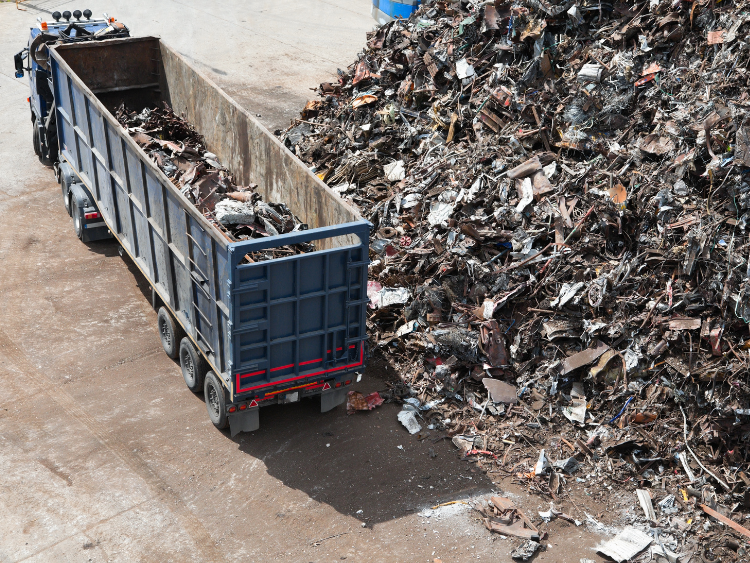
The increased electrification of steelmaking in Europe will lift scrap consumption and result in shortages of the feedstock, ultimately making its import necessary. The region must act to limit exports of this increasingly strategic material, while closed-loop recycling systems, such as established by Outokumpu in Finland, are the future, Kallanish heard at an industry event.
Although hydrogen-based direct reduced iron is widely touted as the basis for a decarbonised steel industry, and the technology is ready, the energy requirement is currently prohibitive, ArcelorMittal Poland (AMP) head of corporate governance & government affairs, head of energy & environment office Tomasz Slezak said at the European Steel Congress in Katowice on Tuesday.
Given the regulatory pressure and decarbonisation course already set, “we don’t have another option” but to transform to EAF-based production using scrap, Slezak observed. Poland now has a huge scrap surplus that it exports, but in the not-so-distant future this will turn into a deficit, with strong competition among mills. Prices will therefore increase, pushing up production costs.
One example of this competition will be that between ArcelorMittal Poland and Weglokoks’ prospective steelworks (see separate story).
Polish Steel Association (HIPH) chief executive Mirosław Motyka pointed out that Poland could utilise more of its scrap resources, over 1.2 million tonnes of which it exported in the first half of 2023, up 13% on-year. Consumption in the period was down 18% to 2.4mt. Exports are going to countries that produce steel, which then gets shipped back to Poland. These countries may adhere to weak or no ESG standards, making them unsuitable business partners for Europe, Motyka explained.
Scrap recycling standards in Poland are very high and suppliers are ready to cater for increased domestic demand, said ArcelorMittal Recykling Polska board member Piotr Gluzniewicz. Besides regular destination markets Germany and Czech Republic, Polish exporters have in recent years started shipping material to Turkey and the Indian subcontinent, he added.
A high level of recycling will be important, in order to remove impurities, as EAF mills become increasingly active in the production of flat products, as is the case in the US, said Motyka. Components such as tin and copper will need to be carefully removed. As for zinc in scrap, this gets converted during EAF steelmaking into dust, which can also be recycled, added Slezak.
Adam Smith Poland

German analyst sees prices dropping further in 2024
The current low steel prices in Germany, and its neighbouring countries, will not rebound so soon going into 2024, according to Peter Fertig, analyst at MBI Infosource.
Speaking at MBI’s Stahltag conference in Frankfurt on Tuesday, Fertig cited an array of economic factors influencing EU prices: from local energy costs and purchasing indices to incentives in Asia and the strikes at Australia’s LNG plants.
For local coil prices, he referred to the forecast he gave at last year’s event, stating that “the worst-case scenario, mercifully, did not come true”. For hot rolled coil, that would have been €375/tonne ($401). But neither did the best-case scenario of €925 match the effective March peak of around €850. In fact, the average value Kallanish heard from him back then – €650/t – is more or less the average at which prices remained throughout summer.
Going forward, however, Fertig recommended preparing for a further dip, although the range of scenarios is less extreme than those he assumed for 2023. For 2024, he predicts an average price of €575/t for HRC in 2024, in between a best case of €750 and worst case of €475.
His preview extended to other steel products. For cold rolled coil, he anticipates an average price of €625 (best €825, worst €525); for rebar €500 (best €725, worst €425); and for wire rod €575 (best €825, worst €450).
In his presentation, he noted that profitability has recovered slightly for makers of flat products, but will remain tense for long products. One aspect here is the weakness of the construction industry, which mostly affects long products, he noted.
Christian Koehl Germany

Slow trading keeps HRC prices flat across Europe
Buyers of HRC across Europe continued to hold back from big purchases, mainly booking what was strictly necessary to fill gaps in stock or for back-to-back business, sources told Fastmarkets.
“It’s very much a buyer’s market,” a trading source in Northern Europe said, adding that they have been receiving calls from producers asking whether there have been any inquiries.
European mills had short orders books, with end-October delivery said to still be available from some producers.
Buyers’ estimates of tradeable values were reported at €630-640 ($672-683) per tonne ex-works on Tuesday, while offers from integrated mills in the region were reported in a wider range of €630-680 per tonne ex-works. The upper end of the offer range, however, was not considered workable by buyers, given the poor demand and low downstream prices .
One of the major concerns for buyers was the weak consumption and poor performance of practically all the key steel end-user sectors, with the exception of the automotive industry, although it was still working below pre-pandemic levels.
Notably, in July 2023, the EU car market grew by 15.2% year on year, to 851,156 registered units. This growth, however, can be attributed to the region’s rebound from a low comparison base in 2022, primarily caused by vehicle component shortages, the European Automotive Manufacturers Association said.
“The consumption [of steel] in general is weak [and] there is no rebound in sight this year, I’m afraid,” a steel service center in Germany told Fastmarkets. “In September, our sales [of processed HRC] to [end users] were about 20% lower [year on year].”
Another factor limiting trading in the spot market was bearish expectations among buyers for October.
The next EU safeguarding import quota period will start on October 1, and market sources expected large tonnages of imported HRC to flood the local market and affect domestic prices in Europe.
Fastmarkets calculated its daily steel hot-rolled coil index domestic, exw Northern Europe at €635.00 per tonne on Tuesday, down by €2.50 per tonne from €637.50 per tonne the previous day.
https://dashboard.fastmarkets.com/p/MB-STE-0028
The index was down by €10.00 per tonne week on week and by €1.25 per tonne month on month.
Fastmarkets’ calculation of its corresponding daily steel hot-rolled coil index domestic, exw Italy, meanwhile, was €623.33 per tonne on Tuesday, down by €2.92 per tonne from €626.25 per tonne on Monday.
The Italian index was down by €9.17 per tonne week on week and by €6.67 per tonne month on month.
Italian producers could offer coil for delivery in late October/early November, which indicated thin order books, market sources said. Offers were reported around €640-650 per tonne delivered (about €625-635 per tonne ex-works) for such material.
Similarly to Northern Europe, Italian buyers preferred to postpone restocking until October.
Import HRC offers, meanwhile, were largely stable compared with last week, although one supplier from Vietnam was reported to have lowered its offer due to a weak domestic market.
Offers from Vietnam for November-shipment coil were heard around €585 per tonne CFR to Italy.
Offers from Japan were reported at €600-610 per tonne CFR for January arrival.
And Indian suppliers were out of the market, with no interest in export sales to Europe because of their strong domestic market, market participants said.
Published by: Julia Bolotova
