


CBAM export impact concerns EU steelmakers: Federacciai
The transitional phase of the EU’s Carbon Border Adjustment Mechanism (CBAM) will begin on 1 October. As the implementation approaches, market participants in Europe are discussing the new system and its challenges. Steelmakers remain concerned for the future of steel exports.
Flavio Bregant, director general of Federacciai, the Italian steelmakers’ association, confirmed in a webinar on Thursday attended by Kallanish that the main problem for steelmakers is CBAM’s impact on their exports once the transitional phase is completed. CBAM’s full implementation is scheduled from January 2026.
“At the moment, CBAM only covers imports. We are happy to hear from the European Commission that they will look into the issue of exports in 2025, but we have explained the problem multiple times already and until now we have received no answers,” Bregant lamented.
From the beginning of 2026, free allocations of Emissions Trading System (ETS) certificates will be phased out, further increasing costs of production for European steelmakers to ensure the low-emission transformation takes place. This is set to make European steelmakers less competitive in the international steel market, hence the difficulties in exporting if fiscal support is not secured from the European Commission.
“Personally, I see exports of European steel products falling to zero once CBAM is fully implemented. This will result in the need for European steelmakers to reduce output at their mills, while keeping the doors open to imports,” Bregant explained. “I see exports falling, not imports.”
Other representatives of the steel supply chain, on the other hand, are concerned by the potential reduction in EU imports as a result of CBAM implementation (see related articles).
In 2022, European steelmakers exported over 16 million tonnes of finished steel products. This figure is over 10mt below the record levels registered in 2012-2016.
Emanuele Norsa Italy


Unions warn of possible Acciaierie d’Italia production shutdown
Acciaierie d’Italia (ADI)’s trade unions are seeking a meeting with the government to address the troubles the company is going through, Kallanish learns from a Fim Fiom Uilm union source.
“ADI is experiencing a phase of abandonment and dangerous decline destined in a very short time to deliver it to an irreversible state of shutdown, with very serious occupational as well as industrial consequences. This is without considering the numerous incidents that occur daily in the workplace and which put at risk the safety of workers,” the union says in a note.
Despite government funding, ADI management is not keeping any of the commitments made on production volumes and investments, or paying contractors and starting renovations on long-idled blast furnace no.5 at Taranto, the union says.
Unions representing ADI’s subsidiary in Cornigliano, near Genoa, also warn of a possible production shutdown due to a lack of maintenance work, which is causing accidents and the need for new components for the outdated equipment.
Earlier this year, the Italian finance ministry authorised the payment of €680 million ($724m) to ADI, the joint venture between state company Invitalia and ArcelorMittal. This year, the plant in Genoa should see a revamping of the tinplate re-rolling lines, while Novi Ligure will see a revamp of the coating line. ADI will also boost the Racconigi warehouses’ automation. In the second half of 2023, the steelmaker also vowed to start the refurbishment of BF no.5 and begin construction of an electric arc furnace (see Kallanish 1 February).
The company confirmed its forecast of producing at least 4 million tonnes at its Taranto steelworks in 2023, with the aim of reaching 5mt in 2024. Sources who spoke to Kallanish however believe it will reach about half of that amount.
ADI did not comment before press deadline.
Natalia Capra France

Poland’s first offshore wind farm secures financing
The European Investment Bank (EIB) has agreed to loan up to €610 million ($649m) for the construction of the first offshore windfarm in Poland and one of the largest in the world.
Wind power is touted to be a critical supplier of the energy required for steel industry decarbonisation as well as a major future steel demand driver. Offshore wind is an entirely new market in Poland but with huge prospects thanks to its Baltic Sea access, Kallanish notes.
The Baltic Power offshore windfarm operation will comprise 76 wind turbines for an overall capacity of 1,140MW, with construction set to be completed by mid-2026. This is the first offshore windfarm to reach financial close under the new Polish Offshore Wind Contracts for Difference (CfD) regulatory regime.
The project is of strategic importance and will also contribute to the objectives of the REPowerEU Plan, by rolling out clean energy capacity to support EU energy independence and its security of supply, the bank says.
“Financing for Baltic Power will support the first offshore wind farm project in Poland and will certainly open the way for the green transformation and other future offshore wind energy projects,” says EIB vice-president Teresa Czerwińska.
Baltic Power is a company owned by PKN ORLEN (51% of ownership) and Northland Power (49% of ownership). “Despite the recent challenges for the offshore wind sector in some markets, Northland continues to find a way to advance large-scale offshore wind projects with attractive economics,” says Northland chief executive Mike Crawley.
Construction of Poland’s first offshore wind farm is to start this year, with 18GW of offshore production expected by 2040, Poland’s environment minister, Anna Moskwa, said earlier this week (see Kallanish passim).
Last week, European Commission president Ursula von der Leyen pledged support to the EU’s wind power industry, promising a European Wind Power package, a move welcomed by Eurofer.
Last month, Poland’s Industrial Development Agency (ARP) broke ground together with its partners, Spain’s GRI Renewable Industries and Poland-based Baltic Towers, on a new offshore wind tower factory in Gdansk. The plant will be capable of producing towers for the largest, 15MW capacity wind turbines.
For wind turbines, over 90% of total material requirements are steel and concrete. Steel requirement is projected to fall from 140 tonnes/MW to 110t/MW by 2050 for gearbox turbines, and from 400 t/MW to 320 t/MW for direct-drive turbines, according to Energy Transitions Commission research.
Adam Smith Poland
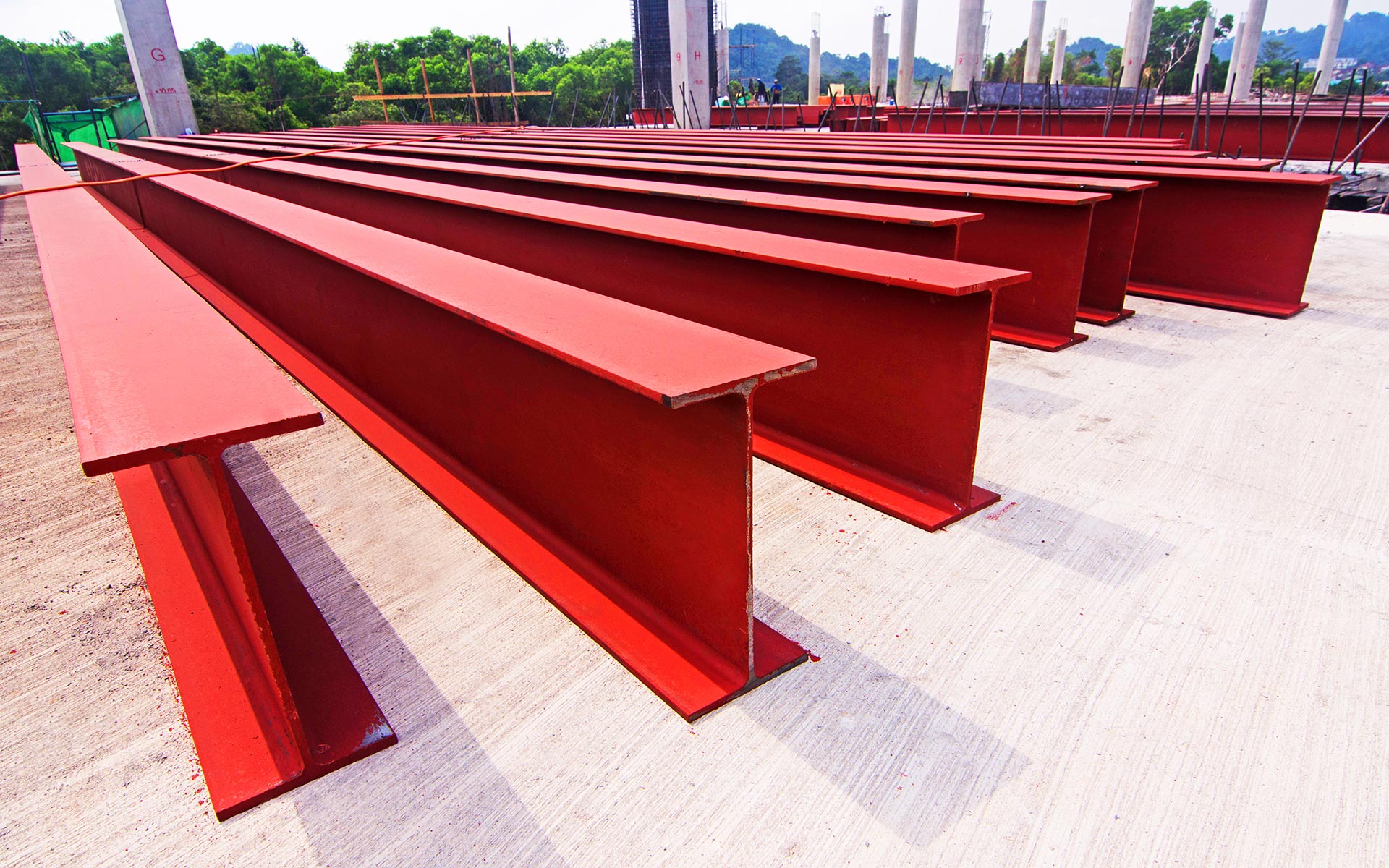
European steel beams market narrows downward on poor demand
Fastmarkets’ weekly price assessment for steel beams, domestic, delivered Northern Europe, was €720-760 ($770-812) per tonne on Wednesday, narrowing downward by €20 per tonne from €720-780 per tonne a week earlier.
Similarly, Fastmarkets’ weekly price assessment for steel beams, domestic, delivered Southern Europe, was also €720-760 per tonne on Wednesday, narrowing downward by €30 per tonne week on week from €720-790 per tonne.
Fastmarkets heard that mills have been pushing for prices to rise as high as €770 per tonne, but market sources said that stockholders were not accepting such increases “because [end-user] selling prices are too low.”
Meanwhile, scrap feedstock prices in the bellwether Turkish market moved up in the week after fresh bookings that came because some steelmakers were replenishing their stock levels.
Fastmarkets’ calculation of its daily index for steel scrap, HMS 1&2 (80:20 mix), North Europe origin, cfr Turkey, was $372.41 per tonne on Wednesday, up by $2.17 per tonne week on week from $370.24 per tonne.
Published by: Holly Chant


Turkish steel industry enters into stagnation period: Colakoglu CEO
The Turkish steel industry has entered into a stagnation period, as the growth period has come to an end amid increased conflicts around the world, Ugur Dalbeler, CEO of Colakoglu, said at the 89th Irepas Meeting held in Istanbul Sept. 18.
Highlighting the decline seen in Turkish mills’ steel exports and steel production in 2023 amid unfavorable market conditions and protection measures, the CEO said: “We should keep what we have in our hands, but it will be hard.”
Steel export/import coverage ratio of the Turkish steel industry fell to 48:100 in the first seven months of 2023 from 94:100 a year prior, as steel exports declined 44% on the year to 5.3 million mt on low demand in main export markets, while imports increased by 22% on the year to 11 million mt, the Turkish Steel Producers’ Association data showed.
Despite the 7.7% on the year rise seen in Turkey’s crude steel production in July after a 14-month declining trend, crude steel production remained 13.3% lower on the year at 18.8 million mt in the first seven months of 2023, according to TCUD data.
Stiff Asian suppliers, particularly China, competition both in the domestic and global markets also harmed Turkish steel mills’ production and sales in 2023.
Turkish steel producers submitted a petition at the beginning of September to Turkey’s Trade Ministry for an antidumping investigation on imports of hot-rolled coil (HRC) from Chinese, Indian and Russian suppliers, as Dalbeler previously told S&P Global Commodity Insights.
“The global trade activity declined notably, due to high inflation, strong dollar and the Russia-Ukraine war,” Dalbeler said, adding that sanctions on Russian steel have also become a threat for Turkish steel producers.
“Some US officials have visited some companies in Turkey explaining the risks of not cutting ties with Russia,” the CEO said, adding that the EU producers have been also asking Turkish producers to prove that they have not been using Russian-origin semi-finished steel.
Noting that the US and the EU have been maintaining protection measures, Dalbeler said: “They have changed the rules of the play during the game as their competitive power declined.”
Highlighting that the EU has initiated its carbon border adjustment mechanism, the Colakoglu CEO said Turkey should also bring its own regulations into force in this regard.
Major Turkish steel producer Colakoglu, meanwhile, recently completed its ongoing capacity increase project and increased its HRC production capacity by 50% to 4.5 million mt/year despite unfavorable market conditions, Dalbeler noted.
Platts, part of S&P Global, last assessed domestic Turkish HRC at $655/mt ex-works on Sept. 15, down $10/mt on the week.
Author: Cenk Can


Steel mills selling ‘below cost’ in Northern European long steel markets
Customers remained resistant to restocking significant tonnages because they expected further price declines.
Mills asserted, however, that further price drops were not feasible because it would mean selling below cost.
Mills have begun to reduce their output to manage the depressed market conditions, Fastmarkets heard.
Fastmarkets’ weekly price assessment for steel reinforcing bar (rebar), domestic, delivered Northern Europe, was €560-580 ($599-620) per tonne on Wednesday, down by €20 per tonne week on week from €580-600 per tonne.
Bearish sentiment and weak demand resulted in minimal trading in the Northern European rebar market, Fastmarkets heard.
“The market is not moving at the moment. Mills want to increase prices but buyers are not accepting this. Import offers are at a similar price, so there is zero demand for imports at the moment,” a trader source in Germany said.
“There is no trading activity. Input costs such as scrap have risen, but customers still expect discounts,” a buyer source said.
“I am out of the market now, and I am not buying. Prices are not moving because there is so little market activity,” a buyer source from Austria said.
Producers cannot reduce their prices any further without hitting the cost line, industry sources said.
Fastmarkets’ weekly price assessment for steel wire rod (mesh quality), domestic, delivered Northern Europe, was €580-590 per tonne on Wednesday, narrowing downward week on week by €10 per tonne from €580-600 per tonne.
Current downward price pressure in the Northern European market has prompted wire rod producers to cut their output, Fastmarkets heard.
Producers have raised their offer prices to €600 per tonne delivered, but the market has not yet accepted this.
“Prices have to increase because mills are losing money, so if price rises are not accepted, production cuts are unavoidable,” a wire rod trader in the region said.
“Customers are only restocking minimum tonnages because they think prices will continue to go down,” the same source added. “Cut-and-benders are dragging prices down because they are selling at unworkably low prices and attempting to restock at low prices. But prices around €570 per tonne delivered are not workable for producers.”
Published by: India-Inés Levy

European steel hollow sections prices widen down amid weak end-user demand
Fastmarkets’ weekly price assessment for steel sections (medium) domestic, delivered Northern Europe was €750-800 ($802- 855) per tonne on Wednesday, widening downward by €20 per tonne from €770-800 per tonne on September 13.
Similarly, Fastmarkets’ weekly price assessment for steel sections (medium) domestic, delivered Southern Europe was €750-800 per tonne on Wednesday, widening downward by €20 per tonne week on week from €770-800 per tonne.
“We are not placing very large orders at this moment,” one trader in Northern Europe said.
Sources in Northern and Southern Europe said trading was very limited in the past seven days amid slow demand and high raw material prices.
Hot-rolled coil feedstock prices fell in the week, however, with trading at low levels and buyers postponing restocking.
Fastmarkets’ daily calculation of its steel hot-rolled coil index domestic, exw Northern Europe was €634.88 per tonne on Wednesday, down by €7.20 per tonne from €642.08 per tonne a week earlier.
Traders said sections stock levels have been quite low, with buyers only purchasing limited volumes.
One market participant in Southern Europe said traders that don’t currently need to buy material are waiting until the start of the next EU safeguarding import quota period on October 1.
They added that they expect imported sections to be on offer at a €50-100 per tonne discount, depending on size and thickness.
But a second market participant in northern Europe said they don’t think sections imports will be flooding the market in October due to weak end-user demand and long — three to four-months — lead times.
Published by: Holly Chant

HRC buyers in Europe continue holding back from trading
Fastmarkets calculated its daily steel hot-rolled coil index domestic, exw Northern Europe at €633.75 ($677.43) per tonne on September 21, down by €1.13 per tonne from €634.88 per tonne the previous day.
The index was down by €7.50 per tonne week on week and by €0.83 per tonne month on month.
Buyers estimated tradeable price levels at €620-650 per tonne ex-works.
Offers from integrated mills in the region for HRC with lead times of five to six weeks were heard between €630-670 per tonne ex-works.
A re-roller from the Benelux area was heard offering HRC to the region at €625 per tonne delivered.
In general, trading remained quite thin in the European HRC market, despite some lower offers available and short lead times.
Slow sales to end-users led to destocking at stockholders, steel service centers and slower purchasing in the upstream market as a result.
“The main problem is the lack of demand. Our sales [to end-users] are down 15-20% on-year,” a distributor in Northern Europe said.
“We are not in a hurry [to book HRC], we do not even inquire mills about prices,” a second distributor in the region said. “Stock level is not high, but more than enough for the current demand levels,” he added.
At the same time, producer sources said that any steep HRC price drops were unlikely due to rising production costs.
“Rollover [of domestic HRC prices] is the most likely scenario for October. I don’t think import volumes that are waiting in ports and will be released to the market in October will pressure the domestic HRC market significantly,” a mill source said. “Those bookings [for import HRC] were done in the end of the second quarter, when the gap between domestic and import prices was over €100 per tonne. Since that time, domestic prices have dropped so the gap won’t be that dramatic.”
Meanwhile, Fastmarkets’ calculation of its daily steel hot-rolled coil index domestic, exw Italy was €622.50 per tonne on Thursday, up by just €0.42 per tonne from €622.08 per tonne on Wednesday.
The Italian index was, however, down by €5.83 per tonne week on week, and down by €7.50 per tonne month on month.
Buyers’ ideas of a tradeable price level for HRC in the nation were generally no higher than €610-630 per tonne ex-works.
An offer from an integrated mill in the region for late-October delivery coil was heard at €650 per tonne delivered, which nets back to about €635 per tonne ex-works.
Italian buyers had a similar attitude and were not chasing for new orders, focused instead on destocking.
Import HRC offers to Europe from Asian countries were reported at €585-610 per tonne CFR to Italy for January-arrival, with the lower end available from Vietnamese suppliers.
Indian mills were reportedly out of the market in the week to September 21.
The demand for imported coil remained low due to long lead times and the relatively small gap with domestic prices.
“The prices for import [HRC] should be way below €600 per tonne CFR, maybe at €540-550 per tonne [CFR] maximum, given safeguards quota risks and dull market in general,” a buyer in Italy said.
Published by: Julia Bolotova

Andritz to supply 100-MW electrolysis plant for Salzgitter green steel in Germany
Germany’s Salzgitter has ordered a 100-MW electrolysis plant from Andritz to produce green hydrogen, replacing coal in the steel production process at the company’s Salzgitter Flachstahl from 2026, the companies said in statements Sept. 20.
The plant will produce around 9,000 mt/year of hydrogen, with HydrogenPro supplying the high-pressure alkaline electrolyzers, using its 5.5-MW cell stacks, it said in a separate statement.
“This order represents a major milestone for our partnership with ANDRITZ, and the first step in our European expansion,” HydrogenPro CEO Jarle Dragvik said in the statement.
The project is part of Salzgitter’s Salcos program, which it will develop in three stages.

In a first phase from 2026, Salzgitter will commission a direct reduction plant, an electric arc furnace, and the 100-MW electrolysis plant.
The DRI unit will have a production capacity of over 2 million mt/year of direct reduced iron, while the EAF will produce 1.9 million mt/year of steel, according to Salzgitter Flachstahl and engineering company Primetal, which will build the EAF.
It aims to convert its operations to “virtually CO2-free steel production” by the end of 2033.
The first stage of Salcos is backed by subsidies from Germany’s federal government and the state of Lower Saxony, as well as by the company’s own funds.
Salzgitter Flachstahl Chairman Ulrich Grethe said the development of hydrogen infrastructure in Germany was key to unlocking industrial decarbonization.
“In order to enable us to reduce the CO2 footprint of our steel production in the future, it is imperative that we connect to the emerging hydrogen infrastructure as quickly as possible,” Grethe said in the statement.
German gas transmission system operators in July published a draft hydrogen pipeline network map, linking hydrogen production and demand centers, storage facilities, power plants and import corridors across the country.
The proposed network is made up of converted existing natural gas pipelines, along with newly constructed dedicated hydrogen pipes.
The core network will include key infrastructure expected to be operational by 2032, with scope to expand the network further in later stages.
Germany is targeting domestic renewable hydrogen production capacity of 10 GW by 2030, and is also eyeing large-scale imports through schemes such as H2Global.
Platts, part of S&P Global Commodity Insights, assessed the cost of producing renewable hydrogen via alkaline electrolysis in Europe at Eur6.15/kg ($6.58/kg) Sept. 19 (Netherlands, including capex), based on month-ahead power prices. Proton exchange membrane electrolysis production was assessed at Eur7.23/kg.
Author: James Burgess


Proposed Section 232 changes a mixed bag: AISI
A proposed new rule, issued by the US Commerce Department’s Bureau of Industry and Security, aimed at improving the exclusion process for Section 232 steel and aluminum tariffs, appears to be a “mixed bag” for the domestic industry, according to American Iron and Steel Institute CEO Kevin Dempsey. The proposed rule issued Aug. 28 includes four primary changes “intended to create a more transparent, fair and efficient process,” the BIS said. One of the biggest unknowns with the proposed change is what products would fall under a newly established list of “general denied exclusions,” or GDEs.
US Commerce sets zero tariffs for certain pipe, bar
Large diameter welded pipe from Turkey was not sold in the US at less than normal value during a period of review, the US Commerce Department said in a final determination. As a result, final dumping margins were set at zero for mandatory respondent HDM Celik Boru Sanayi Ve Ticaret and companies not examined for individual review.
Similarly, in a final determination, US Commerce said producers and exporters of stainless steel bar from India did not make sales to the US at less than normal value during a period of review. Therefore, it set a final dumping margin of zero for Laxcon Steels and affiliates, Bhansali Bright Bars, Bhansali Inc., and Venus Wire Industries and affiliates.
US slap subsidy rates on tubes, plates
However, in a separate review, US Commerce found countervailable subsidies were provided to producers and exporters of certain cold-drawn mechanical tubing from India. As a result, final subsidy rates were set at 3.39% for Goodluck India, 3.97% for Tube Investments of India, and 3.74% for Lal bab Seamless Tubes and Metamorphosis Engitech India.
Also, US Commerce found countervailable subsidies were provided to certain South Korean producers and exporters of cut-to-length steel plate during a period of review. Hyundai Steel and Dongkuk Steel were assigned a final subsidy rate of 1.08%. The administrative review, which spanned the 2021 calendar year, was rescinded for BDP International and Sung Jin Steel as they were found to have no reviewable shipments, sales or entries of subject merchandise during the period of review.
Latin American steelmakers seek CBAM extension
Latin American steelmakers pressed for deadlines for adhesion to the European Commission’s Carbon Border Adjustment Mechanism to be extended, representatives of regional steelmaking associations said in a joint public statement Sept. 19. The associations’ members will find it difficult to comply with the timetabled requirements for continued export product access to the EU, a major steel trade partner, according to the statement issued by Latin American Steel Association, or Alacero.
UK starts review of steel safeguards
The UK government started an extension review of a safeguard measure on 15 categories of steel products, the UK Trade Remedies Authority said Sept. 5. The measure is due to expire on June 30, 2024. The review will recommend to the Secretary of State for Business and Trade whether the safeguard measure should be extended by up to two further years to 2026. The products include: hot-rolled coils and cold-rolled coils (non-alloy and other alloy), metallic and organic coated sheet, tin mill products, alloy and non-alloy merchant bars and light sections, rebar angles, shapes, sections of iron or non-alloy steel, railway material, gas pipe, hollow section and welded tube.
UK to maintain tariffs on Chinese flat steel
Also, the UK government accepted the Trade Remedies Authority’s final recommendation to keep anti-dumping and countervailing measures on hot-rolled flat and coil steel from China until April 7, 2027, and to keep the anti-dumping measure on imports from Brazil, Iran and Russia until Oct. 7, 2027. The UK’s export ban on all imports from Russia due to the war in Ukraine also was extended to hot-rolled flat and coil steel.
Turkish steelmakers want probe into Chinese HRC
Turkish steel producers submitted a petition to the country’s Trade Ministry for an anti-dumping investigation on imports of hot-rolled coil from Chinese, Indian and Russian suppliers, Ugur Dalbeler, CEO of major Turkish steelmaker Colakoglu and vice president of Turkish Steel Exporters’ Union, told S&P Global Commodity Insights Sept. 12. If the ministry decides to open an investigation, it could impose additional duties on imports of HRC from these countries, sources said.
The petition followed a statement from the Turkish Steel Producers’ Association (TCUD) to S&P Global Sept. 1. “China, which became Turkey’s second steel supplier after Russia, is trying to transfer the oversupply generated from the shrinkage seen in its construction sector to Turkey,” TCUD said, adding that it was crucial to prohibit imports of low-priced Chinese steel to narrow the current deficit of the Turkish steel industry,” the association said. Turkey’s imports of HRC from China rose more than fivefold on the year to 1.01 million mt in H1 2023. The country also became Turkey’s third top CRC supplier at 58,000 mt in the first half, up 65% on the year, Turkish Statistical Institute data seen by S&P Global showed.
Spain delays takeover of Cepsa
Spain’s government put on hold a takeover by creditors of Spanish steelmaker Cepsa, which was approved by a court, a spokesman for the Industry Ministry said Sept. 6. The takeover operation fell under recently approved Spanish Law 571/2023, which requires any takeover by foreign capital to be authorized by the country’s cabinet, the spokesman said. The rule, which was implemented during the COVID-19 pandemic in 2020 and is provisionally in place until December 2024 for potential European buyers, would likely apply to two of the creditors, one from Germany and one from Ireland, Spanish financial daily Expansion said in a report Sept. 6.
Thailand investigates circumvention of tariffs
Thailand began investigating alleged evasion of antidumping duties on flat steel products from China, the Department of Foreign Trade (DFT) said Sept. 16. The probe, which resulted from a petition made by Sahaviriya Steel Industries, G J Steel, G Steel and Sahaviriya Plate Mill on behalf of local participants, involves 17 Chinese steel companies, the DFT said. Also, the DFT probe followed a decision by Thailand to prolong antidumping duties on the import of flat hot-rolled steel in coil and non-coil form from China and Malaysia for another five years, from July 11, 2023, to July 10, 2028.
Malaysia reviews galvanized products from China, Vietnam
Malaysia began a review of antidumping duties on galvanized iron imports from China and Vietnam that are due to expire on March 7, 2024, the Ministry of Investment, Trade and Industry said Sept. 6, and is thus seeking views from interested parties. The tariffs, which range between nil and 16.13%, took effect March 8, 2019, and were scheduled to expire after five years. The views should be submitted by Sept. 30, 2023. The tariffs cover “flat rolled product of iron alloy or non-alloy steel, plated or coated with zinc, using hot dip process (galvanized iron coils/sheets or galvanized steel coils/sheets).”
Author: Clement Choo