

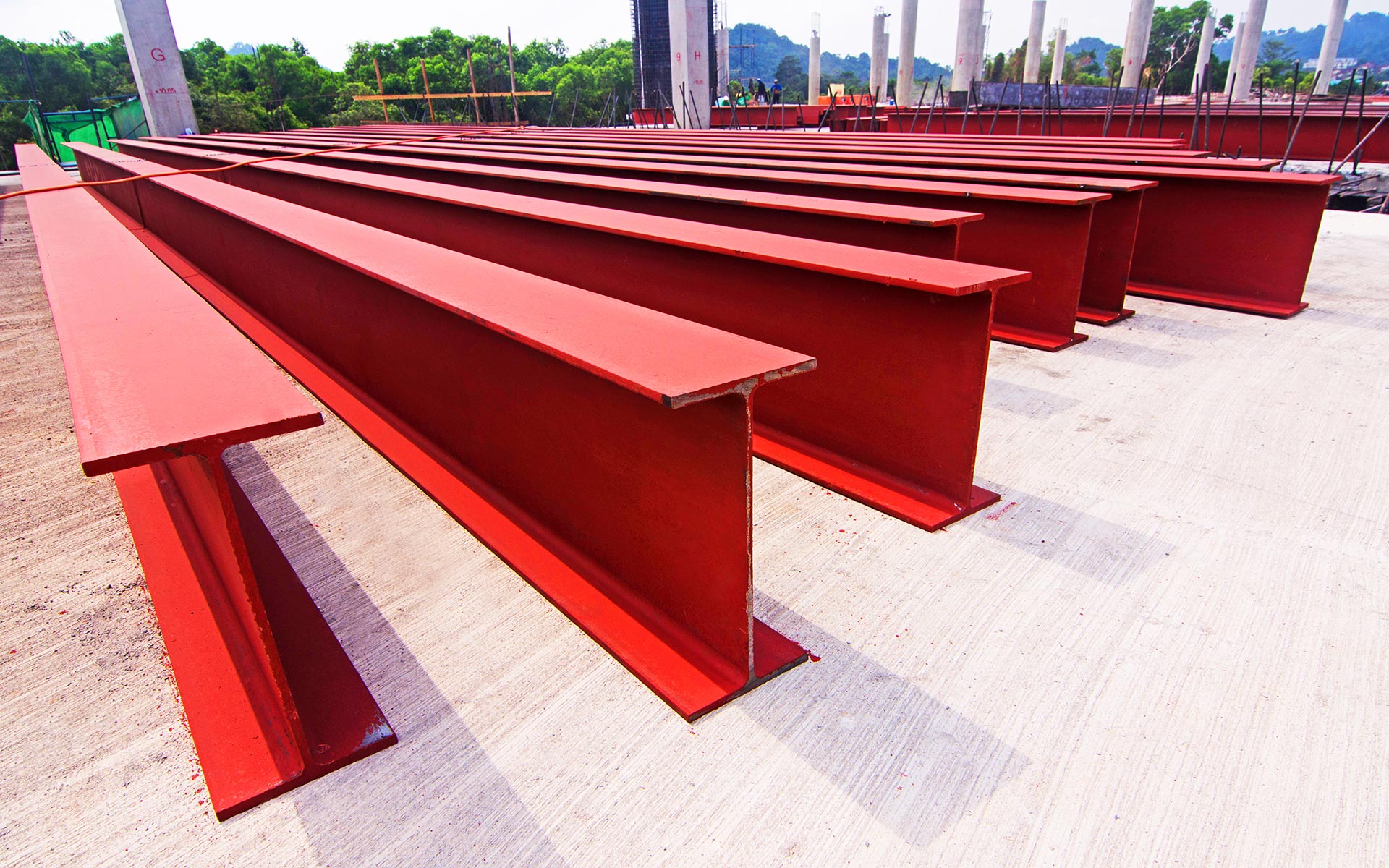
Steel beams producers in Europe target higher prices; market flat
Fastmarkets’ weekly price assessment for steel beams, domestic, delivered Northern Europe was €720-780 ($764-827) per tonne on Wednesday, unchanged from a week earlier.
Fastmarkets’ weekly price assessment for steel beams, domestic, delivered Southern Europe was €720-780 per tonne on Wednesday, flat week on week.
One trader in northern Europe reported offers for the product at €800 per tonne, although bookings at these levels were not confirmed by market participants.
Sources said they did not think prices would fall further, with mills unwilling to sell at lower prices.
Trading remained limited amid ongoing weak demand as a result of slow construction consumption.
Meanwhile, scrap feedstock in Turkey’s bellwether market moved down amid weak finished steel demand in the country’s domestic and export markets.
Fastmarkets’ calculation of its daily index for steel scrap HMS 1&2 (80:20 mix) North Europe origin, cfr Turkey was $359.50 per tonne on Wednesday, down $4.13 per tonne week on week from $363.63 per tonne, and down $10.48 per tonne month on month.
Published by: Holly Chant

Ukraine’s restoration will need 3.5mt of steel: Metinvest
Ukraine will need 3.5 million tonnes of steel for the restoration of housing and social infrastructure due to the war with Russia, estimates Metinvest’s trading arm, Metinvest-SMC.
The company launched its detailed concept at the II Architecture and Construction Business Forum held in Kyiv on 5-6 October. Representatives of government and business, including builders, developers, architects and banks, spent two days discussing how to work together to ensure Ukraine’s rapid recovery.
“The beginning of the country’s large-scale reconstruction depends on victory and, according to our estimates, around 3.5 million tonnes of steel will be needed to restore housing and social infrastructure,” says the company’s construction segment head, Tetyana Skrypka. “We have taken into account the extent of the destruction of buildings, with more than 65,000 affected, and the average metal content of these facilities. The restoration will require time – forecast at between five to ten years – so we also considered average annual steel consumption.”
The country’s Steel Dream restoration concept created by Metinvest-SMC is based on the principle of “build Ukrainian” and unites various domestic producers. In the six months since the presentation of the first concept, around 50 partners have joined the project, including steel plants, designers, furniture producers and building materials manufacturers.
“In addition to Mariupol, authorities in two other Ukrainian cities have expressed their readiness to restore destroyed facilities as part of Steel Dream projects,” Metinvest says. “Negotiations and work on building projects adapted to local conditions are being conducted with several communities. In addition, considering the significant interest in the Steel Dream concept, especially from foreign partners, the project team is undergoing accreditation at international foundations for approval of the project.”
Ukraine decreased crude steel production in September to 558,000 tonnes, down by 3.4% compared to August but up 64% on-year (see Kallanish passim). In January-September, it produced 4.6mt of steel, still down 17% on-year.
Svetoslav Abrossimov Bulgaria


Market questions omissions in EU seamless pipe review
The European Commission has initiated an expiry review of anti-dumping measures on Russia-origin imports of seamless pipe and tube of an external diameter up 406.4mm and carbon equivalent value (CEV) of 0.86.
The request for a review, submitted in June by the European Steel Tube Association (ESTA), “is based on the grounds that the expiry of the measures would be likely to result in recurrence of dumping and recurrence of injury to the Union industry,” states the Commission official journal entry seen by Kallanish.
According to informed sources, the review should have covered Ukraine, which was included in the previous case with Russia and which is exporting high volumes of seamless pipe to Europe. However, for geopolitical reasons related to the Ukraine war, the Commission decided to exclude Ukraine.
“It seems very odd that AD measures versus Ukraine originally in the same case as Russia are not showing in the same review,” one well-placed market source comments. “It cannot be explained by economical reasons as EU Customs import statistics are showing that imports originating in Ukraine were the largest in volume until summer 2022 … Ukraine’s exports to Europe are only second to China which made a huge leap in volumes between 2021 and 2022,” the source continues.
“Meanwhile, imports originating in Russia are very limited, first because of AD measures in place, and because of the total ban on trade due to the sanctions enforced on Russia. It is indeed very peculiar that EU authorities would be willing to go against Russia that does not represent any real threat but no action is taken to against Ukraine which is importing huge volumes into the EU, totally unchecked as all trade measures [anti-dumping and safeguard] have been lifted for Ukraine since June 2022,” the source adds.
The source says the Commission is ignoring the main threat represented by China, which doubled its export volumes to Europe in a year. “Does it make sense to attack Russia … leaving the two main sources of import, China and Ukraine, without any investigation?” the source asks.
According to Eurostat data, in 2020 Ukraine exported to the EU 97,409 tonnes of seamless pipe with diameter up to 406.4mm, in 2021 it shipped 101,579t and in 2022 this was 99,217t. In the first half of 2023 the country supplied 44,826t to Europe.
In 2020, China exported 78,414t to the EU and in 2021 it was 74,741t. In 2022 the figure jumped to 128,940t, while in H1 this year China already shipped 129,570t.
Imports from Russia are almost non-existent thanks to the measures in place.
Natalia Capra France

ArcelorMittal Fos-sur-Mer blast furnace to remain idled
ArcelorMittal Méditerranée will temporarily shut down one of its two blast furnaces at Fos-sur-Mer, Kallanish learns from a company spokesperson. Blast furnace number 1, which is currently idle for technical reasons, will not resume production following maintenance, until market consumption improves.
“The demand situation will be reassessed by the end of the first quarter of 2024. During this period, adaptation measures will be put in place, with priority given to staff training and measures to ensure the long-term viability of the industrial facilities. Maintaining continuity of service for our customers remains our priority,” the spokesperson comments.
ArcelorMittal Méditerranée is continuing to invest in decarbonising the site and ensuring its long-term viability. This includes the future installation of an electric arc furnace, as well as the ongoing construction of a ladle furnace for €73 million ($77m), which will increase the use of recycled steel.
The new EAF will be operational from 2027 and will replace one blast furnace by the end of the decade. ArcelorMittal has two blast furnaces at Fos-sur-Mer.
The French government will support the overall project with an investment of €1.7 billion. ArcelorMittal and the French government signed last year a strategic partnership for these investments (see Kallanish passim).
Natalia Capra France

EU coil centres feel pressure to sell off
As coil prices from northwestern European mills remain weak, but apparently will not sink much further, the deterioration downstream is more severe, market players point out.
“It is not the mills nor demand that determines the market and prices, but the distributors and service centres, pressured by the necessity to clear inventories and generate cash,” one Ruhr-based service centre (SSC) manager tells Kallanish. “You need continuous liquidity, otherwise you might run into insolvency even though your annual balance sheet is fine,” he explains.
Sales levels from SSCs and distributors have reached a critically low level, due to the slowdown in business among their customers, of which many have introduced short working. According to the manager, 60% of the total coil volume for end users goes via distributors, and 40% is sold from mills directly. “It is hard to tell who started the dumping, if it was the mills or the distributors,” he says.
In line with many others in Germany and Austria, he sees mill prices for hot rolled coil at between €600 and €640/tonne ex-works ($638-680). “This means €660 delivered for service centres, and many are selling off for €680,” which means making a loss in view of an SSC’s costs for processing services, storing, transportation and others.
According to an Austrian source, a realistic price would be €720/t for HRC to cover all costs. In southern Germany, too, “I hear prices of under €700 for HRC cut and slit, and below €800 for CRC,” he observes. Normally, SSCs need a premium of €60-70/t to break even, but ideally try to fetch €100, if times allow, players say.
Christian Koehl Germany

EUROFER calls for robust EU-US Global Arrangement to address steel industry’s existential challenges
The EU-US Summit planned for 20 October in Washington should pave the way for a global solution to tackle the two existential challenges facing the steel industry worldwide: non-market excess capacity and carbon intensity. Only a strong, international binding agreement can adequately respond to a new global context where government-fuelled, carbon-intensive excess capacity has reached 600 million tonnes, urges the European Steel Association.
“We expect to have an interim agreement to be announced by Commission President Ursula von der Leyen and US President Joe Biden, outlining an ambitious framework that will provide clear guidance and include the substantive elements of the Global Arrangement on Sustainable Steel and Aluminium (GASSA). The details will need to be worked out in the coming months”, said Axel Eggert, Director General of the European Steel Association (EUROFER). “The GASSA should be an international agreement binding transatlantic partners with a common vision while also remaining open to other like-minded countries with closely aligned trade policies and measures. Individual actions taken in isolation cannot have a global impact on excess capacity and decarbonisation”, he added.
Recently, the OECD expressed grave concerns about the deterioration of the global steel market, where excess capacity has now surpassed 600 million tonnes – more than the total OECD steel capacity. This excess capacity is mainly found in Asia, the Middle East and North Africa. Furthermore, new non-market capacity expansions are primarily focused on very carbon-intensive, traditional coal-based furnaces. Another 150 million tonnes of steel capacity are set to become operational by 2026, while global steel demand is expected to remain weak. “This new capacity alone, locking-in CO2 emissions for decades, will result in more CO2 emissions than the entire EU steel industry combined, erasing all of the EU steel industry’s emission reduction efforts up to 2050 in just three years”, stressed Mr. Eggert.
Today, the global steel industry is responsible for over 10% of global CO2 emissions, to which EU steel production contributes only a fraction (6% of total global steel emissions). If the global steel industry and other large industrial emitters are not decarbonised by 2050, the UN climate target of staying below a 1.5 or even 2-degree Celsius increase will not be achieved.
“The GASSA is a unique – and perhaps the only – opportunity to reach substantial emission reductions in the global steel industry”, emphasised Mr. Eggert. “The EU steel industry is currently in the most vulnerable situation, having lost around 30 million tonnes of sales in the EU and foreign markets over the past decade. We need an effective GSSA to transition towards carbon neutrality and support the EU’s strategic autonomy objective in a sustainable manner. Traditional trade instruments are fit for purpose, but their purpose is not to address global non-market excess capacity, while the Carbon Border Adjustment Mechanism (CBMA) has still to prove its effectiveness to level the playing field”, he concluded.
Source: eurofer.eu
