

Worldsteel slashes demand forecast amid inflation, geopolitical conflict
Worldsteel has revised down its 2023 global steel demand forecast to 1.8% on-year growth, compared to the 2.3% growth projected in April. High interest rates continue to stifle investment and consumption, while manufacturing continues to slow despite supply chain issues easing. Uncertainty stems from China’s structural transition phase and rising geopolitical conflicts.
Steel demand is seen reaching 1.81 billion tonnes in 2023. In 2024, it is projected to rise a further 1.9% to 1.85 billion t. “Considering the delayed effect of the tightening monetary policy, we expect steel demand recovery in 2024 to be slow in the advanced economies,” worldsteel economics committee chairman Máximo Vedoya says in a note seen by Kallanish. “The performance of emerging economies continues to diverge, with emerging Asia maintaining resilience.”
China’s property market should stabilise in the latter part of the year and China’s steel demand will record slight positive growth thanks to government measures. “The 2024 outlook for China remains uncertain depending on the policy directions to tackle the current economic difficulties,” Vedoya adds.
Besides Chinese uncertainty, increasing regional conflicts contributing to rising oil prices and further geo-economic fragmentation are downside risks.
Despite construction activity faltering, “infrastructure investment is showing positive momentum in many regions, even in the advanced economies, reflecting the effect of decarbonisation efforts”, Vedoya says.
Chinese steel demand in 2023 should record 2% growth, supported by infrastructure investments and stabilisation in the property sector. For 2024, worldsteel forecasts flat on-year steel demand, if government stimulus provides support. However, the real estate market and exports will continue to exert negative pressure on steel demand, which could contract without stimulus.
In the EU, monetary policy is expected to remain tight, meaning a rebound in real demand is not foreseen for 2024. However, as destocking cycles end, a technical rebound will enable positive growth in demand next year. EU plus UK demand is seen dropping 5.1% this year, compared to the April forecast of a 0.4% decline. It should rebound 5.8% next year.
The region’s growth engine, Germany, is in particular trouble, with both a manufacturing recession and a housing crisis. Demand is seen plummeting 10% this year and rebounding 10.6% in 2024.
Despite the resilience of the US economy, residential construction is expected to contract in 2023 and 2024. The 2022 Infrastructure Law and Inflation Reduction Act (IRA) is supporting infrastructure growth, while the automotive sector is expected to continue its post-pandemic recovery. The lagged effect of tight monetary policy points to downside risk for 2024. Demand is seen falling 1.1% this year and rebounding 1.6% next year.
Adam Smith Poland

Austrian institutions investigate scrap analysis
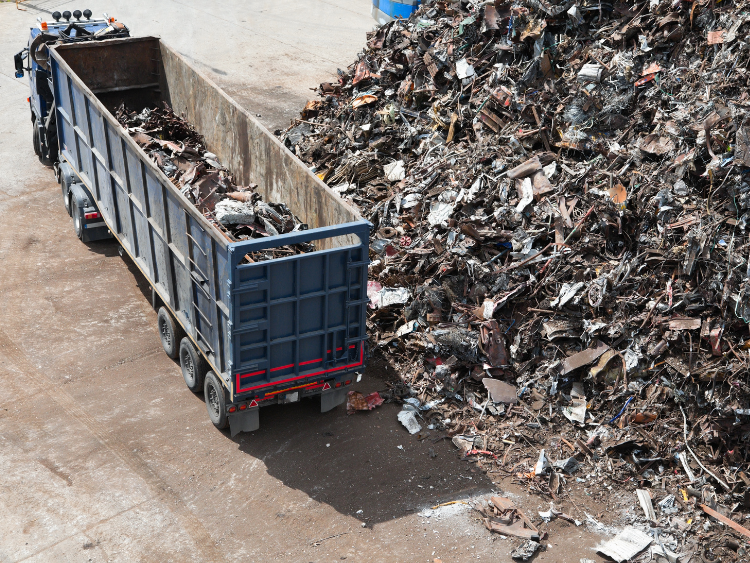
Austrian steelmakers and research bodies have launched a research project on the improvement of scrap selection by means of artificial intelligence and spectral analysis.
The project is titled InSpecScrap, and involves voestalpine, rebar maker Marienhütte, along with research institutes TU (Technical University) Graz, Joanneum Research, Know Center and competence centre K1-MET.
It was launched by the Austrian Society for Metallurgy and Materials (ASMET) and the state government of Styria, home of voestalpine’s Donawitz site, as one of ten projects in a competition named “Green Tech X”. InSpecScrap is therefore profiting from and complementing the trend for “green” steel.
At the launch event of the project, participants explained that they aim to detect all characteristics of the composition and quality of scrap already at the scrap yard, news agency APA reports. Researchers have started testing a combination of spectral cameras and artificial intelligence to achieve better accuracy when analysing scrap ingredients and qualities, Kallanish notes.
Marienhütte managing director Markus Ritter is quoted as saying he prefers sourcing scrap from domestic sources, rather than long and border-crossing transportation. The mill needs some 470,000 tonnes/year of scrap for its rebar production, which is shipped nearly exclusively by train.
Christian Koehl Germany

Port of Liverpool expands steel terminal amid demand
Peel Ports Group says it will extend its steel and metals terminal in response to strong growth in customer demand at the Port of Liverpool.
The UK’s second-largest port operator began construction of the 20,000-square foot extended warehouse at its North 3 Canada Dock in 2023. Its investment comes as the Port of Liverpool enjoyed one of its busiest months for steel volumes in September, with more than 75,000 tonnes handled across the port and Birkenhead Docks.
This was the port’s busiest month for steel in more than two years, when 93,000t were handled at the site in July 2021.
An initial 8,000 square feet of the newly created warehouse space is already in use. A second phase of construction work to build an extra 12,000 square feet of the terminal is ongoing and scheduled to be completed in December.
“We’re really pleased to have seen such an increase in demand for steel handling at our port in recent months,” Peel Ports Group Mersey Ports Director Phil Hall says in a note seen by Kallanish. “This positive news led to us choosing to increase the size of our facility, which offers customers the chance to expand their capacity, as well as improving our handling facilities at the port.”
Adam Smith Poland

Duferco inaugurates new mill
Italian sections producer Duferco Travi e Profilati has inaugurated the new Smart Beam Manufacturing (SMB) rolling mill at its San Zeno Naviglio site near Brescia, boosting capacity and sustainability, Kallanish learns from the company.
The new SMB mill supplied by SMS meets the company’s objective of enlarging its product range, improving quality and boosting capacity. It says it plans to become the “best cost producer” for sections at an international level. The new mill has a capacity of 700,000 tonnes/year at an overall investment of €250 million ($264m).
The San Zeno Naviglio site will use mostly clean energy. Duferco has signed a long-term power purchase agreement with a wind energy producer which, coupled with the photovoltaic capacity installed at the facility, will allow the mill to fully function with renewable energy. This will reduce carbon footprint and cut 28,000 tonnes/year of CO2. The site is digitalised and will use artificial intelligence to optimise the production process and energy consumption in the pursuit of a “zero waste” policy.
“The mill uses the most modern digital technologies and data analysis to save energy, and water, and guarantee safety as well as product quality. Innovation and sustainability in the steel industry are one and the same. AI has brought about an epochal paradigm shift, even if the human factor, focus, empathy, competence, determination are indispensable ingredients that the machine cannot replace,” Duferco president Antonio Gozzi says in a note.
Duferco Travi e Profilati has four facilities in San Zeno Naviglio, Giammoro, Pallanzeno and San Giovanni Valdarno, with a combined yearly output of 1 million tonnes of long products.
Natalia Capra France

European steel HRC producers seek higher prices on mounting costs
Major steelmakers have gradually started pushing for higher prices, seeking a €15-20 ($16-21) per tonne increase, claiming that the increases were necessary to cover input costs.
“Current prices [for HRC] are unsustainable,” a steelmaker source told Fastmarkets.
In general, HRC offers were reported to be around €645-650 ($680-685) per tonne ex-works from three integrated steelmakers in Northern Europe, compared with €630 per tonne heard last week.
Lead times from local mills varied between four and six weeks, sources said.
Buyers were cautious about the attempt to raise prices, claiming that mills’ order books were too weak and demand too slow to support even a small rise.
“Spot market activity in Northern and Southern Europe is still not significant,” a second steelmaker in Northern Europe said.
“Mills have low order books, and on a firm bid they still would negotiate a discount,” a steel service center in Northern Europe said. “It looks like [the steelmakers] want to stop the downtrend with this increase and signal to the market that the bottom has been reached.”
Buyers’ estimates of tradeable values were heard at €600-620 per tonne ex-works on Tuesday. Mills, however, claimed that the lower end of that range was “below costs” for them.
Even though inventory levels were trending lower at steel service centers and distributors, they continued to postpone restocking, market sources said.
“Buyers will come back for volumes when they have the understanding that, if they don’t book today, tomorrow [HRC] will be more expensive,” a third mill source said.
“More and more customers are out of stock. But they are still buying carefully,” a trading source said.
Fastmarkets calculated its daily steel hot-rolled coil index domestic, exw Northern Europe at €618.57 per tonne on October 17, up by €3.82 per tonne from €614.75 per tonne on October 16.
The index was down by €1.43 per tonne week on week, and down by €16.31 per tonne month on month.
In Southern Europe, meanwhile, Fastmarkets calculated its corresponding daily steel hot-rolled coil index domestic, exw Italy at €592.71 per tonne on October 17, down by €2.29 per tonne from €595.00 per tonne on October 16.
The index was also down by €7.29 per tonne week on week and by €33.29 per tonne month on month.
In Italy, tradable values for HRC were reported by buyers at €580-590 per tonne ex-works, while producers tried to keep offers at a minimum of €600 per tonne-ex-works.
But after other European steelmakers attempted to increase their prices, market sources suggested that Italian mills would follow suit and try to push offers higher as well.
Trading in the spot market remained very quiet, however, with steel service centers and distributors “aggressively destocking,” according to market sources.
For imports, two sources reported HRC offers at $600 per tonne CFR from Japan for end-December shipment, noting that some Japanese producers were starting to become aggressive with their offers.
Another trader said that Japanese producers were offering HRC to Europe at prices no lower than $620 per tonne CFR.
In general, most HRC offers from Asia were in the range of €580-600 per tonne CFR for December shipment.
Published by: Julia Bolotova
