


Revista InfoAcero Octubre 2023
En el siguiente enlace pueden acceder a la edición de Octubre de nuestra revista InfoAcero
Destacamos a continuación algunos de sus contenidos:
- Opinión – D. Gerardo García – Junta Directiva UAHE.
- Evolución del Índice de Precios de Productos Siderúrgicos – UAHE
- Sector Siderúrgico: Previsión a corto plazo demanda de Acero- WoldSteel Association Octubre 2023.
- Resumen 19º Forum Productos Siderúrgicos, Castelldefels – 4 Octubre
- Colaboración ASCEM: “El Acero puede salvarte la vida” – Sr. Joan Carles Codina- Secretario ASCEM


Report: coal-based steelmaking more than double green plans
New plans for coal-based steelmaking capacity are outpacing greener primary steel production methods with only a third of the world’s top 50 producers having announced targets to reach net zero by mid-century, Kallanish notes from a report.
The report was prepared by Global Energy Monitor and Stockholm Environment Institute’s Leadership Group for Industry Transition. It warns that planned coal-based blast furnace capacity worldwide totals 208.2 million tonnes/year, two-and-a-half times greater than the 83.6mt/y in planned primary green iron and steel capacity.
The report also finds that the investments in primary green iron and steel projects are growing, but mostly in developed markets and not fast enough to outpace emissions-intensive technologies.
It notes that the steel sector accounts for an estimated 7-9% of direct global greenhouse gas emissions, and the International Energy Agency has said that carbon dioxide emissions from heavy industries need to drop by 93% in order to reach net zero emissions by 2050.
Yet only 17 of the largest 50 steel producers have publicly committed to achieving net zero by mid-century, despite these 50 producers being responsible for more than 60% of the sector’s emissions.
The 17 producers that have a 2050 net zero goal account for more than a quarter (527mt/y) of global steel production.
Data also show that only two of 50 producers have included Scope 3 emissions calculations in their net zero goals.
The report notes that Scope 3 emissions play a significant role in steelmaking and can account for well over 40% of overall emissions from the sector.
Siew Mung Tan Malaysia


Dillinger supplies plate for Dutch offshore wind farm
Dillinger has supplied around 115,000 tonnes of heavy plate for the Hollandse Kust Zuid 1-4 offshore wind farm, which has just celebrated its official opening.
The wind farm is located 18-36km into the North Sea off the Dutch coast, between the cities of Scheveningen and Zandvoort. The farm is built on monopile foundations stretching 62 to 75 metres long and weighing up to 955t, in water depths reaching 17-28m. Dillinger supplied the heavy plate for these monopile foundation structures in thicknesses ranging from 54-90mm, Kallanish hears from the company.
With 139 turbines and an installed capacity of 1.5GW, Hollandse Kust Zuid is one of the largest offshore wind farms in the world, according to Dillinger. It can supply approximately 1.5 million households with renewable energy each year.
During construction of Hollandse Kust Zuid, the natural surroundings were also included for the first time in the design of the wind farm. These measures include enlarged water holes in the foundation elements that provide shelter for marine life inside the turbines, as well as boulders and stones of various sizes to construct the scour protection.
Artificial rocky reefs have been created on several scour protection systems to make them more attractive to a greater number of fish, crabs, and crustaceans, Dillinger notes.
Christian Koehl Germany

EU needs industrial deal, new VP position: associations
Europe needs a “real and tangible” Industrial Policy covering the full supply chain to ensure it does not drop out of the world’s clean technology race, a host of industrial associations including Eurofer have urged in a letter to EU heads of government.
The industry representatives say the next European Commission must appoint an executive vice president responsible for delivering the EU’s full industrial policy rethink.
Action is required against the threat of further European deindustrialisation and supply insecurity. “Global competition for clean technology and raw materials leadership has intensified. China has established a growing footprint across most clean tech sectors, while the US has taken a decisive step forward with its Inflation Reduction Act,” the associations say in the letter seen by Kallanish.
“All this is happening while Europe’s investment situation has worsened since Russia’s invasion of Ukraine with high energy prices, inflation, and growing supply risks. Europe’s ambitions are heavily challenged – from our wind industry to our electric and fuel cell vehicle supply chains, to our solar and electrolysers manufacturing goals, to our metal and chemicals producers,” it continues.
The associations have asked member state governments to request that the next European Commission delivers an “EU Clean Industrial Deal” competitiveness package in its first 100 days of office.
Industry representatives request five pillars from an EU industrial deal, including for the bloc to make its financial tools much easier to access for companies, learning from the US Inflation Reduction Act. Significant new sources of EU-level funding specifically allocated to clean energy supply chains will be essential. Secondly, the EU’s new rules on fast-tracking permitting for production and deployment need to be enforced at national level, for all cleantech sectors.
Next, the EU must urgently deliver globally competitive energy prices that bring competitiveness and investment certainty to both generators and consumers. This is the key precondition to ensure Europe’s energy transition and the security of energy, metals, and clean technologies supply, the associations observe.
EU industry and trade policies should be designed strategically to support clean tech manufacturing and supply chain goals, including remedying third-country unfair practices, and establishing free trade agreements for raw materials, energy, and technology transfer.
Finally, Europe’s focus on developing full domestic supply chains needs appropriate market incentive measures that reward technology producers for procuring local materials or components, the letter concludes.
Adam Smith Poland

Salzgitter selects Friesen Elektra for renewable energy supply
Salzgitter and utility Friesen Elektra have signed a long-term purchase agreement for power from the “Sande Hybrid Energy Park”, which is currently being built in the Friesland region in Lower Saxony, Germany. The park is scheduled to go online at the start of 2024.
As from May 2024, a permanent supply of around 80MW of green electricity from the park has been secured for Salzgitter Flachstahl, the steelmaker’s strip mill. The already existing “Sande Wind Farm” is currently being expanded with the aim of sourcing energy from wind turbines and photovoltaic systems. In the final stage of construction, the Sande Hybrid Energy Park will deliver an overall output in excess of 120MW, Kallanish learns.
“Green” power from the photovoltaic plants is initially an integral component of Salzgitter Flachstahl’s regular power procurement portfolio, the company notes. The long-term plan aims to harness the power for the production of green hydrogen. At the same time, the agreement includes the option of procuring hydrogen produced locally, it adds.
“Implementing sustainable steel along with energy production is becoming increasingly important not only for us, but also for our suppliers and customers,” says Salzgitter chief executive Gunnar Groebler.
Christian Koehl Germany

Italian rebar makers return to quoting
Some Italian rebar producers are back to quoting at increased prices this week after they stopped sales for ten days due to high production costs. However, uncertainty continues, as do low sales volumes. Producers still have very short visibility, sources tell Kallanish.
Rebar makers are now asking for €330/tonne base ex-works. Transaction values this week however are stable on-week and hovering at €280-290/t ($295-305) base ex-works. Very few transactions for small volumes are reported taking place at €300/t. Including extras, domestic rebar is fetching €540-560/t base ex-works. Domestic mesh is meanwhile being sold at about €370-380/t, also stable on-week. Buyers must add transport and around €300/t size extras.
The hike attempt is meant to stop values from declining further and recover some margins. Distributors and fabricators who spoke to Kallanish say they have some work thanks to infrastructure projects, but larger distributors are seeing their margins squeezed due to the lower sales volumes. One firm says it is beginning to sell its range of long products at below cost and sees the market being particularly quiet.
Natalia Capra France
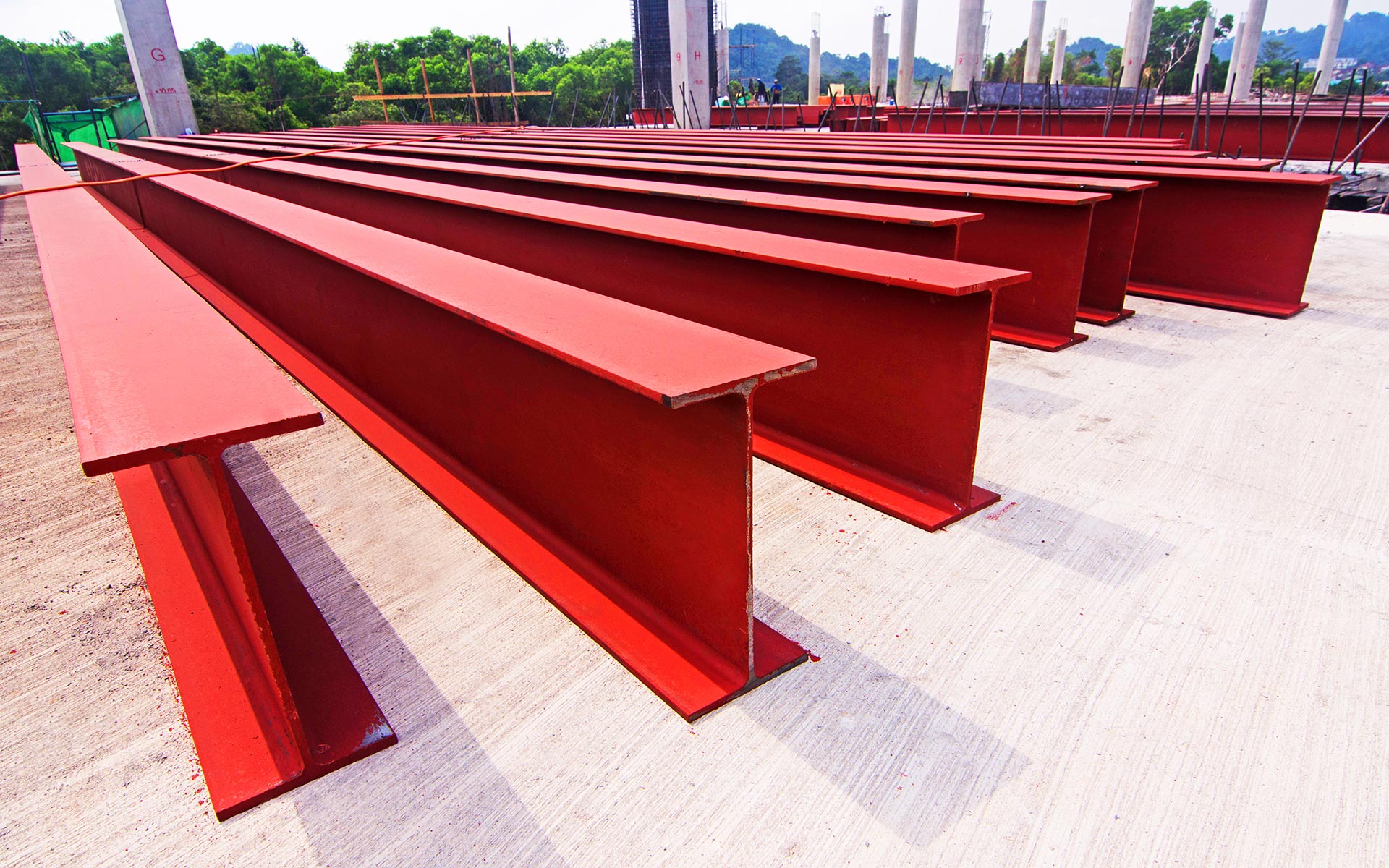
Steel beams prices in Europe narrow amid weak demand, energy cost concerns
Fastmarkets’ weekly price assessment for steel beams domestic, delivered Northern Europe was €730-750 ($772- 791) per tonne on Wednesday, with the price range narrowing by €10-30 per tonne from €720-780 per tonne a week earlier.
Similarly, Fastmarkets’ weekly price assessment for steel beams domestic, delivered Northern Europe was €730-750 ($772- 791) per tonne on Wednesday, also narrowing by €10-30 per tonne from €720-780 per tonne a week earlier.
Market participants had a gloomy steel demand outlook for the rest of the year, with one trader in northern Europe saying that steel industry companies were struggling due to the lack of trading.
Steel demand in the European Union, as well as in the United Kingdom, is forecast to fall by 5.1% overall in 2023, but growth is expected in 2024, according to Worldsteel.
A second source said they did not expect prices to fall much further due to rising energy costs with the winter season approaching.
The EU is reportedly considering extending an emergency gas price cap that was introduced in February due to uncertainty and concerns over energy costs in the region.
Meanwhile, scrap feedstock prices in Turkey’s bellwether market fell, with poor finished steel sales pulling down the market.
Fastmarkets’ calculation of its daily index for steel scrap HMS 1&2 (80:20 mix) North Europe origin, cfr Turkey was $347.65 per tonne on Wednesday, down by $11.85 per tonne week on week from $359.50 per tonne.
Published by: Holly Chant


Mills target price rises in Southern European long steel market, demand remains weak
With input costs rising, mills have targeted increased offer prices for November. But whether the market will accept these price rises remains to be seen, sources said.
Fastmarkets price assessment for steel reinforcing bar (rebar) domestic, exw Italy was €580-615 ($614-651) per tonne on Wednesday, narrowing by €5 per tonne from €575-620 last week.
Mills in the Italian rebar market withdrew from the market in the week to October 25, and will return to the market with higher offer prices toward the end of October or the beginning of November, sources said.
Low demand, high stocks and high input costs resulted in broadly unchanged prices, sources said.
“Producers are trying to increase rebar prices by €20-30 per tonne, but demand remains very low and customers have bought at lower prices through early-to-mid October so it’s difficult to close new orders at a higher price,” a buyer source said.
“Building activity is slow due to high-priced materials, high inflation, high bank rates and now bad weather,” the source added.
Despite weak economic conditions, mills will raise prices to cover their costs, sources said.
“I would say most mills are targeting €30-per-tonne price increases. Customers acknowledge the dignity of the requests for new prices and we are confident [that] November will bring increases on the portfolio,” a producer source told Fastmarkets.
Offer prices were reported at around €610-630 per tonne EXW, while estimates of workable prices were closer to €580-600 per tonne, sources told Fastmarkets.
The market remains in wait-and-see mode, holding out to see whether these prices rises will be accepted.
“Producers are trying to increase the price because they have said that during the past month they have lost money,” a second buyer source in the region said.
And a trader source told Fastmarkets: “Offer prices are rising but, with weak demand, the mills are hardly selling, so it is difficult to ascertain the correct price,” a trader source said.
Fastmarkets’ price assessment for steel reinforcing bar (rebar), domestic, delivered, Spain, meanwhile, was €590-615 per tonne stable week-on-week.
Southern European wire rod
Sentiment remained depressed in the Southern European wire rod market amid weak demand.
Fastmarkets’ price assessment for steel wire rod (mesh quality), domestic, delivered Southern Europe, was €570-590 per tonne on Wednesday, stable week-on-week.
“Prices are stable around €580 per tonne EXW, but with costs increasing and an upward trend across long steel products in Europe, mills are likely to push for higher prices in the wire rod market,” a producer source said.
Published by: India-Inés Levy

Slow end-user demand pressures European downstream flat steel prices
Slow demand from the automotive and construction industries was a major concern for the market, sources said.
“Our clients from [the] automotive [industry] booked only around 40% of their usual tonnages for November,” a steel service center source in Germany said.
Some producers in Northern and Southern Europe still could offer December-delivery coil, which indicated weak order books.
In Germany, however, some mills reportedly could only offer January-delivery coil, but this was due to some output reduction rather than good order books, sources said.
In Northern Europe, local producers were aiming for €720 ($762) per tonne ex-works for CRC and €730-745 per tonne ex-works for HDG.
One mill estimated the price for CRC at €750 per tonne ex-works and around €770-780 per tonne ex-works for HDG.
Buyers, however, estimated tradable values to be lower, at €700-710 per tonne ex-works for CRC and €720-725 per tonne ex-works for HDG coil.
Italy-origin HDG was offered to Germany at around €760-770 per tonne delivered.
Mills claimed that due to input costs, current prices were unsustainable for them and they were mulling rises for January-delivery coil.
Fastmarkets’ weekly price assessment for steel cold-rolled coil domestic, exw Northern Europe was €700-710 per tonne on Wednesday, narrowing downward by €5 per tonne from €710-715 per tonne on October 18.
And the corresponding weekly price assessment for steel hot-dipped galvanized coil domestic, exw Northern Europe was €720-725 per tonne on Wednesday, stable over the past seven days.
Overseas suppliers of CRC and HDG have also been trying to push offers slightly up during the assessment week, sources said.
Asian suppliers were offering material for shipment in January-February.
Japan-origin CRC was offered to Southern Europe at €680 per tonne CFR, compared with recent bookings of €670 per tonne CFR in mid-October.
A producer from South Korea was offering CRC to Southern Europe at €675 per tonne CFR.
A Vietnamese supplier was said to be aiming for $815-830 per tonne CFR for 0.5mm HDG with z100-120 coating, for mid-January shipment.
Published by: Julia Bolotova

European end users accelerate low-emission steel pull
The number of end users looking into low-emission steel procurement continues to increase in Europe, including for innovative applications such as wave energy, Kallanish notes.
SSAB and wave energy developer CorPower Ocean have signed an agreement to explore the development of one of the world’s first wave energy power plants made using fossil-free steel from 2026.
CorPower Ocean makes products that harness ocean waves to generate clean energy, and recently deployed its first commercial scale device off the coast of northern Portugal. Currently around 25% of these products’ lifetime CO2 emissions comes from the use of steel as a material. SSAB has been a supplier for ten years. Its customer now plans to build a wave energy system with significantly lower carbon emissions.
A recent CorPower Ocean study showed wave energy will play an instrumental role helping decarbonise the steel industry, by being used to create green hydrogen to make green steel. Ocean energy could help stabilise the carbon-free energy supply required for electrolysis to produce hydrogen, given the intermittency of wind and solar supply (see Kallanish passim).
Ventilation systems producer Lindab meanwhile says it has contracted ArcelorMittal to supply recycled steel for use in its ventilation ducts. This material contains 75% recycled material, resulting in a 62% reduction in climate impact, the Swedish firm says.
This complements Lindab’s procurement of fossil-free steel from SSAB, which is scheduled to start in 2026 after the parties signed an agreement two years ago (see Kallanish passim).
“Steel manufacturers are making a lot of progress right now. We want to offer customers choices so that they, like us, can benefit from the technological advances in sustainability. Ventilation ducts are very well suited for production in recycled and fossil-free steel. Considering how many metres of ventilation ducts there are in a large building, sustainable ventilation ducts make a difference to the overall climate impact of the building,” says Lindab president and chief executive Ola Ringdahl.
Adam Smith Poland