


European HRC producers maintain high offers; slow consumption hampers price rise
The HRC price recovery across Europe was mainly being driven by reduced supply resulting from output cuts and some restocking activity, but end-user demand has remained subdued, Fastmarkets heard.
January-rolling HRC was on offer from integrated mills in Northern Europe at €680 ($730) per tonne ex-works. One supplier was reported to be ready to consider €660 per tonne ex-works for larger volumes.
But no trades have been reported at that level yet, even though prices in the spot market have increased recently, supported by limited availability and improved trading.
Transactions for December-rolling HRC were reported at €630-640 per tonne ex-works in the region.
“Buyers are concerned about the sustainability of the [price] uptrend,” a trading source in the Benelux area said. “There is no support from consumption, so [buyers] remain cautious about volumes and do not stockpile.”
On the other hand, some market sources suggested that reduced supply and more expensive imports would support a price increase for first-quarter-rolling HRC.
Fastmarkets calculated its daily steel hot-rolled coil index, domestic, exw Northern Europe at €640 ($687) per tonne on November 7, down by €2.50 per tonne from €642.50 per tonne on Monday November 6.
The index was up by €17.50 per tonne week on week and by €23 per tonne month on month.
In Southern Europe, Fastmarkets calculated its daily steel hot-rolled coil index, domestic, exw Italy at €621.25 per tonne on November 7, down by €6.25 per tonne from €627.50 per tonne on November 6.
The Italian index was also up by €17.50 per tonne week on week and up by €15.28 per tonne month on month.
HRC offers from Italian mills were heard at €640-650 per tonne delivered, which would net back to €625-635 per tonne ex-works.
Several market sources said that mills still had December-rolling HRC available.
But end-user demand has remained weak in the region, although buying has started to pick up since the end of October, with big buyers coming back to the market for restocking.
Output cuts and uncompetitive imports were also supportive of price rises.
“Buying [activity] is not booming, but it is better than it was three weeks ago. All big buyers are back in the market, inquiring for [HRC] tonnages,” a steel service center said.
Overseas suppliers could only offer January-shipment HRC, which would mean February-March arrival.
Only Turkish mills could still offer December shipment, but the offer price of €640-650 per tonne CFR to Italy, duty included, was not considered workable by EU buyers.
A Ukrainian supplier was reported to be out of the market. The most recent offers of Ukraine-origin coil were heard at €600 per tonne CFR to Italy in the second half of October.
The lowest HRC offers were no longer available, with most Asian mills offering HRC to Europe at €610-620 per tonne CFR. But several sources said that, for large tonnages of 30,000 tonnes and more, Vietnamese mills were accepting €590 per tonne CFR to Italy
Published by: Julia Bolotova

French, Benelux scrap remains stable despite export-driven uptrend
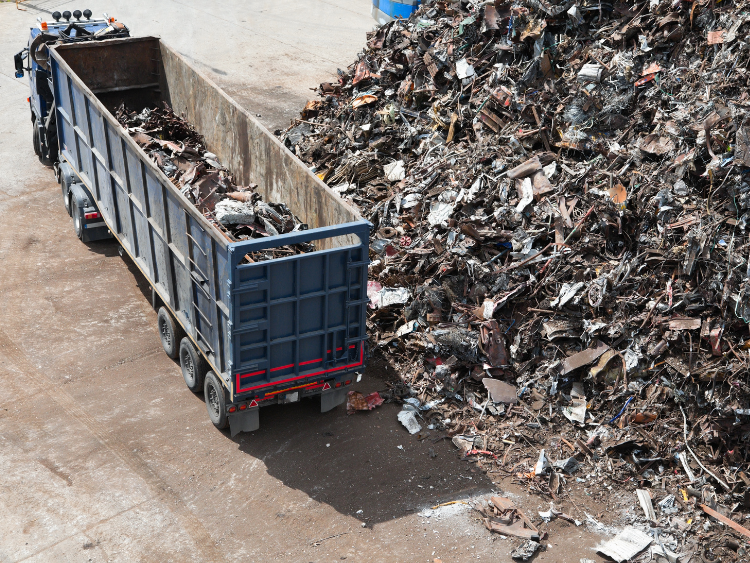
French and Benelux scrap prices are seen stable this month, with some downward fluctuation for certain grades depending on needs. This follows a slight decline in October, in line with the uncertainty in long and flat products markets.
Shortages amid lower scrap collection persist, with sellers preferring to export material to other destinations outside Europe, Kallanish notes.
Indian and North African buyers are making purchases. Turkish mills are buying scrap in Europe at higher prices, fearing procurement difficulties due to lower collection rates and intensifying containerised and seaborne scrap exports.
While European mills would tend to keep values stable this month, sellers are beginning to ask for a €10/tonne ($10.6) increase due to international hikes and reported shortages. The European market continues to be stagnant in terms of finished flat and long steel sales, with end-user activity quiet. Steelmakers will continue to implement production cuts this month.
In October, E40 and E8 were sold at €340-345/t delivered on average. Demolition E3 was at €320-330/t, while the lower E1C quality sold at €300/t delivered on average, sources suggest.
Natalia Capra France


Galati begins blast furnace restart, appoints general manager
Liberty Galati has begun the restart of blast furnace no.5, which the firm says will be sustained by adapting to challenging market conditions, as well as “ongoing support and cooperation” from customers and suppliers.
The steelmaker idled the unit last month due to severe weather in the Black Sea and low water levels on the Danube River (see Kallanish passim). This came at the same time as Liberty Steel idled its Ostrava BF no.3 due to weak steel demand across Europe.
The steelmaking group says it is adjusting its product mix and production schedules, reducing its cost base and working with government to bridge energy price differentials experienced across Europe. This, coupled with stakeholder support, will help to ensure the Galati BF restart is sustained and the plant remains competitive through market cycles and as it undergoes its low-carbon transition, the firm adds.
“Our renewed focus on cost competitive semi-finished products is yielding results, helping us to increase downstream capacity utilisation, and improve cash flows which will start to improve trade payables over the next few months. We continue to work with government on solutions to bridge energy cost differentials, which now make up nearly 40% of the variable cost per tonne of steel produced, compared with just 8% in 2019,” says Galati plant operations managing director Prasanta Mishra.
Galati is the second-largest energy user in Romania, meaning energy price rises have a big impact on its variable costs. Carbon taxes now cost Galati around €150/tonne of steel produced.
The firm points out it is competing with companies from other EU countries whose governments are shielding them from energy policy costs that make up a substantial part of the total price. This makes it hard for Romania-made steel to compete in its domestic market, it adds.
In other news, Galati has appointed Radu Ionescu as its new general manager. Ionescu is a lawyer who has advised Liberty on a range of strategic decisions made in Romania in recent years.
Adam Smith Poland
Pre-fair EU coil price hike raises eyebrows
Most hot strip mills in northwestern Europe have been heard lifting their price offers last week, but buyers do not expect the hikes to affect the market immediately.
The announcement comes barely one month after the last hike attempt, which was comparably modest at €20/tonne ($21.40), while now the offers heard are between €40 and €60 higher. One Dutch buyer tells Kallanish he was “completely taken by surprise” by the extent of the hike, which seems hardly justified in the current environment of economic reservation.
German sources were less stirred by the announcement, an attitude attributable to the proximity and awareness of the big coil trade fair this week, the Blechexpo in Stuttgart. “That’s [coil price hikes] typical gunslinging in the run-up to the fair,” a buyer of an automotive supplier says. All other German sources agree.
The annual German sheet fairs in November are normally a platform to start negotiations for annual contracts with big OEMs. “In the run-up to the fair, mills want a strong price base for annual contracts, so they lift their spot market price, although they are two different things,” a service centre manager explains.
“It is a very blatant move,” a buyer of a trader company finds. He sees the hike attempts at around €60/t, while another manager even hears of €70+. “They are aiming towards the €700 ($749) mark for hot rolled coil,” he says. But then he states there is little reason to believe that upcoming transactions will occur at much higher than the €620-630/t that was valid before.
Christian Koehl Germany