

Turkey’s Erciyas Pipe signs export deal to EU
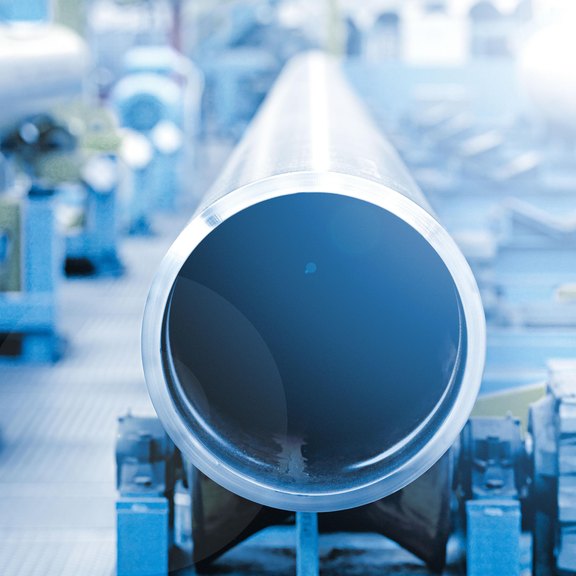
Turkish pipemaker Erciyas Çelik Boru and its partners will produce natural gas pipe for the European market, says Erciyas in a bourse filing seen by Kallanish.
The value of the contract totals €164.8 million with Erciyas Pipe’s share at 22.5%.
Shipments are expected to be realised in 2025.
Erciyas Pipe has an annual production capacity of 600,000 tonnes.
Burcak Alpman Turkey


PWO Group sources low-emissions steel from Salzgitter
PWO Group, a German automotive supplier originally known as Progress-Werk Oberkirch, intends to purchase carbon-reduced steel from Salzgitter starting in 2026, Kallanish learns from the group.
It says it has signed a partnership agreement with Salzgitter Mannesmann Stahlservice GmbH with the intention of reducing greenhouse gas (GHG) emissions when purchasing steel, the most important raw material for its business. “This will enable us to offer our customers an environmentally friendly alternative to conventionally produced steel in the future,” PWO says.
“We have already achieved extensive reductions in greenhouse gas emissions in our production and energy procurement processes,” comments PWO chief executive Carlo Lazzarini. “Now, we are also accelerating the decarbonisation of our value chain.”
Group chief financial officer Jochen Lischer adds: “By 2030, we want to reduce our absolute GHG emissions in Scope 3 by 28% versus the base year of 2019. The purchase of ‘green steel’ from Salzgitter Mannesmann Stahlservice, with a CO2 footprint in production that is up to 95% lower, will help us to realise this goal.”
Christian Koehl Germany

Thyssenkrupp Materials sells Spanish unit to Arania
Thyssenkrupp Materials Services has announced the sale of Spanish subsidiary thyssenkrupp Materials Processing Lamincer S.A.U. to Arania S.A.U., a unit of Grupo Arania.
Thyssenkrupp Materials Processing Lamincer was founded in 1986 in Mungia, in the Basque province of Biscay. The German group initially held a minority stake, and took full ownership in 2009, making it part of tk Materials Processing Europe. The Spanish cold-roller firm has 75 employees, a capacity for around 40,000 tonnes/year, and specialises in carbon cold-rolled strip, structural steel and micro-alloyed materials.
Tk Materials had already initiated the focusing of its own portfolio in 2019 as part of the strategic development of “Materials as a Service”. The sale of the Spanish company is a further step in this direction, Kallanish learns from the German group. As a cold-rolling company, Lamincer is not part of the core business of the materials distribution and service provider, tk says, but notes that it continues to be active at several locations in Spain.
Steel processor Grupo Arania has five production locations and presence in 65 countries, and employs more than 1,000 people with a sales turnover of €500 million ($555m). It is divided into business units for cold-rolled strip, welded tubes, heavy loads and lightweight loads storage systems.
Christian Koehl Germany

German steel industry bemoans continuing output drop
The downward trend of German steel production has sustained itself through year-end 2023, the country’s steel federation Wirtschaftsvereinigung (WV) Stahl writes in a review titled “Energy costs and low economy lead to historic production drops.”
For the full year 2023, the federation expects a year-on-year decline of 4%, to around 35.5 million tonnes of crude steel. 2023 would thus be one of the weakest years ever in terms of output.
In particular, the electric arc furnace route faced a big slump, by 11% to an estimated 10.1m tonnes, a level last seen 30 years ago, the federation notes. In comparison with the year before the energy price shock in 2022, EAF production fell by nearly 20%.
The federation expresses particular concern over the length of the recession that accompanies the drop of production. Since March 2022, output has fallen over a period of 21 months, with one minor uptick in September 2023. A negative cycle of this length has not been seen in Germany so far, WV Stahl states.
In November, crude steel output came to 2.7 million tonnes, down 2.4% on November 2022. Kallanish notes that the more pronounced fall occurred on the blast furnace route (-6.7%, to 1.83m tonnes), likely attributable to temporary shutdowns at several mills, while EAF production rose by 8.7%, to 871,000 tonnes. The federation does not provide an interpretation for this latest uptick.
Christian Koehl Germany

Biden formally extends EU tariff exemptions through 2025
According to the President’s plan, outlined in full on the White House website, EU steel and aluminium products are subject to “a tariff rate quota (TRQ) that restricts the quantity of steel articles imported into the United States from the EU without the application of the tariff.”
The US and EU agreed to the TRQ volume of 3.3 million tonnes.
“[This volume] is consistent with the objective of reaching and maintaining a sufficient capacity utilisation rate in the domestic steel industry,” reads the President’s proclamation.
TRQ measures replace the 25% tariff imposed on EU steel as discussions discussions over the Global Arrangement on Sustainable Steel and Aluminium continue.
“During the past two years, the United States and the EU have made substantial progress to identify the sources of non-market excess capacity and the actions needed to address distortions resulting from that non-market excess capacity. The United States and the EU are continuing their discussions on global steel and aluminium arrangements to restore market-oriented conditions in their steel and aluminium sectors and support the reduction of the greenhouse gas emissions intensity of steel and aluminium across all modes of production,” Biden states.
In an American Iron and Steel Institute (AISI) statement, president and ceo Kevin Dempsey shares approval for Biden’s proclamation.
“AISI welcomes the Biden administration’s action today to extend the TRQs on EU steel for two years to allow additional time for negotiations on the proposed Global Arrangement on Sustainable Steel and Aluminum. The American steel industry strongly supports the administration’s efforts to establish new mechanisms to address effectively global non-market excess capacity in steel and the higher carbon intensity of imported steel versus clean American steel,” Dempsey says in the AISI statement.
Earlier this month, the EU agreed to suspend its retaliatory measures on the US Section 232 tariffs through 31 March 2025.
Kristen DiLandro USA