


Romania’s Intertranscom acquires Dan Steel, eyes production restart
Romanian manufacturer of welded mesh wire Intertranscom Impex SRL has acquired steel wire producer Dan Steel, based in Beclean, Intertransocm confirms to Kallanish.
The bankrupt plant was sold at a public auction for €7.5 million ($8.15m).
The new owner plans to restart production and to transform the plant into one of the main employers in Beclean, it tells Kallanish.
CITR Cluj Branch, together with Prime Insolv Practice, as judicial liquidators, organised the previous auction for Dan Steel last June with a starting price of €23m, down from €25m and €28m in the prior auctions respectively.
Dan Steel Group was active in the production of wire and wire products, with a production capacity exceeding 100,000 tonnes/year. The asset comprises over 40 hectares of land, buildings with a total usable area of 75,460 square meters and related equipment.
The mill produced a range of carbon and galvanized steel wire, as well as welded mesh, fencing and nails. The company imported feedstock from Ukraine, Italy, Poland, Belarus and Moldova, from suppliers such as ArcelorMittal, Metinvest, Belarussian Steel Works and Moldova Steel Works. Its main competitors were IS Campia Turzii, Ductil Steel Buzau, and Metalicplas. The main export markets in 2019 were Hungary and Slovakia.
In 2019, the firm suffered from weaker domestic demand compared to 2018 and had planned to increase exports to new markets after shipments abroad also declined on-year (see Kallanish passim). Production fell 26% on-year in 2022 to 31,994t.
In 2020, Dan Steel was directed into insolvency proceedings following a request from creditor Unicredit Leasing Corporation. Its bankruptcy procedure was initiated in March 2022.
The company has accumulated debt of over €35m, which has created additional pressure on its financial situation.
Svetoslav Abrossimov Bulgaria


Germany earmarks €1 billion for ArcelorMittal decarbonisation: reports
ArcelorMittal’s German mills might soon obtain more than €1 billion ($1.1 billion) in public subsidies for their transition towards low-emission steelmaking, Kallanish hears.
ArcelorMittal has been on standby for a positive decision on the subsidy, after Germany’s other oxygen-route mills had state aid approved one after the other last year. Subsidies have so far been granted to thyssenkrupp (€2 billion), Salzgitter AG (€1 billion) and Stahl-Holding Saar mills Dillinger and Saarstahl (€2.6 billion).
According to business daily Handelsblatt, an initial tranche of subsidies for ArcelorMittal’s two oxygen-route mills, Bremen and Eisenhüttenstadt, could be released in the first quarter of this year. Citing federal government insiders, it writes that the tranche will be between €1 and €1.2 billion. The exact amount is still under discussion between the company, the German government, and the European Commission, the paper writes.
It quotes the vice chairman of union IG Metall, Jürgen Kerner, as saying that an approval is expected “in the coming weeks”. The paper notes that funds for the technical conversion of the steel mills would only be the first part of a bundle of subsidies. It gives the figure of €7 billion that also covers the first years of operation, to cushion higher production costs.
Christian Koehl Germany

Europe HRC prices supported by limited supply
In Northern Europe, prices continued to climb slowly, but traded volumes were still limited in the spot market.
“Buyers are booking only the volumes they absolutely need, to avoid building stocks,” a buyer source said.
Deals for domestically produced HRC in the region were heard at €750-770 ($815-837) per tonne ex-works, with most trades heard at the lower end of that price range.
Higher offers of €800-820 per tonne ex-works were still not being achieved in sales, according to market sources.
Lead times were mostly in April, but some producers could still offer March delivery, Fastmarkets heard.
Both producers and buyers agreed that the sharp price uptrend was driven by tight supply, while demand from all end-user sectors, except the automotive industry, was weak. Demand for steel from the automotive sector was also not booming, but rather was “stable at lower levels — not rising, but not declining either,” market sources said.
“We see that quite a few blast furnaces are still idled in Europe, [and] importing HRC is getting increasingly tricky. So far, these factors have helped mills to get higher prices [for coil],” a second buyer source said.
As a result, Fastmarkets calculated its daily steel hot-rolled coil index, domestic, exw Northern Europe at €751.25 per tonne on January 26, up by just €1.67 per tonne from €749.58 per tonne on Thursday January 25.
The index was also up by €7.25 per tonne week on week and by €55.75 per tonne month on month.
Fastmarkets calculated its corresponding daily steel hot-rolled coil index, domestic, exw Italy at €745 per tonne on Friday, up by €4 per tonne from €741 on the previous day.
The index was also up by €9.58 per tonne week on week and by €56.67 per tonne month on month.
Trading in the Italian market was also limited, and supply was limited as well, market sources said. This allowed local suppliers to secure higher prices in deals.
Transactions were reported at €745-750 per tonne ex-works in Italy on January 26.
Official offers were slightly higher, around €770-780 per tonne delivered (€755-765 per tonne ex-works) for March-/April-delivery HRC.
HRC offers from Indian and South Korean mills for April shipment were reported at €670-690 per tonne cfr Italy.
One Turkish supplier was offering HRC to Italy at €700 per tonne cfr, including anti-dumping duties.
Published by: Julia Bolotova


Polish rebar, wire rod prices up with mills still bullish despite low demand
Rebar
Polish mills remained bullish this week and offered rebar at 2,900-2,920 Polish zloty ($720-725) per tonne CPT, which would net back to 2,880-2,890 zloty per tonne ex-works.
An even higher offer price of 2,950 zloty per tonne CPT was reported heard in the market, which would net back to about 2,920 zloty per tonne ex-works. But this price was not confirmed by market participants and it was excluded from Fastmarkets’ final assessment.
In comparison, last week, Polish mills mostly offered rebar at 2,900 zloty per tonne CPT, about 2,880 zloty per tonne ex-works.
Most market participants described trading as “quiet” this week, although some deals for large volumes were heard.
“Two significant deals for around 5,000-10,000 tonnes each took place this week,” a consumer source told Fastmarkets. These were traded around 2,880 zloty per tonne CPT, about 2,850 zloty per tonne ex-works. But these deals discarded from the assessment because the volumes did not comply with Fastmarkets’ methodology.
Last week, smaller quantities of about 300 tonnes were traded around 2,850 zloty per tonne CPT, 2,820 zloty per tonne ex-works. Fastmarkets excluded this level from its assessment as well, because the deals were concluded in the previous assessment period.
Deals for 12mm rebar this week were heard at 2,870 zloty per tonne ex-works.
As a result, Fastmarkets’ weekly price assessment for steel reinforcing bar (rebar), domestic, exw Poland, was 2,870-2,890 zloty per tonne on Friday, up by 10-20 zloty per tonne from 2,860-2,870 zloty per tonne on January 19.
According to Fastmarkets’ sources, prices for rebar in the secondary market varied in the range of 2,850-2,900 zloty per tonne CPT.
Offers of imported material from Italy were heard at €660 ($717) per tonne CPT, and from Moldova at €665 per tonne CPT.
Wire rod
Polish mills continued to offer wire rod in the range of 3,000-3,300 zloty per tonne CPT in the week to January 26, market sources said.
But the tradable price was estimated at 2,900-3,100 zloty per tonne CPT. Deals for small volumes were heard in that price range.
Consequently, Fastmarkets’ weekly price assessment for steel wire rod (drawing quality), domestic, delivered Poland, was 2,900-3,100 zloty per tonne on January 26, up by 100 zloty per tonne from 2,800-3,000 zloty per tonne on January 19.
“This week, Polish mills were sending material from their orders for [production in] January. New offers for February are expected soon,” a distributor source told Fastmarkets.
They added that demand from all industrial sectors remained weak, and that there was no restocking activity.
Offers of imported material from Italy were heard in the range of €670-699 per tonne CPT.
Import offers of mesh-grade wire rod from Ukraine were heard at €660-670 per tonne CPT, Fastmarkets heard, and some deals for such material were concluded at prices in that range.
Published by: Darina Kahramanova

Italian heavy plate prices rise despite trading slowdown
Domestic prices for heavy plate in Italy have increased slightly in the week ended Jan. 26 although trading activity has slowed down.
“In plate market, there is no big restocking, but prices hold largely stable,” a mill source said. “There is regular trading and big buyers would have to return to the market looking for volumes soon.”
“Demand for plate is normal, slab prices are high, re-rollers are looking for higher plate prices and generally the market seems healthy,” a Germany-based distributor said.
Platts assessed domestic prices for heavy plate in South Europe up Eur5/mt on the week to Eur770/mt ex-works Italy on Jan. 26.
Majority of deals have been heard at Eur760-780/mt ex-works Italy. Italian mills have been aiming for Eur800/mt ex-works for the material.
Platts assessed prices for imported slab in the region at $660/mt CIF Italy on Jan. 26, down $10/mt on the week.
Deals for slab from Asia have been heard at $650-$660/mt CIF Italy and tradable values — at $670-$680/mt CIF Italy.
Some market participants, however, had less optimistic view on the demand.
“We have very poor inquiries and orders, the market is still suffering from the lowest turnover from stock in history in December and therefore a stock level which is not as low as expected plus big purchases in last year at old prices,” another Germany-based distributor said.
Platts assessed domestic prices for heavy plate in Northwest Europe down Eur10/mt on the week to Eur830/mt ex-works Ruhr on Jan. 26.
Offers of heavy plates from German mills have been reported at Eur810-850/mt ex-works Ruhr, but lower prices were available only for limited volumes.
Northwest European re-rollers have been offering the material at Eur800-850/mt ex-works and a supplier from Central Europe — at Eur800/mt ex-works.
Author: Maria Tanatar, maria.tanatar@spglobal.com

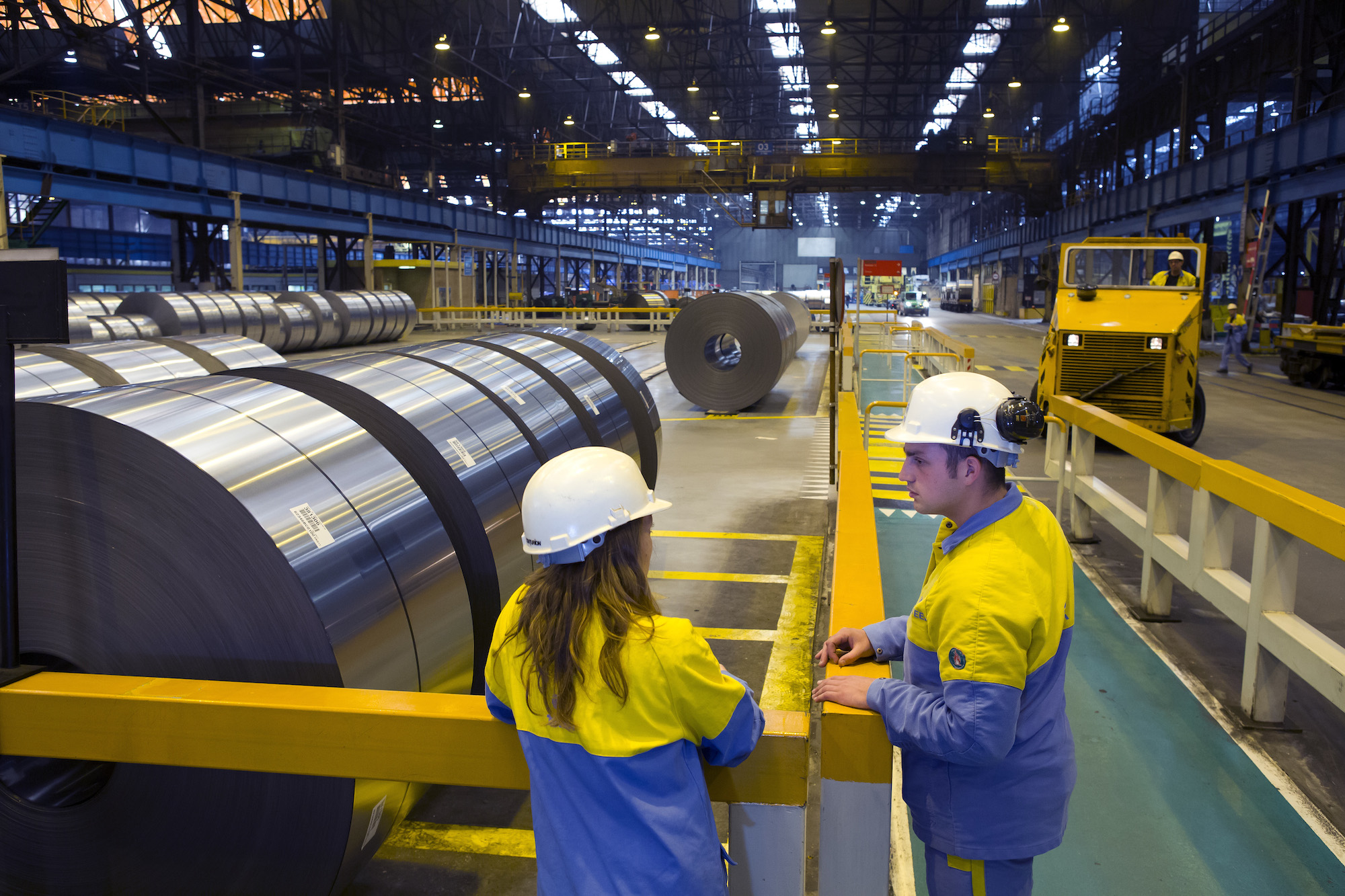
Tata Steel to close coating line and service center in Turkey
TSIM’s color coating line and service center, which started operations in 2000, are located in Adapazari, near Istanbul.
Tata Steel said the specificity and limited scale of the production operations in Turkey have been negatively affected financially by rapidly changing market conditions, such as increased competition, price fluctuations, and evolving market demands.
“As these challenges are anticipated to persist in the medium and long term, it has therefore been decided to cease operations in Turkey,” it said.
“With TSIM’s high differentiation of its product and service portfolio in colors, and considering the extreme market developments, sustaining its business model is no longer feasible,” said Gunilla Saltin, member of the board of Tata Steel Nederland, adding that they emphasize the uninterrupted continuity of their sales and after-sales services in Turkey.
The closure of production and operations at Adapazari will take place over the coming weeks.
Slow demand in main export markets, lower imported coated coil offers to Turkey, particularly from Asian suppliers, as well as high input costs pressured Turkish mills’ flat steel pricing throughout 2023.
Platts, part of S&P Global Commodity Insights, last assessed the weekly Turkish domestic HDG price at $890/mt EXW Jan. 19, down $10/mt on week.
Author: Cenk Can

Thyssenkrupp opens Mexican service centre
Thyssenkrupp Materials Services’ new service centre (SSC) in Mexico was inaugurated last week, the company tells Kallanish.
The thyssenkrupp Materials de México SSC in San Luis Potosí will specialise in serving the growing local automotive industry, the company says, highlighting sustainability, electromobility and light vehicle-building. The firm invested $37 million in the unit, which will create around 65 new jobs.
TK Materials has now deployed a total investment of more than $100m in North America in the last 15 months, it notes.
The SSC will join three other service centres located in the country, in the cities of Saltillo, Puebla and Silao. The latter has a steel and aluminium blanking line, and will operate in conjunction with San Luis Potosí since they are situated 170km apart.
San Luis Potosí will feature a Schuler cutting line, which allows the cutting of raw pieces of aluminium and high-strength steels used in the automotive industry.
Christian Koehl Germany