


EUROMETAL visited service centers in northern Spain
The Director General of EUROMETAL, Ricardo Silva, visited last week the long products service center and proximity multi-product stockholding distributor TIRSO CSA in Santander and the Tata Steel Layde flat service center in Durango.
During the visit to the TIRSO CSA facilities, it was possible to meet and exchange with the president of the Spanish federation of distributors UAHE and member of the EUROMETAL presidency, Roberto Gongalez.
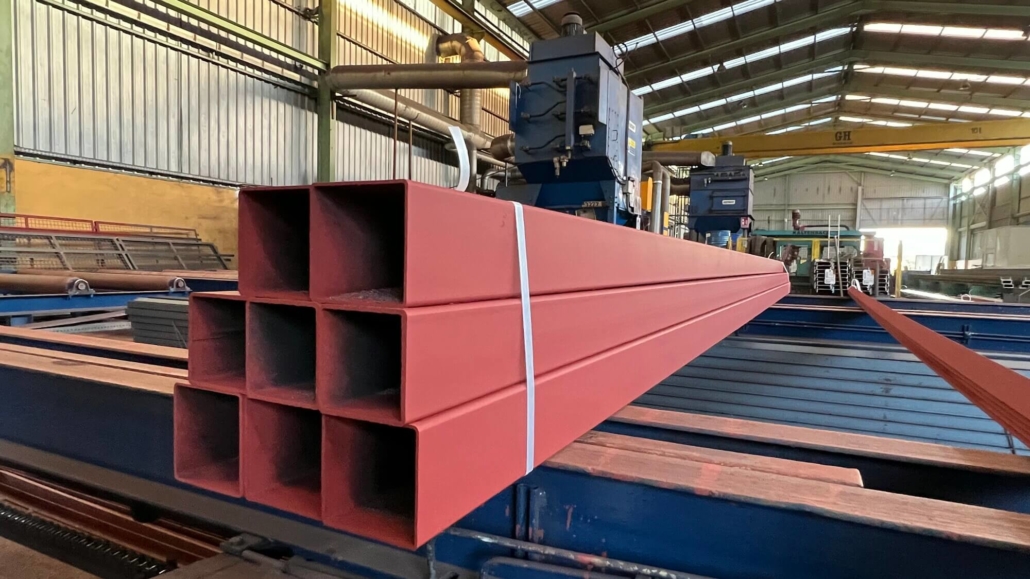
TIRSO CSA covers the distribution of certified steel products and custom supplies, by performing oxyfuel cutting, plasma cutting, longitudinal cutting, drilling, shot blasting and painting of steel parts and structures. Equipped with modern cutting lines, it has an area of 25,000 m2, of which approximately 12,000 m2 are under cover. The company is present in Cantabria, Gran Canarias, Tenerife and Asturias.
During the meeting, it was possible to address the context of steel distribution in Spain but also to reflect and prepare the meeting of the National Federations members of EUROMETAL, to take place later in the year 2024.
The visit to Durango allowed us to meet with the managing director of Tata Steel Layde and president of EUROMETAL, Fernando Espada.
Layde managing director told us about the long history of this Bizkaia service center in northern Spain and the various processes such as slitting lines, cut-to-length, pickling, annealing, skinpass, cold rolled services and sendzimir rolling technology supplying to different and demanding sectors like automotive, industry, construction, home appliances and furniture.

This meeting also made it possible to prepare the first meeting of the EUROMETAL presidency, to be held on April 11, 2024 in Santiago de Compostela and address various pending issues related to the day-to-day life of our federation.

EU provides €3m for redundant German Vallourec employees
The European Commission has proposed to support 835 workers dismissed in the German steel industry with €3 million ($3.3m) from the European Globalisation Adjustment Fund for Displaced Workers (EGF).
In November 2023, Germany applied for EGF funding to help the workers dismissed by steel tubes producer Vallourec, after the company decided to close its German tube mills to move production to Brazil.
The support includes guidance, such as counselling and vocational orientation, job search assistance like job scouting or participation in job fairs, as well as training offers, Kallanish learns from a Commission bulletin. Former workers can also receive funding of up to €22,000 for starting their own business. They can receive allowances when they participate in support measures such as training courses, and bonus payments or salary top-ups when they start a new job.
The total estimated cost of the measures is about €5 million, of which the EGF will cover 60%, or €3m. The remaining 40%, or €2m, will be financed through the German federal budget and the German Public Employment Service.
EGF support is available for people affected by all types of unexpected major restructuring events, including the economic effects of Russia’s invasion of Ukraine and other sources of geopolitical instability. Also included are larger economic trends like decarbonisation and automation. Member states can apply for EU funding when at least 200 workers lose their jobs within a specific reference period.
Christian Koehl Germany


ArcelorMittal advances Fos-sur-Mer electrification
ArcelorMittal will commission the new ladle furnace at its facility in Fos-sur-Mer, southern France, in the second quarter. This will represent “the beginning of the electrification of the plant in Fos-sur-Mer”, the steelmaker says in a note obtained by Kallanish.
It aims to ramp up the unit between April and May. No production stoppages or slowdown are scheduled during the start-up and integration.
The 85-tonne transformer, two domes, three electrodes to convey the electrical power necessary to heat the liquid steel, six electrical rooms, 300 meters of conveyor belt and a control room are now being built. The ladle furnace will heat the steel to the right temperature, compensating for the cooling generated by the addition of recycled steel in larger quantities at the converter stage.
This will reduce the carbon footprint of the site by almost 10% as the company aims to reach a 35% reduction by 2030. The furnace will have a full capacity of 50 megawatts. The total investment was €76 million ($82m), including €15m from the French state as part of the “France Relance” growth plan.
A new electric arc furnace in Fos will be operational from 2027 and will replace one blast furnace by the end of the decade. At present, ArcelorMittal has two blast furnaces at Fos-sur-Mer.
Natalia Capra France
Tenova tests hydrogen for steelmaking
Funded by the European Commission for a budget of about €3.3 million ($3.5m), HyTecHeat will be testing hybrid heating technologies based on natural gas with a progressive increase of hydrogen up to 100% in downstream processing, Kallanish learns from Tenova.
The firm will install an electrolyser at its Italian headquarters in Castellanza that will test industrial burners. “Three demo cases testing innovative multifuel burners will facilitate the hydrogen transition of the steel sector paving the way for the abatement of Scope 1 CO2 emissions … One of the demo cases Tenova is participating in is focused on the system integration between hydrogen-ready burner, electrolyser, and storage systems,” Tenova explains.
Snam will provide the hydrogen storage system and De Nora will supply its new electrolyser called the Dragonfly. Besides the burners, the testing will cover the entire production process from green energy production to a photovoltaic system, hydrogen generation, and storage, process control and safety issues.
The project responds to the need to develop an industrial-scale technology that includes renewable hydrogen production, storage, and usage in thermal combustion processes.
Several sources in the steel industry, however, believe green hydrogen production and storage is currently too expensive a technology to decarbonise steelmaking.
Despite investing in companies involved in hydrogen through its “XCarb” innovation fund, ArcelorMittal said in 2021 that decarbonising steel from other carbon capturing technologies has proven more effective so far, and less expensive.
ArcelorMittal Europe chief executive Geert van Poelvoorde reiterated last month that using green hydrogen in the short term would push steelmakers out of the market for being uncompetitive (see Kallanish passim).
Antonio Gozzi, owner of Duferco, previously said decarbonised gas may be the best and most achievable solution for Italian energy independence and cheap energy for industry and households. Gas prices may decline significantly in the coming years due to lower future European demand and massive supply in the Mediterranean area, where giant deposits will make it largely available. Gas could be cheaply imported into Italy from countries such as Algeria, Egypt, Israel or Cyprus.
An industrial country such as Italy needs base load energy besides intermittent renewable sources, Gozzi said. Green hydrogen production requires vast renewable energy and water, which is a precious and rare commodity, he added.
Natalia Capra France

HRC buyers in Europe remain quiet, awaiting further price falls
Buyers preferred to stay on the sidelines and expect the general downtrend seen in February to continue into March, sources said.
Lead times remained quite short at European producers, so buyers continued to postpone restocking, sources said.
“Mills can deliver HRC in about six to eight weeks, so [there is] no rush from our side,” a buyer in Germany told Fastmarkets. “It looks like there is still room for a price correction.”
Offers continued to be reported at €730-750 ($790-812) per tonne ex-works from integrated mills in Northern Europe, with an offer from a re-roller in the region heard at €690-700 per tonne ex-works.
Buyer estimates of the workable price in the spot market came in at €700-720 per tonne ex-works on Friday.
Fastmarkets calculated its daily steel HRC index, domestic, exw Northern Europe at €715.50 per tonne on Friday, down by €2 per tonne from €717.50 per tonne on Thursday.
The index was down by €6.63 per tonne week on week and by €46.50 per tonne month on month.
Sources told Fastmarkets that output cuts were needed to rebalance the market because there is no prospect of a rebound in end-user demand.
“Mills get no orders [but] they still have order books [for the second quarter] to fill. They cannot be super flexible with prices because, at €700 per tonne [ex-works], costs are already starting to bite. So, it looks like adjusting output would be the logical next step,” a buyer in the Benelux area said.
But mills have made no official announcements so far this week.
In Southern Europe, Fastmarkets’ corresponding daily steel HRC index, domestic, exw Italy was calculated at €707.92 per tonne on Friday, down by €4.58 per tonne day on day from €712.50 per tonne.
The index was also down by €7.08 per tonne week on week and by €47.58 per tonne month on month.
Local suppliers reduced their domestic offers in the spot market to around €720 per tonne delivered (€705-710 per tonne ex-works) in the week to March 1, sources said.
And additional discounts, of up to €10-15 per tonne, were possible for bigger tonnages, according to some market participants.
“There were reports of HRC offers below €700 per tonne ex-works from [domestic HRC producers], but it is not a flat offer price for the spot market, rather it is for big steel service centers and tube makers,” a source in the Italian market said.
In the import market, meanwhile, one big-tonnage deal for Vietnam-origin HRC was heard at around €585 per tonne CFR. The cargo composition was not clear at the time of publication, but several sources said it was a mix of HRC and steel slab.
The price from Vietnam would only be possible for large cargoes, sources said, adding that other offers from Asian suppliers – notably from Vietnam, Taiwan and Japan – were heard at around €610-620 per tonne CFR.
“There are some big buyers in Italy that typically rely on imports and always book [HRC] cargoes from overseas suppliers; this is their business model. For the rest of the market, demand for import [HRC] remains low,” a buyer in Italy said.
Published by: Julia Bolotova


Some flat steel prices decline in Turkish market on weak demand
The market was slow because of the uncertainty before the local elections in Turkey scheduled for March 31.
Furthermore, scrap and iron ore prices have been decreasing, leading to an expectation that flat steel prices will fall further, sources said.
Fastmarkets’ latest index for steel scrap HMS 1&2 (80:20 mix) North Europe origin, cfr Turkey was calculated at $390.27 per tonne on Thursday February 29, down by $16.36 week on week from $406.63 per tonne.
And Fastmarkets’ index for iron ore 65% Fe Brazil-origin fines, cfr Qingdao averaged $129.13 per tonne in the week to Friday, down by $6.05 per tonne from an average of $135.18 in the previous week.
Turkish producers were accepting orders for April and May production during the past seven days, Fastmarkets heard.
Domestic prices
Fastmarkets’ weekly price assessment for steel hot-rolled coil domestic, exw Turkey was $680-700 per tonne on Friday, widening downward from $690-700 per tonne on February 23.
Turkish HRC producers were offering around $680-700 per tonne ex-works during the week, but demand was limited, market sources said.
The latest price assessment for steel cold-rolled coil domestic, exw Turkey was $790-820 per tonne on Friday, down week on week from $800-830 per tonne.
Turkish producers were offering CRC with 1mm thickness at $790-830 per tonne ex-works during the past seven days, widening downward from $800-830 per tonne ex-works in the previous week. Market participants believed that $830 per tonne was too high considering current demand.
HRC exports
The export market for Turkish HRC remained slow during the past week, Fastmarkets understands.
Turkish producers were reportedly offering HRC at $670-690 per tonne FOB, but no major deals were heard.
Fastmarkets’ price assessment for steel hot-rolled coil export, fob main port Turkey was $670-690 per tonne on Friday, unchanged week on week.
Import prices
China reportedly offered HRC at $580-585 per tonne CFR, down from previous offers at $600-610 per tonne CFR.
No major deals were heard.
Fastmarkets’ weekly price assessment for steel hot-rolled coil import, cfr main port Turkey was $580-585 per tonne on Friday, down from $585-610 per tonne on February 23.
And Fastmarkets’ price assessment for steel cold-rolled coil import, cfr main port Turkey was $690-700 per tonne on Friday, unchanged week on week due to a lack of new prices in the market.

Polish steel rebar prices down under pressure from imports
Fastmarkets’ weekly price assessment for steel reinforcing bar (rebar), domestic, exw Poland, was 2,758-2,850 zloty ($691-714) per tonne on Friday. This was down by 20-29 zloty per tonne week on week from 2,787-2,870 zloty per tonne on February 23.
Polish mills were offering rebar this week in the range of 2,800-2,950 zloty per tonne CPT, which would net back to 2,780-2,920 zloty per tonne ex-works.
In comparison, last week, the prevailing offer price for domestic rebar was 2,900 zloty per tonne CPT, about 2,880 zloty per tonne ex-works. But this price was not firm because, since last week, Polish mills have been offering discounts on larger volumes.
This week, some producers lowered their official offers by 100 zloty per tonne, market sources told Fastmarkets. As a result, offers of 2,900 zloty per tonne CPT and above were not widely accepted in the spot market.
“Everyone expects [prices from] mills to go down to at least 2,750 zloty per tonne CPT [about 2,730 zloty per tonne ex-works] for larger purchases,” a distributor source told Fastmarkets.
But this estimate was not widely agreed by other market participants, who estimated the tradable price for more significant volumes in the range of 2,758-2,780 zloty per tonne ex-works.
A deal for 200 tonnes of rebar was heard concluded at 2,870 zloty per tonne CPT, about 2,850 zloty per tonne ex-works.
Demand for Polish rebar remained comparatively low, however, although with some improvements seen in the cut-and-bend sector.
“There are some investments. And some construction sites are expected to start work in March or April,” a second distributor source told Fastmarkets.
The fall in the price of Polish rebar was seen to be mainly due to strong competition from imports.
“The lower offers from Polish mills were in response to cheap imported material,” a consumer source told Fastmarkets, adding that import offers of rebar from Germany to Poland were heard at €640 ($693) per tonne CPT.
A trader source told Fastmarkets that import offers from Italy have been heard this week at €635 per tonne CPT, from Hungary at €645 per tonne CPT, and from Moldova at €658 per tonne CPT.
In comparison, two weeks earlier, some offers of imported rebar from Italy and Hungary to Poland were heard at €650-655 per tonne CPT. Even then, such prices were low compared with offers from Polish mills.
Blockade of Poland-Ukraine border
Meanwhile, a blockade by farmers of the Poland-Ukraine border continued to create difficulties for imports of steel products into Poland, market sources said.
Farmers across Europe have been protesting for weeks against the stringent requirements of the European Green Deal and what they have said was “unfair” competition from outside the EU.
“Since February 16, the Polish railways have not been accepting any new shipments,” the first distributor source told Fastmarkets. “As much as 5,000 tonnes of rebar, which we were supposed to [have received] in February, has been stopped and postponed to March. No-one knows how long this will go on.”
According to the same source, only two shipment stations were not included in the stoppages.
The source added that the blockade of the border has had some effect on importers, but it was not affecting the entire market.
“The queue on the Ukrainian side has sometimes reached 70km long,” Yuliya Mezentseva, head of logistics at Metinvest Polska, said in an interview with Polish news outlet Puls Biznesu in February.
“The Polish-Ukrainian agreement stipulates that six trains a day with steel and ore should pass through… the Medyka border crossing,” she added. “In practice, [only] three or four are allowed through, because the Polish border [authorities] and railway administrators give priority to other transport.”
Mezentseva explained that the long waits on the border increasesd costs for the company. “For every hour at a standstill, we have to pay 1.90 Swiss francs [$2.16] per commercial wagon,” she said.
On February 28, Polish and Ukrainian officials discussed the border blockade but did not achieve a clear solution to the problem.
Julia Bolotova in Brussels contributed to this report.
Published by: Darina Kahramanova

China may continue to be a threat to global steel industry in 2024: TCUD
China may continue to be a threat to the global steel industry in 2024, including the Turkish steel sector, due to the possibility that it could continue focusing on export markets with subsidized prices arising from insufficient growth in its own market, Turkish Steel Producers’ Association said in a statement.
Stiff competition by China in some of Turkey’s main export markets restricted Turkish mills’ market shares in 2023, while low-priced inflows from China into the Turkish steel market pressured domestic mills’ steel pricing and output, the association said in a statement seen by S&P Global Commodity Insights Feb. 29.
The rise seen in steel imports from China was despite the anti-dumping (AD) investigation opened by the Turkish Ministry of Trade on Oct. 31, 2023, against imports of hot-rolled coil from China, India, Japan and Russia.
The result of the investigation, which is expected to be announced in the coming months, could limit import volumes in 2024, according to industry sources.
Meanwhile, Turkey’s crude steel production fell 4% year on year in 2023 to 33.7 million mt, TCUD data showed, owing to slow demand and stiff import competition that pressured Turkish mills’ prices and output.
Turkish steel producers, however, are aiming to exceed the 15.2 million mt steel export volume in 2022, which is also expected to support their output volumes.
Turkey’s steel exports already increased notably by 23% on the year to 895,000 mt in January, the recent TCUD data showed.
“The rise in high quality steel investments in Turkey in recent years, like stainless steel, armor steel as well as railway wheels, supported January steel exports,” the association said.
Turkey’s flat steel exports increased substantially by 89.1% year on year to 348,000 mt in January, while long steel exports rose only 2% to 537,000 mt due to shipping disruptions in the Red Sea, TCUD noted.
According to TCUD data, the steel export/import coverage ratio of the Turkish steel industry rose to 61.6:100 in the first month of 2024 from 55.1:100 a year prior amid the rise seen in export volumes.
The association is expecting the increase in Turkish mills’ steel exports to continue in the coming months, with interest rate cut expectations in the EU as of the second quarter of 2024 to support steel demand in Turkey’s main steel export destination.
Slowed demand both in the domestic and export markets, however, has put pressure on Turkish mills’ steel pricing in recent weeks.
Platts last assessed the Turkish HRC steel price at $680/mt ex-works Feb. 23, down $10/mt on the week in a slow market, according to S&P Global data.
Author: Cenk Can


UK Tariff-rate steel import quota should follow temporary quota suspension: ISTA
The International Steel Trade Association is suggesting tariff-rate quotas following a temporary suspension of hot-rolled coil import quotas into the UK, ISTA told S&P Global Commodity Insights March 1.
ISTA members met with the UK Trade Remedies Authority Feb. 28 to discuss the import situation particularly for category 1 hot-rolled coil as steelmaker Tata Steel will be starting to idle its two blast furnaces by the end of 2024 and commission and electric arc furnace in 2026. It would import steel products for customers during the idling from its Dutch and Indian mills and third parties.
The TRA started a suspension review of TRQs on Category 1 steel Feb. 9 while also recommending a nine-month suspension.
Julian Verden, managing director of trading house Stemcor Europe and ISTA’s chairman, told S&P Global Commodity Insights that a short suspension of quotas would not work.
“A longer one is needed, not only because it will give more time to better assess the implications of Tata’s proposed changes but mainly because it will help buyers as importers often purchase on longer lead times, usually from three to six months,” Verden said.
‘’It is key that all Tata’s likely logistical issues are taken into consideration when reviewing the current safeguards. There will be continually changing circumstances which will require great flexibility from the TRA.‘’
Due to the market fragmentation of ISTA members, there are different views on how the review should end. Most members S&P Global asked agreed a suspension should be put in place for nine months starting from April or even better in July, and after that the reconsideration of the quotas.
The TRA’s position is that a suspension for the Category 1 coils safeguard measure would provide temporary relief in the market, while the TRA finishes the TRQ review. It would suspend the TRQ for Category 1 steel products on the basis that there has been a temporary change in market conditions and no injury is likely to be caused to UK producers as a result. The TRQ review is looking whether the TRQ should be amended to reflect changes in the market since the safeguard started.
Sources said determining a quota rate would not be clear how much Tata will start to import, becoming effectively an importer of hot rolled coils and then transforming them into cold-rolled or hot-dipped galvanized coil, a move criticised by worker representatives who called for a ballot on a potential strike in April. The ballot will start March 8 and end April 11.
According to sources, TRA representatives gave an example that maybe even a quota based on importers historical volumes can be taken under consideration, but this will penalize new importers that just entered in the UK market as some sources pointed out.
“This idea will reduce market opportunities to newcomers like us, as we have recently begun purchasing Category 1 HRC; however under historical data this won’t be recognized,” Oliver Roe, CEO of OPR Group, said in the sideline echoing other importers. The company started to trade in July 2023.
Some import quotas have been swiftly filled early in the year, leaving importers unable to import from certain countries or pay an import tax up to 25%.
The HRC quota for the all other country quota category of the current period (January-March) was exhausted Jan. 18, while the quota for Taiwanese HRC imports went critical Feb. 2, leaving 1,378 mt left to import as of March 1. HRC imports from the European Union stood at an available balance of 235,351 mt March 1, and the quota balance for Turkish HRC stood at 37,005 mt March 1. The new quota period opens April 1.
Platts assessed UK HRC at GBP650/mt DDP West Midlands Feb. 29, down GBP20/mt week on week.
Authors Annalisa Villa, annalisa.villa@spglobal.com, Laura Varriale, laura.varriale@spglobal.com