


Will CBAM protect the European steel industry?
In mid-February, the European Commission started the process of reviewing the protective tariff quotas on steel imports. This was prompted by an appeal from 14 member states to extend the tariff quotas until 2026. In their appeal, they pointed out that it was necessary to protect the market before the start of the CBAM.
If one expects that the CBAM will restrict imports, this is far from the case. CBAM was conceived as an instrument of protection. But it is a specific tool.
CBAM does not restrict imports directly. It levels the playing field for European steel companies and importers. With these parameters, it will not be able to produce a result similar to the protective measures.
Let’s look into the future for an example. Spring 2027. The global picture has not changed compared to today. Overcapacity in China has been joined by overcapacity in India, the MENA countries. Steel companies from Japan and South Korea, with similar CO2 emissions to European competitors, are increasing exports to Europe. MENA producers have an advantage over BF-BOF producers from Europe by offering low-carbon products. Imports are increasing uncontrollably.
Case is in point, that:
- Today, carbon payments are not a significant competitive factor in the European market. Local stilmakers do not bear a significant burden of carbon payments. If such a burden grows, it will proportionally grow for local producers and importers. That is, no one will get an advantage.
- The CO2 emissions of local producers are only slightly different from global ones. Again, Europeans do not get an advantage over importers.
Long steel capacity is dominated by electric arc furnace technology (EAF), where carbon intensity is no higher than 0.4 tons of CO2 per ton of steel (scope 1). And this is not only in the EU, but also in importers. The EU weighted average is 0.255 tons of CO2 per ton of steel. So the advantage of the Europeans is not so great.
The costs of European producers to buy emission quotas will increase in proportion to the growth of importers’ payments under the CBAM. In 2022, free allowances covered 84% of emissions of European EAF producers. That is, with the implementation of the CBAM, the costs for local and for importers will increase almost equally. Conventionally, margins will remain status quo.
In other words, CBAM payments will not give advantages to European producers of long products. This means that without protective quotas, imports can flood into the EU market. Some countries’ quotas, such as Türkiye’s for rebar in 2023, have been poorly utilized. But the quota of other countries for wire rod in Q1 2024 was chosen in a day. So were the quotas of other countries for bars. Without these restrictions, imports would definitely have been higher.
Part of imports of long products could have been produced by blast furnace – converter (BF-BOF) technology. Such products will be uncompetitive on the EU market after the introduction of CBAM. In the absence of protective quotas, it could be substituted by supplies from other countries, and European producers would not benefit from it.
The situation is similar in the flat steel market. For integrated steel producers (BF-BOF), the costs of carbon payments will increase in the same way as for imported products, since in 2022 free allowances covered up to 93% of emissions of integrated producers. This situation sets the stage for the amounts of CBAM and ETS payments to be shifted to the buyer. This will give both local producers and importers additional margins, which will only increase the attractiveness of imports.
The CBAM is intended to protect the EU market from gray steel, but it will not be able to limit imports of low-carbon products. Such projects are being actively developed in MENA with the aim of exporting to Europe.
Import pressure will be felt not so much in volumes but in prices. The European industry is stagnant and the situation will not change fundamentally. Having entered the market protection system, it is practically impossible to get out of it without negative consequences for the steel industry. Especially now, when a number of new steelmaking projects have been announced in many regions, which will most likely lead to an increase in the level of overcapacity around the world.
Therefore, we believe that even if the current tariff quota system is not extended beyond 2026, it should be replaced by another similar design, another legal mechanism that will restrict imports. For example, it could be a «special duty,» active anti-dumping investigations against any counterparty that increases exports, or other innovative ways.
Can CBAM be twisted to be a barrier to imports? We believe not anymore. Such concerns were there at the design stage of the mechanism. The risk was an uneven application of CBAM. For example, if free quotas for local producers would have been retained, but importers would have to pay payments for the entire volume of emissions.
The mechanism of export subsidies under CBAM is regularly discussed, although it is more a matter of the ETS mechanism. There is a high likelihood of this type of subsidy being applied here. It could work like a refund of export VAT. The company makes a VAT payment but then files a return and gets a refund. The more similar mechanism works for offsetting indirect carbon costs embedded in the price of electricity consumed.
The use of other types of EU subsidies to steel producers to improve their margins and competitiveness is also very likely. We have already seen active energy subsidies during the period of price increases. Or financing part of capital investments, which is blessed for green or energy saving projects.
The Ukrainian steel industry, being a part of the European one, will definitely lose from the inflow of imports to the European market. However, not being a member of the European Union, Ukraine has no possibility to apply such support measures for the steel industry.
When the system of protective quotas was introduced in 2019 on the basis of country quotas, Ukraine lost quite significantly in the supply of pipes, shapes, long products. Today, Ukraine is exempt from the protective quotas when supplying steel products to the EU. This gives advantages in a number of segments and an opportunity to trade more actively with Europe in the absence of other alternatives.
It is extremely important that the decision to exclude Ukraine from the protective quotas be extended. Otherwise, for such products as hot-rolled coil, Ukraine will fall into the quota of other countries together with Asian countries, which accounted for 53.6% of steel imports to the EU in 2023. It is extremely difficult to compete within the quota of other countries, and the volume of quarterly quotas is used up in one day. Not to mention the supply of other products.
Andrii Tarasenko (Chief Analyst – GMK Cente)
Source: gmk.center


EU HRC market remains bearish on poor end-user demand
“There is no demand in the market at present at all,” a German service center source said. “Prices can go further down in the near term.”
Some market participants said mills may have to trim their output if real demand does not recover in the short term.
Steelmakers, however, remained firm regarding current output levels, as poor demand for imports has forced buyers to purchase from domestic mills.
“We are not under pressure to cut output. Capacities are good for now,” a Benelux-based mill source said.
Tradable values for domestic HRC in Northwest Europe were estimated at Eur660-680/mt ex-works Ruhr March 11. Offers were heard at Eur700/mt ex-works Ruhr.
Platts assessed the price of domestic HRC in Northwest Europe down Eur10/mt on the day at Eur690/mt ex-works Ruhr March 11.
Uncertainties regarding safeguard quotas for Q2 deterred buyers’ interest in imported HRC, with a source saying that “No one knows how long the quotas for other countries will last in Q2.” “It might get exhausted within a day or two of being announced.”
Offers for imported HRC were heard at Eur610-650/mt CIF Antwerp, all for the third-quarter arrival. Meanwhile, a deal was reported at Eur625/mt CIF Antwerp for August delivery.
Platts assessed the price of imported HRC in Northwest Europe stable on the day at Eur614/mt CIF Antwerp March 11.
Author Rituparna Nath, rituparna.nath@spglobal.

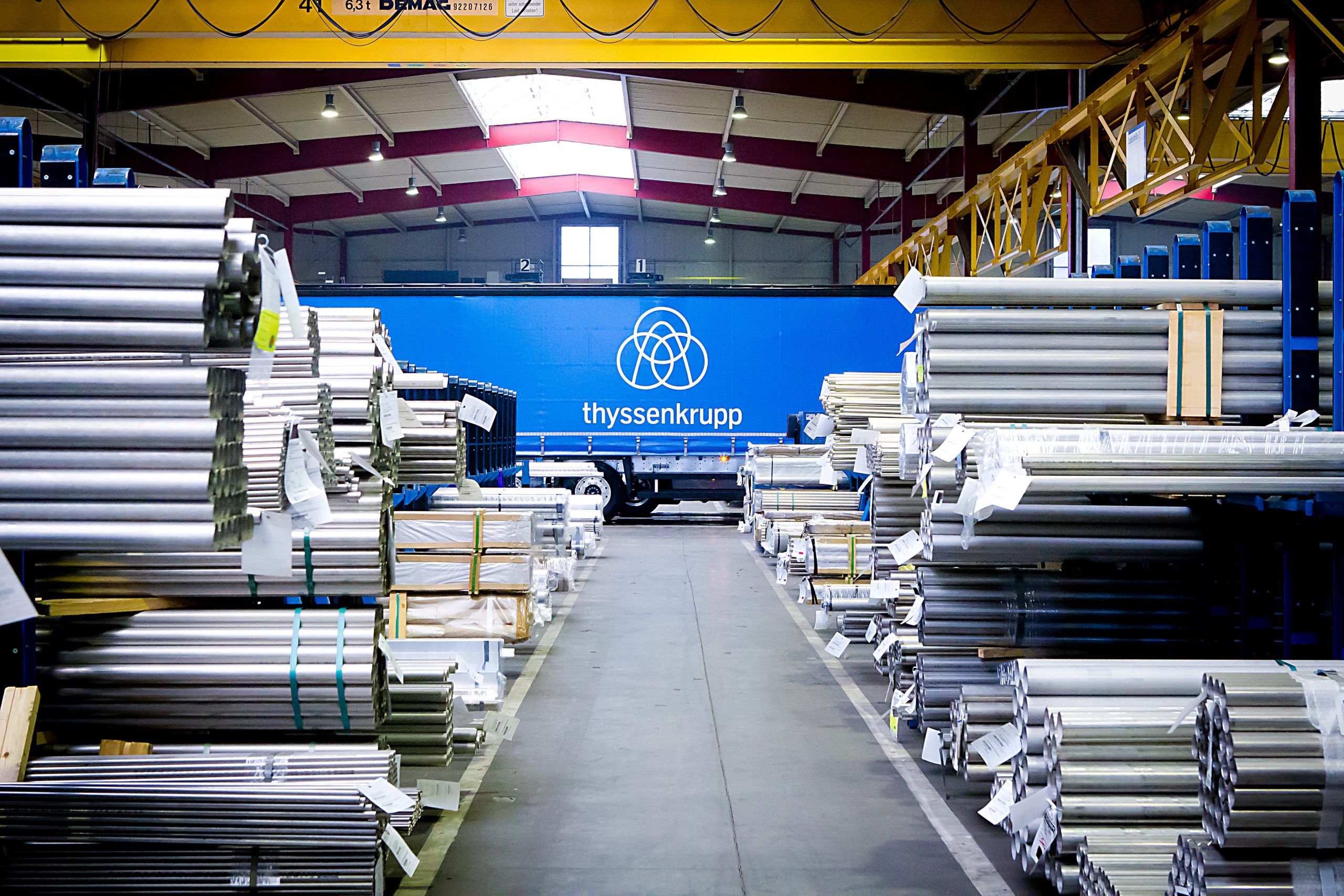
Thyssenkrupp seeks lower-emission tugboat fleet
Thyssenkrupp Veerhaven, the logistics subsidiary of thyssenkrupp Steel Europe based in Rotterdam, has commissioned designs for a climate-friendly pusher tug.
For thyssenkrupp Veerhaven, this is the next port of call on its voyage to the sustainable fleet of the future, the parent company says. Following the evaluation, its seven pusher boats are to be gradually superceded by environmentally friendly models at the end of their technical service life, Kallanish hears.
The seven tugs ply a route between Europoort Rotterdam and the Ruhr area throughout the year, transporting around 18 million tonnes of raw materials for the iron and steel plants. According to tk Steel, the use of methanol as a fuel could save around 80% of current CO2 emissions, compared with the fossil-fuel diesel. The planned ships will be optimised for lower water levels, as the River Rhine tends to dip below critical levels more and more frequently during the summer months.
Normally, thyssenkrupp Veerhaven directly commissions shipyards to build a new vessel.
“For the uncharted waters of sustainable fuels, however, we took an innovative approach and arranged for specialist design offices to prepare offers for three separate designs,” says the unit’s ceo, Frank Tazelaar.
Christian Koehl Germany


European HRC prices slide further; buyers waiting for ‘rock bottom’
Fastmarkets calculated its daily steel HRC index, domestic, exw Northern Europe, at €699.33 ($764.92) per tonne on Monday, down by €4.92 per tonne from €704.25 per tonne on March 8.
The index was down by €15.67 per tonne week on week and by €51.17 per tonne month on month.
In Northern Europe, offers of HRC were heard around €720-730 per tonne ex-works from integrated producers, but market participants estimated this level to be unworkable.
According to buyers, tradable market levels were in the range of €680-710 per tonne ex-works.
Demand remained weak, and no major deals were heard in the market.
“No matter what the price is now, there is no demand [and] there are no [HRC] volumes [being] traded,” a steel service center in Germany said.
Market participants were convinced that the “rock bottom” of HRC prices has yet to be reached. Due to this expectation, buyers continued to refrain from trading.
“No one intends to sign contracts in a falling market,” a buyer source told Fastmarkets, adding that buyers’ strategy to postpone bookings and bring prices down was being successful. Now customers were trying to bring prices below the €700 per tonne ex-works mark, but it was not clear where the bottom would be.
“The downtrend is not over yet, and prices are likely to keep sliding,” a second buyer source told Fastmarkets.
But there were differing expectations for the “rock bottom” of HRC prices in Northern Europe. A third buyer source expressed the opinion that it would be around €650 per tonne ex-works, while a seller source said that prices would stabilize around €680 per tonne ex-works.
“There is plenty of speculation about the rock bottom for the [HRC] price,” a second buyer source said. “One thing is clear – mills cannot keep reducing prices [because] the cost line is already close. Production cuts [at European mills] might help to stop the downtrend.”
In Southern Europe, Fastmarkets’ steel HRC index, domestic, exw Italy, was calculated at €675.00 per tonne on Monday, down by €3.75 per tonne from €678.75 per tonne on March 8.
The index was down by €19.00 per tonne week on week and by €73.75 per tonne month on month.
In Italy, offers of HRC were heard at €690 per tonne delivered, which would net back to €680 per tonne ex-works.
Market participants estimated the tradable market price in the range of €680-690 per tonne ex-works.
“Room [for further price decreases] is limited,” a fourth buyer source said, adding that a further price drop by €20-30 per tonne was still possible.
Import offers of HRC from Vietnam to Italy were heard at €595-600 per tonne CFR.
According to the first buyer source, the tradable price for imports was in the range of €580-600 per tonne CFR, pointing out that sizeable tonnages of HRC were already stored in EU ports waiting for customs clearance in the second quarter of the year.


Sales by German steel distributors decline in 2023
The average monthly sales volume of Germany’s stockholding steel distributors last year was 786,000 tonnes, roughly 5% below the monthly average of the preceding year 2022, which had achieved 826,000t.
Contrary to the preceding year, 2023 did not see a single month with sold tonnage above 1 million tonnes. That million-tonne level was attained in March 2022. March was the best-selling month of 2023, with 994,000t. December was the lowest-selling month with 465,000t, 13% below the figure of December 2022, Kallanish learns from statistics compiled by German steel stockholders federation BDS.
The total volume of finished steel products sold was 9.43mt in 2022, 5% less than in 2022. Flat products account for roughly 60% of the sales, long products were 30%, with some 10% taken by “miscellaneous products” such as wire rod.
The average monthly inventories in 2022 were 1.96mt, down appoximately 6% from 2022. The split was 1.22mt of flat products, 607,000t of long products and 41,700t of miscellaneous products. At the end of the year, the inventories stood at 1.85mt, compared with 1.95mt a year earlier.
Christian Koehl Germany

Assofermet: Low orders plague Italian flat distribution
In March, distributors and service centres’ orders and shipped volumes are seen declining compared to March 2023, Italian steel trade association Assofermet says in its market note sent to Kallanish. The association does not forecast further strong reductions in coil prices and says a rebound may be close.
Italian service centres and flats products distributors have been witnessing a strong demand contraction from end-users to which distributors reacted by granting price reductions. These were “judged in many cases to be excessive, as well as illogical,” the note says
The gap between European and imported prices of coils from the Far East has widened again. Asian coil producers are quoting prices that are close to those of October and November last year. However, due to the strong uncertainty driven by insufficient consumption, service centres are shunning offers coming from non-EU countries subject to safeguard quotas. Furthermore, the issue of attacks on Red Sea shipping is resolved in many cases by circumnavigating Africa, which adds costs and lengthens time of delivery.
Order books of European steel mills seem to have dwindled and many of them have been forced to revise prices downwards hoping to gain new orders despite high production costs. Apparent consumption has disappeared and customers’ orders continue to be for low quantities, Assofermet says and its highlights a shortage at some distributors’ warehouses caused by the slowdown in coil supply.
The association sees a deterioration of sales of coils derivatives including sheets and tubes. “The international political situation complicates the forecast of future prospects by generating a general wait-and-see attitude which, as has been reported several times, freezes investments… Uncertainty prevents strategic planning of inventories,” Assofermet concludes.
Natalia Capra France