

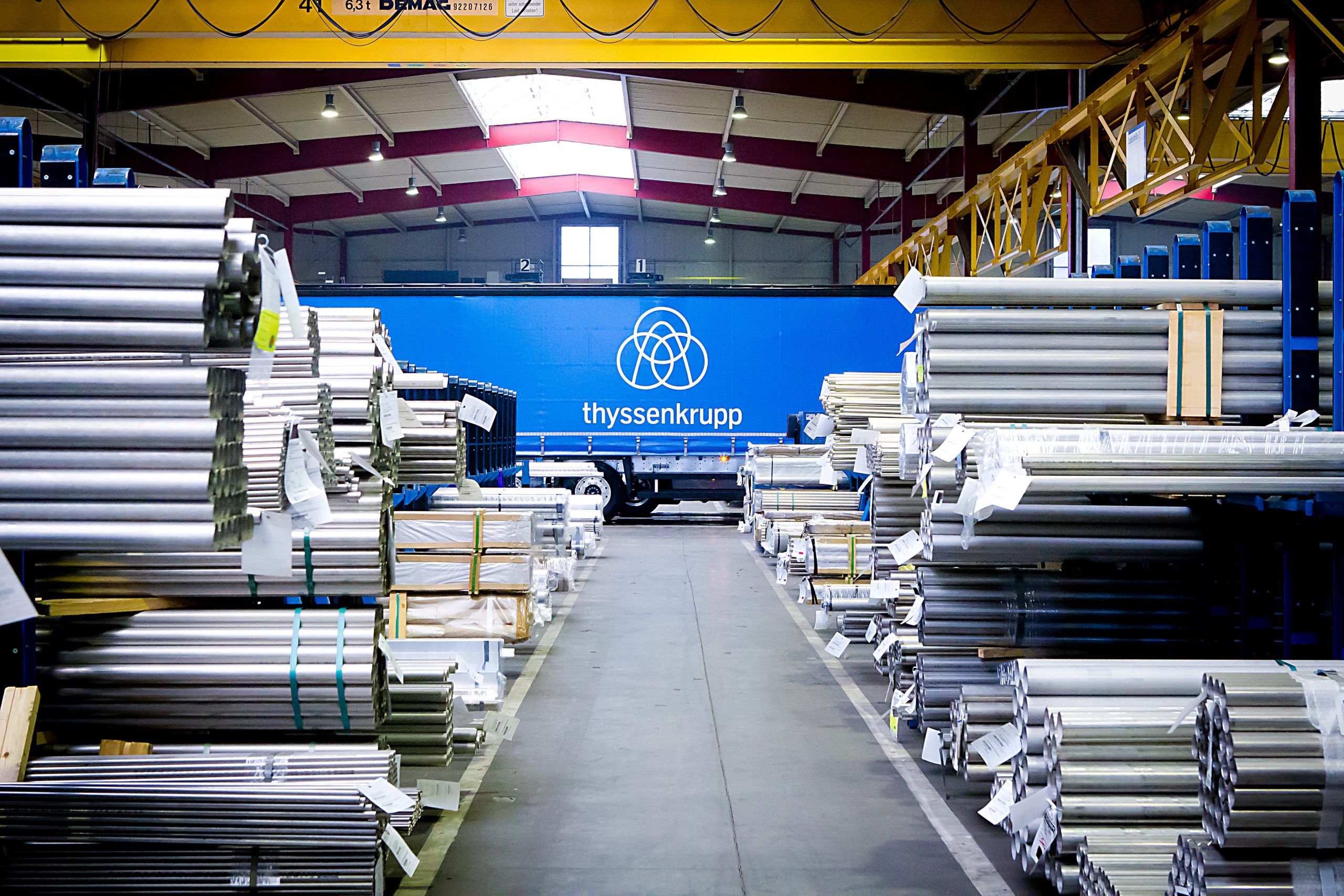
Thyssenkrupp to cut steel output in Germany by around 20%
During a meeting of its executive board on Thursday April 11, the company decided to scale back steel output at its largest steelmaking hub in Duisburg, North Rhine-Westphalia, it said in a press release on the same day.
The Duisburg site has a production capacity of around 11.7 million tpy of pig iron at four blast furnaces (BFs) and around 11 million tpy of crude steel.
The company said steel output will be brought down in line with actual steel shipment levels over the past three years. The registered steel shipments from Thyssenkrupp’s steel assets were around 9-9.5 million tonnes, while actual production levels were noticeably higher at 11.5 million tonnes, the company said.
The company operates mainly in the flat steel products sector and is one of the largest global suppliers of high-grade flat steel.
Thyssenkrupp said it expects shipment volumes to remain at mentioned levels, that is around 20% below previous production levels.
Rising costs of production, increased import pressure from Asian countries and ongoing deterioration of steel balance were the key factors undermining the competitiveness of Europe-produced steel, the company said.
“Shipping volumes are expected to remain at the level registered over recent years in the future as well. In comparison, the total production capacity still installed today is far too high, meaning that the entire production network is structurally underutilized,” Thyssenkrupp said in the release.
The company said that planned measures would entail job cuts, but did not give details on the number of losses.
Fastmarkets asked Thyssenkrupp for further information on the exact steps and the timeline for scaling production down but the company did not comment.
“Most likely it will be one to two BFs down, but then rolling lines in Bochum also need to be adjusted. Hard to say exactly at this stage,” a source in Germany said.
Speculations about output and job cuts at Thyssenkrupp first emerged in February this year, but the company denied all allegations at the time.
European flat steel market brief
Prices for flat steel in Europe have been falling non-stop since early February 2024, following a short-term rebound in January driven by restocking.
In March 2024, Fastmarkets’ daily steel hot-rolled coil index, domestic, exw Northern Europe averaged €691.99 ($742.78) per tonne, down by €46.29 per tonne from €738.28 per tonne in February.
On April 11, the index was calculated at €640.35 per tonne, down by €2.90 per tonne from €643.25 per tonne the previous day.
And market sources were not ruling out further downward correction in April amid weak demand and oversupply.
“For months, we have been talking about the need to reduce steel production in Europe, but nothing has been done,” a buyer in Germany said. “[HRC] prices have decreased a lot since January and keep sliding, but nobody is booking because lead times remain short and the downtrend has not stopped.”
And sources say end-user demand for steel in Europe is unlikely to rebound strongly in 2024, but rather remain rather stable at low levels.
This view follows outlooks Worldsteel and Eurofer, the European steel industry association.
Notably, in its short-range outlook published in April 2024, Worldsteel pointed out that the EU remains the region currently facing the biggest challenges.
“The region and in particular its steel using sectors are challenged on a multitude of fronts – geopolitical shifts and uncertainty, high inflation, monetary tightening and partial withdrawal of fiscal support, and still high energy and commodity prices…After only a technical rebound in 2024, the region’s steel demand is expected to finally show a meaningful recovery with a 5.3% growth in 2025. The forecasted steel demand for the EU in 2024 is only 1.5 Mt higher than the pandemic trough in 2020,” Worldsteel said.
According to Eurofer, EU apparent demand is expected to recover by 5.6%, rising to 137 million tonnes in 2024. This was revised down its previous upbeat forecast of a 7.6% recovery for the year.
Will other European steelmakers follow?
In the past years, crude steel output in Europe has been declining.
In 2022, crude steel production across Europe amounted to 136.3 million tonnes, down from 152.6 million tonnes in the previous year. The decline was due to massive output cuts implemented by European mills in the third and fourth quarters of 2022, facing deteriorating demand and falling steel prices.
In 2023 steel output sank even deeper, even considering the low comparative base in the previous year. Crude steel production in 2023 was 126.3 million tonnes.
In the same year, steel production in Germany, which is the Europe’s largest steelmaker, hit the lowest market since 2009, reaching just about 35.4 million tonnes of steel. This was down 3.9% year on year amid challenging market fundamentals and high costs of production.
Some market sources believe this tendency will prevail in the upcoming years.
“We are heading toward a post-industrial society, with less steel needed in the upcoming years. [The steel] industry is clever enough not to create overcapacity,” a mill source in Europe said.
“Steel production in Europe would be no more than 120 million tonnes [per year] by 2030,” another producer source told Fastmarkets.
‘Green transformation unaffected’
Thyssenkrupp stressed that production realignment measures will not affect its green transformation plans.
“The construction of the first direct reduction plant at the Duisburg site will continue as planned, supported by the funding released by the federal and state governments for this purpose and essentially relating to the ambitious ramp-up of the plant’s hydrogen-based operation,” the company said.
Thyssenkrupp is building a 2.3 million tpy DRI module in Duisburg and by 2030, the plans be capable of producing around 5 million tpy of low-CO2 steel, Fastmarkets reported previously.
https://dashboard.fastmarkets.com/a/5108753/thyssenkrupp-sets-aside-funds-for-hydrogen-powered-dri-plant
Most European BF-based steelmakers have been investing in green steel projects in the past years, cutting emissions to comply with strict EU regulations.
But market sources did not expect new capacities to result in oversupply in the steel market because old furnaces will be gradually switched off.
“Interest for fossil-free steel will be bigger than supply, so in the short term there definitely will be room for new capacities,” a mill source said.


UNESID cautiously optimistic for Spanish steel sector in 2024
The Spanish steelmakers association UNESID has shared its 2023 data regarding the steel sector and its forecasts for this year.
Accordingly, the association stated that in 2023, due to high energy costs, local crude steel production decreased by 1.2 percent year on year to 11.4 million mt, which was the level recorded in 2020 and that the sector faced challenges because of the same reason. Despite the drop in production, scrap recycling activities in the country increased by 3.2 percent year on year to 9.3 million mt. Thus, Spain remained among the main recyclers in the EU. However, in the given year, domestic sales amounted to 6.4 million mt, down by 1.3 percent compared to the previous year, which was closer to the level recorded in 2020.
UNESID pointed out that demand in the local market rose by 1.2 percent year on year to 12.6 million mt in 2023. Specifically, demand for long products increased by 4.3 percent, which offset the 0.5 percent decrease in flats demand. Yet, imports from third countries represented more than 30 percent of total domestic consumption. Regarding foreign trade, the association highlighted that in 2023 steel imports went up by 3.3 percent year on year to 10.1 million mt and that imports from third countries, which showed a 1.3 percent decrease, were at the highest level of the last 15 years at 4.1 million mt. On the other hand, total exports from Spain dropped by 5.8 percent compared to 2022 to 7.6 million mt, while exports to third countries were down by 0.7 percent year on year to 2.1 million mt, which was one of the lowest export levels.
Andrés Barceló, general director of UNESID, stated that, despite the ups and downs of the last two years, the preliminary data for this year shows optimism, though it should be approached with caution. Mr. Barceló also pointed out that activity figures have shown some improvement since the end of last year. He also warned that carbon costs and a drop in European industrial demand will continue to affect the steel sector. “The industry is committed to decarbonization, but in order to achieve it, it needs the authorities to facilitate the conditions that guarantee the competitiveness of its companies,” Barceló added.
