


Polish rebar prices continue to slide on weak demand, strong competition from imports
Some producers had tried to increase prices but were unsuccessful because buyers refused to accept the higher prices – ArcelorMittal, for instance, pushed up its offer price for long steel products across Europe by €20 ($21.33) per tonne, sources told Fastmarkets on the sidelines of Wire & Tube fair in Dusseldorf, Germany, on Tuesday.
Fastmarkets’ weekly price assessment for steel reinforcing bar (rebar), domestic, exw Poland was 2,600-2,630 zloty ($640-647) per tonne on Friday, down by 40-50 zloty per tonne from 2,650-2,670 zloty per tonne on April 5.
A distributor source based in Poland said it had not heard about any ArcelorMittal price increases, adding that some offers from the local mills had come in at 2,620 zloty per tonne CPT, which nets back to 2,600 zloty per tonne ex-works, and that some deals had been signed at that price.
A second distributor source reported slightly higher offers at around 2,650 zloty per tonne CPT, which nets back to about 2,630 zloty per tonne ex-works.
The first distributor source said the downtrend would continue in the coming weeks and prices could even drop below 2,600 zloty per tonne CPT – equivalent to about 2,580 zloty per tonne ex-works.
The source forecast that any rebound in prices will only be possible at the end of May.
It was even rumored among Polish market participants that one mill producing rebar might even stop operations to reduce the chance of any further price falls.
The second distributor source said the mill was more likely to continue operating with a reduced output.
Speaking on the sidelines of the Dusseldorf Wire & Tube fair in Dusseldorf, sources also told Fastmarkets that any positivity in the construction sector resulting from the release of blocked European funds would boost demand for rebar.
In February, European Commission president Ursula von der Leyen announced that Warsaw would be able to access €137 billion in funds.
But sources told Fastmarkets that it would take some time – maybe until the end of this year – before the projects start being executed.
Another factor supporting the downtrend in Polish rebar prices was the strength of the Polish zloty, which makes imports more competitive, the second distributor source told Fastmarkets.
On Friday April 19, €1 was traded for 4.33 Polish zloty, while on April 12, €1 was 4.26 zloty.
Published by: Darina Kahramanova


Steel HRC prices in Europe hit bottom, sources say
Restocking activity was subdued across the HRC markets, with mainly limited tonnages heard traded.
Distributors and steel service centers preferred to keep their inventories at medium to low levels, citing weaker sales downstream.
“The real demand is not there, so any pick-up [in trading] we see now is related to restocking and wouldn’t drive a sustainable rebound [in HRC prices],” a steel service center source said.
Northern European integrated mills were offering HRC with lead times of 4-5 weeks at €620-640 ($661-682) per tonne ex-works.
A Benelux-based re-roller was offering HRC at €600 per tonne ex-works in the region. Deals were reported at €620-630 per tonne ex-works in Germany in the week to Friday. And most buyers continued to estimate tradeable values within the same range.
As a result, Fastmarkets calculated its daily steel HRC index, domestic, exw Northern Europe, at €625.50 per tonne on April 19, down marginally by €1.58 per tonne from €627.08 per tonne the day before.
The index was down by €13.67 per tonne week on week and by €58.46 per tonne month on month.
Most market sources believed that prices in the region have already hit rock-bottom and that the market has reached a “turning point.” They saw a strong rebound as unlikely in the near term, due to a lack of support from steel-consuming sectors.
For example, Worldsteel’s short-range outlook published in April highlighted that the EU was still the region facing the biggest challenges.
“The region, and in particular its steel-using sectors, are challenged on a multitude of fronts – geopolitical shifts and uncertainty, high inflation, monetary tightening and partial withdrawal of fiscal support, and still high energy and commodity prices,” Worldsteel said.
“After only a technical rebound in 2024,” it added, “the region’s steel demand is expected to finally show a meaningful recovery with 5.3% growth in 2025. The forecast steel demand for the EU in 2024 is only 1.5 [million tonnes] higher than the pandemic trough in 2020.”
In Southern Europe, meanwhile, Fastmarkets calculated its daily steel HRC index, domestic, exw Italy, at €620.00 per tonne on Friday, down by €0.42 per tonne from €620.42 per tonne on the day before.
The Italian index was down by €5.00 per tonne week on week and by €48.75 per tonne month on month.
HRC with end-May lead times from one domestic supplier was heard offered at €640 per tonne delivered, equivalent to €630 per tonne ex-works.
Buyers estimated achievable prices at €610-620 per tonne ex-works, with transactions heard at €615-620 per tonne ex-works.
Asian suppliers have been trying to increase HRC prices to Europe, with most sellers targeting prices no lower than €600 per tonne cfr for HRC with June shipment.
Several market sources said that lower prices were available from Saudi Arabia earlier in the week, around €580 per tonne CFR to Southern Europe, but for low volumes.
Published by: Julia Bolotova

UK TRA recommends extension of steel safeguard measures
The UK Trade Remedies Authority (TRA) proposes a two-year extension to protect the country’s steel industry from import surges, Kallanish learns from an agency announcement on Friday.
The current measure, covering 15 steel categories, is set to expire on 30 June, but could be extended until 2026. However, another safeguard measure for these steel categories cannot be implemented for another eight years if extended. In this case, businesses could request new trade remedy measures from the TRA for specific categories of steel products if they believe that the UK industry was being harmed or was under threat from dumped or subsidised imports, in anticipation of the possible expiration of the safeguard measure.
The TRA’s extension review found that allowing the safeguard measure to expire could lead to increased imports and a recurrence of serious injury to UK producers across all 15 steel categories. Stakeholders had until 7 March to respond to the TRA’s initial findings. The secretary of state will review this recommendation before making a decision, as per WTO rules.
This extension review is separate from reviews on hot rolled flat and coil steel, initiated in response to market condition changes affecting category 1 steel supply.
The TRA initiated a suspension review and a tariff rate quota review in response to applications from Tata Steel UK (TSUK) and Kromat Trading on 9 February this year. The findings of these reviews will be published later.
Elina Virchenko UAE

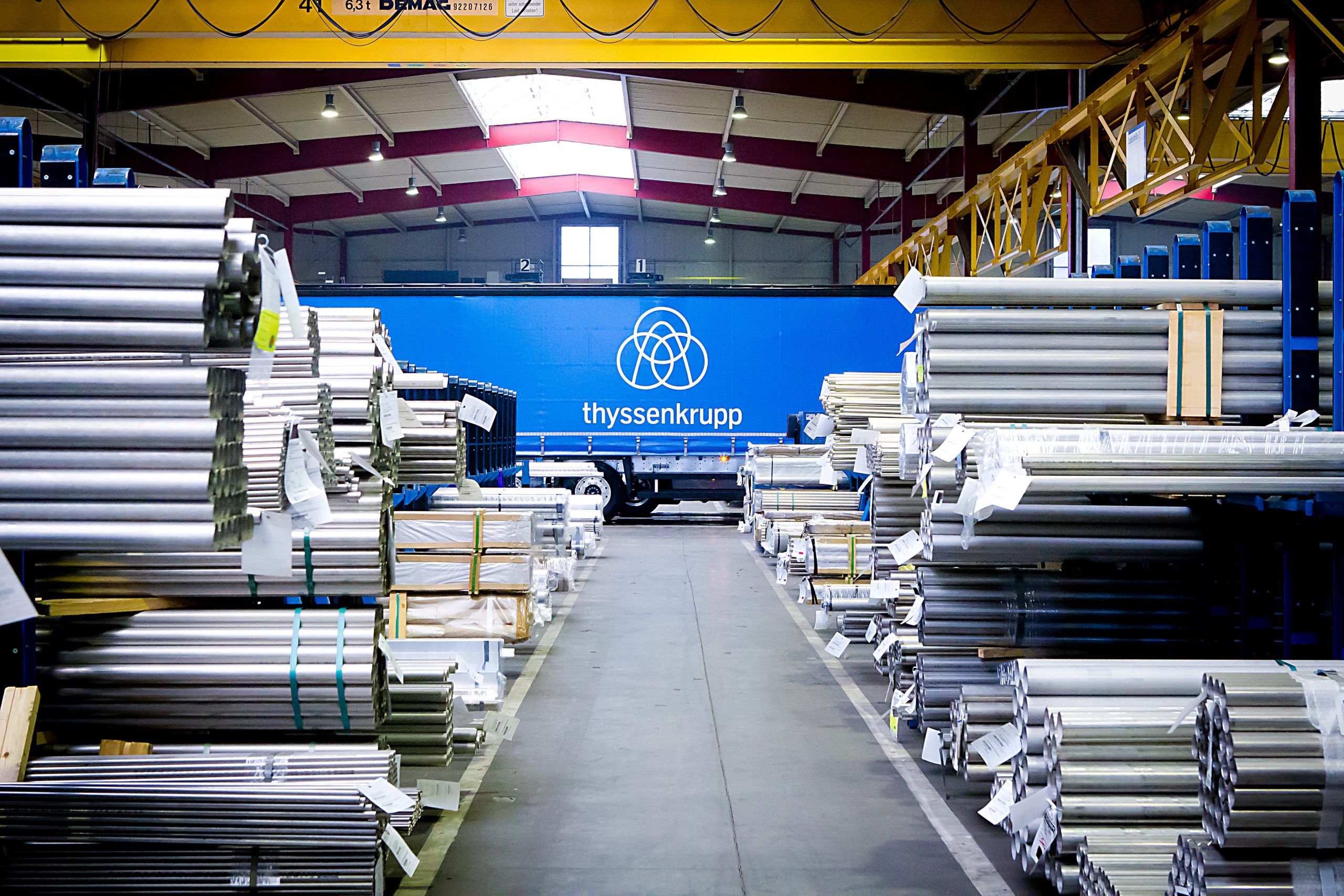
Thyssenkrupp Materials buys carbon-reduced goods from tk Steel
Thyssenkrupp (tk) Steel Europe has agreed to sell climate-friendly steel to its tk Materials Services, Kallanish learns from the affiliates, which have signed a memorandum of understanding to cement the arrangement.
Both companies are divisions of Germany’s thyssenkrupp AG, which is a conglomerate with several other non-steel-related activities. However, in contrast to many other steel groups, tk Materials, which claims to be Europe’s largest steel distributor, operates independently from the steelmaking division, with the freedom of purchasing from any supplier.
Thyssenkrupp Schulte, the German unit of tk Materials, commits to purchasing fixed quantities of C02-reduced “bluemint” steel with immediate effect. In future years, the quantities are to increase gradually and the purchase agreement is to run up to and including 2030, the companies says. Tk Schulte will supply the German domestic market as well as other stockholding units in Western and Eastern Europe.
According to Detlef Schotten, ceo of tk Schulte, there is growing demand from customers for CO2-reduced alternatives.
“This trend will continue to grow in the coming years,” he says, noting that the company sees itself as a partner for customers to support them in their endeavours to become more sustainable. “This includes a comprehensive portfolio of products and solutions that create ecological added value.”
As part of its Beyond sustainability strategy, tk Materials has set itself the goal of becoming carbon-neutral by 2030 (scope 1 and 2 emissions).
Christian Koehl Germany

Salzgitter secures ‘green loan’ for decarbonisation
Salzgitter AG has signed two export credit agency (ECA)-covered “Green Loan” financings to support the decarbonisation of its steel manufacturing operations.
The total amount of €500 million ($532m) ECA-backed senior unsecured financing package consists of two tranches which involve the main plantbuilders of the technical conversion, Kallanish understands. A €300 million export credit facility is covered by SACE, the Italian Export Credit Agency, with Simest CIRR support in connection to the direct reduction of iron ore plant supplied by Tenova/Danieli.
A €200 million export credit facility is covered by Oesterreichische Kontrollbank (OeKB), the Austrian Export Credit Agency, in connection to the electric arc furnace supplied by Primetals from Austria.
These facilities are among the first ECA-covered corporate Green Loans in the steel sector worldwide and the first in Germany, Salzgitter points out.
The finance parties, SACE and Simest were advised by Norton Rose Fulbright, while Salzgitter AG was advised by Linklaters. The financing process also involved BNP Paribas, Commerzbank and Deutsche Bank. The loans, structured under Loan Market Association’s Green Loan Principles, will fund a portion of the €2.3 billion phase 1 of the Salzgitter Low CO2 Steelmaking programme.
Christian Koehl Germany