


thyssenkrupp appoints Nadja Håkansson as CEO
thyssenkrupp appointed Nadja Håkansson as Chief Executive Officer of thyssenkrupp Uhde.
Nadja Håkansson has held various management positions at Siemens and Siemens Energy and brings more than 18 years of national and international experience in the areas of supply chain management, operations, sales and corporate management.
Most recently, as Senior Vice President Region Africa for Siemens Energy, she was responsible for the company’s overall portfolio development in the African market.
“thyssenkrupp Uhde has significant potential for shaping the green transformation in our industry, and I am honored to lead this prestigious company as we embark on this exciting journey together,”
“I am so excited to begin a new journey with thyssenkrupp Uhde on May 1, and lead the organization in achieving a significant impact in the green transformation and industrial decarbonization 🍀💫, wrote Håkansson.
I am looking forward to working with the thyssenkrupp Uhde team to shape a new chapter for the company, for our customers and for society!”

Bureaucratic delays threaten support for transition: Eurofer
European Resilience Fund money, meant to support investment by steelmakers into cleaner technology, could no longer be available when steelmakers need it, according to Eurofer.
The so-called RRF fund requires the project be implemented by 2026, which is too short notice for the timeline used in building big plants. “Equipment suppliers say they cannot deliver such plants before 2026,” Eurofer director general Axel Eggert said on the sidelines of “The Future of EU Industry” conference in Brussels attended by Kallanish earlier this month. “We are losing €1 billion [$1.1 billion] because of that.”
The system is caught between the RRF’s expiry date, technology suppliers’ delivery schedules and delays in implementation of relevant legislation at EU member level (see separate story). Eggert gave the example of a case in which a supplier cannot deliver the equipment earlier than 2027, meaning that one mill already granted €1 billion is now at risk of losing it. “We do not need more money, but we need better coordination,” Eggert maintained.
Another issue is that EU members seem to favour decarbonisation in principle but do not make it a prerequisite in their own public tenders. “In this sense, there is a huge contradiction,” Eggert said, adding that 40% of all spending in the EU is public. If EU public procurement legislation included references to green products, this would allow for the creation of lead markets for green steel/green products in the EU, he concluded.
Christian Koehl Germany

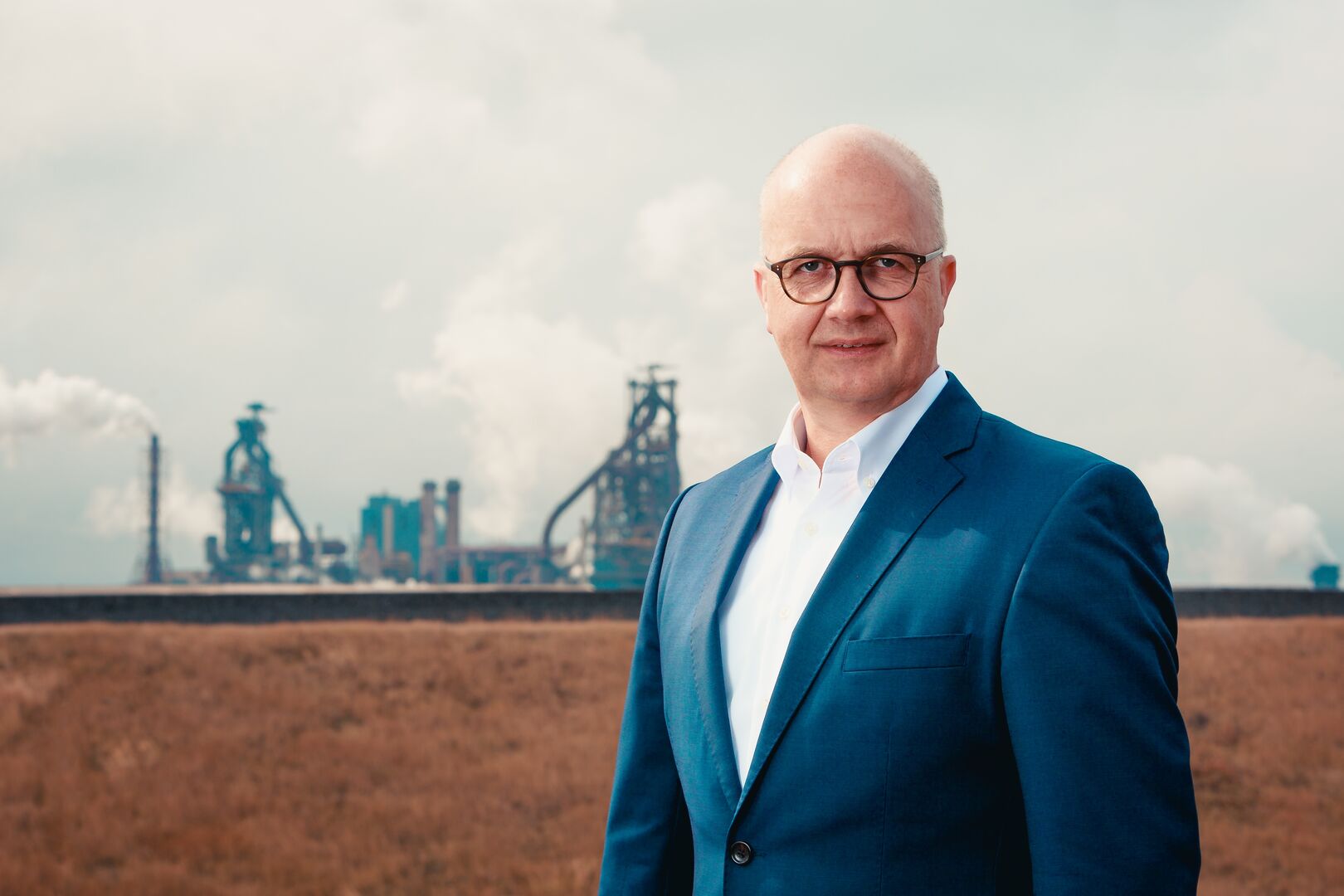
Europe needs integration, confidence amid de-industrialisation: Tata’s Adam
Europeans must look beyond their regional identities and unite both economically and administratively to ensure greater prosperity, says Tata Steel Netherlands and UK chairman Henrik Adam, who was appointed Eurofer president earlier this year.
“We Europeans see ourselves as Cologners, as Frenchmen, or Bavarians, rather than as Europeans,” he told Kallanish in an interview at last week’s wire+Tube trade fair in Düsseldorf. “The EU’s gross domestic product is bigger than that of the USA, but hardly anyone is aware of it,” he noted. “In Europe, we tend to downplay ourselves too much.”
This is not only an issue of mentality, but can mean complex hurdles in the process enabling the investments steelmakers need into cleaner technology as part of the transition to emission-free steel. “You need permissions and approvals on the national, the regional, even on the municipal levels, and this is very time-consuming,” Adam bemoaned. This could even lead to the loss of public EU money for some projects if the funding has a limited lifetime (see separate story).
In competition with overseas countries, Europe’s manufacturing industries are losing markets, but the loss must be mitigated. “A de-industrialisation of Europe cannot be avoided, but we need to keep it within limits,” he said. The industry therefore needs such trade fairs as wire+Tube, so that players remain informed and can exchange ideas, he added.
As a German, Adams pointed out some deficiencies Germany has in the energy transition in comparison with many countries with smaller populations. For wind parks, for instance, “the Baltic Sea coast does not have the wind, and our [Germany’s] North Sea coastline is small compared with the Netherlands,” he noted. Countries like Austria, Switzerland and Sweden have hydropower, while Spain and Portugal can draw strongly on solar power, he concluded.
Christian Koehl Germany

Ukraine: ArcelorMittal investiert in neues Werk für Bauprodukte
ArcelorMittal Construction plant ein neues Werk für Bauprodukte in der Ukraine zu errichten, um den Wiederaufbau des Landes während und nach dem Krieg zu unterstützen. Die Investition soll in der Region Kiew auch 100 neue Arbeitsplätze schaffen.
Das Unternehmen ArcelorMittal Construction hat in Kiew eine Absichtserklärung mit Ukraine Invest, dem Investitionsförderungsbüro des Landes, unterzeichnet. Die geplante Investition sieht die Errichtung einer hochmodernen Produktionsstätte vor, in der Stahltrapezprofile und Sandwichpanele für die Gebäudehülle hergestellt werden. Dafür will der Konzern seinen recycelten und erneuerbar erzeugten Xcarb-Stahl in Kombination mit energieeffizienten Isolierkernen verwenden. Die Konstruktionslösung erfülle alle Anforderungen an Fassaden und Dächer von Gebäuden, insbesondere im Industrie-, Handels-, Logistik-, Agrar- und Lebensmittelsegment. Erklärtes Ziel ist ist, die beschädigte wirtschaftliche und infrastrukturelle Landschaft der Ukraine wiederzubeleben.
ArcelorMittal: „Positive Rolle beim Wiederaufbau“
In den kommenden Jahren will ArcelorMittal 40 Millionen Euro in die neue Anlage investieren – und so auch mehr als 100 neue Arbeitsplätze in der Region Kiew schaffen. „ArcelorMittal Construction ist fest entschlossen, eine positive Rolle beim Wiederaufbau der Ukraine zu spielen. Wir hoffen, mit dieser Investition nicht nur Strukturen wieder aufzubauen, sondern auch Gemeinden und das soziale Leben zu erneuern und so eine bessere und widerstandsfähigere Zukunft für alle zu gewährleisten“, erklärt Jean-Christophe Kennel, CEO von ArcelorMittal Construction.
Das Team von Ukraine Invest werde ArcelorMittal bei seinen Geschäften in der Ukraine beraten, so der geschäftsführende Direktor Oleksandr Melnychenko (Bildmitte). Zudem wolle man die Kommunikation zwischen den Vertretern des Investors und den Regierungsbehörden auf allen Ebenen ermöglichen und Unterstützung bei der Lösung von Problemen bieten, mit denen der Investor bei seinen Geschäften in der Ukraine konfrontiert sein könnte. „Ich bin ArcelorMittal Construction für die Zusammenarbeit bei der Entwicklung der ukrainischen Wirtschaft dankbar“, betont Melnychenko.