


EUROMETAL seminar discussed decarbonisation at the University of Luxembourg
EUROMETAL organized a Seminar on the supply chain for metals, together with the Luxembourg Center for Logistics & Supply Chain Management (LCL) and the University of Luxembourg.
This unusual event brought together the academic world and the industrial world with a view to awakening students’ interest in the problems and challenges of our sector.


EUROMETAL President Fernando Espada explained the role played by Stockholding and SSC distribution in the steel supply chain and the market shares of both compared to direct deliveries from the mills. The seminar proceeded with a presentation on how to make the Steel Supply Chain more environmentally friendly by Henri Reding, CEO ArcelorMittal Luxembourg.
Another major topic on the agenda was renewable energy. Rafael Lopez, CEO of TaiichiO & Wolf Projects from GreenSteel Group, explained to us the challenges and complications modeling steel supply chain for offshore wind sector.Targeting the interior market such as Luxembourg and the greater Region, the challenges of hydrogen infrastructures were addressed by Alfredo Esteve, CEO of Steel Trade Iberia of the GreenSteel Group and the solutions bringing hydrogen to Luxembourg by Prof. Stefan Maas, University of Luxembourg.
The seminar was concluded with a demo of LCL’s CAVE Lab on power price forecasting web-app. The demo was presented by Mohammad Namakshenas, Postdoctoral Researcher at University of Luxembourg.
25 people participated in this event in person while online we were followed by 50 participants from all continents.
The interactions during and after the presentations demonstrated the value and interest of the seminar and also the need to share good practices and information between the different players in the supply chain. Especially at a time when we all have to paddle towards decarbonisation, with all the challenges that this will entail.
This event would not have been possible without the support of the Luxembourg Center for Logistics & Supply Chain Management and the University of Luxembourg who welcomed us in their facilities on Campus Kirchberg.

thyssenkrupp to sell 20% of steel business to EP Corporate Group
German industrial conglomerate thyssenkrupp has agreed to sell a 20% stake in its steel business to EP Corporate Group (EPCG), it said April 26.
The transaction was expected to close during the current financial year, subject to approval from relevant authorities and the supervisory board of thyssenkrupp, the steelmaker said.
It said they were also discussing EPCG acquiring a further 30% in the steel business, called thyssenkrupp Steel Europe, which would form an equal 50:50 joint venture.
On an April 26 media call on the strategic partnership, thyssenkrupp CEO Miguel Lopez said both parties had agreed to not disclose the economic aspects of the transaction.
EPCG is an umbrella company that owns all strategic shareholdings of Czech billionaire Daniel Kretinsky and his top-management team, including energy company EPH.
EPCG Member of the Board Jiri Novacek said on the call that EPCG saw thyssenkrupp Steel Europe as a good candidate for its portfolio, as EPCG was a significant player in the energy sector and was searching for opportunities in industries that were exposed to higher energy costs, which it aimed to help become more resilient and robust through cooperation with an energy player.
Novacek said energy was becoming one of the most important items in the cost structure, so the cooperation with an energy player was “something that is natural and we see other examples in Europe as well.”
“We’re convinced that the JV concept will serve as a good basis for a much more resilient position from where thyssenkrupp Steel Europe will benefit,” he said.
“This is especially true in the situation in which the entire European steel sector will undergo a very similar transformation, as we have seen and are still seeing in the energy sector,” he said, adding that a robust and resilient thyssenkrupp Steel Europe would enable security of supply for customers.
“Together, we will also make an important contribution to the decarbonization of the steel industry,” Novacek said.
thyssenkrupp previously mentioned taking on a strategic partner in November 2023, saying at the time that it was in negotiations with EPH over a potential JV as part of its aim to secure energy for the decarbonization of the steel operations.
It said previously that the tinplate plant Rasselstein will also be part of the steel JV.
The thyssenkrupp steel mill accounts for 2.5% of Germany’s entire CO2 emissions.
thyssenkrupp is building its first direct reduction plant in Duisburg, where it plans to start using hydrogen in 2028 and move to 10% hydrogen use in 2029.
Lopez said on the call that the project was considered to be a blueprint for the decarbonization of the industry.
The company invested Eur3 billion ($3.22 billion) in the plant, which includes the support of Eur2 billion from the German government.
“The demand for green power will increase in the forthcoming years and for the hydrogen operation of the first DR plant, 10 TWh/year is needed,” Lopez said.
“The successful transformation of the steel industry depends upon the fact whether we can make it to produce green power in sufficient quantities in marketable conditions,” he added.
Novacek explained that thyssenkrupp Steel Europe would not be obliged to offtake green energy from EPCG, but rather it would act as a backup or fallback scenario.
“Which, especially in the pioneering project like the buildup of the DRI project in Duisburg, is always useful because, obviously, the assumptions are that such high volumes of energy will be at hand and will be at place, but especially in the initial periods of time, it is often that this is not the case,” Novacek said.
“Our aim is to make thyssenkrupp Steel Europe ready to launch the project and to ramp up the project in the way it is envisaged, but not to make it a commitment … it’s not only the actual capacity that matters, but also the trading robustness on which thyssenkrupp Steel Europe could rely on,” he said.
EPCG did not aim to be a passive investor, Novacek added, but wanted to have an influence on how thyssenkrupp Steel Europe’s strategy was formulated and implemented.
“That is also the reason why we approached the opportunity in this two-stage process. First, to be allowed at the table and contribute to the discussion in forming the strategy for the future,” he said.
Platts, part of S&P Global Commodity Insights, assessed domestic HRC prices in Northern Europe at Eur625/mt ex-works Ruhr April 25, down 8.8% since the start of 2024.
Jacqueline Holman


European HRC prices stable, mills expected to increase offers
Domestic prices for hot-rolled coil in Europe have been stable on April 25 and steelmakers are expected to push offers up soon.
Domestic prices have been supported by combination of restocking of distributors and lack of competitive import offers after the change in Euro to the US dollar exchange rate. In addition, long lead times and expected changes in safeguard measures also made buyers hold back from overseas coil purchases.
These factors put an end to the downtrend that had been settled in the European market since the end of January.
Despite limited real demand, the mills are expected to increase offers soon, sources said.
“The mills plan to hold prices at current rates and maybe push for the increase as there is no competition with import,” a German service-center source said. “But end-user demand remains low.”
“Would not be surprised if mills try to lift offers if they have managed to make some sales at these lower levels,” a trader said. “Have to see if the market can absorb a price increase though.”
Platts assessed domestic prices for hot-rolled coil in Northwest Europe stable on day at Eur625/mt ex-works Ruhr on April 25.
Deals and tradable values were reported at Eur620-630/mt ex-works Ruhr.
Offers have been reported at Eur620-630/mt ex-works Ruhr and at Eur610-615/mt ex-works Ruhr for big lots.
Platts assessed prices for imported hot-rolled coil in Northwest Europe at Eur610/mt CIF Antwerp on April 25, stable on the day.
Offers of the material from Asia have been heard at Eur600-630/mt CIF Antwerp.

EU’s Russia-origin semis, iron imports continue to fall
The EU reduced imports of steel products and ferrous raw materials from Russia in January-February, show Eurostat data.
Volumes amounted to 577,000 tonnes, down by 34.6% on-year, Kallanish notes. Revenue generated by these shipments decreased 33% to $291 million.
The main share of imports was taken by semi-finished products – 82.2% of total supply. Semis shipments decreased in January-February by 11% on-year to 474,600t. Belgium took 141,600t, down by 31% on-year.
Imports of pig iron from Russia to the EU in January-February amounted to 78,320t, down 69% on-year. Italy imported 37,660t, down by 82.2% on-year.
Supplies of iron ore from Russia to the EU amounted to only 9,360t, which is 87.6% less on-year. The entire volume was shipped to Slovakia. The Netherlands imported 6,380t of ferroalloys, up 16.3% on-year. Lithuania’s scrap intake amounted to 3,030t, down 57.2% on-year.
In 2023, Russia’s steel and raw materials exports to the EU amounted to 4.8 million tonnes, down by 39.5% on-year, for €2.4 billion.
Last year, European steelmakers association Eurofer voiced concern over the European Commission’s decision to continue to allow Russian slab to enter the EU until 2028 (see Kallanish passim).
As part of the EU’s 12th Russia sanctions package, EU importers will be able to import some 3 million tonnes/year of slab from Russia until October 2026. The quota will then be reduced further, to 2.6mt and then 2mt respectively during the following 12-month periods through October 2028.
Meanwhile, Russian billet imports into the EU will be prohibited from April 2024.
EU pig iron imports from Russia have meanwhile been banned from 2026 and are subject to quotas in 2024 and 2025.
Svetoslav Abrossimov Bulgaria

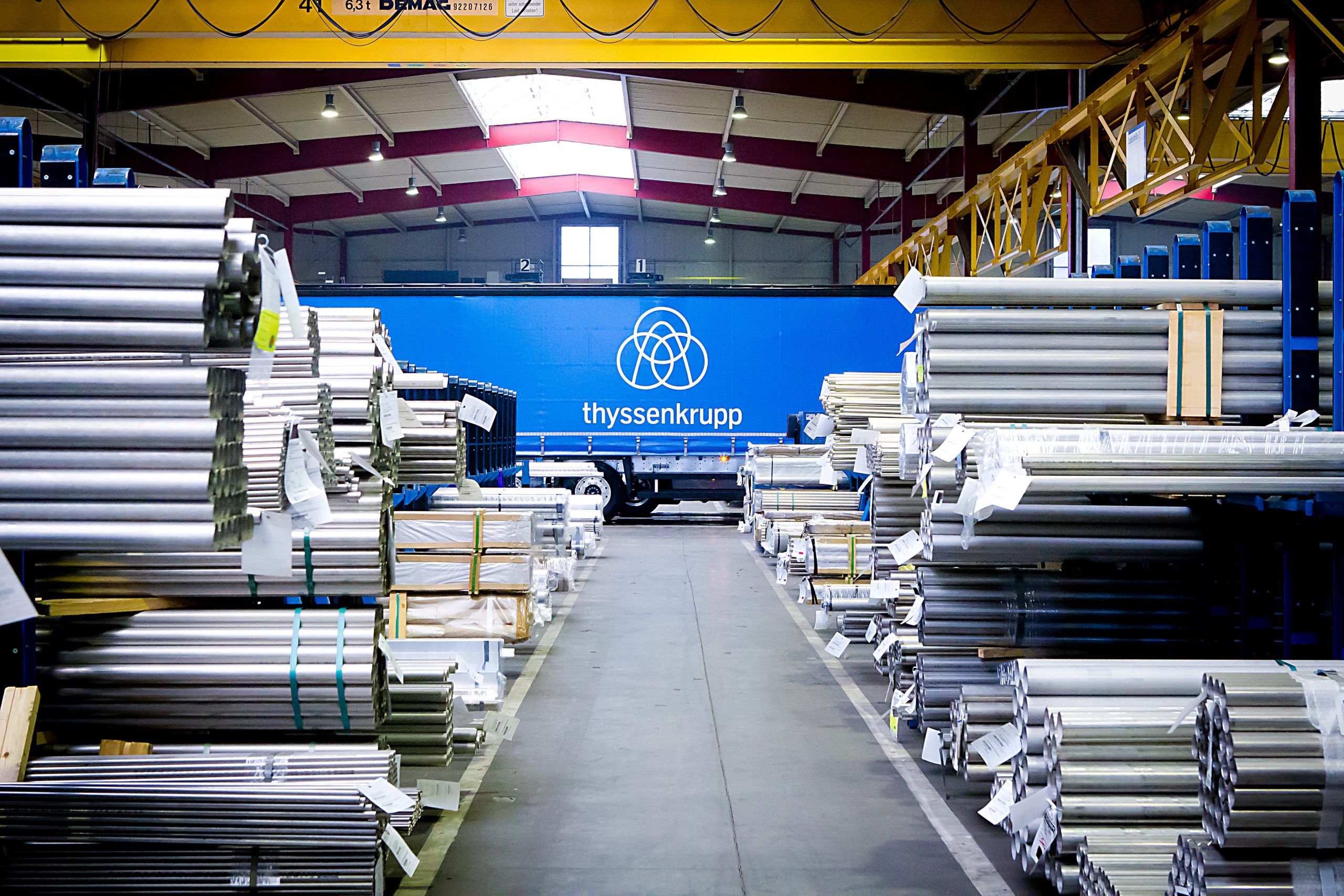
Thyssenkrupp Schulte to cut 450 jobs
Thyssenkrupp Schulte, the German steel stockholder unit of thyssenkrupp Materials Services, says it is carrying out a “strategic realignment” of its business model in order to consolidate and further expand its market position.
As part of the restructuring, job cuts and the closure of several sites are unavoidable, Kallanish hears from the firm. In total, approximately 450 jobs are to be affected, and the company intends to make the restructuring socially responsible. Discussions with the relevant co-determination bodies on the details of the transformation will begin shortly, it says.
It cites persistently difficult market conditions in Germany and the process of change which is affecting the European industry and, especially, the materials distribution business.
While demand for steel has been declining for years, the company points to continuously increasing customer demand for materials-related services. As part of its “Materials as a Service” strategy, thyssenkrupp Schulte has already addressed this trend in Germany. The company will focus on strengthening and expanding its service business, it says.
Thyssenkrupp Schulte, headquartered in Essen, has a network of over 40 locations, serving customers from various sectors of the manufacturing industry, including industry, trade and construction. The portfolio ranges from flat products, profiles and tubes to expert advice and a comprehensive range of services along the value chain. It currently employs around 2,300 people.
Christian Koehl Germany

SSAB sees energy sector optimism, bemoans construction demand
SSAB predicts good demand for wind power and other renewables in the second quarter. These sectors are decidedly international and would benefit the Swedish company’s major units, SSAB Europe and SSAB Americas.
During the firm’s quarterly earnings call, chief executive Martin Lindqvist pointed to increasing activity for offshore wind in the USA, and also for bridge-building, which both require plate made by SSAB.
Looking at the past quarter, Lindqvist expressed some disappointment that expected restocking at service centres and users in the USA did not come about. He noted that the company’s US volumes go to end users and service centres in equal shares, and that service centres, especially, remained reserved.
In Europe, the company’s Finnish plants were affected by the national strikes, which saw the company lose out on 100,000 tonnes of production and inventory, Kallanish heard from Lindqvist during the call.
For its third main division, SSAB Special Steel, Lindqvist sports optimism, and stated that the company has kept improving the mix towards special steel “day-by-day, month-by-month”.
Prices for these products in the USA have weakened lately, arguably coming from high levels, while Europe will see a stabilisation. This is evident on the basis of the order backlog for the second quarter, with 90% of volumes already booked, “so the visibility is pretty good”, he noted.
Regarding customer segments other than energy, SSAB’s outlook is more modest. It expresses pessimism over construction, a typical local market, which it says is doing particularly weak in the Nordics. This also affects demand from makers of construction machinery, with weaker demand in Europe, China stabilising at a low level, and relative stability in North America.
Christian Koehl Germany

Aenor certifies Alfonso Gallardo operations
Spanish certification authority Asociación Española de Normalización y Certificación (Aenor) has awarded steelmaker Alfonso Gallardo (AG) for developing high-quality standards.
The company’s plant in Jerez de los Caballeros in Badajoz achieved international standards ISO 9001, ISO 50001 and ISO 14001 after audits evaluated performance on sustainable, environmental and energy efficiency criteria, Kallanish notes.
“The certification is a confirmation of AG’s continued commitment to operational excellence and its dedication to meeting the highest international standards in all areas of its business,” says the company’s flat steel unit’s general director, Orlando Ribeiro.
The ISO 9001 standard recognises excellence in quality management, ensuring that products and services consistently meet customer expectations. The ISO 14001 standard validates the company’s efforts in environmental management, guaranteeing that all operations are carried out sustainably. ISO 50001 highlights Alfonso Gallardo’s commitment to energy efficiency, promoting responsible practices that reduce energy consumption and minimise environmental impact.
Gallardo Balboa belongs to Spain-based CL Grupo Industrial’s steel unit together with Siderúrgica Balboa, Ferromallas, Galvacolor, Corrugados Getafe, Lasaomallas, Marceliano Martín and Steel Solaris. The company’s plant in Jerez de los Caballeros re-rolls galvanised and pre-painted coils, and manufactures welded pipes, ribbons, strips and profiles.
Todor Kirkov Bulgaria