

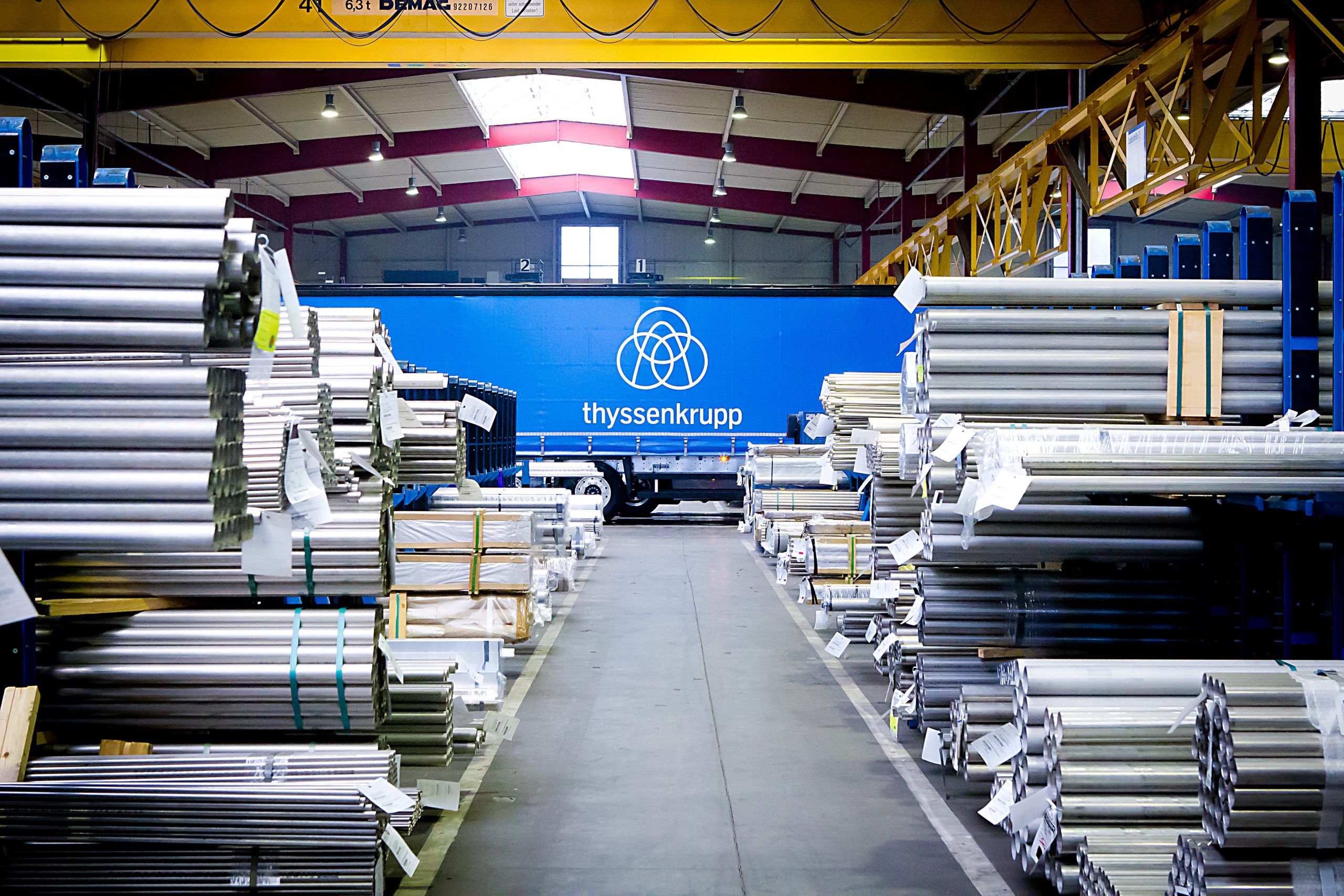
ThyssenKrupp Schulte to close seven sites
ThyssenKrupp Schulte will close seven sites as part of its restructuring drive, market sources told Argus today.
The company will close stockholding warehouses in Braunschweig, Rheine, Munich, Nuremberg, Freiberg, Mannheim and Frankfurt, according to multiple market sources.
Last month the company said it would be closing sites and cutting around 450 jobs, but did not reveal which sites would be affected.
“Fundamental structural adjustments are necessary to better respond to market changes in the future”, the company said when it announced the restructuring, citing declining materials demand and increasing demand for materials-related services. All the impacted locations are stockholding sites and do not provide additional processing.
ThyssenKrupp Schulte is part of ThyssenKrupp Materials Services and distributes stainless, carbon and non-ferrous metals from around 40 locations.
A ThyssenKrupp Materials Services spokesperson said it could not comment on the affected locations, as “discussions with the respective co-determination bodies have only just begun and the details of the transformation are the subject of these discussions”.
“At ThyssenKrupp Schulte we are aiming to transform the business model in order to increase the company’s profitability and enable Schulte to respond even better to changing customer needs,” the spokesperson added.


Carbon capture trial begins at ArcelorMittal Belgium
ArcelorMittal Gent has started operating a pilot carbon capture unit on its blast furnace off-gas in conjunction with Mitsubishi Heavy Industries (MHI), BHP, and Mitsubishi Development, Kallanish notes.
The pilot unit will operate at the Belgian steelworks for 1-2 years, to test the feasibility of progress to full-scale deployment of the technology to capture a sizeable portion of the Gent site emissions. Engineers have been working on site since January to assemble and commission the unit.
In October 2022, the four parties announced their collaboration on a multi-year trial of MHI’s carbon capture technology (Advanced KM CDR Process) at multiple carbon dioxide emission points, starting at the Gent steelmaking site.
The pilot carbon capture unit will initially be tested with blast furnace off-gases, and off-gases from the hot strip mill reheating furnace. It has the potential to be trialled to capture other important steelmaking gases such as reformer flue gas from a direct reduced iron plant, ArcelorMittal notes.
The development of the carbon capture solution at Gent could feed into multiple CO2 transport and storage projects under development in the North Sea region and contribute to global technological solutions required for decarbonisation of steel production, the firm adds.
Speaking at this week’s Gent consortium meeting, BHP group sales & marketing officer Michiel Hovers said: “This represents real progress in proving up the feasibility of carbon capture for steel production.” Mitsubishi Development chief executive Kenichiro Tauchi added: “This pilot is a significant step towards advancement of carbon capture technology as a potential solution to achieve solid emission reductions in the steel sector.”
This development is separate from ArcelorMittal Gent’s Steelanol facility, an industrial-scale demonstration plant that will capture waste gases from the blast furnace and biologically convert them into recycled carbonethanol. This project, in partnership with LanzaTech, Primetals Technologies and ERM, produced its first industrial ethanol last November.
Christian Koehl Germany


Italian plate market stagnates, prices low
The Italian heavy plate market remains quiet this month, with orders weak and mostly back-to-back, sources tell Kallanish.
Prices have declined by some €30/tonne ($32) compared to April on the back of low consumption. Both large and smaller buyers are not in a purchasing mood and are preferring to book low tonnages, to avoid any commitment. The distribution sector is also selling low volumes, but frequently, as clients are demanding quick delivery.
Asian-origin quotes have long lead times but competitive prices, at €600-620/t cfr Italy. The first four months of the year were “sufficient” in terms of sales. However, the main point of concern remains the lack of margins, mill sources report. With the current cost of production and sourcing slab, prices for S275 should be at about €60/t higher, they agree.
Italian plate re-rollers are quoting June lead times. Domestic S275 grade transactions are at between €700-710/t ex-works on average, while S355 is being transacted at €30/t more, sources suggest.
Imported slab prices from Asia are at about $580-600/t cfr Italy.
Natalia Capra France

HRC prices remain flat across Europe; mills reluctant to provide discounts
Fastmarkets calculated its daily steel hot-rolled coil index domestic, exw Northern Europe at €638.75 ($694.16) per tonne on Tuesday, marginally up by €0.42 per tonne from €638.33 per tonne on the previous day.
The index was down by €2.13 per tonne week on week but up by €13.25 per tonne month on month.
Traded volumes remained low, with buyers opting for hand-to-mouth bookings, Fastmarkets understands.
“We have seen more inquiries from distributors and steel service centers [for HRC] in May, but volumes are limited – nobody’s booking a single tonne more than required,” a mill source said.
And a second mill source said: “Real demand is limited, with no signs of recovery in the short- to medium term, so nobody is building stocks.”
Estimates of tradable prices for June-July delivery HRC came in at €630-650 per tonne ex-works.
“Mills are still struggling for orders but, for the past three weeks, they’ve stopped granting discounts and have tried to [increase] or at least stabilize prices [for HRC],” a buyer source said.
And other market participants said that prompt-delivery prices were higher, around €670-680 per tonne ex-works.
Italy-origin HRC was heard offered to Germany at €670 per tonne delivered on Tuesday.
And transactions for Italian HRC were reported at €650-670 per tonne delivered, but only for limited volumes.
Fastmarkets’ corresponding daily steel hot-rolled coil index domestic, exw Italy was calculated at €633.75 per tonne on Tuesday, up by €0.42 per tonne from €633.33 per tonne on the day before.
The index was down by €2.51 per tonne week on week but up by €13.75 per tonne month on month.
Trading in Italy’s HRC market was also limited, sources told Fastmarkets.
One local mill kept its offer price at €670 per tonne delivered (€660 per tonne ex-works) for June-July delivery coil.
And buyers put the tradable prices at as high as €640-650 per tonne delivered (€630-640 per tonne ex-works).
But some sources said that it was hard to increase downstream prices amid persistently slow end-user demand.
In the secondary market, 3-6 mm HR sheet was traded at no higher than €700-730 per tonne CPT, with most trades around €720-730 per tonne CPT, Fastmarkets understands.
And while some overseas suppliers have started granting some discounts, interest in imports showed no signs of improvement due to the looming import safeguard risks in the EU, sources told Fastmarkets.
Notably, July-shipment HRC from Vietnam was available at €580-590 per tonne CFR, while HRC from India was on offer in Europe at €590 per tonne CFR.
And offers from Taiwan, Japan and South Korea were heard at €600-615 per tonne CFR for July-August shipment.
July-shipment HRC from Turkey, meanwhile, was on offer at €610-620 per tonne CFR, including the anti-dumping duty, sources said.
But bids were no higher than €550-560 per tonne CFR – a price well outside the acceptable range for overseas suppliers.
Published by: Julia Bolotova
