


Steel under pressure: OECD Outlook signals volatility ahead
The OECD has released its annual Steel Market Outlook for 2025, offering a comprehensive and sobering analysis of the global steel industry’s current dynamics and mid-term trends.
The report highlights persistent structural challenges that continue to weigh heavily on the sector, including the return of overcapacity, a slowdown in global demand, intensifying trade tensions, and mounting competitive distortions driven by non-market practices.
OECD forecasts a 6.7% increase in global steelmaking capacity (165 million tonnes) between 2025 and 2027 — with Asia (particularly China and India) accounting for nearly 60% of the expansion. At the same time, global demand is expected to grow only 0.7% annually, with a decline in China, stability in the OECD area, and stronger growth only in selected emerging regions such as ASEAN and MENA.
As a result, capacity utilisation rates could fall again, reviving the conditions of oversupply that led to previous price collapses and financial pressure on even the most efficient producers.
The report reaffirms that non-market policies and subsidies continue to distort the playing field, especially in China, where government support to steelmakers is ten times higher (relative to revenues) than in OECD economies. This support has enabled a surge in Chinese exports, now reaching 118 million tonnes, triggering a wave of trade defence measures.
In 2024 alone, 81 antidumping investigations were launched globally — nearly five times more than the previous year — mostly targeting Asian exporters. The report warns of growing circumvention practices, where products are rerouted or modified to bypass trade barriers.
The Outlook also warns that overcapacity is undermining the steel sector’s ability to invest in decarbonisation technologies. More than 40% of the new capacity expected by 2027 will be installed using the traditional, high-emissions BF/BOF route. While many companies are exploring low-carbon alternatives (such as hydrogen-based DRI or carbon capture), unequal access to renewable energy and high-grade iron ores could reshape future production and trade flows.
The OECD stresses that international cooperation — both among governments and within the industry — is essential to restore market balance, improve transparency, and support the green transition in a competitive and sustainable manner.
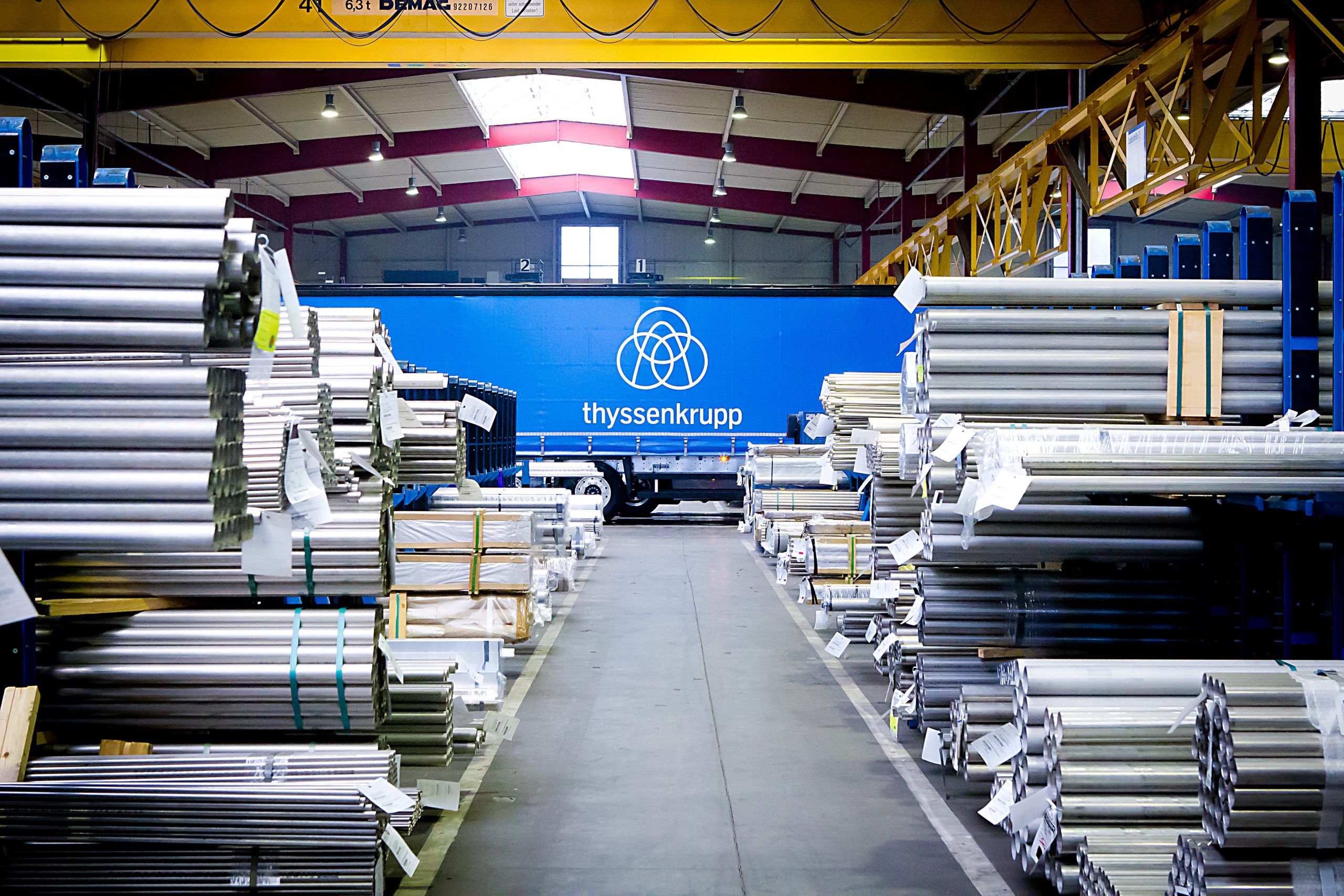
Thyssenkrupp opens Materials Services to investors
German conglomerate thyssenkrupp AG has decided to divest further shareholdings in various divisions. This will also affect thyssenkrupp Materials Services, the division for distribution and trading of steel and other materials, Kallanish notes.
The group’s plan, announced on Monday, is to gradually separate all its business segments and open them up for third-party investment. It has already taken this step by agreeing to turn thyssenkrupp Steel Europe into a 50-50 joint venture with Czech energy company EP Corporate Group (EPCG).
“In the coming years, the Materials Services and Automotive Technology segments are also to be prepared for the capital markets and become independent,” thyssenkrupp writes in an announcement.
Media reports over the weekend already suggested that tk Materials Services would be floated on the stock market, citing sources familiar with the plans. In that case, Germany’s largest steel distribution groups with international locations – the other being Klöckner & Co – would become publicly-listed companies.
This sweeping clean-up move does not come unexpectedly, although thyssenkrupp chief executive Miguel López called Materials Services a core activity just earlier this month. The group divested last year 20% in steelmaking division tk Steel to EPCG, with the intention of ultimately making it a 50-50 joint venture.
Regarding its other divisions, thyssenkrupp says it aims to retain controlling interests once they have been made ready for the capital market. This would basically make thyssenkrupp a holding of diverse stakes in independent companies.
The statement does not mention any potential layoffs. Media reports say that tk plans to cut 500 of 1,000 jobs at its Essen headquarters, plus 1,000 more in diverse administration roles. Policymakers from the North Rhine Westphalia state government were quoted as calling the plans “dramatic”.
Christian Koehl Germany


Italian steel production continues to increase
Italian crude steel production increased again in April following a hike in March and in the first quarter, industry association Federacciai says in a note obtained by Kallanish.
April production hiked 6% on-year to just over 1.7 million tonnes. Output in the first four month of the year also increased, by 3.8% on-year, to 7.3mt.
“The improved trend has involved the two families of hot re-rolled products,” Federacciai states. Flat steel production increased by 13.3% to 817,000t in April and by 10.5% to 3.3mt in January-April. Longs output increased 6.5% to 1mt in April and by 0.9% to 4.1mt in the first four months.
Italian production has continued to decline in recent years, falling by 5% on-year in 2024 to 19.9mt, by 2.5% on-year in 2023 to 21mt and by 11.5% y-o-y in 2022 to 21.6mt.
Natalia Capra France